

Why do those old buildings matter, anyway? For the same reasons business travelers say they sometimes wake up in hotel rooms wondering briefly what city they’re in.
To be sure, the miracles of mass production and modern American prosperity confer upon more of us than ever before a range of material goods and services that make our lives more comfortable and convenient. On the other hand, the mass market has also created a society in which many consumer goods tend to seem the same, the store names are identical wherever we go, and the ambience of even high-end retailing and dining is more predictable than enticing.
In this homogenized environment, there is a premium on things that remind us of the specialness of our time and place, things that help give daily life greater spice than the wait for the end of the same old commercial break.
Old or historic buildings do just that. Much of what we call today historic architecture came long before the era of mass production in housing, so it is the product of individual design and construction. Great old houses, churches, and commercial buildings stand as landmarks to the excitement of quality, individuality, and ingenuity.
When we talk about historic architecture in Evansville, we commonly think of the Riverside Historic District. There is good reason for this, as that neighborhood of old homes near the Ohio River is as rich a place of history and design and urban living as any city could hope for. And most people recognize a few other monuments as being special to our past and present, like the Old Post Office, the Old Courthouse, and the Willard Library.
But there are scores of other places that anchor us to our history and enrich our lives by making Evansville stand distinct from, say, Des Moines, Iowa, or Lexington, Ky.
Like the country’s third-oldest professional baseball park, Bosse Field. Or Mayor Boehne’s house at 1119 Lincoln Ave., or Trinity Methodist Church on Third Street, built during the Civil War. The full block of splendid workers’ cottages miraculously still standing near Lincoln Elementary School.
Some of the city’s jewels sit just off the beaten track. Who could ask for a lovelier neighborhood than the one surrounding Akin Park, though tens of thousands pass nearby each day without gaining the experience. Not far away on streets like east Adams and Madison, there are hosts of attractive 19th Century homes and churches that make the area a special place to live.
Even more hidden are some archaeological remnants, like the odd diamond-shaped parcel near the Southwestern Indiana Mental Health Center that represents Evansville’s earliest cemetery. And the very occasional diagonal labels on Main Street that reflect the city’s role as a leading manufacturer of cast-iron storefronts, produced by the craftsmen at Mesker Steel.[pagebreak]
Other landmarks connect us to great national movements in American history. The twin libraries on West Franklin and in Bayard Park reflect the monumental effort of Andrew Carnegie to extend book lending to millions of Americans for whom it was not previously available. Likewise, Garvin Park represents a respectable sculpted landscape from the “City Beautiful” movement of the early 20th Century, of which New York’s Central Park is the most famous example.
Some Evansville corners have been reused multiple times in multiple styles and purposes. The new Koch Family Children’s Museum of Evansville, of course, formerly served as the Central Library in one of our best Art Deco buildings (the Greyhound bus station is our other gem from that era, though it’s Art Moderne). This was previously the site of Evans Hall, a Gothic headquarters for the temperance movement, which in turn stood on the ground of a tavern where Colonel Evans’ sons engaged in a fatal argument. Mrs. Evans bought the place, tore it down, and offered it for temperance purposes.
Like history in general, of course, history in architecture is an ongoing story. The story of Evansville’s tomorrow will rest in part on whether present generations make the effort to build distinctively rather than settle for the mundane. We do in fact sometimes get this right. Mayor Frank McDonald Sr. went the extra mile during the 1960s to engage the famous Chicago firm of Skidmore, Owings, & Merrill for the new campus of local government. The resulting Civic Center Complex is plainly superior to similar installations built contemporaneously in South Bend, Fort Wayne, and Indianapolis.
Other modern entries to our public architecture are good candidates for long-run acclaim. The new Central Library, the recent David L. Rice Library at the University of Southern Indiana, and the interiors, at least, of The Centre. On the private side, the headquarters of Integra Bank stands well above the crowd. Evansville will be a better place if we value and encourage more such endeavors.
And whether Evansville will continue to be a good place to live is really the point of it all.
Yes, we historic preservationists are often led to ask ourselves, “What will future generations say of us if we let this landmark or that one disappear under the wrecking ball?” But the most important question is whether the city will be a good place to live. Will it be a spot where one can get a good education, find a decent job, and raise a family?
And more than that, will it be a city rich in places to live and visit? Will it put value on the special aspects of life, like quality education and the arts and fine architecture and great neighborhoods? Will it do all this in a way that helps our children envision how far their own futures can take them?
Preserving our city’s great historic architecture and building great new landmarks are an important part of
assuring that Evansville will be all that it can be.
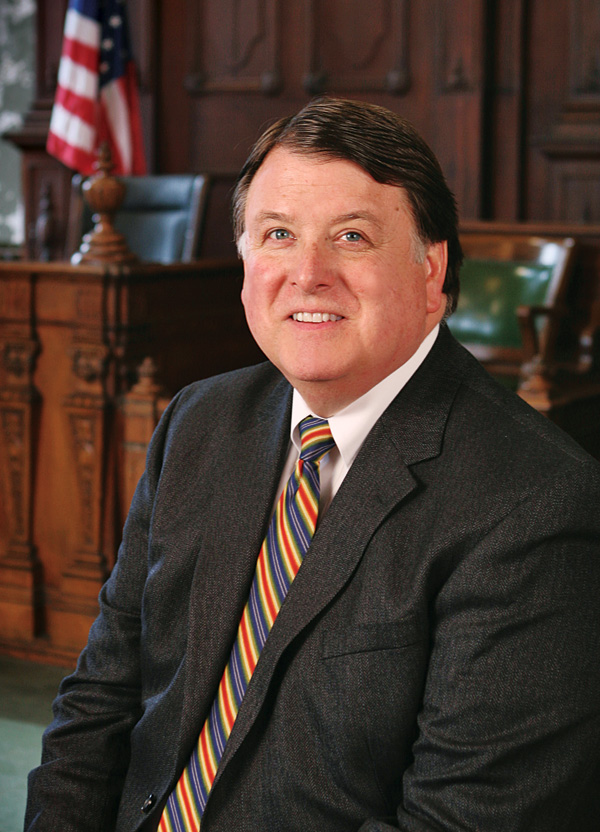
Shepard is an Evansville native and former deputy to the late Mayor Russell Lloyd Sr. He’s a nationally known advocate of historic preservation. In March, he was sworn in for his fifth term as the Indiana Supreme Court Chief Justice.