


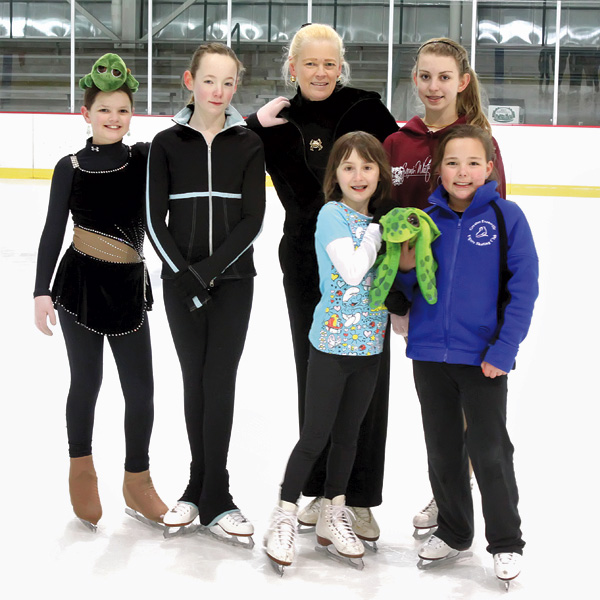
Bundled in a down jacket, warm-ups, and mittens, George Ann Griffin Atkinson stands on the sidelines of the rink at Swonder Ice Arena preparing her students for an upcoming regional figure skating competition. In the 12 hours a week she spends on the ice coaching with additional hours of practice, she says cold limbs come with the territory: “It’s the occupational hazard of being a figure skater.”
In the coming months, the veteran skater expects a surge of young, new students to join her on the ice; this tends to occur with the conclusion of the Winter Olympic Games, she says. Griffin’s own motivation to pursue the sport, however, blossomed well into adulthood.
At age 3, the Evansville native survived a bout with polio. She avoided paralysis and other severe complications, but the viral illness left her with poor reflexes. As part of her physical recovery, her parents enrolled her in acrobatics, ballet, and skating lessons. Griffin remembers wobbling across a tiny municipal ice rink as a 6-year-old. The recreational skating program was meant for fun, not serious training; in her two years of participation, she confesses she never took the sport seriously. She went on to chase other dreams: After graduating from high school, Griffin headed to the University of Evansville for her bachelor’s degree and eventually earned a master’s degree and completed doctoral coursework at the University of Louisville. Her early career included a stint as a psychologist at a local rehabilitation hospital, and for 25 years, she has been employed as a math instructor at the University of Southern Indiana.
Griffin didn’t delve into the world of figure skating again until her son, George Michael Atkinson, grew enamored with the sport after watching competitions on television. Coached at Swonder Ice Arena by former skating pro Richard Swenning, he laced up his first pair of skates before his third birthday. After Swenning left the city, the young skater found another inspiring coach in the late Robert Graham. The former Ice Follies skater came to Evansville from Seattle, says Griffin, who calls Graham an accomplished showman with a knack for encouraging ambitious, young skaters. Soon after George began training with Graham, the coach built a rapport with Griffin, too. She was enrolled in ballet classes and physically fit, so Graham encouraged her to take to the ice. Griffin started skating to bond with her son, she says, never imagining it would be more than a hobby.
When Graham left Evansville, the mother and son headed north to train at the Indiana/World Skating Academy in Indianapolis, where Graham took his advanced skaters during summers. As a teen, George competed twice at the national U.S. Junior Figure Skating Championships and received an invitation to an international competition in Canada. Although his focus has shifted away from skating (the Butler University graduate currently is pursuing a master’s degree in business administration), he still teaches private lessons and group classes during the summer.
Long after George tapered back his time on the ice, Griffin — now passionate about the sport — kept training. She’s accomplished dramatic lifts and throws she says she never imagined she could do, and she can land a double Salchow (a jump where the skater takes off from one foot, completes two revolutions in the air, and lands on the opposite foot). Her skills include both freestyle and ice dancing, which she calls her forte. Griffin currently is learning the Tango Romantica (the compulsory dance at this year’s Olympics) and the Austrian Waltz.[pagebreak]
Griffin has medaled in several competitions and has received a gold medal in a U.S. Figure Skating skills test, which she likens to a degree. She’s rubbed elbows with some of the skating world’s elite including Nicole Bobek, Irina Slutskaya, Christopher Dean, and Todd Eldredge. During a practice session in Indianapolis, Griffin was observed by legendary figure skater Scott Hamilton, who told her he liked her routine. “He was so down to earth and very gracious,” Griffin recalls, “and it was a highlight of my skating experience.”
In 2002, Griffin was asked to coach, something she never considered previously. “I assumed there were special classes you had to take in order to be a coach, but when I talked to my coaches and friends, they were very encouraging and said I should do it,” she says, noting that she has passed numerous testing achievements in the coaching realm and plans to achieve more this year.
Griffin focuses on teaching her students the fundamentals of skating and offers them a solid foundation before moving them on to harder skills. This also helps buffer the harsh judging which can occur in the sport. Her students say that practice, patience, and a steady effort make all the difference in their performances.
“She encourages everyone to reach their personal best,” says Taylor Travis, 14, who has been coached by Griffin for five years. “She is invested emotionally in her skaters and always has them looking toward their future.”
“She’s like a second mother to me, and she has helped me accomplish all of my moves,” says ice dancer Belle Junge, 16. “She likes to challenge her skaters, but it is always in a positive way. She is patient, tolerant, and a great person to work with.”
Griffin realizes that skating is not only expensive but also physically demanding and often focused on the young. She does not shy away from taking on older students or those with disabilities such as Susan Nance, a 56-year-old blind student who trains with her at Swonder. Nance initially wanted to take group lessons, but she struggled with running into other skaters. Rink officials called Griffin about taking on Nance as a private student; due to Griffin’s background in working with people with disabilities, they thought the pairing would be a good fit.
Nance agrees: “Skating for me is so freeing, and George Ann is extremely patient and understanding that someone has to be out on the ice with me at all times,” she says. “I am not the kind of student that is going to be a feather in her cap or fare well with group lessons, but she has helped me overcome my own limitations. I enjoy the feeling of movement I get when I am out on the ice.”
“She may have a few unique challenges, but she’s a wonderful student,” Griffin adds. “We were able to figure out a system that works for her.”
This spring, Griffin knows to expect the aforementioned surge of new students, spurred on by the enthralling performances at the Olympics. She’s quick to point out that most skaters and coaches have alternative careers once the gold medal dreams dim, and she encourages her skaters to complement their sport with a good education and solid career path.
“There is more to the sport than people think,” Griffin says. “Figure skating can be a tough world beyond cold fingers and toes, and it is my job not to overburden my students with the details of skating, but rather to let them foster a love for the sport and gain a passion for excellence in all that they do and to cherish the memories and friendships that they have made.”