


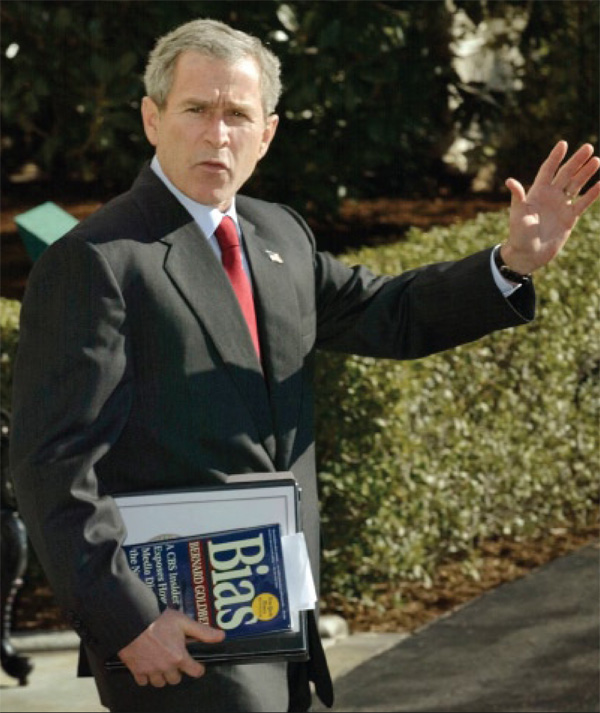
In October 2003, fed up with the way national media was covering the rebuilding efforts in Iraq, President George W. Bush stated, “I’m mindful of the filter through which some news travels, and sometimes you just have to go over the heads of the filter and speak directly to the people, and that’s what we will continue to do.”
Those involved in the debate on news media bias believed President Bush’s statement to be weighty, the “public relations equivalent of a declaration of war aimed at the national media,” as John Roberts of “CBS News” put it.
But it hardly was a new accusation. Since the 1930s, public opinion polls have shown hostility toward the media for biased coverage. Today, few words can inflame like this loaded word. Yet bias — news media bias — is the topic of the first installment in this new recurring department. You won’t read about the 2008 presidential campaign — ACORN or Governor Sarah Palin’s campaign wardrobe — here. By the time you read this story, you’ll know who is elected president of the United States and will likely have formed your own opinions on the role news media bias played in this election.
Does bias exist in the news media? According to Mark Shifflet, Ph.D., associate professor of mass communication and chair of the communication department at the University of Evansville, “The topic of bias is heavily researched, and there is no consensus.”
Labels and Definitions
Key arguments in the bias debate center on distinguishing definitions and labels: media bias and news media bias, conservative and liberal, media and media elite, journalists and pundits. Conservatives in the debate (including Bernard Goldberg, author of Bias and Arrogance, and L. Brent Bozell III, author and founder of the Media Research Center) believe the arrogance of the media elite is the root cause of contemporary bias. This media elite, Goldberg writes, “…can pretty much stay clear of conservative attitudes and assumptions and even conservative people, secure in the knowledge that they’re not really missing anything worth knowing.”
Everyone’s Biased
Other themes in the debate over news media bias include bias being in the eye of the beholder and the factioning of the American media landscape. Mizell Stewart III, editor of the Evansville Courier & Press, says, “We’ve seen a splintering of the mass market into a collection of niches. Savvy operators may try to cater to their audience.”
Bob Walters, news director at WTVW Fox 7, believes all journalists bring bias to the table. “Everyone is biased,” Walters says. “We are all shaped by where we grew up, our religious backgrounds, our education, everything we have experienced in life in the process of becoming adults. For someone to say they are totally neutral, totally unbiased, is to say you don’t have a lot of passion for issues.”
Locally, editors and news directors say they strive for balance and fairness through the diversity of their newsrooms and through dialogue. Walters says, “We strive for balance through collaboration. We talk about stories, allowing staff to raise concerns. It is an open dialogue, and we’re willing to call each other on the carpet about biases because we all have them.”
Stewart describes the same process in his newsroom, adding, “Readers approach the newspaper from their points of view as well. On our end, we do our level best to be sure that all points of view are represented.”[pagebreak]
Arrogance
Maureen Hayden, managing editor of Evansville Living, worked as a newspaper reporter for more than 20 years. While she cautions that one can’t lump all members of the media together, she says, “Still, too often it seems there isn’t enough self-examination in a newsroom. I’d argue that is often due to time constraints and the pressure of deadlines, rather than something more intentional or nefarious like political bias.”
“Where I see the arrogance is in the refusal to engage in more self-examination, and that’s the arrogance that often damages credibility. Journalism is not unlike politics or social work — people in these professions are convinced they’ve been called to serve the public. That can be noble and necessary. But it can also lead to self-aggrandizement and the inability to engage in a conversation with critics.”
Information Proliferation
There is no question that much of the current conversation about bias focuses on the national broadcast media — both network and cable. Stewart says, “They (the cable news networks) are trying to fill 72 hours (weekly) of airtime with what amounts to two hours of news. This results in two hours of news delivery and 70 hours of talking about the news. This is particularly true now with the presidential campaign. (They say,) ‘If we don’t have new news, we’ll talk about the news.’”
Mike Roeder, director of government affairs at Vectren Corp., is a self-described news junkie who previously was Vectren’s director of corporate communications and also has held academic, association, and governmental positions in communications and media relations. He says, “Nationally, media has gotten in the business of making news rather than reporting news. Breaking news, TV crawlers, and news alerts on marginally important information have become a great news marketing tool, but have blurred the line between news and entertainment.”
If it Bleeds, It Leads
Ross Atkin, a 1967 Harrison High School graduate, has worked for 37 years in various writing and editing positions at The Christian Science Monitor, a national newspaper headquartered in Boston known for its reputation of being fair and balanced (despite its name, which might suggest otherwise).
Atkin says the CS Monitor’s motto, “To injure no man, but to bless all mankind,” may seem unusual for a newspaper, but it “frames decisions editorially — clearly or subliminally — for us.” Recently, the CS Monitor, which historically does not extensively market for readership, produced a direct mail marketing offer stating: “If you’re tired of the Liberal … Conservative … Sensationalist bias in the media today … Let us introduce you to a newspaper that’ll give it to you straight.” (As Evansville Living went to press, the CS Monitor announced a Web-first strategy, shifting to a weekly print publishing format.)
Hayden argues that “rather than an elitist, leftist bias, the media’s bias is on the side of conflict. Reporters too often are fight promoters. There is a reason why ‘If it bleeds, it leads’ is a cliché in a newsroom. The media likes a good fight.”
Asking the Questions
In local media, news directors and editors say they run potential stories through a series of questions. “Regarding fairness,” Stewart says, “I think we have to ask ourselves: Are we holding up a mirror to our community? Are we showing all sides of a story?”
“In the end,” says Walters, “we ask ourselves these questions about running a story: How do you justify running it? If you don’t run it, how do you justify your decision not to run it? Does the public have a right to know?”