

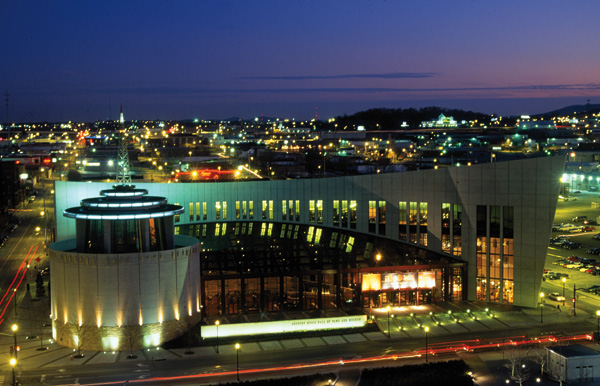
Until I read Harlan Howard’s quote inscribed on a wall in Nashville, the reason for country music’s popularity had been a mystery to me. “Country music is three chords and the truth,” Howard once said, and his definition fit so perfectly, leaders at the Country Music Hall of Fame and Museum placed his words on a prominent 20-foot wall for guests to read at the $37 million complex. The music legend’s words were exactly what I needed during my four-day trip to the Country Music Capital of the World in Tennessee: The quote was strikingly succinct, and I looked for Howard’s idea to define the city.
A quick trip south brings Evansvillians to Nashville, a place locals claim was birthed by music as soon as settlers whipped out their fiddles for jigs in the early 1700s. Davy Crockett — a congressman, “king of the wild frontier,” and fantastic fiddler — was Nashville’s first celebrity, they also say. Many others followed, including 20th century icons such as Hank Williams, Patsy Cline, and Roy Rogers. With such a rich history, the city celebrates its music daily: From tours of the former RCA studio to barbecue ribs so tender the meat falls straight from the bone, country music feels somehow ingrained in every aspect of the city’s culture.
The staple attraction epitomizing that culture is the Country Music Hall of Fame and Museum. In 2009, more than 80,000 visitors passed through the hall’s doors. A leading reason was Family Tradition: The Williams Family Legacy, an exhibition that felt like I was stepping into a Web site. Williams’ videos and music played, and touch-screens led me through a pictorial life of the famous music family, which includes Hank Williams and his son Hank Williams Jr. The family granted intimate access to their story, and the effect was warm and inspiring.
The exhibit runs through 2011, and the impact shaped a remarkable 2010 season, says Tina Wright, director of media relations: “We feel like we are hitting our stride.” Museum staples also deserve attention: Inside is the library of country music — a 1 million song archive. Video screens dot the floors recalling special musical moments, and musicians’ personal items are displayed. (Check out bluegrass legend Bill Monroe’s Bible and the joker card he always used a bookmark.)
Bookmarked on my trip was a visit to Historic RCA Studio B for a public tour and history lesson about the local music scene. Elvis Presley recorded 250 songs at this studio that was open for three decades until it closed the day after his death in 1977 (pure coincidence). Scores of other famous artists established the studio as the place for the “Nashville sound” — a 1950s mixing of country music with pop sounds. Today, photographs of artists such as Dolly Parton, Willie Nelson, Chet Atkins, and numerous others reveal the history of the studio, and the ending of the tour includes the option to record your voice to Presley’s romantic and smooth “I Can’t Help Falling in Love with You.” I sang with my tour group and received a CD of my recording. My style is called the “monotone sound.”
I was steps away from up-and-coming country stars; perennial favorites; and current country, bluegrass, and western music superstars when I caught a show at the Grand Ole Opry, a venue for live music performances that have been broadcast on the radio for more than 60 years. I saw Rascal Flatts — a multi-platinum country music trio — end the show, but the highlight was Little Jimmy Dickens, who, at less than five feet, commanded attention on stage when he opened the show. Dickens set the tone with upbeat songs and fantastic jokes about his life as a septuagenarian. With 60 years performing at the Grand Ole Opry, he still is a regular and worth the trip.[pagebreak]
With a seating capacity of 4,372, the Grand Ole Opry is fun, but it’s hardly intimate. The Bluebird Cafe, on the other hand, demands intimacy from patrons, and if musicians don’t receive silent attention, the distracting patrons are booted. The policy is strict, and the bar and restaurant’s motto is “Shhh!” Since 1982, venue owners have boasted they have showcased songwriters before they became stars, including Garth Brooks, Kenny Chesney, and Taylor Swift. Often, those who launch their careers at Bluebird become reoccurring guests, and original acoustic music is heard seven days a week.
Filled with country music, I headed to downtown Nashville to become filled with country culinary staples at Jack’s Bar-B-Que restaurant. The New York Times, Los Angeles Times, and Southern Living call owner Jack Cawthon’s hickory-flavored barbecue the best in Nashville, and with 420 pounds of pork prepared each day, Cawthon’s recipe lives up to a big reputation. He began his career as a caterer, but Cawthon wanted a more casual earning. He opened his eatery in 1976, and now “I get to wear a hat,” says Cawthon in his trademark cowboy hat. So popular has his barbecue become that talk show host Oprah Winfrey, who went to high school in Nashville, asks for Jack’s barbecue on her private jet.
The accommodation offering a refreshing respite from the country music scene is the Gaylord Opryland Resort & Convention Center. On Thanksgiving Day in 1977, Opryland was 580 rooms and a ballroom used to support the nearby Grand Ole Opry. More than 2,000 rooms, 8,200 tropical plants, and a three-and-a-half story waterfall later, the resort feels like its own city, and Opryland guests, who have included celebrities such as poet Maya Angelou, actor Jim Carrey, and former President George H.W. Bush, need maps to find their way to the resort’s amenities and attractions, including the 20,000-square-foot, European-inspired spa, salon, and fitness center — known as Relache — and the 14,000-square-foot, upscale Fuse Nightclub, which plays dance music.
Refreshing as the dance beats are, the town is about country music, and after my trip, I still am not a yeehawing fan. I am a fan of country music’s city, Nashville, for the live music, history, and food. It would take more than three chords to express what I mean in song, but it would be the truth.
When You Go:
• The Bluebird Cafe – (615) 383-1461 – www.bluebirdcafe.com
• Country Music Hall of Fame and Museum – (615) 416-2001 – www.countrymusichalloffame.com
• Gaylord Opryland Resort & Convention Center – (888) 777-6779 – www.gaylordhotels.com
• Grand Ole Opry – (615) 871-6779 – www.opry.com
• Historic RCA Studio B – (615) 416-2001 – www.countrymusichalloffame.com
• Jack’s Bar-B-Que – (615) 254-5715 – www.jacksbarbeque.com