With Appreciation

0

Later this month, Tucker Publishing Group leaders will join our peers in Chicago for the City and Regional Magazine Association’s 35th annual conference. This will be the 10th straight year for us to attend, and I am proud to represent the small market segment of CRMA by serving on the national board of directors for the third year. We are particularly pleased to be members of this association because of the very stringent set of journalistic and publishing criteria that must be constantly maintained.

We also are very gratified this year to be finalists — determined by judges from such luminaries as the Wall Street Journal, Esquire, National Geographic Magazine, and others — in two very important award categories: Community Service Project for the 2010 Evansville Living Downtown Idea Home (in which we partnered with the city of Evansville and Indiana Landmarks) and something I am equally proud of, Best Ancillary Publication for Evansville Business. We already are one of the smallest cities to have a lifestyle publication with Evansville Living, but to see the success and continued growth of Evansville Business in such a small market has been very gratifying. I thank the readers, advertisers, and supporters who help make this possible. Let me assure you that the support is appreciated. We will let you know how we fared.

As with most professions, there occasionally are some nice perks associated with publishing magazines. One of the best ever was afforded to me just last week. Several months ago, when I first heard about legendary E Street Band drummer Max Weinberg coming to play and lecture at the University of Evansville’s Snyder Concert & Lecture Series, I was borderline incredulous at Evansville’s and my good fortune as a “borderline” but very passionate drummer. Max (along with Charlie Watts of the Rolling Stones) is my longtime drumming idol.

Fortunately, as an alum, friend, and publisher, I was able to wrangle an invite to the pre-show dinner. Pretty cool to walk into an intimate dining space and converse with someone you literally grew up listening to and seeing live — several (!) times. Then it was onto the show at the Victory Theatre, where I was able to ensconce myself less than 30 feet from the man himself on the stage. The UE Jazz Ensemble definitely was jumpin’, and watching Max “do his thing” and obviously enjoy doing it was quite a thrill. It was very apparent from audience interaction that I wasn’t the only one.

But the best was yet to come. Since Max had an early morning commitment in Nashville the next morning, I was able to hang out for 90 minutes or so after the show with him and then drive him to Nashville. As we drove through the night, having a good time and interesting conversation, it really reminded me that in many ways, a famous rock star is not that different than you and me — it’s just that he occasionally talks about his friend Bruce and reflects on playing the Super Bowl halftime show!

As always, I look forward to hearing from you.

Regards,

Todd A. Tucker
Publisher

Retro Restoration

0
Ryan Smith, owner and manager of Hoosier Hot Rods & Classics in Haubstadt, Ind., leans back on his 1967 Mustang fastback.

For one week in June, the highways are transformed. A flashy flame-painted Corvette C5 and striped Mustang share the road with an old Mopar and an immaculate 1953 Buick. Each vehicle is buffed and shined, and monikers such as “Truck Train” and “Pavement Pounder” adorn doors and hoods. Last year, 4,850 cars made the 1,370-mile journey from Newton, Iowa, to Mobile, Ala., for the annual Hot Rod Power Tour. The trip was not without pitfalls. Hot rodders were scattered along the highway performing hasty roadside repairs, and only 1,512 cars completed the tour. But for hot rod enthusiasts such as Ryan Smith, owner and manager of Hoosier Hot Rods & Classics in Haubstadt, Ind., the seven-day, seven-city tour is well worth the risk. Even with gas surpassing three dollars per gallon, Smith is eager to participate again this year. “It’s a passion,” he says. “You’ve got to accept the good with the bad.”

Raised by a family that loved classic cars, Smith started his custom restoration business in 2004. “This is what I do, what I love,” he says. Though he pursued a college degree in computer programming and networking, Smith passed up the programming field to follow his family’s history of restoring cars. His shop spruces up aging automobiles with custom paint jobs, wiring, body work, sheet metal fabrication, and other services. When Smith founded the company, he was the manager, fabricator, and painter. Since then, he has hired nine employees, though he still is personally involved in every project. “It takes a lot of knowledge, a lot of experience, and a lot of time to get good at it,” Smith says.

When the doors are locked for the evening, Smith works on his own restorations. His current projects include a 1930s model Dodge rat rod and a 1939 Plymouth chop top, though his 1967 Mustang fastback is a personal favorite. “The new cars,” Smith says, “just don’t have the soul that the old ones do.”

Hoosier Hot Rods & Classics Inc.
812-768-5221 • www.hoosierhotrods.net

The Psychology of Vacation

0

When a relative in England asked how many paid vacation days my job at this magazine offered, she was surprised at my answer: 15. That’s great, considering many of my fellow Gen Yers receive only 10 days off — and many jobs offer no employee benefits such as vacation. Still, she asked, “How do people survive in America?”

As a media producer at a football club in London, she enjoys 24 vacation days every year. Some of her neighbors in mainland Europe fare even better: Workers in France, for one, earn an average of 38. In the United States, the average employee is granted 13 paid days off, according to Expedia.com’s annual Vacation Deprivation Survey. Still, 34 percent of Americans don’t use all of their vacation time, “giving back” an average of three days each year. 

That’s troubling to Caron Leader, a partner and psychotherapist at aha! Architects of Human Awareness (www.ahacounseling.com), an East Side counseling and consulting firm. “The main reason Americans do not use all of our vacation time is that we as a culture do not value down time or relaxing,” she says. “There is a perception that if one is relaxing, they are lazy.”

That perception leads to excessive job-related stress, which in turn costs American businesses $344 billion a year in medical bills, absenteeism, turnover, and training, according to the Chicago Tribune. Leader questions the term “workaholic,” but says she’s seen clients with problems that arise from too much work. “What typically occurs when they try to turn away from work is a sense of loss of purpose or meaning,” she says. “They simply feel lost without this preoccupation in their lives and use it to avoid other issues within themselves.”

Convinced you need a break? Leader offers these tips for maximizing time off once you’re on vacation. 

Plan ahead. Some times of the year may not be conducive to a restful getaway, so “make sure you take your time off when you can truly relax,” Leader says. Delegate your responsibilities to colleagues so you don’t feel pressured to constantly check in.

Get off the grid. Breaking news: Your Facebook, e-mail, and LinkedIn accounts will be just fine if you log off for a week or two. Leave your computer at home if possible, then turn off gadgets and don’t allow yourself access to them. If you must work, Leader suggests limiting it to 30 minutes or an hour every other day.

Expect the best. Instead of clinging to your smartphone, check it once a day. Better yet, leave your hotel number or other contact information where coworkers can reach you in case of an emergency. “My motto in life is, ‘No news is good news,’” Leader says. “Try to remember if something really needs your attention, someone will contact you.”

War Room

0

In 1966, a teenage David Jones shipped out for Vietnam. Fifteen months later, the clean-cut Marine came home to a nation that had given rise to hippies, protests, and Jefferson Airplane’s “White Rabbit.” Like many other Vietnam veterans, Jones faced scorn and criticism after his return to the United States.

Still, his military background “always has stayed with me. I’ve never lost my interest in it,” says the Maryland native. “I don’t glorify war; I hope people seek peaceful means to anything. That’s what I bring into my law practice.”

Jones, a founding partner of Jones Wallace Attorneys and corporation counsel for the City of Evansville, displays wartime relics — mostly from the Vietnam and Civil Wars — in his 16th-floor corner office in Downtown Evansville. His wife Lauren, a paralegal with the firm and chief of staff for the city’s law department, calls his office “the museum,” Jones jokes.

Much of Jones’ Civil War collection has found a temporary home in an actual museum — the Evansville Museum of Arts, History and Science. The featured history exhibit, “Reflections on the Civil War,” runs through June 26.

Code of Honor
Jones’ family has a long legacy of military service. The framed newspaper article atop the bookcase pays tribute to his grandfather, who was blinded in a submarine accident during World War I.

Military Memories
The bottom shelf of a bookcase displays Jones’ personal items from the Vietnam War: military dog tags, a Kabar knife, a helmet, and a photo of himself as a 19-year-old Marine. Jones framed his certificate of honorable discharge and a telegram from former Sen. Daniel Brewster appointing him to the U.S. Merchant Marine Academy.

Time Gone By

A display highlights Jones’ Civil War memorabilia, largely collected from artifact dealers: a Confederate musket, a wooden canteen carved with a soldier’s initials, and a Confederate $50 bill. An assortment of battered uniform buttons (framed on the wall) hangs next to a document from the Grand Army of the Republic. The organization of Union soldiers gave the certificate to Jones’ great-great-grandmother for supporting her husband, who fought in the Civil War. Also of note is the souvenir ribbon from an 1887 reunion of Union and Confederate troops in Evansville.

Battle Flag
Neatly folded in a drawer is a Japanese flag stained with blood. Jones’ uncle brought it back from a World War II battlefield, and Jones keeps it tucked away out of respect. “If I knew the family it belonged to,” he says, “I’d send it back.”

Arena Action
From his office in the former Old National Bank building at 420 Main St., Jones arguably has one of the city’s best views of the new Downtown arena. A webcam mounted two stories above his office provides a live feed of construction at www.joneswallace.com.

Photo Shop

0

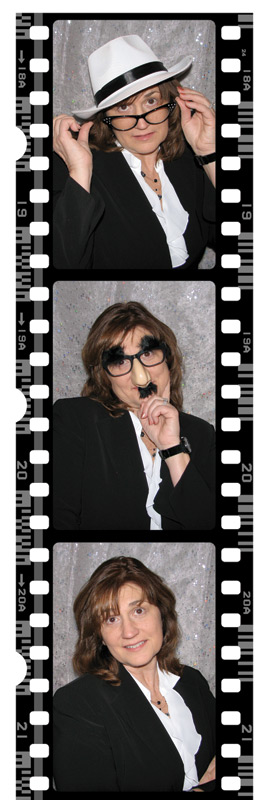
In November 2009, Joy Loeffler mingled at a wedding reception in Indianapolis when she noticed a photo booth similar to those in malls or tourist traps. She watched as relatives donned large, outrageous hats and bright boas and stepped inside the photo booth. They made silly faces and laughed. For their efforts, they received four commemorative photos. “I was amazed at how much fun people were having,” Loeffler says, “and they came away with some great keepsakes.” 

Loeffler loves photography, and at the time, she was enrolled in classes at Ivy Tech Community College which put her behind the lens. After the reception, she Googled “photo booths” in her hotel room. Her husband Jerry heads Loeffler Painting Co., and with his entrepreneurial spirit fueling her, Loeffler dreamed of running a business revolving around her hobby. Within a month, Loeffler purchased a 4-by-4 portable booth, ordered dozens of props — from fuzzy boas to fake noses — at costume shops such as Nick Nackery, and asked her Ivy Tech computer graphics instructor to develop a logo, business cards, and a website for her business: FunShots Photobooth. 

By December 2009, Loeffler needed a gig, so she offered Pat Rayburn — a close friend and owner of Willow Lanes, a bowling alley — her services pro bono. “I didn’t want to charge anyone in case I crashed and burned,” Loeffler says. Rayburn gave Loeffler a chance at a company Christmas party held at Willow Lanes. It was guerrilla marketing. Interested partygoers took promotional materials, and her one-woman/one-photo booth business took off. By the end of 2010, her photo booth was in 10 events, and by March 2011, she had 30 reservations. Loeffler has a second photo booth ready for the 2011 wedding season beginning in April.

“Lots of times, there is a longer line (for the photo booth) than at the bar,” she says. At one reception, a group of young men headed to the booth. These were “really good-looking kids in their mid-20s, carrying that little wand and wearing the crown,” Loeffler says. “It’s a great ice-breaker.”

For more information, visit www.funshotsphotobooth.com.

Opinion Leaders

0

When PeerIndex debuted on July 28, 2010, Fast Company magazine’s Addy Dugdale dubbed it “the 140-character version of the Google vanity search.” But, the idea of the website, www.peerindex.com, is to answer a question for business leaders and marketing professionals big on social media outlets such as Facebook and Twitter. Sure, some companies may tweet, but is anyone listening?

PeerIndex’s algorithm uses figures — the number of followers, amount of activity, and a frequency from followers to repost or re-tweet messages — to determine a company’s promotional prowess. PeerIndex then assigns a number between one and 100. The higher the number, the more influence a company has.

Evansville Living, Tucker Publishing Group’s flagship magazine, joined PeerIndex on July 30, 2010, and we gave ourselves six months to flex our marketing moxie. By the end of the experiment, our PeerIndex hit 20, which might seem low. But PeerIndex is a global tool, so while the number may reflect the little influence we have — for example — in China or on Lady Gaga fans, there’s more to the ranking. According to PeerIndex, our top topics (Evansville, Vanderburgh County, and hospitality) show we’re a source heavily influencing all things Hoosier.

Though Evansville Living joined PeerIndex so the website could more accurately gauge our social media use, any business posting status updates or tweeting has a PeerIndex number — whether they know it or not. 

But the less-than-a-year-old PeerIndex might make more of an impact in the future, especially if the website’s problems (such as the algorithm’s propensity for businesses and tech topics) are fixed. As Dugdale predicts, “Once fully tweaked and glitches ironed out, you can see this becoming an obsession for the mouthy brigade of the online community, probably forcing them to up their game — and their tweet rate.”

Back it Up

0

About a year ago, a good friend lost his MacBook Pro — full of sensitive data because he had just prepared his tax information. Little did he know there were two simple ways he could have saved all of his information without even plugging in an external storage device. With the April 18, 2011, tax deadline approaching, you can make sure your information is secure.

Apple has created two levels of backup that have made my life less stressful, and they don’t even require any effort. All I need is a team of hardware (called Time Capsule) and software (MobileMe).

Time Capsule basically is a router and a server-grade hard drive built into one unit that uses Time Machine (a backup utility) to back up your data — in the background — without attaching any wires. So, if my MacBook breaks or is lost, I could easily restore my information onto a new laptop with Time Capsule: the entire hard drive, programs, music, movies, pictures, and all files.

MobileMe, by itself, makes life easier. Besides syncing your contacts, bookmarks, and calendar throughout your iPod, iPad, Mac, and PC, MobileMe has a feature called iDisk. Essentially, iDisk is a hard drive in the cloud. You wouldn’t back up your entire hard drive on it, but it’s great for syncing or mirroring your files with your computer.

I have set up iDisk so that when I use my iMac, my files are there; if I go to my MacBook, my files are there as well. They constantly are being synced to the cloud, so if I pull up a spreadsheet, add information, then save it, iDisk will sync that file without requiring me to manually transfer the information.

With Time Capsule and MobileMe, my friend easily could have restored his tax information rather than redoing a full year’s work. I use both of these products on a day-to-day basis, confident that should something go wrong, I will not lose any data.

— “Gadget Now” columnist John Nugent is an independent commercial real estate professional and an Apple
enthusiast. Contact him at [email protected].

Quick Trip

0

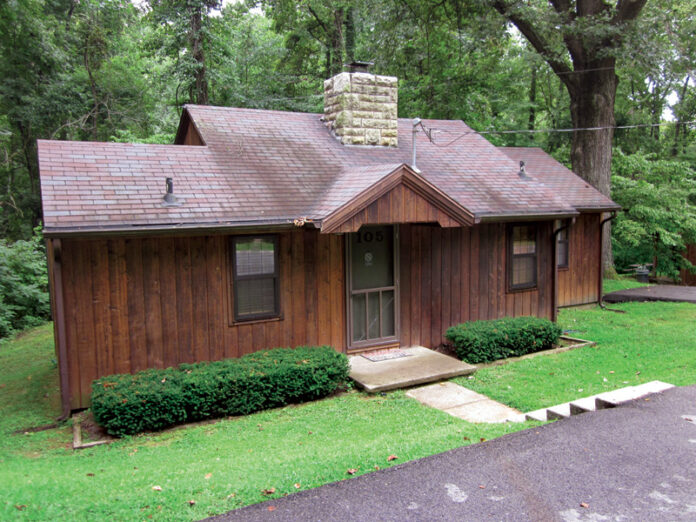
In search of a fun vacation spot for their families, three Evansville couples decided to spend an October weekend in 1987 at John James Audubon State Park in Henderson, Ky. The first left turn across the bridge into the Bluegrass State became their weekend getaway. The families — Janet and Ray Raisor, Carol and Roger Watson, and Lori and Will Smith — rented six cabins. The red, gold, and orange leaves hung like jewels from the trees. It was an oasis from the city. For the next 23 years since their first trip, the three couples have invited their friends and family to spend a weekend at the scenic venue. The added value: “It’s close to home,” says Ray Raisor, president of the Easter Seals Rehabilitation Center and a “charter member” of the tradition. “I sneak back all the time.”

The notion that Evansvillians could feel like they were making an escape despite the short drive doesn’t surprise Julie McDonald, a park naturalist at Audubon. “I think that people are looking for pearls in their backyard,” she says. The park, founded in the 1930s to preserve the legacy of John James Audubon, a prominent American naturalist and artist in the early 19th century, offers 6.5 miles of hiking trails. The Museum and Nature Center boasts a wildlife Observation Room, a hands-on Discovery Center, and a Learning Center with environmental and art programs. “We have activities going on year-round for people of all interests and ages,” says McDonald.

For Raisor and his friends, it’s a weekend of ghost stories, card games, and father-son football tournaments. As much as the trip bonds the families closer, Raisor also has become closer to Audubon staff. “They look forward to seeing us every year,” he says. “At least, they claim they do. I think there’s a bond that is really special that exists. We call it our Audubon family.”

Legal Aid

0

In April 2008, hundreds of lawyers filled what once was the Wedgwood Hall of the Old Courthouse. The meeting that day of the Evansville Bar Association served two purposes. It was the group’s annual luncheon, a chance to mingle among like-minded peers, but then-bar president Dan Carwile had chosen the recently restored room for a reason.

He wanted to show how a bequest from the estate of John and Evelyn Sanders (around $200,000) provided the thrust needed to restore the neglected Wedgwood Hall, a former library in the 1891-built courthouse. Another $100,000 from the Old Courthouse Foundation saved the room from its crumbling condition. “It looked like something out of the French Revolution,” says Kelley Coures, president of the Old Courthouse Foundation. “It was in such bad shape.” 

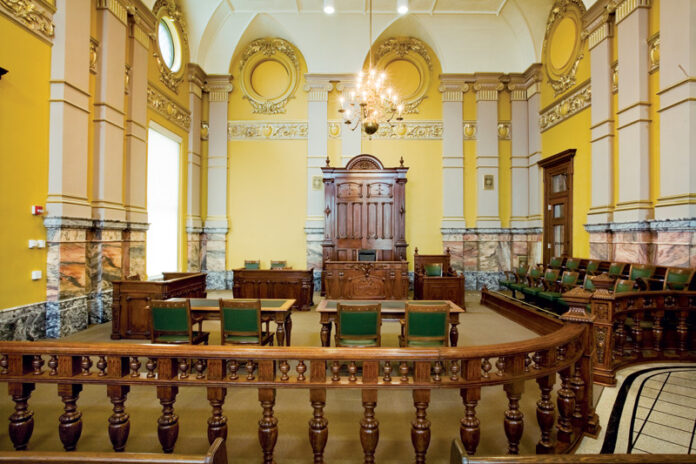
Down the hall, the old superior courtroom needed similar attention. The ornate judge’s seat had cracks in the wood, stuffing spewed from the ripped upholstered jury seats, oak railings showed splits, and plaster fell from the ceiling. Carwile, the managing director of Old National Advisors, saw possibility.

The sight of the courtroom “almost brought me to tears,” says Krista Lockyear, the current bar president. Lockyear, an attorney with Rudolph, Fine, Porter & Johnson, never had served in a courtroom with such grandeur. Her colleagues in the EBA agreed the once-beautiful room with a soaring ceiling, limestone walls, and elaborate woodwork deserved a renaissance — and they could make it happen. 2011 marks the 100th anniversary of the EBA, Carwile explained, and this restoration project could be their celebration.

In late April, the fundraising efforts of the 539-member EBA (a $300,000 capital campaign) will bring a restored look to the old courtroom. But these lawyers’ labors produced more than a nice spit and shine. 

Nearly two centuries ago, an argument between John Harvey and his wife escalated on May 8, 1823, and their commotion prompted a concerned neighbor to break up the disturbance. Harvey shot his neighbor for his troubles. Nine days later, police arrested Harvey for murder. He went to trial, a jury of his peers found him guilty on June 11, and two weeks passed before Harvey became the first man executed for a crime committed in Evansville. More than 1,500 people — roughly 12 times the size of the city’s then-population — arrived in the town square (what now is the corner of Third and Main streets) to witness his hanging, or as a reporter from the Evansville Gazette described it, watch Harvey be “launched into eternity.” Harvey was buried in the town square until the 1850s when a developer wanted to build a hotel above his grave, so excavators removed Harvey’s body. A local doctor took Harvey’s skeleton for a learning tool in his office. From there, where Harvey’s skeleton went is a mystery, but it reappeared one day in 1957 when a member of a West Side family asked leaders at the Evansville Museum of Arts, History and Science, something like this: “Hey, would you like a free skeleton?”

Today’s museum officials keep the skeleton — believed to be Harvey’s remains — in storage. They hired a forensic anthropologist to uncover the identity of the man. His tests showed the skeleton is about the same age as Harvey and experienced neck trauma. But with no known Harvey relatives and a skeleton with a missing vertebra, the anthropologist couldn’t conclude if this was the skeleton of the murderous John Harvey.

Harvey’s case — the first of only two executions in Evansville — is part of the EBA’s history, and when leaders of the EBA initially discussed how to celebrate the 100th anniversary, bar members wanted that history to be remembered. Member Todd Glass, an attorney at Fine & Hatfield, wanted more than a coffeetable history book. He thought an exhibition of sorts was in order, and this restoration of the old superior courtroom was the opportunity to make that happen.[pagebreak]

The superior courtroom was one of four rooms (including the Wedgwood Hall and the circuit and probate courtrooms) Kelley Coures thought was in dire need of restoration when he became president of the Old Courthouse Foundation in 2005. Coures is an admitted fan of “kooky, old Evansville.” He researches the city’s past as a hobby, and his interest in local history often translates into the storyline for the annual Reitz Home murder mysteries held every August in the historic First Street mansion. To Coures, the Old Courthouse is the temple for Evansville’s history, a defining landmark unlike any other structure in the world. 

Even with such character and grandeur, the Old Courthouse almost met the wrecking ball in the 1960s when a community-wide effort bulldozed Downtown buildings as a means to replace historic structures with modern facilities. Architect Henry Wolters never thought such a fate might destroy his courthouse in the late 1800s. He designed it to last 500 years, barring natural calamity.

The high cost of demolition saved the building, but the Civic Center Complex emptied the courthouse of tenants. Today, the former library with robust green walls, renamed the Old Courthouse Ballroom, is an events facility for weddings and corporate meetings. This restoration also became Coures’ brochure, the real-life testament to potential donors that change was possible. He contacted Carwile and arranged a visit inside the courthouse.

Because Coures had secured estimates from Mike Shoulders, president of VPS Architecture, who headed the restoration of Wedgwood Hall, Carwile knew the superior courtroom needed $300,000 for repairs. Coures hoped EBA members could donate $25,000, a nice bump to start fundraising, but Carwile believed the total price tag was possible.

A few contemporaries at the EBA wondered if they threw so much money at the project, what would happen to the room? Wouldn’t it fall into disrepair again since, after all, Evansville has modern courtrooms used every weekday just two blocks away? The answer was no. 

“We’ve basically been calling it a history project,” says Glass. Not only did bar members raise funds to restore the superior courtroom, they commissioned Bill Bartelt, a historian in Newburgh and author of “There I Grew Up”: Remembering Abraham Lincoln’s Youth, to research and compose the history of the legal system in Evansville. Bartelt’s discoveries begin in 1818 with the first district prosecutor and judge, but his work is more than a simple timeline. He covers aspects of local law such as the aforementioned city’s first execution and the assassination of Evansville’s first African-American lawyer, Ernest G. Tidrington, in the early 1900s. Bartelt uncovered nearly two centuries of courtroom stories with vibrant characters who would make the perfect cast for dozens of seasons of Judge Judy. 

Those stories are part of the “history project” EBA members will display in the room adjacent to the superior courtroom. Inside, interactive kiosks will show video vignettes on Evansville’s legal history developed by students in an educational award-winning history class at Reitz High School. Alongside the videos are oral histories from dozens of bar members, and photos of the Old Courthouse, the jail, and other landmarks of Evansville justice will complete the room. The aim is to bring a museum vibe to the historic structure. It’s the reason EBA members believe the superior courtroom won’t fall into disrepair again. They aren’t keeping it around for beauty’s sake. It will be used, at the very least, for educational purposes.   

Vanderburgh Circuit Court Judge Carl Heldt, a history major in college, was a strong proponent of the restoration. As the president of the Evansville Bar Foundation, EBA’s philanthropic arm, Heldt thought the courtroom could be used for its intended purpose once more. “Where you have non-security issues, you could still get a court reporter down there,” says Carwile. “I think we may see this space used more functionally. I hope all this builds upon itself, and we have more interest in the building.”

Carwile can see the Old Courthouse from his office in the Old National Bank headquarters on Main Street daily, and from there, he can count the number of landmarks Downtown such as Central Library, the Koch Family Children’s Museum of Evansville, and the Old Jail. “We have several structures Downtown that are just awesome,” says Carwile, “absolutely awesome, so I’m encouraged by what’s going on in our community. Good things are happening in Evansville, and this is a part of it.”

In celebration of the organization’s 100th anniversary, members of the EBA will rename the superior courtroom in honor of Indiana Chief Justice Randall Shepard. The Evansville native is a dedicated supporter of historic preservation, and his foundation made a significant grant to the restoration of the superior courtroom. The restoration is scheduled for completion by April 29. Then, the public can view the old superior courtroom on weekdays between 9 a.m. and 5 p.m.

Flying Solo

0
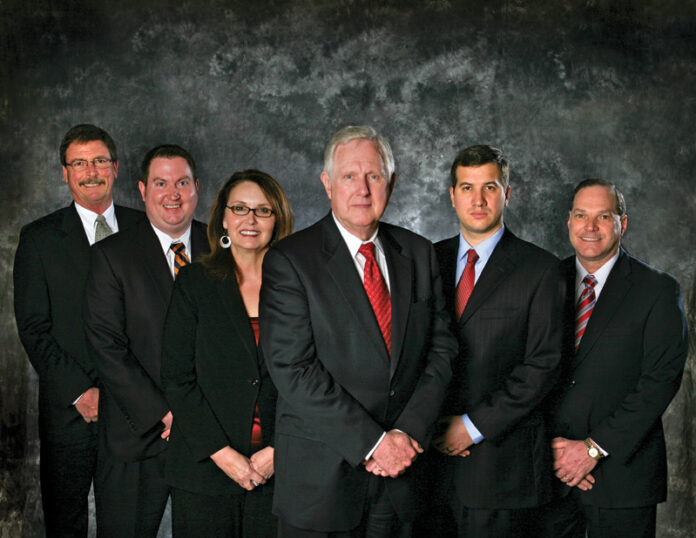
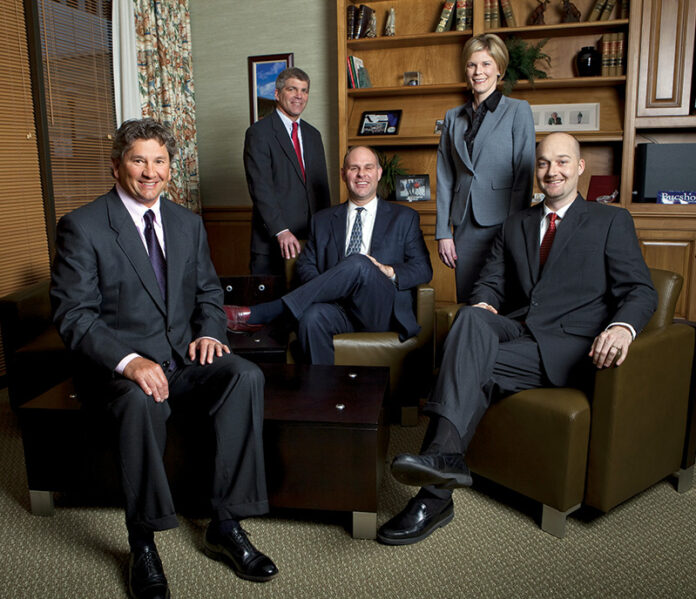
Evansville Commerce Bank leaders.

In 2004, Tom Austerman traveled to Chicago for a conference that would come to shape the future of his banking career. There, the Evansville banker attended a presentation by Joseph D. Reid, chairman and CEO of bank development company Capitol Bancorp Ltd. Reid, a straight-talking former attorney, told the audience about his company’s concept of developing community banks through a method similar to franchising: providing seed money, support services, and back-office operations while recruiting local management. After several years, the multi-billion-dollar company, based in Lansing, Mich., and Phoenix, would buy the banks it had helped start, making them a wholly owned chartered subsidiary of Capitol Bancorp Ltd.

The idea captivated Austerman, the founding president and CEO of Bank of Evansville. Two years later, when Austerman founded Evansville Commerce Bank in Downtown Evansville’s Hulman Building, Capitol seemed an ideal partner. The company’s innovative model had “worked perfectly,” Austerman says, “a couple dozen times.”

Then came what now is dubbed the “Great Recession,” an economic downturn that pummeled Capitol’s home bases in Michigan and Arizona. As unemployment numbers soared to record highs, national bank giants failed, and the New York Stock Exchange threatened to delist Capitol’s stock, Evansville Commerce Bank’s management and directors felt there was an opportunity in the midst of chaos. This spring finds the bank, after receiving the required regulatory approvals, in the process of conducting a public stock offering that will restructure Evansville Commerce Bank as “the only Evansville bank that will be locally owned, locally managed, and 100 percent locally focused,” says Austerman. “Because we believe in Evansville and the people and businesses who live and work in the Evansville area, we want to bring the bank’s ownership home.”

Seven years ago, at the banking conference in Chicago, Austerman by chance was seated at Reid’s table during a luncheon. The two discussed Capitol’s unique strategies, and Reid, named 2005’s Innovator of the Year by the financial services industry publication American Banker, “was taking a different route than everyone else,” says Austerman. Rather than establish a prominent national identity, Capitol left the branding decisions and management to its community bank partners. The concept was unusual, but it worked: In 2003, Fortune magazine named Capitol to its list of the nation’s 100 fastest-growing small public companies. “To the more typical mindset that stresses accumulation — building up more territory under your direct control, planting more flags, sticking more under your umbrella — Reid’s strategy may appear utterly foreign,” wrote ABA Banking Journal executive editor Steve Cocheo in 2007. “Indeed, most of Capitol’s banks bear no obvious connection to the holding company in name, look, logo, or any of the other branding techniques that others place such importance on.”

While Austerman’s lunchtime conversation with Reid was enlightening, “I didn’t think anything or do anything because of it at the time,” Austerman says. Then, in mid-2005, after Austerman had retired from Bank of Evansville (now German American Bank), Reid called. The man known for building banks around great leaders — rather than specific markets — was impressed by Austerman’s track record, and he asked Austerman to consider starting a new community bank in Evansville with Capitol’s assistance. The bank development company would provide 51 percent of the startup funds, and Austerman would be responsible for raising the other 49 percent locally.

Austerman found the offer irresistible. On May 31, 2006, Evansville Commerce Bank opened as the 44th bank in Capitol’s nationwide network.

Soon, Capitol would become one of the nation’s biggest bank development companies, boasting 64 banks in 17 states. But the company also had an abundance of real estate loans in troubled markets plagued by foreclosures and plunging home values. In 2008, Capitol dipped into the red and began restructuring its operations, selling banks and reining in growth. The next year, the company landed near the bottom of Forbes’ annual Best and Worst Banks ratings, ranking No. 96 of 100.

Capitol’s original plan — to buy out Evansville Commerce Bank and turn it loose in 2009 — no longer was possible. Austerman says instead, Capitol suggested he shrink the bank’s assets as a way to maintain adequate capital ratios. After a period of steady growth, “we just were frozen,” Austerman recalls. The Evansville Commerce Bank board of directors considered selling the bank, but as they interviewed buyers, a common thread emerged: All of the potential purchasers championed Evansville as a prime place to do business. “Our board heard that enough that they said, ‘If everyone else sees this,’” Austerman says, “‘maybe we ought to keep it and go independent.’”

Today, Evansville Commerce Bank stands on the brink of autonomy. With the aid of Commerce Street Capital, a Dallas-based investment bank, the bank is making a public stock offering to buy back the 51 percent ownership from Capitol. The minimum investment, says John Broderick, Commerce Street’s senior vice president, bank development, is $10,125 with stock units costing $16.20 each. Austerman expects the offering to start to realizing results in April and conclude by July 31. The bank needs to raise $2.3 million to buy out Capitol, and Austerman predicts Evansville Commerce Bank could achieve independence as early as this summer. 

Going solo will affect the bank in numerous ways: Evansville Commerce Bank will focus less on commercial real estate loans and more on operating or working capital that will help small businesses grow and prosper. The bank will be able to re-enter a growth mode after two years of shrinking, and additionally, Austerman hopes to have several small, cost-effective banking offices on Evansville’s West, East, and North sides. “Most importantly, our policies, practices, and procedures will be suited to the realities of Evansville rather than other national or regional markets,” Austerman says. “The way that you think and go about things can make a big difference. We have Toyota; (Michigan has) Chrysler. Toyota is pushing out cars, and Chrysler’s trying to make payroll. It can’t help but affect how you view things.”

The transition to becoming a fully independent bank has made Austerman’s ambition — to create a locally owned, managed, funded, and 100 percent locally focused bank — a reality. “When you live it, when you feel it, you can make decisions based on what you know to be true rather than formulas or statistics,” he says. “We can bring the art and science back to banking.”

Evansville Commerce Bank
20 N.W. Fourth St.
812-492-1800
www.evansvillecommercebank.com

Five People You Need to Know

0

Randy Wheeler
For nearly 30 years, Randy Wheeler has reported on local happenings, shakeups, and milestones. One reason for his longevity: He has a voice that never goes out of style. The award-winning WIKY radio newsman still comes to press conferences in a suit. The wardrobe isn’t for his audience. He’s on the radio, after all. The suit reminds sources he’s the constant professional dedicated to reporting news his listeners need to know.

Amy Walker
Since 1985, Evansville’s Public Education Foundation has awarded millions of dollars for programs at local schools. Heading that 26-year tradition is Amy Walker, the PEF’s executive director. From teacher development courses to a summer musical to a citywide, student-driven music concert, Walker’s aid adds depth to the classroom setting.

Liz Mumford
Liz Mumford — a New Harmony, Ind., native — gave the Under the Beams concerts, held in a historic stone and clay brick building with a soaring ceiling, powerful headlining acts. Last year, she played a new tune as the new producing artistic director of Tales & Scales, Evansville’s traveling music-telling troupe. In 1986, the troupe — then in its first year — earned nationwide acclaim. Mumford’s the perfect fit to maintain the group’s prominence.

Ronald Rochon
When Linda Bennett became the third president of the University of Southern Indiana, she soon named Rochon her replacement as the provost and called him “enthusiastic and energetic.” Now, his enthusiasm is a major contribution to a student body of more than 10,000. His goal: to transform the youth into critical-thinking professionals ready for the workforce.

Sharon Kazee
Her husband, Thomas Kazee, may have landed the role of the University of Evansville’s 23rd president last year, but Sharon is a standout in her own right. The former vice president for arts and academics and dean at the South Carolina Governor’s School for the Arts and Humanities has been an educator for 30 years. In Evansville, she has attended board meetings and nonprofit luncheons. Like any great educator, Kazee used these visits as research — a way to determine how she can help the most. Already she’s committed to Signature School as a director, as well as the Evansville Public Art Commission.

This is Wine Country

0
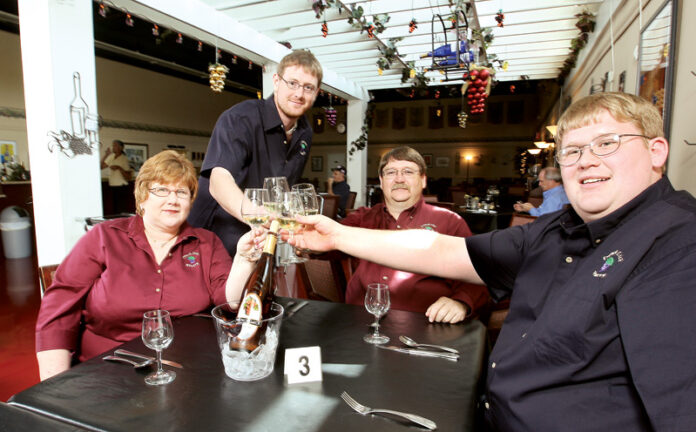
Kim, Nicholas, John, and Aaron Doty gather at their family’s winery, French Lick Winery.

When Southern Indiana residents Kim and John Doty scouted locations for a winery, they settled on French Lick, Ind. The town was a half-hour’s drive from their home in Jasper, Ind., and the landmark that once attracted national politicians and sports stars, the grand West Baden Springs Hotel, had fallen into disrepair. The plans that would revitalize the area — including massive renovations and a casino resort — were years from being finalized. Still, the couple believed in French Lick’s potential to be a thriving tourist destination. “With a winery,” Kim Doty says, “you need a lot of tourist traffic.”

Today, French Lick’s two elegant hotels, casino, trains, and other attractions boast plenty of visitors. So does the 15-year-old French Lick Winery, which offers tastings, tours, and an on-site Italian restaurant. It’s one of 54 Indiana wineries riding a crest in the state’s wine industry, a modern renaissance that will be showcased on May 21 at the sixth annual Historic Newburgh and Evansville Living Wine, Art & Jazz Festival.

The seeds of success were planted — literally — in 1796, when a Swiss immigrant arrived in the United States and eventually settled in the newly surveyed Indiana Territory. He planted a hardy grape variety in present-day Vevay, Ind., and the crop flourished through the hot summers and chilly winters.

By the early 20th century, wineries prospered in rural hamlets across Indiana. Then came Prohibition. The effects far outlasted the repeal: It wasn’t until 1971, when the Small Winery Act allowed wineries to sell directly to the public rather than working through distributors, that Hoosier wineries once again began to thrive.

Now, the wine craze is nationwide. In 2010, the United States overtook France as the world’s top wine-consuming nation. In spite of (or maybe because of) the economic recession, the California-based Wine Institute notes that wine consumption in the U.S. hit an all-time high in 2009, showing a 25 percent increase in the last decade alone. 

Indiana’s wine industry, too, is growing faster than ever. “People want to enjoy ‘local,’” says Jeanette Merritt, marketing director for the Indiana Wine Grape Council. “As more and more things fight for disposable income dollars, consumers have to figure out what is the value in their spending. Many seem to be choosing to keep their money in local communities.” Ten wineries opened in 2010, and Merritt predicts another 10 may open this year. (The IWGC, based at Purdue University in West Lafayette, aims to boost economic development by providing research and marketing to the wine industry.) 

Another boon to the industry are collaborative efforts such as the state’s first wine trail, the Indiana Uplands Wine Trail in Southern Indiana. The trail includes Best Vineyards (Elizabeth), Brown County (Nashville), Butler (Bloomington), Carousel (Bedford), Huber (Starlight), Oliver (Bloomington), Turtle Run (Corydon), and Winzerwald (Bristow) wineries.

The trail, of which French Lick Winery owner Kim Doty is president, began in 2003 after a fateful car ride to Indianapolis. As Doty, Ted Huber of Huber Winery, and Dan Adams of Winzerwald Winery drove together to the Indy International Wine Competition, Doty recalls Huber musing, “You know, you look on the map, and there are a bunch of quality wineries right here in this section of the state.” 

The comment inspired the birth of a wine trail: Visitors pick up a free “passport” at any member winery, and if they complete the trail by visiting each of the nine wineries, they receive a prize (this year, an insulated wine carrier sporting the trail’s logo). Plus, they’re entered into drawings for prizes such as weekend getaways at wineries and bed-and-breakfasts. Member wineries also team up to present events such as Toast to Spring (April 9-10), which features free wine and cheese pairings. “Working on the wine trail together,” Doty says, “the nine of us know each other well, get along well, and are very supportive of each other.”

That camaraderie is evident at the Historic Newburgh and Evansville Living Wine, Art & Jazz Festival, a showcase of regional vintners, restaurants, artists, and musicians along the banks of the Ohio River. As of press time, participating wineries were Best Vineyards (Elizabeth), Blue Heron (Cannelton), Buck Creek (Indianapolis), Carousel (Bedford), Easley (Indianapolis), French Lick (West Baden Springs), Huber (Starlight), Indian Creek (Georgetown), Oliver (Bloomington), Scout Mountain (Corydon), Turtle Run (Corydon), and Windy Knoll (Vincennes) wineries. 

Carol Hicks Schaefer, executive director of Historic Newburgh, says that one change to this year’s festival is the addition of a third large tent dedicated to music performances. (Vintners, food vendors, and artists will share the other two tents.)  The festival hours also have been extended until 10 p.m. “Last year, 9 p.m. rolled around, and people didn’t want to leave,” Schaefer says. “The party was just getting started.”

Lisa Seif

0
Seif hosts a weekly radio program about addiction on 1400 AM at 11:30 a.m. on Saturdays.

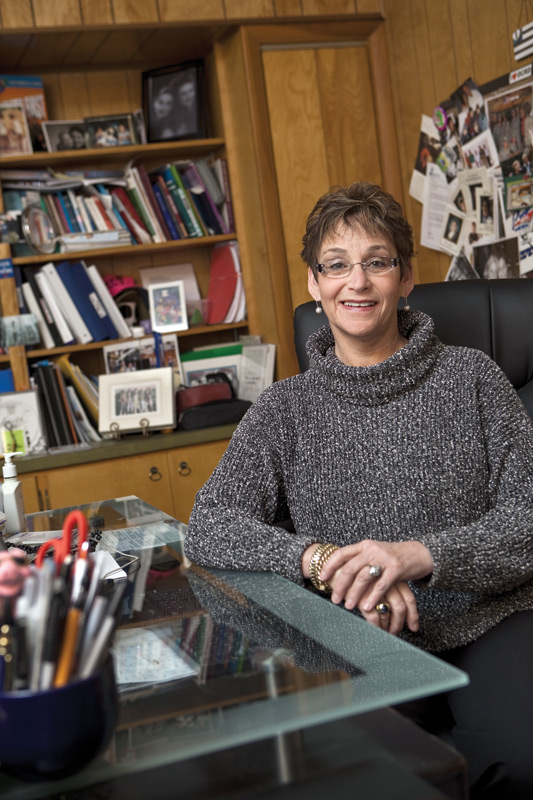
Lisa Seif’s rebellious spirit was fueled by what she calls the “social earthquake” of the 1960s. That decade produced a corresponding drug culture that hit the Harrisburg, Pa., native hard. By age 20, Seif had a drug problem. She promised her father, diagnosed with lung cancer, she’d quit hard drugs. Seif failed. Soon, he passed away. A year later, Seif left college to be with her mother, who had moved to Evansville after falling ill with lung disease. Another promise. Another failure. Another parent passed away.

Seif’s sister demanded she go to rehab or leave Evansville. “Thank God for rehabilitation and treatment,” says Seif, who recently celebrated her 30th anniversary of sobriety in March.

Today, in addition to her private practice, Integrity Psychological & Counseling, Seif is the director of court substance abuse programs for the Warrick County judicial system. The program not only holds addicted individuals accountable for their crimes but also connects them with treatment and close monitoring — services that have been proven to work better than incarceration, probation, or treatment alone. The ripple effect of Seif’s work is enormous: According to the National Association of Drug Court Professionals, drug courts reduce crime as much as 35 percent compared to other sentencing options, and they produce cost savings of up to $12,000 per patient. 

Seif’s mission: “To screen out who are the criminals and who are the ones who truly, if they got clean and sober, would be better,” she says. “If that’s the case, I’m their voice.” 

I just got swept away in the movement, but I also was swept away by the effect and how it altered my reality. It altered the way I felt about myself. It altered the way I saw the world. It numbed me out from the insecurities and inadequacies that I felt. I thought I’d hit a gold mine. I thought I’d found magic.

My father was diagnosed with lung cancer when I was a senior in high school. My father was everything to me, and I made a promise to him that I was going to quit all of this stuff because all he ever wanted was for me to be a productive, happy, moral, contributing person to society. I really made a conscious effort to quit just to please him because that was his dying wish. And I meant it. I think I lasted a weekend.

I was raised in a good Jewish home. My mother survived the Holocaust, so I was very aware of how important it was that I look like a productive young girl who was raised in a good home. But I was too into the culture of the drug movement. All my friends, my language, my whole lifestyle became consumed with it. It’s not just you get addicted to a drug or you get addicted to alcohol; it’s the whole lifestyle that goes with it.

What I think is chronically misunderstood is people still think (addiction) happens to this kind of person from a divorced home, or this kind of person from an alcoholic home, or this kind of person who didn’t have certain opportunities. I think we need to really let everybody know that alcoholism and addiction can happen to anyone. Anyone. Sure, biology plays a role, but the quantity and frequency of use is what dictates whether they will have alcoholism or addiction or not. It has nothing to do with their morals, their religion, their socio-economic status.

There’s a lot of “lock them up and throw away the key” mentality. Maybe because I lost my parents so young, I believe that we owe it to our families and our community to help them understand that people can get better.

You look at somebody’s criminal record, and he looks like a monster. We had a guy in our drug court who, by the time he was 25, had eight DUIs. You look at him on paper and think, “Oh my God, this guy’s going to kill somebody drunk driving.” He is a danger to society, but jail’s not going to cure the addictive disorder. Unless clean and sober, he’s going to get out of jail and keep drinking and driving like he always has.

Restaurants We’re Trying

0
Windmill Donuts (Photo by Heather Gray)

Windmill Donuts & Pizza: The menu is not the healthiest, the pizza toppings are limited, but we are so enamored with the concept: donuts and pizza in the same restaurant. Right inside this Northeast Side joint is a display case of confectionery creations ready to entice with sugary splendor, and the clientele tends to mosey in. Windmill, lodged in the former Huddle House, is a place to linger, and why not? The menu is a guilty pleasure, and the ample donut size isn’t for scarfing down (the chocolate-topped honey bun takes at least 20 minutes to eat). Don’t think calories; think fun.

Truffles Eatery & Catering: With a warm yellow façade and striking black roof, this restaurant, a former Dairy Queen on State Road 261 in Newburgh, has several changes that are beyond cosmetic. Owner Ralph Wilson overhauled the interior with a mix-and-match of rehabbed wood pieces. One new important contribution is the menu — a heart-warming selection of poetic-sounding breakfast items such as the cremini mushroom and pepper omelet, the house-made granola with cranberry-infused yogurt, and the sweet Weisenberger white grits with spiced apples. Topped with sautéed apples spiced with clove, star anise, and cinnamon, these stone-ground grits from Kentucky are slow-cooked with butter, cream, and sugar.

Five Guys Burgers and Fries: The Washington, D.C.-based restaurant has a Facebook page with nearly 500,000 fans — a sure sign the burger joint is well-liked. Further proof is inside the East Side location where Five Guys press clippings from across the United States line the walls. The open kitchen is a sea of red and white as uniform-clad workers hustle to fill orders for a busy lunch crowd. The assembly-line process is a chaotic masterpiece for making big, juicy hamburgers with an exhausting list of free toppings: mayo, relish, onions, lettuce, pickles, tomatoes, grilled onions, grilled mushrooms, ketchup, mustard, jalapenos, green peppers, steak sauce, and barbecue sauce. The fries — so large that they border on potato wedge big — overflow from the carton. That’s extra bang for your buck, but this is no value meal.

The Fast Track

0

Every spring offers an opportunity to dress like a sophisticated Southerner — and pull it off — thanks to the opening of the Keeneland racetrack (April 8) in Lexington, Ky., and the Kentucky Derby (May 7) at Churchill Downs in Louisville. To dress properly, think bright colors, light fabrics (like linen), and big hats.

Fun, Fun, Fun!

0

My lexicon is filled with “fun.” More than a magazine editor should, I tend to speak colloquially, use idioms and clichés liberally (especially old-fashioned terms), and introduce plenty of phrases that my family calls Kristen-isms. I’m a big fan of the word “fun.”

“Let’s do something fun this weekend.”
“Oh, how fun!”
“What fun things have you done lately?”
“That is so cool and fun.”

I’m sure I say these statements several times each day, and I realize they probably make me sound more like a high schooler than a 40-something mom and editor.

I talk about fun. I like to have fun. Fun is a serious issue these days. In researching the topic of fun for this letter, a respected book I’ve not read repeatedly turned up, Homo Ludens, written in 1938 by Dutch historian, cultural theorist, and professor Johan Huizinga. It discusses the importance of the play element of culture and society. Even today, the book is a primary tool used by game designers in prescribing what sort of play is fun for folks. The Latin title of the book means “Man the Player” or “Playing Man.”

Fun and play are inextricably connected. My friend Stacy often speaks of people she admires as being “filled with a playful spirit.” Yet modern life is so serious! For so many people, the economic hardships of the past few years have drained the fun from life. Fortunately, Evansville is home to plenty of fun people, a joyous, spirit-filled handful who agreed to help us bring fun and play into our lives.

Among the four tenets of this magazine’s mission is the objective “to inform, instruct, amuse, and entertain our readers.” Amuse and entertain! Certainly we’re in the business of fun.

I hope you’ve had fun reading this. I always have fun writing these letters, and of course our staff (a very fun bunch) has fun putting together each issue for you. Now, go have some fun!  As always, I look forward to hearing from you.

Sincerely,
Kristen K Tucker
Kristen K. Tucker
Publisher & Editor

Balls of Fury

0

If a receptionist takes a call at the TV station from a viewer who throws off a comment about plans to drive his truck to the transmitter site and commit unspeakable acts, it could be time to call the police. At this time of year at CBS 44 WEVV, we just call it March Madness. Although the games don’t begin until Thurs., March 20, the hundreds of phone calls begin right after the copy machines start spitting out brackets on “Selection Sunday,” March 16. In the words of most of our callers, “Just who the hell makes the game decisions and why?”

Every March, CBS 44 finds itself in the eye of a truly perfect storm. Basketball is king and queen in the Tri-State. Unlike most other parts of the country, roundball loyalties don’t lie with only one or two teams. Think Indiana, Kentucky, Illinois, Southern Illinois, Purdue, Evansville, Butler, Western Kentucky, Louisville, Tennessee, Murray State. It’s not uncommon for several of these teams to have a berth in the tournament.

It begins with eight teams playing at the same time in each of four different flights across two days. The next two days don’t get much better. One of the great mathematical minds once commented about the impossibility of two pieces of matter occupying the same space at the same time. It’s not any easier to squeeze four basketball games onto the same TV set at the same time, even with HiDef on screens that measure greater than 52 inches. Three long-time managers at CBS 44 negotiate the madness every year between our viewers and the network. Think Middle East peace negotiations.

Two days before the tournament begins, CBS sends us a list of every game they have pre-assigned to our station along with air times. CBS assigns games based on regional and national interest, which is often determined by nothing more than geography. Since WEVV is in Indiana, CBS assigns games that involve Indiana schools. That works beautifully, except when a Kentucky school or an Illinois school is in the mix. WEVV is allowed to request game changes. We often do, and we often get a fast, favorable decision.

It gets tricky, though, when two games of local interest are occurring at the same time. That’s when the next, crucial decision comes into play. During opening round games, it is always the network’s desire to show portions of as many games as possible. Here in the Tri-State, viewers like to see their teams’ games in their entirety — even when it’s a blowout.  We’re not lying when we say we can’t do anything about the game choice because that’s what “the network gave us.”  WEVV is allowed to request a game as a “constant” (meaning the video feed we receive from the network will never leave the game until the final buzzer sounds) or as a “primary” (meaning the video feed we receive from the network will primarily stay with the assigned game but may jump to other games as they near their finishes). We choose the “primary” feed when two teams of local interest are playing in separate games at the same time. When the choice involves Indiana and Kentucky, WEVV follows the unwritten rule of always choosing “constant.” In the event IU and UK are playing at the same time? We pray to the basketball gods every season not to even send us there.

During the tournament, CBS anoints some games as being of “national interest.” Those games are fed to virtually all of the network’s 196 affiliates, unless there is an overwhelming plea of “local interest.” Just last year, we tried to convince the network bigwigs that we should be able to carry the Tennessee game because Bruce Pearl was a local boy done good. The answer: “(chuckle) Good try, but no.”

Many callers suggest we use our second station, MyTSN, to show games. It seems perfectly simple in this age of digital communication. And, honestly? It is. The almighty dollar rears its head, though. CBS doesn’t want to dilute the audience, which would dilute its take from some pretty pricey, national commercial real estate.

So, when you call WEVV in late March — and we know you will — keep in mind that we feel your pain. I think it has something to do with ears and cauliflower, after having a phone planted on the side of one’s head for far too long. Let the games begin!

Basketball fan Tim Black is the station manager at CBS 44 WEVV

Join the Fun

A root beer saloon. Roller skates. Dancing shoes. From places for playing to fascinating people to cool skills, couch potatoes aren’t welcomed here. Grab the bull by the horns — literally — and have some fun this spring.

Fun People: Sue and Jack Schriber

Sue and Jack Schriber are as extroverted as any one couple can be. They’ve translated a lifetime love of theater into a community passion by educating students and creating civic performances. To know them is to embrace enthusiasm, and the Schribers are extraordinary volunteers who donate to worthy causes such as the Public Education Foundation/EVSC summer musicals, Evansville Civic Theatre, Evansville Philharmonic Orchestra, and the Reitz Home murder mysteries.

Fun People: The Rob

The Rob sounds young yet polished, professional yet laid back, relaxed yet engaged. On weekday evenings, the Kiss FM radio personality (who ditches his last name, Hirschbuhl, when on air) may have all the credentials to host a great show, but what he’s done with that talent is more important: The Rob has created a community. His regular callers (they phone so often, they’ve earned nicknames) are as vital to the show as his affable, chuckling sidekick, Big Boy (who weighs 439 pounds). It’s interactive, fun, and just a little racy. www.1061evansville.com

Fun People: Don Baggett

Don Baggett had been practicing magic for six years before landing his first paying gig ($15!) at a nursing home. The 16-year-old piled into his 1972 Impala filled with props and entertained the geriatric crowd. The show’s success led to a lifetime of magic. “I liked getting in front of people,” Baggett says, “but I couldn’t sing worth a darn.” He performs around 250 shows a year on top of his fulltime job as the operations manager of Rheem Manufacturing. Magic is “a hobby I’ve been fortunate enough to do a lot of,” Baggett says.

2011 marks his 25th anniversary in the International Brotherhood of Magicians, an organization dedicated to the art of illusion. His dedication will earn him a spot in the Order of Merlin, an elite group of magicians, later this year. Credit Baggett’s upbeat personality for his longevity. “My job isn’t just to fool (the audience),” Baggett says. “We’re supposed to have a good time together.”

For more on Don Baggett and the International Brotherhood of Magicians, visit www.donbaggett.com or www.magician.org.

A Loaded Bull

It’s not like Evansville’s never had a bar with a mechanical bull before, but when Stoney’s opened in early 2011, the newest addition to Casino Aztar’s nightclub-centric The District was a hit. Perhaps that should be “hits,” plural, as in “the number of times bodies hit the floor after a ride on the mechanical bull ended with an abrupt toss.”

But patrons’ hour-long wait in February’s bitter cold signaled that this country-western-themed bar with waitresses clad in bikinis and chaps meant the inside was standing-room-only. Not that the beer-pong and cornhole players seemed to mind when they eventually elbowed their way through the packed crowd to the 2,000-square-foot, hardwood dance floor.

That popularity hasn’t let up. When the LoCash Cowboys, a well-dressed country music duo, took the Stoney’s stage, an estimated 1,500 were in attendance. Welcome to the party. www.stoneysevansville.com[pagebreak]

Club Hopping

Evansville River City Bop Club
With an eclectic mix of music styles including bop, shag, and rhythm and blues, this swing dance club is a blast from the past. Each meeting at the Holiday Inn (formerly the Evansville Airport Marriott) begins with a lesson for beginners and intermediates followed by open dancing. This swinging group meets once a month and welcomes both members and nonmembers, but since the venue serves alcohol, you must be 21 to attend. www.ercbopclub.com

International Brotherhood of Magicians, Ring 56
From mentalism and illusions to ventriloquism and kids’ shows, this organization offers a stage for aspiring magicians to practice and perform, but with a 64-year history in Evansville, this is one group that won’t be disappearing. Guest lectures come from seasoned professionals such as Aldo Columbini, an award-winning magician who mixes comedic, parlor, and stage magic as he performs across the globe, and Dan Harlan, known for his unconventional use of rubber bands and cutting-edge card tricks. www.ring56.com

Daughters of the Nile
Named after the Egyptian goddess of women and children, Isis Temple No. 41 raises money for children through card parties, handmade quilts, and county fairs. Their contributions go to the Shriners Hospitals for Children. Formed in 1928, this hierarchical and ceremonial organization attracts ladies who are related by birth or marriage to Shriners, Master Masons, or Daughters of the Nile. www.hadishrine.org/nile

Evansville Astronomical Society
Boasting members from physics professors to hobbyists, the EAS provides a venue for astronomy lovers to meet and stargaze away from bright city lights at the Wahnsiedler Observatory in Lynnville, Ind. Members receive unlimited access to the facility’s two telescopes (a 14-foot reflector and a 12.5-foot reflector), and the public is invited to take private or public tours. www.evansvilleastro.org

Evansville Kennel Club
Part of the Kentuckiana Cluster of Shows, the largest all-breed dog show in the nation, this club is a haven for dog enthusiasts. Though now independent of the private restaurant that shared its name, the 113-year-old nonprofit promotes the welfare of dogs through funding, education, training, and research. The EKC is a place for showers, breeders, trainers, or just happy dog lovers. 812-426-2583 or www.evansvillekennelclub.org

Fun People: Karen LeMond

As the co-owner of T.R.U. Event Rental (www.trueventrental.com), the very nature of Karen LeMond’s job is fun: party planning. LeMond may tell you her job is stressful — and we’re sure she’s faced a few bridezillas — but we’ve never gone wrong with a T.R.U. party. A bonus: Her vibrant office floor is a reminder she’s a woman who isn’t afraid to use color, especially purple, which she uses in her outfits regularly. You can find her at the University of Evansville men’s basketball games. She’s the one with the purple glasses and matching fingernails.

Animals, Root Beer, and Storytelling

Inside the Root Beer Saloon in Alto Pass, Ill., (less than two hours west of Evansville in wine country) are 175 mounted deer antlers and more than 150 birds — all killed and stuffed by saloon owner Michael Blank. He’s a hunter and taxidermist, and as an interior designer, Blank has a kitschy aesthetic, best seen inside the saloon. Should you decide you’re just browsing at the overstuffed-on-décor restaurant, Blank kindly will ask you to leave. It’s not a museum, and besides, the three micro-brewed root beers are sweet bliss (and don’t forget about the deli menu). But Blank is an attraction, too. He chops wood to make well-received guitars. Plus, the man is one great storyteller, and good news: He and his longtime girlfriend Cynthia Lucas are the two employees, so chances are good he’ll be working. www.rootbeersaloon.com

[pagebreak]

Four Wheels Keep On Turnin’

Remember the roller skating parties of your grade-school days? The disco ball spun overhead as Journey tunes blasted from the speakers, and your biggest worry was tripping in front of your prepubescent crush. Now, visitors to Evansville’s Skate World can choose between traditional high-top skates or the slimmer in-line variety, but the four-wheeled fun remains the same. Though the rink offers family nights, kids’ days, and a squeaky-clean setting, skating isn’t just for youngsters: The American Heart Association lists roller skating among the best aerobic activities to improve heart and lung health. Don’t stop believin’.

Skate World | 1300 Fairfield Drive, 812-476-0586 | www.skateworldin.com/evansville

How to Learn a New Hobby

When you were a kid, fun learning opportunities abounded: after-school art classes, summer camps, and school clubs. As an adult, educational opportunities still exist — you just have to search a little harder. Here’s a primer on local experts who can help you pursue a new hobby. (Hands-on instruction beats YouTube any day.)

Child’s Play

Kids Kingdom
Located at Sunrise Park, near the LST 325 and the Riverfront corridor of the Pigeon Creek Greenway Passage, this playground is a relative newcomer to Evansville’s landscape. Built in 2004 entirely by volunteers, it’s a sprawling complex of slides, tunnels, monkey bars, and — true to its name — a wooden castle. The grassy grounds are ideal for picnics or games of bocce. www.evansvillegov.org/parks

cMoe
What began as Hands On Discovery, a Junior League of Evansville signature project housed in Eastland Mall, has evolved into the 18,000-square-foot Koch Family Children’s Museum of Evansville (22 S.E. Fifth St.). Now located Downtown and guarded by a polka-dotted Tyrannosaurus rex named Millie, cMoe — which turns 5 this year — is a whimsical wonderland. Kids itching for warm-weather fun after a long winter will love the Quack Factory Gallery, where they can take off their shoes and splash in the company of a 20-foot-tall duck. www.cmoekids.org

Mall Carousel
If you grew up in Evansville before the 1970s, you may remember going ‘round and ‘round on the hand-carved carousel across from Mesker Park Zoo. That carousel left the River City in 1973 (it now resides in a North Carolina amusement park), but you can take a spin on another classic, Venetian-style carousel in the food court of Eastland Mall (800 N. Green River Road). In the midst of a flashy retail scene, the elegant horses, spinning teacups, and childhood glee remain timeless. www.simon.com/mall/?id=164

[pagebreak]

Spots to See Art

We love the Bower-Suhrheinrich Foundation Gallery and the Evansville Museum of Arts, History and Science, but the Tri-State offers plenty of other artsy places. Whether you’re hankering to buy a masterpiece or just admire the creativity of local artists, these off-the-beaten-path galleries deliver.

Studio Slant (www.studioslant.com)
412 E. Second St., Owensboro, Ky., 270-684-3570
10 a.m.-5:30 p.m. Tuesday-Saturday

To curator Katherine Taylor, Studio Slant is a protest of what she calls the “oatmealization” of the world. (Think mass-produced items in big-box stores.) This new art gallery and boutique in fast-growing downtown Owensboro features jewelry, photography, pottery, and other handmade items. A few highlights: the recycled aluminum can jewelry made by Paula Canant of Red Hot Design and the whimsical paintings of Lexington, Ky., artist Ike Moody.

Melvin Peterson Gallery (art.evansville.edu)
Corner of Lincoln and Weinbach avenues, 812-488-2043
Noon-3 p.m. Monday-Friday (August through May)

On the state tourism department’s Indiana Insider Blog, a museum-weary Erik Deckers wrote that the art galleries at Evansville’s universities “really shook me out of my artistic torpor.” One of those galleries, the University of Evansville’s Melvin Peterson Gallery, was dedicated last fall in the former bookstore space. On display through the end of March is the annual student art competition, and from April 9-May 6 is an exhibition showcasing the works of graduating seniors.

Riverwind Gallery (www.riverwindgallery.com)
10400 State Route 662 W., Newburgh, 812-853-2537
9 a.m.-5 p.m. Tuesday-Friday, 10 a.m.-3 p.m. Saturday

Where else can you find duck decoys, colorful pottery, and paintings of local landmarks under the same roof? For more than three decades, Riverwind Gallery has been a staple of Warrick County’s arts scene. From March 12-April 30, the gallery and frame shop hosts an exhibit of beautifully detailed paintings by Joanne Scott Massey and Diane Ubelhor Wunderlich. (See “Paint for a Cause”.)

Girls Just Want to Have Fun

What’s more fun than pampering yourself — on a weeknight? Save the date for Thursday, May 5, when Allure: An Evening for Women will bring local women together with amazing shopping deals, wine, hors d’oeuvres, style shows, and more. The indulgent evening hosted by Tucker Publishing Group, WTVW FOX 7, and the Sholar Center will take place at the Evansville Country Club. See our Guide for more.


Made by Hand

0

When Tom Wintczak first sat down at a potter’s wheel, “it just kind of stirred something in me,” the Posey County resident once told Evansville Living. That moment eventually would propel Wintczak, the former manager of a car rental facility, into a fulltime career as a potter. He specializes in redware, an intricate style dating back to colonial America, and his work recently earned him the title of Indiana Artisan.

The Indiana Artisan initiative was founded in 2008 by a bevy of state agencies promoting tourism development, rural affairs, the arts, and agriculture. Their collective goal: support Hoosier entrepreneurs who create high-quality, handmade art, crafts, and value-added food. (Think cheese, not milk; cider, not apples.)

On April 16-17, Wintczak joins approximately 150 other Indiana Artisans for the inaugural Indiana Artisan Marketplace at the Indiana State Fairgrounds in Indianapolis. (Representing Southwest Indiana along with Wintczak are Evansville fiber artist Karen Hampton, winemaker Donna Adams of Bristow, cookie baker Sister Jean Ballard of Ferdinand, raku potter Nita Claise of Tell City, and Tell City Pretzel co-owner Brad Smith.)

The event lets attendees buy artwork and food directly from the people who produce it. As visitors browse the booths, they’ll hear Indiana music and literary readings. The marketplace is modeled after Kentucky Crafted: The Market, a Louisville event in its 29th year that attracts approximately 8,000 shoppers and wholesaler buyers.

Indiana Artisan program manager Eric Freeman says the statewide initiative recognizes “careful attention to detail, knowledge of a craft, and an entrepreneurial spirit.” For Wintczak, it also recognizes passion and diligence. “These things, good or bad, are always going to be out there,” he says. “That’s a motivating force now to make good-quality things that are beautiful.”

For more information, see our Guide.
Pizza Re-Imagined

0
Rounders' Sauerkraut Pizza

Americans have transformed the Italian pizza for decades: Chicagoans with a love of deep dish, New Yorkers with an affection for giant slices, Californians with a penchant for Asian and Hispanic toppings, and Evansvillians with an obsession with supermodel skinny thin crust thanks to longtime pizza staple, Turoni’s.

But imagine pizza dipped in mustard or topped with peanut butter. Now, try it. Here, we offer three pies from chefs thinking outside the pizza box. 

Mustard Miracle
Rounders Pizza: 510 W. Mill Road, 812-424-4960; 12731 N. Green River Road, 812-867-7172.
The sauerkraut pizza, sans tomato sauce, comes piled with chunky sausages, tomatoes, and beef and slices of onions, pepperoni, and green peppers. Atop all of that is a smooth blend of cheddar and mozzarella cheeses. The sauerkraut makes it feel so wonderfully German, and the Bavarian is a big, beautiful pizza served with a condiment: spicy, brown mustard.

Peanut Butter Pleasure
Samuel’s Place: 518 S. Main St., New Harmony, Ind., 812-682-3001.
If you think peanut butter only belongs with jelly, bananas, or chocolate, you haven’t tried the peanut butter pizza at Samuel’s Place. Everything about this dish resembles a traditional cheese pizza, except for the thin layer of peanut butter atop the crust. The result admittedly isn’t for everyone, but the peanut butter adds a surprisingly mellow, sweet-yet-salty taste to the pie.

Bountiful Bleu
Greek’s Pizzeria: 240 S. Green River Road, 812-402-4733.
Any good chicken cordon bleu recipe demands a light dredging of the chicken through a seasoned flour, but place the recipe on pizza — like Greek’s Pizzeria did — to add more flavor. Topped with baked ham and grilled chicken, the assortment of cheese and a tomato cheese sauce makes for a different and worthwhile pizza.

Beer for Thought

0

Blame prohibition for the decline of American beers in the 20th century. Plenty of beer connoisseurs and historians do. Imports were available after Prohibition was repealed. They weren’t cheap, so the realm of beer used to fall into two categories, either Bud or Miller. It didn’t really matter which keg you tapped. These beers tasted about the same.

Now, American brews bring more flavor — the result of an ongoing beer revolution where taste matters. These beers are fresh and vibrant. If you stroll the aisles of a liquor store, you’ll catch a glimpse of progress: red, golden, brown, or pale ales; wheat beers; pilsners; dunkels; stouts; lagers; or lambics.

We could get quite technical about the differences between beers. (One simple difference begins at the core of the beer-making process. Diverse yeasts create unique fermentations, a cool chemical process turning sugar into alcohol and carbon dioxide.) We’d rather write about the tastes of ales that typically are fruitier and more complex than lagers, which are livelier and sharper. But most importantly, we want to write about community because beer — unlike any other beverage — brings people together. If you’re a stout lover and you meet another stout lover, you know you’re in good company, and it’s a fine feeling to know someone adores the nuances of your favorite brew.

In this feature, raise a glass to your favorite brews and toast the people who love them.

Articles from our Beer Feature:

•  Brew Hub – A great selection of beers isn’t bound by borders
•  110 Bottles of Beer – One man’s quest to become a World Beer Tour champion — 44 times
•  Just Brew It – Three men tapping into the art of homemade beers

Brew Hub

0
Kanpai

Kanpai – The only bar inside this East Side restaurant is for sushi, but as a self-described beer snob, owner Jayson Munoz offers a beer menu that shines with a rotating stock dependent on the seasons. This spring, more wheat and pilsner beers arrive to a menu of around 40 beers (bottles only, no draft). He also is a man dedicated to local — or nearly local — brews such as St. Louis-based Schlafly and Upland, made in Bloomington, Ind. “If Schlafly is going to carry a beer,” Munoz says, “I’m going to pick it up. I love that brewer.” From light, unfiltered wheat beers to oatmeal stouts with aromatic coffee and raisin notes, Schlafly offers 50 styles a year.

And while the selection is large, the goal is to pair beer with entrees. “Beer is like the new wine,” Munoz says. One example: The South-of-the-Border sushi roll, which comes with limes and jalapeños, pairs with the slightly sweet Modelo Especial, a light beer served with a lime. The two are complements, but the choice is yours. “I don’t want to make your experience,” Munoz says. “I want to facilitate your experience.”
   
Gerst Haus – As beer-centric as Gerst Haus may be, the exterior looks like a hardware store because the historic building used to be stocked with tools. Now, it’s stocked with beer.

The name comes from German brewmaster William Gerst, who opened a successful brewery in Nashville, Tenn., in 1890. With that kind of legacy — and a rich German heritage in Southwest Indiana — this Franklin Street restaurant and bar is well known for Deutsch food (think kraut balls) and brews (think 29 beers on tap and around 130 bottled beers).

The most popular is the namesake Gerst beer, an amber brew poured in a frosted fishbowl with a nominal head. The 18-ounce drink is just $2.75.

Gambrinus Libation Emporium – The name Gambrinus Libation Emporium just sounds important. And why not? The terms “sports bar,” “dive,” or “cocktail lounge” don’t jive with this smoke-free environment. Besides, named after a mythical king who invented beer, Gambrinus in Owensboro, Ky., should exude a royal quality as an homage to fine spirits. Owners John and Adrianne Condray — a young, fun couple — created this place after inspiration hit from a downtown renaissance.

And “renaissance” describes their emporium perfectly. From wine to cocktails to beer, the options are broad, but the focus is narrow: Provide a drink menu where poetic descriptions are necessary. BrewDog’s Paradox Macallan Imperial Stout, aged in a former 1987 Macallan sherry cask, is a “mix of chocolate, coffee, dark fruits, and touches of whiskey and sherry” while the New Holland Imperial Hatter is “a robust renovation of the India pale ale.”

Just Brew It

0
The Casual Brewer: Larry Epplin

Mariah Hill, Ind.
Brewing since 1993
Makes four batches (20 gallons) a year.

Why Brew: “I’ve always been a beer lover. There’s no doubt about that,” says Epplin, “but my cousin got me into it. If I could do it as easily as he could, I thought it could be an interesting adventure, and by golly, it was.”

Most Popular Pint: A nut brown ale, a mixture of coffee and chocolate. “My wife really likes it, too,” Epplin says.

The Learning Curve: In 1993, the Internet was a dial-up dream (you couldn’t even get it on your phone), so Epplin needed help to get supplies. He tapped his cousin who lived near St. Louis to order from a home brew kit distributor in the area.

DIY Tips: “The whole bottling aspect is a lot of work,” Epplin says, “but five years ago, I got back into brewing because I could keg it. It’s a quicker, easier process. The greatest thing about kegging is controlling the carbonation. It really enhances the beer.”

The Brewing Enthusiast: Jim Pore

Evansville
Brewing since 1990
Makes 17 batches (170 gallons) a year.

Why Brew: In college, Pore wanted to drink imported beers. The problem: “In the Midwest, we were just starting to develop craftbrews,” he says, “so the imported beer was so expensive back then, especially for a college kid. It made more sense to make what I wanted.”

First Batch: An amber ale. “It wasn’t very good,” Pore says. “It was too light.”

Yeast Master: With the help of a friend, Pore learned to culture yeast for beer. “When we found yeast we liked,” he says, “we cultured them and kept them in quantities.” Today, the popularity of home brewing, plus the ease of Internet shopping, makes yeasts more readily available.

Pil-sner-grimage: In 2008, Pore flew to Belgium. He visited breweries, toured monasteries (where monks make beers), and drank at pubs. “It completely changed my life as far as brewing goes,” he says. He drank fruity lambic beers made from wild yeast. “I can take these beers anywhere, and everyone goes crazy for them,” Pore says, “from someone who doesn’t like beers to hardcore beer drinkers. They’ve never tasted a flavor like that.” At the pubs, hundreds of beers were available. “The intent (for brewers) isn’t to sell large volumes of beer,” he says. “The intent is to do something special with beer.”

• Watch Jim show us how to brew in this special edition of Evansville Living Presents!

The Motivator: Robert Sunderman

Jasper, Ind.
Brewing since 1975

Why Brew: When a client in 1975 shared a drink — and his fascination of home brewing — with Sunderman, he bought a kit and placed it on a card table in his dining room.

First Batch: “A light beer,” made a long time ago, Sunderman says.

Tastes Great: Beer aficionados love to use adjectives specific to brews: acetic (like vinegar), creamy (a soft texture), earthy (like dirt), full-bodied (full of flavor), and more. Sunderman doesn’t have time for that vocabulary, and you don’t need it either to enjoy beers. “People ask me to describe beers all the time,” Sunderman says. “I can’t do that.”

DIY: Sunderman has numerous brews on his resume such as export stouts, old ales, and blondes. He has supplies for interested parties who come from Bloomington, Ind., Nashville, Tenn., and Louisville, Ky., to make brews. A lesson Sunderman tells visitors: “Air is the biggest enemy for beer. You’ve got to keep (the process) clean.”

110 Bottles of Beer

0
Old Chicago general manager Joey Tornatore, Michael Cannon, and Dr. John Reid gather at the bar in Evansville’s Old Chicago.

As a veteran of Old Chicago’s World Beer Tour, Michael Cannon has tasted the world from a glass. His journey through 110 beers began with a Bud Light, a domestic beer from St. Louis, purchased soon after the restaurant’s opening in 2005, but Old Chicago’s beer menu — more than 130 brews deep — is diverse. Inspired, Cannon, whose experience with beer had been limited to domestic brews, ventured to finish the World Beer Tour. Such an achievement had added motivation: the placement of his name on The Famous Hall of Foam, special discounts, invitations to special events and mini-tours, and other rewards.

Cannon now boasts 44 tours. That’s 4,840 beers, which is roughly three each day since the restaurant opened. Cannon ditched his standby, Bud Light, for a new favorite: Smithwick’s Ale, an Irish bittersweet malt which he takes great pains to pronounce properly ever since an Irishman corrected him on a visit to Dublin. (Say it, “Smiddick’s.”)

But, not all of Cannon’s samples are hits. The Australian Sheaf Stout “was kind of like bloody motor oil,” he says. “That actually sounds tastier than the beer was.” Advocates of the Australian brew beg to differ. Evansvillian Dr. John Reid of Agape OB/GYN has completed 10 tours and thinks more highly of the stout, which advocates commend for bitter chocolate and roasted caramel sensations. Plus, it pairs well with lamb.

And that’s the idea of the World Beer Tour. It’s more than a way to win a free T-shirt. Over the past five years, Cannon has developed a diverse palate. He appreciates the lighter beers of China that often lack bitterness and bite. He enjoys brews mixed with seasonal ingredients such as pumpkin spice or berries. “It’s really amazing how creative the brewers can get,” says Cannon.

He convinced his wife of 21 years, Lisa, to join him on his journey. “She just kind of always stuck with the garden-variety stuff,” Cannon says. When she tried Stella Artois (a beer with roots dating to 1366), her opinion of beer changed. The moral of the story? “I think,” says Cannon, “you just have to give things a chance.”

To sign up or learn more about the World Beer Tour at Old Chicago (6550 E. Lloyd Expressway), visit www.oldchicago.com/evansville.

Photos You Didn’t See

0

In our March/April 2011 issue we feature Ben Lang’s custom log cabin ("Rising from the Ashes"). Five years ago, a fire destroyed the cabin and nearly claimed Ben’s life. A love of rural living — and a little convincing from his family — encouraged him to rebuild the luxurious country haven. Here, we present additional photos of the home not seen the magazine.

Link Up

0
Red Lobster's Lobster Pizza. Read more about our chain date in this year's Flavors.

We strive to cover local restaurants in our magazine, but in this issue of Flavors, our annual dining issue, we sent readers on a progressive chain date (“Chain Action”). We aren’t the first city magazine to admit that chains are a vital part of the community. Check out Indianapolis Monthly’s “Chain Reaction.”

Beer Face
Beer is the new wine. That’s what Jayson Munoz thinks. He’s the owner of Kanpai, an Asian bistro big on bottled beer. Munoz gives patrons—and readers—a sampling of pairing beer with dishes (much like wine) in the latest issue (“Beer for Thought”). Here, the ABCs of beer tasting from the founder of Sam Adams.

An Act of Faith
Before the April 16 performance of Brundibar, a Holocaust-era children’s opera (“Songs of Survival”), the Eykamp String Quartet will perform Oliver Messiaen’s Quartet for the End of Time. Composed in a POW camp during World War II on paper supplied by a German officer, the haunting piece of music offered a glimpse of beauty amidst a grim setting — much like Brundibar. Learn more in “A POW’s Awe-Inspiring Act of Faith,” published in The Wall Street Journal.

Planet View
In “Join the Fun,” we uncover what’s fun about our city. One such group: the Evansville Astronomical Society, a group of solar system enthusiasts with telescopes in Lynnville, Ind., focused toward the sky. Astronomers — in other parts of the world — may have spotted the birth of a planet.

Swinging with a Pro
Before Don Mattingly begins his first season as a Major League Baseball manager, we look back at his Evansville upbringing — and the tragic story behind his longtime uniform number in “Twenty-three.” Here, Mattingly offers baseball tips.

Tools of the Trade

0

In every issue of Evansville Living, columnist Eli Haddix entices readers with a new recipe. For this edition of Flavors, he reveals the top five tools he uses to create a culinary masterpiece. “My list is based on my belief that, given these five things, I can make a meal with 10 times more efficiency and precision than I would be able to without them,” Haddix says. “I also subscribe to the Alton Brown school of thought that if a gadget only can do one thing, I don’t need it. I need things that are usable for multiple functions.”

Stand Mixer: Preferably of the KitchenAid variety, this is a must-have when baking and also is helpful with other tasks. With all the attachments, a stand mixer can make mass amounts of slicing, grating, and whisking take much less prep time. Less time prepping means more time to eat. Another bonus: A stand mixer also can make ice cream.

Microplane Grater: If you’ve ever sliced your knuckle while using a box grater, you understand the appeal of a microplane grater: a long, single-surface tool with a handle. This gadget aids in grating fresh spices, citrus fruit zest, and hard cheeses such as Parmesan.

Immersion Blender: Also known as a stick blender or hand blender, but not to be confused with a hand mixer (for whipping batter), the immersion blender is wonderful for creamy soups and perfect sauces. By pureeing and incorporating all ingredients at the same time, it allows you to cook multiple ingredients into your sauces without worrying if the chunks will detract from the presentation.

Utility Knife: With a four- to five-inch serrated blade, this knife gets its name from the fact that it is utilitarian in nature. It works as a bread knife, a filet knife, a citrus fruit slicer, etc.

Santoku or Chef Knife: It doesn’t matter which you own, and stylistically, there isn’t much difference. I prefer the santoku variety for slicing, chopping, or trimming.

View an archive of Haddix’s recipes.

Surf for Your Supper

0

First, the obligatory disclaimer: Read the fine print before you buy a discounted restaurant certificate. (Limits may apply to dates and times, alcohol purchases, and more.) If you have questions, call the restaurant. Better safe than starving.

Dining Discoveries and More (www.diningdiscoveries.com)
This weekly TV show introduces Evansvillians to local restaurants and other businesses, offering discounted certificates to the establishments featured on each episode. Buy yours by calling the on-screen number during the show (10 a.m. Sundays on WEHT Channel 25), or shop online. Recent deals: Half off Greek fare at Acropolis, American cuisine with a river view at Edgewater Grille, tavern food at the Hornet’s Nest, and many other local restaurants.

Restaurant.com (www.restaurant.com)
This massive database includes 15,000 restaurants around the nation, so it’s worth a look if you’re on vacation or travel frequently for business. Remember our disclaimer? The Evansville listings on Restaurant.com include restaurants that have closed (Food With Flair, we barely knew ye) and no longer honor the certificates (one is The Jungle). Recent deals: 60 percent off ($10 for a $25 certificate) at Dave’s Sportsden and 30 percent off ($17.50 for $25) at the Deerhead Sidewalk Café.

Groupon (www.groupon.com/evansville)
This nationwide coupon program launched in Evansville last November. Registration is free, and every morning, Groupon e-mails a “daily deal” to members: up to 90 percent off items such as spa services and event tickets. Buy quickly, as the deals (not the certificates) often expire within a day. Recent deals: $15 for $30 at Angelo’s (try the crab cake appetizer served with pesto sauce) and $12 for $25 at Jaya’s (we’re suckers for the volcano roll).

Songs of Survival

0
Brundibar 2005

Dressed as a black cat, Ela Stein Weissberger sang proudly from a European stage. In the audience were esteemed poets, artists, and musicians, and on stage with Weissberger were dozens of other young singers. The cast performed the fanciful story of a brother and sister who, with help from their friends and three enchanted animals, overcome a tyrannical organ grinder who bans them from singing in the town square to raise money for their sick mother. Good triumphs over evil, and the opera concludes with a victory tune.

That opera, Brundibar, is a light, uplifting fairy tale. Its dark undercurrent isn’t in the content, but the context: Written by Czech composer Hans Krasa, Brundibar premiered at Terezin, a concentration camp near Prague. In light of the atrocities of World War II, the whimsical show became a compelling statement against oppression, a testament to the powers of hope and community.

Of the 140,000 people who passed through Terezin, most, including Krasa, eventually were deported to a near-certain death at camps such as Auschwitz and Treblinka. An estimated 90 percent of Terezin’s children perished during the war. 

But Weissberger lived, and this spring, she’ll travel to Evansville for a local production of Brundibar. On April 16 at the Victory Theatre, a cast of around 40 local students, ranging from tiny second-graders to talented teens, will reprise the performance introduced to Evansville six years ago.

In 2005, the local nonprofit organization CYPRESS (Committee to Promote Respect in Schools) spearheaded an effort to bring the production — and Weissberger — to Evansville. The effects were long-lasting: Amy Walker, executive director of the Public Education Foundation and producer of 2011’s Brundibar performance, was captivated by “the simplicity of it,” she says, “yet the ability for children to get across such a strong message.” Carol Abrams, chair of CYPRESS, received a letter from a cast member’s mother: “Little did we know the impact it would have on our lives,” the letter read. “…What a wonderful lesson in humanitarianism.”

After the 2005 production, the committee decided, “We have got to do this again,” recalls Walker, who also has co-produced 18 PEF/EVSC summer musicals. This year, the opera is directed by retired Castle High School teacher Ellen Cerling and conducted by Evansville Philharmonic Orchestra music director Alfred Savia. Terry Becker, head of the fine and performing arts department at Signature School, serves as vocal coach.

New additions are a simpler set and costumes that are “more along the lines of how it originally was done,” Walker says. Before the show, the Eykamp String Quartet will perform Olivier Messiaen’s haunting Quartet for the End of Time. After the performance, audience members are invited to a free dessert reception throughout the theater.

Once again, Weissberger will share her experiences with Brundibar patrons. Now 80 years old, she’s one of a few survivors from the original cast, and “there’s a sense of urgency,” says Walker. “None of the Holocaust survivors will be around forever, and (the lessons) are more powerful in person.”

For tickets to the public performance of Brundibar, 7:30 p.m. April 16 at the Victory Theatre, call 812-425-5050. For more information, see our Guide.

Jama Williamson

0

On NBC’s hit comedy Parks and Recreation, Jama Williamson plays a beautiful, smart doctor married to Aziz Ansari, who portrays a cocky Hoosier bureaucrat. The show’s characters suspect the arrangement is a green-card marriage considering Ansari is of Indian descent. They’re right — sort of. Williamson’s character is a Canadian who may be deported. The show is smart and clever, playing off stereotypes and preconceived notions. 

Williamson, an Evansville native, never felt the notion to act at Memorial High School. Too committed to cheerleading, Williamson developed her love of performing when she enrolled in an acting elective at the University of Notre Dame. From there, she headed to New York and learned about her craft at Circle in the Square Theatre School.

Williamson had a knack for landing theatrical roles with bizarre quirks, including once playing a dog in Sylvia, the story of a love triangle between a man, his wife, and his dog. And though she’s performed in musicals, “let’s be honest, I’m a performer, but I don’t sing,” Williamson says. Yet, she’ll be one of four celebrity judges on April 15 at Tri-State Idol, a fundraiser for Marian Educational Outreach, a nonprofit organization aiding Catholic education. “I sing in a comedic sense,” Williamson says, “but no one would pay good money to hear me sing in earnest.”

My first real theatrical professional role was an off-Broadway play, Eat the Runt, the grossest title. It was right at the start of the reality TV craze, so (the cast) learned all the parts and let the audience cast the play at the beginning of each performance. We had a different play every night. That was probably the best experience for cutting my teeth because I had to play different characters and never knew which ones I was going to play each night. And I met my husband (Curtis Williams) during that play, so it was good that I got cast. 

I played the role of a talking dog in this play called Sylvia. Sarah Jessica Parker (of Sex and the City fame) originated the role in New York. I studied the behaviors and movements of a labradoodle. That’s what I decided the type of dog I was. It was really fun. A lot of comedy ensued. I’m not sure I’ll get to play a dog again in my life. I’m glad I did once. 

I was one of the cheerleaders helping Debbie get to Dallas (in the off-Broadway musical adaptation of Debbie Does Dallas, a 1970s pornographic film). It was so genius because a lot of the dialogue was lifted straight from the porn. The porn was so famous in its day because it was one of the very first to actually have a plot and a storyline. It’s very funny. They didn’t think they were being funny, but we did it in a comedic way. It became a small, cult hit.

We had too much fun (in Debbie Does Dallas). We would make each other laugh on stage and break character. That would get the audience into it. Interestingly, too, it was very smartly done. The writer and director was a woman, so it was actually quite empowering to women. It was ironic that it wasn’t derogatory to women. The only nudity in the play was actually a man. That was quite disappointing to some folks in the theater. 

I came out to Los Angeles about five years ago for pilot season, a time from January to March each year when the networks cast incoming fall programming. I shot a pilot for CBS with a couple of actors, Zachary Levi (who plays Chuck on NBC comedy Chuck) and James Van Der Beek from Dawson’s Creek. It was a nice transition because TV sitcom is in front of a live audience, much like theater, which I was used to. 

I learned comedic timing through observation. It’s not something you really learn in acting school. I was obsessed with Carol Burnett, and I watched The Carol Burnett Show constantly. With comedy, it’s almost like music. There’s a certain cadence and rhythm that makes things funny.

Small Talk

0

Earlier this year in this column, I stressed the importance of diversifying your garden. (Remember? If you don’t have variety, you’re increasing the risk of pest infestation or disease.) But that doesn’t give free range to pick whatever you wish. Plants don’t always play nicely, and the diversity I so highly recommend becomes a bigger problem than creepy crawlies if you pick plants willy-nilly.  

Last year, I set out to overhaul my backyard. Having a small garden, I looked for plants that wouldn’t overtake the space. Through the years, I’ve noticed garden centers offer more dwarf varieties — perfect for a gardener with a small space or someone who wants less pruning to do every year. 

“Small” is a temporary condition. Too often, I’ve seen a homeowner buy a small plant because it looks great now, but within a few years, that plant quickly outgrows the space. A homeowner in my neighborhood recently planted small spruce trees as shrubs up close to the foundation of their house. Those trees, planted four feet from their foundation, will each grow to be 20 feet wide. 

Size isn’t the only consideration when choosing a plant. Ask yourself: How much sunlight will the plant receive in this space? How much moisture? Many plants are fickle when it comes to the sun, soil, or moisture. If a shade-loving plant gets too much sun, it easily can burn up. In our area, we run into another problem: Our heavy clay soils hold a lot of water, and that can drown a plant’s roots from too much moisture saturating the soil. Do your research before plant shopping. Check plant tags or ask a garden center employee to learn the needs of a plant. Knowledge is plant power.

— Brian Wildeman is a designer with Landscapes by Dallas Foster and Keep Evansville Beautiful’s 2010 community volunteer of the year.

New Blooms

0

Old wooden wagon wheels and stacks of hay stand sentry at the Newburgh Country Store. A rustic wooden sign proclaims, “This here building was bilt in 1863.” [sic] Inside, lamps cast a warm glow on vintage posters and dried flowers hanging from the eaves. Wind chimes compose a melody. A wall lined with jars of sweets such as lemon puffs and butter mints hearkens back to confectionery shops. The store’s brass-toned cash register is around 100 years old.

“Most businesses don’t have that kind of history,” says Nathan Kluger, the managing family member for the country store. His grandfather, Kurt Kluger, purchased an old Catholic church in 1963 for the business, and Nathan is the third generation of his family to manage the Newburgh Country Store. Before taking the helm, he worked in the store and grew familiar with the offerings. He taught English in China and later became a mortgage broker in Indianapolis. In late 2007, Nathan returned to Newburgh to head the store’s operations.   

“We put new life into the business,” Nathan says. One of the updates he engineered is the expansion of the Newburgh Country Store Herb Festival and Plant Sale. The original garden mart began in the Newburgh Country Store parking lot in April 1982 as the brainchild of Kurt and his wife, Marilyn. The event offered thousands of herbs, perennials, and annuals to the public for two spring months. 

Now, Nathan offers the event (running April 1-May 31) at six locations in the Tri-State, including the flagship store. “We’re really trying to have a strong representation of local and regional items,” Nathan says. And why shouldn’t the event feel familiar? “The Newburgh Country Store is a family business,” Nathan says. “I feel tremendously blessed to be a part of that.”

Newburgh Country Store
224 W. Jennings St
Newburgh, IN
Spring hours: 8 a.m.-6 p.m.
Monday-Saturday, 10 a.m.-5 p.m.
812-853-3071
www.newburghcountrystore.com

Hoosier Shandy

0

In March, 65 college basketball teams will compete in one tournament, and Hoosier pride in basketball runs deep. Indiana University’s men’s basketball team is no lock to compete during March Madness, but I’m not a fair-weather fan. This cocktail — which plays off the traditional shandy, a beer mixed with a citrus-flavored soda — beams white and crimson red, IU’s team colors.

Also poetic: The beverage includes an Indiana-brewed beer, an Upland Wheat Ale. To accent the sweet muskiness of the Upland Wheat Ale, the cocktail, known as the Hoosier Shandy, contains Campari, a floral, bitter Italian aperitif. Raise a glass and toast a Hoosier tradition.

—Tom Fischer of Evansville is the host of an online show, BourbonBlog.com. He works closely with his website’s drink advisor, mixologist Stephen Dennison.

Make Your Own
In a room temperature large pint glass, combine these ingredients in order: 1.5 oz. Campari, 1 lemon squeeze, and 1 12-ounce bottle of Upland Wheat Ale.

The Least Amount of Damage

0

 In Ann Arbor, Mich., Zingerman’s is a food institution. It rocks the culinary world with divine treats from an assortment of gourmet food businesses: paesano bread (great for dipping in olive oil) from Zingerman’s Bakehouse, a bacon chocolate pig (a hog-shaped milk chocolate studded with applewood-smoked bacon) from Zingerman’s Deli, or a Detroit street brick (made from goat milk) from Zingerman’s Creamery.

This family of food-related companies has received an impressive amount of national praise. “The coolest small company in America” is a line from Inc. magazine. “One of 25 of the world’s best food markets” claimed Food & Wine magazine. “The deli of my dreams” from the late R.W. Apple in The New York Times.

The multimillion-dollar company has a dedicated following addicted to local food dependent on the seasons. What is less well known about Zingerman’s: It’s a life-changing experience.

I remember my Zingerman’s experience fleetingly, like a dream. The nerves on my hands, still smarting from dunking them in water well past boiling, complained to my brain: “That hurts.” But John Loomis, founder of Zingerman’s Creamery, was talking about the craft of cheese making. His instruction came during Zingerman’s cheese-making class, held every Saturday. I was taking notes, so I could later describe to readers the joys and pains of cheese making. And then, Loomis said, “The best cheese-makers do the least amount of damage.” I felt like the world should stop and the room filled with ardent cheese students should consider the gravity of Loomis’ words. It paralleled an important lesson: Let life happen with the least amount of damage, and life will happen much better.

It’s an abstract notion, but that’s what a trip to Ann Arbor can do to you. The city is awash in artists and thinkers. From a passionate local food movement to powerful theater performances, Ann Arbor is no trip to the beach. The city challenges and energizes you. 

Amish free-range chicken dipped in buttermilk and fried to crisp perfection and the hand-pulled pork pit-smoked on oak wood for 14 hours are two options on the Zingerman’s Roadhouse menu shining with local ingredients used for Southern cuisine. Head chef and managing partner Alex Young finds those dishes most interesting, he says. Young, born in England and raised in California, has had a career that’s taken him throughout the country until he relocated to Ann Arbor to stay close with his wife’s family, who has been in the area since 1823. Besides the menu, the restaurant, built in 2003, has a Southern feel, too, due to reused architectural elements. The floor, for example, is made from the white oak timbers of a former 1830 farmhouse once one mile from the restaurant’s current location.

Downtown, another restaurant is big on reusing building materials. Conor O’Neill’s is a pub and restaurant big on Irish authenticity. The restaurant’s dark woods come from bars in Ireland, Irish workers laid the stone floors, and Irish natives are on staff. 

It’s one of 45 restaurants around Ann Arbor’s Main Street area, and as much media coverage has been given to Michigan’s declining population, according to the 2010 census, you’d never know it on a weekend night on Main Street. The restaurants are packed and the outdoor patios are full of patrons enjoying the cool Michigan summer evenings. 

If there isn’t outdoor seating, that doesn’t mean the interior ambiance isn’t worth it. Mercy’s is an upscale place where fancy cocktails seem like a necessity, not a luxury. The lemon meringue pie martini, made with Absolut Citron and served in a glass rimmed with graham cracker crust crumbles, may have a fun name, but the alcohol is powerful. The food matches the drink menu with carefully prepared dishes including the Burmese coconut chicken soup.

Another restaurant with an impressive menu: Jolly Pumpkin Café & Brewery, loaded with an assortment of craft-brewed goodies such as the naturally cloudy and dry Bam Biere with a strong sour smell, the malty and smooth Siren Amber Ale, and the Golden Manatee Belipago with flavors of chestnut, tapioca, sorghum, and agave nectar. 

The University of Michigan is one reason why Ann Arbor boasts such a burgeoning arts scene. UM professor Francis W. Kelsey’s efforts at archaeological sites from the 1890s to the 1920s led to the Kelsey Museum of Archaeology in 1928. Today, his namesake museum holds items from ancient history, but a couple of the oldest pieces are two mummies. One has six fingers on one hand.

Ann Arbor offers more than a handful of learning experiences. The Exhibit Museum of Natural History houses academic fields such as anthropology, zoology, and paleontology. The 70,000 visitors a year aren’t strolling through a complex college textbook, though. On the second floor, for example, are gigantic displays of dinosaur skeletons hung from the ceiling.

You’ll move from fossils to paintings when you head over to the Ann Arbor Art Center. More than a century old, the arts center comes alive with vibrant pieces from Michigan-based artists. More culture? Nearby Chelsea, Mich., overflows with it, thanks in part to a nationally renowned theater scene led by Hollywood icon Jeff Daniels, a native. He opened the Purple Rose Theatre 20 years ago with a $200,000 budget. Now, it’s grown to $2 million a year. For 43 weeks a year, you can catch shows here — you and 40,000 other patrons who want to see professional Midwest actors at their best. 

The best is exactly what to demand from Ann Arbor, and should it move you like it moved me, Ann Arbor will demand the best from you.

When You Go
Ann Arbor Art Center
Conor O’Neill’s
Exhibit Museum of Natural History
Jolly Pumpkin Café & Brewery
Kelsey Museum of Archaeology
Mercy’s
Purple Rose Theatre
Zingerman’s

Tanar Vagyok

0
Teacher Patrick O’Connor joins his sixth grade class as they prepare for the school’s “English Pronunciation Competition.”

Before we left Evansville to spend the fall 2010 semester in Pécs, Hungary, most of our friends were pretty clear about what my wife, Margaret McMullan, was going to do. She would be the Fulbright fellow, teaching at the University of Pécs and doing research for a book about a forgotten branch of her family tree. Our son, James, would likely be attending a Hungarian school, doing schoolwork for his teachers back in the States, and maybe playing tennis and drums if there were opportunities. My role in this adventure was a little more vague.

My stock response to anyone who asked what I was planning to do for four months in Hungary was that I would work on client marketing projects when possible, take lots of photographs, and mostly keep the family on track, which can be time-consuming in an unfamiliar city in a country where we don’t speak the language. One friend perhaps got a little closer to the truth when he referred to it as a “sweet vacation.” I was thinking more along the lines of a sabbatical from the marketing world, but yes, either way, it would be time off from the usual grind. 

One of our first tasks when we arrived in Pécs was to find a school for our son. We visited a small middle school close to the university, and though they would have accepted James, the principal pointed out that all of the classes were taught in Hungarian, a language James didn’t speak. “He will be bored, no?” she said. She arranged a meeting with Betti, a Hungarian English teacher, and Ava, the principal at the Apáczai Nevelési Központ (“A.N.K.” for short), a public K-12 school a few miles south of the city center. Though the students and faculty were all Hungarian, there was a strong emphasis on learning English at the A.N.K. And, Betti pointed out, since no native English-speaking students were enrolled in the school, James would be especially welcome. When we learned that at least a few of his classes would be taught in English, we decided that it was a good fit. As we were standing to leave, Betti touched my arm and said, “And you’ll be teaching English for us, no?” 

Before we had settled into Pécs, we spent a week in Budapest for Fulbright orientation with the 15 or so other Fulbrighters and their families who would be spread throughout Hungary that year. The Fulbright program is an international educational exchange program that provides talented students and teachers (such as my wife, Margaret, who teaches English and creative writing at the University of Evansville) with the opportunity to study, teach, or research in foreign countries. Aside from the academic emphasis of the Fulbright program, the administrators stressed to us the idea that we were part of a cultural exchange, and that we should immerse ourselves as deeply as possible in our host cities. In that spirit, we, as a family, had decided that we would say, “Igen” (yes), to everything. “More goulash?” Igen. “Fish soup?” Igen. “Palinka?” Igen. So, I answered Betti, “Igen, I can do that.”

I have a bachelor’s degree in English and a master’s degree in creative writing, and I’ve taught quite a bit at both UE and the University of Southern Indiana, so teaching English to kids wasn’t going to be that great a stretch, but I had to make a few things clear to Betti. First, I had no work visa or other documentation that would allow me to legally work in Hungary. Second, I had no certification or experience as a teacher of English as a Second Language (ESL) at any grade level. Third, my Hungarian language skills were limited to polite greetings and ordering beer in restaurants. Betti assured me that none of this would be a problem. School would start in a few days, and they were in dire need of a native English speaker who could teach, so they would find a way around the visa issue. And my lack of Hungarian would be good for the students — they’d hear that much more English.  

So that was that. I finally knew what I was going to do in Hungary. Starting the following week, I taught Tuesdays and Wednesdays at the A.N.K., four lessons each day to the more advanced English language sections for the fourth through eighth grades. Class began at 7:15 a.m.

The A.N.K. is a huge, architecturally confusing facility, shaped sort of like a three-story, split-level heptagon of linked structures with a large courtyard in the middle. There easily are a dozen entrances to the building on both the inner and outer facades, but they’re all nearly identical. Once you’re inside, a wrong turn in the maze of staircases can put you in the exact opposite location that you planned to be.

[pagebreak]

On the first day, James and I arrived about a half hour early so we would have plenty of time to find our way to where we needed to be (in James’s case, a classroom; in mine, the teacher’s lounge to get my first room assignment). But all the entrances were locked, and when we finally found one that was open, we were stopped by the hall monitor, a short, stout, grandmotherly woman. She didn’t speak any English, but she made it clear to us by shaking her head and firing off rapid lines of impatient-sounding Hungarian that she was not going to allow us to pass. I had not been given any ID, and I didn’t know how to say, “I am a teacher” in Hungarian. (It’s the title of this essay, by the way: Tanar vagyok — Teacher I am.) She led James and me into a tiny, windowless classroom and closed the door, leaving us sitting there alone like a couple of reprobates in the semi-darkness. 

After several minutes, James and I decided that we would have to make a run for it. We peeked outside the door and, seeing that the coast was clear, snuck out and eventually found Betti, who helped us get to where we needed to go. 

There was another wrinkle in my teaching assignment that would make it more challenging — I would have no curriculum to follow or textbooks from which to teach. The students did have an English textbook, but it would have been too difficult to coordinate my lessons with the Hungarian English teachers who taught their classes using that text on the other days of the week. We decided that the most valuable thing I could do with the students was to get them talking and writing in English with some vocabulary and grammar work thrown in. In short, I was flying without a net.

There are hundreds of online resources for ESL teachers, ranging from the utterly useless to the exceptionally helpful, and I believe I scoured every last one looking for some can’t-miss strategy for teaching English to children in a non-English-speaking country. Throughout the semester, I spent Mondays preparing for classes on Tuesday and Wednesday, typing up worksheets, and making intricate, moment-by-moment lesson plans, knowing that even if I didn’t know what I was doing, I would at least feel more confident standing at the head of the class if I had a plan.  

On the first day, I used Google Earth on my laptop in each class to fly the students, in amazing detail, from the courtyard in their school to our home in Evansville. “And there’s the U.S., and there’s Indiana, and down here is Evansville … and that’s our driveway … and our house … and that’s where the dog sleeps on sunny days.” When I asked if there was any place they wanted to see in the United States, the most common response was “Hollywood.” So we went there, too.

I used my iPhone to record video of the students introducing themselves so I could memorize their names and get the pronunciation right. I studied those videos for hours, but I’m fairly certain that I still made a hash of their names most of the time. 

The students love anything from computer company Apple. Once, when I asked the class to come up with fun role-play situations, a particularly bright kid nicknamed Stigi suggested that we role-play purchasing a “17-inch Macbook Pro at the Apple Store in New York.” Several students (including Stigi) are big foodies, and they enjoyed the exercise where we ordered dinner from menus I’d downloaded from American restaurants such as T.G.I. Friday’s, Outback Steakhouse, and Chili’s (“What’s a ‘Jalapeno Smokehouse Bacon Burger?’”).  

We did some vocabulary and grammar work, too, but I think the best learning moments happened while we were doing things like role-playing a visit to the doctor, reading stories and plays out loud, or listening to music on my laptop and identifying the instruments they heard. The seventh graders’ favorite activity was reading Margaret’s novel, How I Found the Strong, aloud for a few minutes at the end of each lesson. And they were on their best behavior when Margaret came to class on the last day to hear them read. After each student had read a few paragraphs aloud, Margaret read that beautiful last chapter of her award-winning book about a courageous boy who risks his life to help a slave during the Civil War. She signed copies for each of them. I think we all learned something then. For me, it was that I really do love to teach, and I was going to miss these kids a lot.

Teaching at the A.N.K. was, without a doubt, the most challenging and rewarding aspect of my time in Hungary. I’m not sure how much I taught them about speaking English, but they all had a chance to try out their English voices, and I think they had fun doing it. I know I’ll keep those kids with me for the rest of my life. They’re delightful, brave children who were willing to let me, a total stranger, into their classrooms for a few months. Stigi keeps me up-to-date on his latest cooking achievements and sends me links to his favorite Jamie Oliver videos through Facebook. Others have given me their e-mail addresses, so I hope we can stay in touch, though it’s hard to imagine that I’ll ever see them again in person. 

A final thought: If you’re not a teacher and you’re ever lucky enough to be asked to teach kids, anywhere, even in a place like Hungary, say, “Igen.” Say, “Yes.”

Set for Growth

0
Mark Pettinga, chief executive officer of Pettinga Financial Advisors, is joined by his team.

In the early 1990s, Mark Pettinga was a financial advisor in Indianapolis when his wife, Gayle Gerling Pettinga, received a call from her father, Gary Gerling. He offered her the chance to lead his Evansville law firm, an organization Gerling founded in 1963. Gerling Pettinga worked long hours as an attorney for Eli Lilly & Co., a large pharmaceutical company. The lure of her hometown with the added opportunity of someday owning her father’s law firm convinced the couple to accept the offer.

His wife’s entrepreneurial opportunity left Pettinga few options. He had met his wife in law school where he admits he had little aspiration for becoming a practicing attorney. “I went to law school,” says Pettinga, “more than anything because I thought having a law degree would be good training for whatever I might want to do.” The graduate of Indiana University’s undergraduate business school had a “fascination with current events,” he says, “especially in the financial marketplace.” Armed with his juris doctorate, Pettinga landed a position in the Trust and Asset Management Group at Bank One in Indianapolis. He handled trusts and estates and a bit of investing. Nearly two years later in 1989, Pettinga sat behind a desk in the then-Big Eight accounting firm, Ernst & Whinney (now Ernst & Young). There, he was the “financial planning guy,” Pettinga says, “for one of the largest tax practices in the state of Indiana.” At Ernst, he learned to number crunch for CEOs of major corporations in Central Indiana. “That’s where I got my analytical background,” Pettinga says. 

In 1992, Pettinga joined Oxford Financial Advisors (now Oxford Financial Group), a large independent financial advisory firm in Indianapolis. There, he became a top financial advisor.

But two years later, Pettinga was unemployed in Evansville. “It was one of those situations where the ultimate success was bred out of necessity,” he says. He leased a small office space in the Court Building Downtown. Pettinga had a folding table, a laptop, a portable printer, and a handful of clients from Indianapolis and Fort Wayne, Ind. He was the receptionist, office manager, financial advisor, and owner; his loaded workdays began at 7 a.m. and often ended at 2 a.m. After six months, he added a receptionist. The difference between the receptionist and Pettinga? The receptionist had a salary, and Pettinga did not. Still, he was making progress, earning more clients, and expanding his reach. 

After one year in business, Matt Volkman called. The Evansville native wanted to join the young venture. Volkman was working at an Indianapolis investment firm but was interested in relocating to his hometown. One interview later, Volkman landed the role of partner. “I was nervous all over again,” Pettinga says. “I had to meet a two-person payroll, and I hadn’t even paid myself yet.” This was the beginning of his $600 million investment firm, and late last year, Pettinga made a major deal that ensured his business, Pettinga Financial Advisors, will last long after he retires. Given the financial crisis, it was almost the deal that never was.

The United States continues to recover two years after the collapse of Lehman Brothers, one of the nation’s investment giants, set off a series of federal interventions that made the government a large lender. Tagged a “financial meltdown” of sorts, the situation was so complex that numerous writers, bloggers, and TV analysts offered panic-inducing commentary on the national economy. 

It was a crisis that put an opportunity on hold for Pettinga. Back in 2006, when the global economy was a happier subject, Pettinga received a call from John Palmer of Focus Financial Partners, a firm founded in New York City in January 2006 with $3.5 billion in assets. Palmer wasn’t looking for a deal right away. “For years, he was just someone on the other end of a telephone,” Pettinga says. “It was very superficial.” Palmer simply was curious. He wanted to know about Pettinga, learn how he views investments, and understand his philosophy. 

Pettinga credits his late father, Cornelius, as the role model who shaped his work ethic. “My father was not a flashy man,” Pettinga says. Cornelius earned a doctorate in chemistry and headed manufacturing and research development for Eli Lilly for decades. Among his hobbies was collecting art, figurines, and knickknacks shaped like turtles. The lore of the turtle appealed to Cornelius. They were creatures, Pettinga says, that “kept their nose to the grindstone,” and Cornelius believed “staying the course, being diligent, and doing what’s right means you’ll end up winning the race,” his son says. After Pettinga launched his business, the turtle became the company’s symbol, a tribute to his father and a reminder of his philosophy. “T. Rowe Price has the ram. The Hartford has the elk — big and stately,” says Pettinga, “and I just have a turtle.”

[pagebreak]

Palmer loved this approach, and his colleagues at Focus Financial did, too. They contemplated plans for an acquisition. Then, the financial meltdown halted talks of mergers or acquisitions by anyone in the industry. It also prevented Pettinga from recommending that clients put money into stocks, and if clients don’t put money into stocks, Pettinga can’t charge them fees for managing their wealth. If the whole idea sounds counterproductive to making money, it is. “These past 10 years have been the most rewarding, not because people have said, ‘You’ve made me money hand-over-fist.’ More than anything, what we’ve done is saved people from financial disaster,” says Pettinga. “We make certain the people who could already afford to be retired can continue to afford to be retired or people who were saving for retirement are still on track for retirement. Our bottom line is we didn’t blow it for our clients.”
    Pettinga’s decision to protect clients during what was largely considered the worst economic downturn since the Great Depression was another achievement that leaders at Focus Financial noticed. “The firm’s high organic growth rate — particularly fostered by their care of client assets in market downturns — and extremely high client retention rates make them a standout in this industry,” says Vamsi Yadlapati, vice president of Focus Financial. “Pettinga is one of the largest and most successful fee-only RIAs (registered investment advisors) in the region.”

Once the troubled economic waters began to show signs of calming in late 2009, Pettinga was attracting numerous businesses interested in his firm, but the deals they offered didn’t help him. “To these firms, it was all about the deal,” Pettinga says. “They just wanted to acquire the assets. They didn’t care about the clients. We are more than just financial advisors. We end up counseling (clients) not just on financial matters. We share their hopes, dreams, successes, and failures. In many cases, we become part of their extended family.” 

What Focus Financial offered Pettinga was a great business model, and the two companies sealed the deal on Dec. 31, 2010. “Frankly, they are better at business than we are,” says Pettinga, “because that’s all they do.” Focus Financial has $40 billion in assets with 18 partner firms and two further affiliates, operating in a total of 44 states and employing nearly 700 people. “What they’re doing,” says Pettinga, “is taking the best practices at each of those firms and sharing those practices with us. That is making us better.”

One such practice brings a deeper reserve of resources for the Security Exchange Commission’s compliance issues. “The compliance and regulatory environment is incredibly complex, very expensive to meet, and changes almost on a daily basis,” Pettinga says. His seven-person staff has a full workload, and Focus Financial leaders have employees dedicated solely to compliance issues. They offer suggestions for better record keeping and making certain every compliance-related issue is addressed.  

Clients of Pettinga Financial may not notice a change in business, considering each Pettinga advisor continues to nurture client relationships and manage client assets as they always have. Focus Financial’s involvement also ensures Pettinga Financial can exist long after Pettinga, Volkman, and the third partner, Brian Goebel, retire (whenever they so choose to). “In many cases, the financial advisory firms die when the founders retire,” Pettinga says. In cases where a second generation of advisors buys out the founders, the transition often takes years to complete. The deal with Focus Financial gives Pettinga the option for a clean transition. “Joining Focus gave us institutional strength and ensures our firm’s perpetual existence,” he says. “I can now tell my clients, ‘Pettinga is no longer about me, Matt, and Brian. Pettinga (Financial Advisors) is an institution.’”

Not that the 51-year-old plans to retire this decade. Instead, Pettinga is thinking big picture, and much of that has to do with recent hire Tonya Borders, the company’s chief financial and compliance officer. The former chief operating officer for the private wealth division of Integra Bank came to Pettinga’s attention when she appeared in a magazine article. He contacted her, and regardless what happened with the Focus deal, Pettinga wanted Borders to work for his company. He needed a professional manager; Borders’ primary responsibility is day-to-day operations and assisting Pettinga’s implementation of longer-term strategies. This frees up Pettinga to do what he does best and enjoys the most: serving his clients, he says.

With the added financial strength of Focus behind him, Pettinga is now in a position to look at acquiring other financial advisory firms in this region. He plans to add an additional advisory firm in the next year. Within five years, he hopes to open offices in Indianapolis, Louisville, Nashville, or Fort Wayne.

Regardless of where the future may take Pettinga Financial, the firm remains a local company with professionals and staff committed to serving their clients as they always have. “One of the most critical elements of the (Focus) deal,” Pettinga says, “is that Focus does not have a blueprint that they are forcing on us.” Leaders at Focus just want to help Pettinga grow faster. “Now,” Pettinga says, “we just move forward.”

Twenty-three

0

Numbers tell a story in baseball. Casual fans might know the value of a 20-game winner or the importance of a .300 hitter. Mention figures like 56 or 511 to hardcore aficionados, and you’ll probably get an earful about Joe DiMaggio’s hitting streak and Cy Young’s career victory total. Sometimes, a subtler tale lies behind a number, a story that gets as much notice as a single leaf among bright autumn foliage. 

Since coming to Los Angeles in 2008, Dodgers hitting coach Don Mattingly — who will succeed Joe Torre as manager when the Major League Baseball season begins in April — has worn number 8. But during his years as a star first baseman for the New York Yankees, “Donnie Baseball” wore number 23. Mattingly’s reason for picking that number is rooted in tragedy and family love.  

When he suited up in his first sports uniform in March 1964, Don wasn’t quite 3 years old. His older brother Jerry had helped Rex Mundi High School, a former Evansville Catholic school, to the final four of the state basketball championships. Jerry, a 6-foot-2, 195-pound senior, was a major contributor to the team’s 26-3 record. 

The late Bill Mattingly, Don’s father, once said the future American League Most Valuable Player “was sort of a mascot for that state finals basketball team. He was just a little guy, always hanging around practice. For the tournament, he wore a kind of homemade outfit with a Rex Mundi school letter on the shirt and a pair of little white shorts.” 

Playing with a severe cold in the semifinals, Jerry scored the game’s first two points and sank a game-tying bucket in the third quarter. Rex Mundi lost to eventual state champion Lafayette Jefferson, despite Jerry’s team-leading 19 points. 

Jerry earned 11 letters in three sports in high school. A receiver on the football team, he was a favorite target for Bob Griese, the future quarterback for Purdue University and the Miami Dolphins. A local newspaper reported that Jerry had “unfurled some of the most spectacular performances ever seen on Evansville gridirons.”

An infielder-outfielder in baseball, Jerry teamed with Griese in 1963 to lead their American Legion team to the national tournament. Jerry’s .413 average won the tourney batting title. “There was a big marble plaque in our basement,” recalls Don, “a plaque Jerry won for leading the tournament in hitting that year. We had a small house, and I spent most of my time down in that basement. I remember seeing that plaque all the time. It was kind of heavy — something you don’t forget.”   

Jerry turned down several scholarships from major football powers to accept a basketball offer from Evansville College. He earned three varsity basketball letters with the Purple Aces and played baseball for three seasons. In 1965, Jerry’s freshman year, Evansville won the NCAA college division basketball title. He worked his way into the starting lineup as a junior. “Strong rebounder despite his 6-2 height,” says Jerry’s 1967-1968 player sketch. “Probable starter with quick moves. Jerry is in excellent shape and has the desire and ability to make the difference in a close game.” As a senior, Jerry scored 281 points in 28 games to help Evansville reach the NCAA college division quarterfinals.

Jerry spent a fifth year at Evansville and earned a degree in education in 1969. After graduation, he landed a recreation director’s position at an Evansville preparatory school. The job was due to start in the fall, and Arad McCutchan, Jerry’s college basketball coach, wanted him to work at McCutchan’s summer camp. But Jerry decided on a construction job that offered higher pay.

Shortly after 8 a.m. on Aug. 18, 1969, Jerry was working on a highway construction project near the Southwest Indiana town of Griffin. According to contemporary accounts, Jerry was next to the front of an asphalt spreader when his right foot got caught in a wheel. He was thrown backwards onto the pavement and apparently knocked unconscious. Unable to see Jerry’s prostrate form, the driver kept moving the black-topping device forward. Before a foreman saw what had happened, a wheel rolled over Jerry and crushed his chest. The coroner’s report said he died of head and internal injuries.

Jerry was only four weeks past his 23rd birthday, and he left behind a widow and two small children. Also surviving were his parents, Bill and Mary, a sister, and four brothers. Eight-year-old Don was too young to understand the depths of the trauma. “The guy who owned the construction company came to the house to tell my parents,” Don says. “I remember my mom and dad sending me outside, and I remember being out in the backyard with a bat, trying to impress that guy with my swing.”[pagebreak]

Among the family was the only Mattingly daughter, Judie Ann Turner, and in time, the other Mattingly boys followed Jerry’s example, blossoming into exceptional athletes. “Randy was five years older than Michael,” says Don, “and Michael was five years older than me. We played wiffle ball, basketball, football, and everything else in the backyard and down the street. Me and Michael were at odds pretty good. We’d fight all the time.”  

Born five years after Jerry, Randy became a star quarterback for Evansville College. He was the Cleveland Browns’ fourth-round pick in 1973 and finished his career in the Canadian Football League. Michael went on to star in baseball and basketball at the University of Southern Indiana.

Don also carved a reputation in sports for himself. At age 13, he traveled to Colorado for the national junior Olympic basketball championships. At Evansville’s Memorial High School, he was a guard on the basketball team and played quarterback and defensive back for the football squad.

Don’s best sport was baseball, and he was a pitcher and first baseman for his high school team. In Don’s junior year, Memorial went undefeated and won the state title in 1978. The school’s 59-game win streak ended a year later in the state championship game. Over his four years at Memorial, Mattingly compiled a .462 batting average and earned an award for scholarship, leadership, and athletic ability.  

The New York Yankees selected Don in the 19th round of the 1979 draft. He was assigned number 62 at his first spring training camp. A year later, he wore number 46. He played his first game for the Yankees in 1982, and in 1983, when he became New York’s regular first baseman, Don requested uniform number 23. “I was turning 23 that year, and my brother Jerry was 23 when he passed away,” says Don, “so it felt like the right number for me.” 

Don went on to become one of the Yankees’ finest first baseman. He retired in 1995 with a career .307 batting average, nine Gold Gloves, and the 1985 American League’s Most Valuable Player trophy. 

“When I came up, Lou Piniella, Rich Gossage, Bobby Murcer, Willie Randolph, Graig Nettles — all those guys were there and they took me under their wing,” says Don. “They took care of me and showed me how to play. Over time, you realize that when kids come up, you take care of them and make sure they do things right. You pass along some of the knowledge you got from playing in New York.”     

The season after Don’s retirement, New York right fielder Paul O’Neill maintained that Don’s professional conduct had left its imprint on the Yankees. “This is still Don Mattingly’s team,” O’Neill told then ESPN columnist Peter Gammons. “Almost all the young players here learned the way to work and act from Mattingly, and it’s carried over. I don’t know how many more years it will last, but for now, Don Mattingly is still the captain of this team.” That 1996 season the Yanks went on to win the World Series. “Mattingly’s team” would go on to win three consecutive titles from 1998-2000. 

The Yankees retired Mattingly’s uniform number on Aug. 31, 1997, putting him in elite company. Other Yankee legends whose uniforms have been retired include Hall of Famers Lou Gehrig, Babe Ruth, Joe DiMaggio, Mickey Mantle, Bill Dickey, Yogi Berra, and Whitey Ford. 

No one would have been prouder than Jerry, whose work ethic, athletic skill, and personal character had set a solid example for a kid brother. “He was a big part of it,” says Don. “Evansville’s a blue-collar town. When you come from that part of the country, you work hard at everything you do. You work hard, and you play hard — for your mom and dad, for your family, for the people who helped you get there.” Don will take that attitude — that work ethic — into his new role in the MLB this spring as the Dodgers’ manager.

For more information, visit losangeles.dodgers.mlb.com.

Damon Murray

0

Frozen grape juice concentrate, yeast, sugar, a glass jug, and a balloon were all Damon Murray needed to make his first batch of wine, inspired by a basic how-to on the Internet.  “Within minutes, the balloon (stretched over the bottle opening as an airlock) started inflating, so I knew it was working,” he says. “The next day, I checked on it only to find that the balloon had popped, spraying the room with a nice purple pattern.”

That was 15 years ago. Today, Murray has refined the process, and under the name “Jester’s Best,” he produces eight flavors of fruit wine in his Evansville basement including Mystique (raspberry, blueberry, strawberry, and blackberry) and Nine & Forty (white grape and peach). He talked with Evansville Living about his hobby. 

In the beginning, I was afraid to use real fruit, and I didn’t write down the process. I used concentrated juices, dumped it all into jugs, and hoped for the best. What I ended up with was a yeasty and sometimes carbonated mess that could only be classified as toxic waste. … Through trial and error, I eventually took the leap into fresh fruit and juices. It takes a little longer with fruit and requires a lot of straining, but it pays off in the long run.

The name “Jester’s Best” came from a poem that I wrote many years ago, called “The Jester.” I entered it into a writing contest in Martinsville, Ind., and won. I always have been a somewhat jovial person, and laughter is so good for relieving stress, so the Jester name is somewhat fitting for anything associated with me. 

(My seasonal wine) Two Cartwheels actually is made with dandelions. As it turns out, it is not only delicious, but one of my favorites. I have friends “harvesting” the pesky flowers from their yards every spring and freezing them for me. 

It always is nice to have a good glass with dinner, knowing that it wasn’t something you picked up at the store, but a beverage you made with your own hands. … I used to not be the most patient of people, but the winemaking process has shown me that if you allow time for it to perfect itself, the results are amazing. 

Saved from the Wrecking Ball

0

Made from Indiana limestone, 14 allegorical figures top the Old Courthouse. Craftsman Franz Englesmann began sculpting for the impressive courthouse in 1888. 

A year later, just blocks away, leaders at the Vulcan Plow Co. on First Street received a majestic 9-foot, 6-inch statue. The hollow metal figure had a long, god-like beard, but he wore a simple apron. His pious features were by design: Vulcan was the ancient Roman god of fire. He became the trademark of the Evansville-based company, and the imposing figure overlooked the riverfront until 1957 when the Vulcan building met the same fate as many historic structures. It was torn down as another victim of an urban-renewal project. 

During that same time, community leaders were eyeing the courthouse for demolition. What saved it was the high cost of razing, says Kelley Coures, president of the Old Courthouse Foundation. By 2011, the Old Courthouse had an 85-percent occupancy rate. 

But the Old Courthouse hasn’t been the only thing worth saving. Shortly before the scheduled demolition of the Vulcan building, Dr. Frederick L. Kiechle, a pathologist, saved the Vulcan statue from the wrecking ball and placed the behemoth in his family garden. From there, the Vulcan changed ownership several times until it landed under the protection of the Old Courthouse Preservation Society (now known as the Old Courthouse Foundation). Today, the Vulcan statue stands in the basement of the Old Courthouse.

Smell the Roses

0

The smell of freshly cut grass and budding yellow tulips can be a refreshing reminder that spring finally is here. Another reminder: 55 percent of people in the United States will suffer from itchy eyes, runny noses, constant sneezing, or other allergy-related symptoms. Dr. Clovis Manley, medical director of Plaza Park Family Practice and Dèjá Vu Skin & Vein Center, offers insight into allergy truths and myths.

Children can outgrow allergies.
“This is true. Allergies can come and go during the course of your lifetime. It’s also possible that you may develop new allergies.”

I should save my prescription allergy medicine for the days I’m suffering the most.
“This is partly true. Antihistamines are quick acting, so you should use them as needed. If you’re using inhaled corticosteroid medicines such as Singulair, these work better if you have them in your system for a few weeks.”

Allergies are not life-threatening.
“Allergies can be life-threatening if they are associated with allergic asthma. If someone is extensively exposed to something they’re allergic to and this sets off an asthma reaction, it potentially could be life-threatening.” 

Moving to a different region will cure my allergies.
“That may have been true in the past, but we’ve noticed that people tend to take their trees, shrubs, and grasses with them when they move. Now, many allergens exist elsewhere when they used to only exist (in the Midwest).” 

Environmental factors always are the cause of allergies.
“Not entirely true. I encourage people to get tested because many think they have environmental allergies when they really have irritation problems from occupational or toxic exposures such as smoke and chemicals.”

Tamara Gieselman

0

To Tamara Gieselman, the United Methodist Church’s slogan, “Open Hearts, Open Minds, Open Doors,” represents more than a catchy branding effort. Since landing a job in 2009 as the University of Evansville chaplain, Gieselman has founded a series of public forums called “Who Is My Neighbor,” aimed at offering insight into world religions. 

The first, a panel discussion of Islam, was prompted by last fall’s mosque-building controversy in New York City and the media frenzy surrounding a Florida pastor who threatened to burn the Quran. More than 200 people showed up to the forum, and numbers remained strong for the second event, focused on Judaism. “The crowds have indicated,” Gieselman says, “that people do want a safe place to learn and ask questions.” 

I grew up in a small, rural church and had fairly conservative beliefs and theology. I struggled with being a female and being called to ordained ministry. I’d never seen a female minister; I had people tell me I shouldn’t be one. 

During my time at UE, I realized God was bigger than I ever imagined. I was forced to think theologically and try to understand the context of the Bible — how and to whom the text was written — as opposed to just reading words on a page. It’s a big world, and I think college is one’s first understanding of how big that world is.

We are a church-related institution; we’re on a college campus; we should be the ones who offer instruction and help people learn about world religions. We thought it was important for us to lead the way in our own community and help people better understand other faiths so fear doesn’t drive our actions.

This spring, Gieselman — a 1995 UE graduate — plans to host forums on Hinduism and Buddhism.

For event dates and more information, visit www.evansville.edu.

Rebuilt to Last

0

Thomas Garvin arrived in Evansville in the mid-19th century with $7 in his pocket. He soon became a prominent lawyer. The white-collar worker bought land on the North Side for a picnic grove. After his death, Garvin’s heirs sold the land in 1915 to the city, and the 80-acre Garvin Park became a reality.

Ten years later, a local Kiwanis Club oversaw the creation of Garvin Park’s fountain. The fountain “was always called the gateway to the north of Evansville,” says longtime Kiwanis member Jim Morgan. During its 87 years, the ornate fountain has undergone a series of restorations, most notably in 1936 after a car hit it. 

In 1989, Operation City Beautiful (now Keep Evansville Beautiful) created a $10,000 fund to maintain the local landmark. Though the organization has dedicated more than 20 years to preserving the fountain, according to Ann Ennis, KEB’s executive director, lately the fund has not been enough. The octogenarian fountain needs help. The water has not worked for years, its walls are crumbling, and the landscaping is overgrown.

In early 2011, Ennis launched a new campaign to restore the fountain, and KEB is looking for donations to return it to its grandeur. The nonprofit has raised $36,000 of the $53,000 goal. KEB leaders intend for a complete makeover: overhauling the fountain’s mechanical system, repairing the gates and cobblestone wall, and refurbishing the landscaping. 

The biggest change will be a new energy-efficient, multicolored LED lighting system. “It’s been lit since 1956,” says Ennis, “but this time, we are going for a much more extraordinary, unique show.” The donations also will contribute to the fountain’s maintenance fund to sustain the improvements. “People love this city,” says Ennis, “and people love its history.”

To donate, call KEB at 812-425-4461.

Chew On This

0

Sweet CeCe’s (8680 High Pointe Drive, Newburgh) opened in February in the Newburgh Walmart complex off Bell Road. The concept, which originated in the Nashville, Tenn., area, allows customers to create their own frozen yogurt desserts by choosing from eight flavors of frozen yogurt and adding toppings: candy, cookies, fruit, and more. … A second Zoup! (4660 N. First Ave.) has opened on the North Side. The restaurant with the emphasis on soups comes from the same Evansville franchise owner, Nooshin Mehrnia. … Another restaurant just opened on the North Side is Windmill Donuts & Pizza (3030 N. Green River Road). The concept follows the restaurant’s name: The menu offers donuts and pizza with meaty and veggie toppings (plus, bagels, rolls, muffins, and cookies). … Diner 41 (4301 N. Highway 41) has opened in the former Denny’s on the North Side. The menu varies: Greek dishes, pasta meals, seafood plates, and more. … The Grand Buffet (1356 N. Green River Road) has opened in the former Old Country Buffet on the East Side. The restaurant serves Asian cuisine and other international dishes.

Nibbles

Madeleine’s: A Fusion Restaurant (423 S.E. Second St.) has added lunch hours. The upscale restaurant in a historic district Downtown is now open from 11 a.m.-2 p.m. for lunch on Tuesdays-Fridays. The menu includes items such as a fried soft shell crab sandwich with arugula and Cajun aioli or Cuban pork tacos with jalapeno slaw and black bean salsa. … In March, longtime owners Heidi and Paul Krause sold Penny Lane Coffeehouse (600 S.E. Second St.) to Brian Bennett and his fiancée Jenn Cooper. The couple plans to increase hours and bring back musical acts.

Paint for a Cause

0

Joanne Massey is a realist painter fond of using acrylics, watercolors, and oils to create lush florals and landscapes. A fellow disciple of realism, Diane Ubelhor-Wunderlich creates watercolors that feature fauna rather than flora. Though they favor different mediums and subjects, both artists share a love of art and charity.

Six years ago, Massey and Ubelhor-Wunderlich collaborated on an acrylic and watercolor painting for an auction supporting the treatment and research of ALS, a disease affecting nerve cells in the brain and the spinal cord. Though they were good friends with similar tastes, Massey admits it was the most challenging project she ever has attempted. 

“Something that is dear to my heart will be dear to her, too,” says Massey. “We argued as girls do. We each wanted it our own way, and we laughed a lot about it,” she says. It took nearly a dozen attempts and many disagreements, but eventually they created an acrylic and watercolor piece of two elks in a sunlit meadow surrounded by wildflowers. “As artistically challenging as that was,” says Massey, “it was very rewarding to complete the painting and auction it to benefit ALS.”

The two friends have worked together again for a March 12-April 30 exhibition at the Riverwind Gallery. This time, their work benefits the Ronald McDonald House, a 10-bedroom “home away from home” for Tri-State families with critically ill children. “We both have been blessed to have healthy children and have both been touched by someone with really sick kids,” says Massey. “We know what a great refuge the Ronald McDonald House is.”

For more information, see our Guide.

Rising from the Ashes

0

Around 1:20 a.m. on a chilly Saturday, Jeff Butts headed home from a late-night game of bowling. As he drove down Denzer Road, a narrow, tree-lined country road northwest of Evansville, he spotted something in the darkness: flames shooting from his neighbor Ben Lang’s log home.

Lang was sleeping, oblivious to the smoke filling the two-story house he had built by hand. Butts honked the horn and flashed his headlights to wake Lang, who hurried toward the front door. As he ran, a collection of kerosene lamps — which once lined a living room shelf — was igniting, crashing to the floor, and burning holes in the wooden planks.

Outside, Lang jumped in his truck and drove to the back of the driveway. Wrapped in a blanket, “I just sat there,” he says, “and watched it burn.” Firefighters battled the blaze for five hours. By the time daylight broke on February 24, 2006, the house was a skeleton of the 3,800-square-foot cabin that once resembled a rustic resort lodge. Five years of Lang’s own labor had been reduced to charred, black wood.

“At first,” Lang says, “I didn’t think I wanted to build it back.” But after 18 months, $1.3 million, and a little convincing from his son, the second incarnation of Lang’s dream home was complete.

Lang grew up in rural areas west of Evansville and small towns in Oregon (“that’s true God’s country,” he says), and the business owner always has favored the quiet simplicity of country living. As a teen, Lang taught himself carpentry, and he left high school before the end of his freshman year to work for a local roofing company. In 1988, he founded Lang Brothers Construction.

Around a decade later, Lang was living in a 4,600-square-foot house on the West Side, and he dreamed of downsizing and moving to a more remote area. A leisurely Sunday drive through the country led him to a 15-acre plot, passed down through a single family ever since the land was deeded from the federal government. The property on Denzer Road would become the setting for a custom log cabin designed by Bob Timberlake of Hearthstone Homes in Dandridge, Tenn. Filled with rustic touches — a dining room table Lang built from black walnut, a stuffed buffalo head over the stone fireplace, and Native American art from trips to South Dakota — the house would become the luxury log cabin Lang had dreamed of since childhood.

Over the next five years, building the home became a “weekend warrior” job, says Lang, for him and his son, John Robertson. The second time, after the fire (caused by a cracked flue liner in the chimney), the process moved faster. Lang, now semi-retired, lived in an RV on the property while he worked, and Robertson quit his construction job to work full-time on the project. Lang’s girlfriend, Judy Coomer, also contributed labor. 

Today, the cabin is home to Lang, Coomer, and Lang’s elderly father, Bennie. Nestled at the edge of a manmade lake, the retreat is their own Walden, albeit on a grander scale than writer Henry David Thoreau’s forest abode. “I’m not a city girl,” says Coomer, a former electrician and semi-retired nurse. “I don’t like the hustle and bustle. I’d just as soon stay out here.”

Their friends and family seem to share the sentiment. “You never know who’s going to walk in,” says Coomer, who moved to Evansville from Kentucky after meeting Lang online two months after the house fire. “It’s kind of an open door.” With a jaw-dropping entertainment area that opens to the lake, the lower level of the home boasts a full bar with a stove, a pool table and dartboard, and cozy conversation areas around a fireplace and flat-screen TV. Outdoors, a grill is built into the exterior of the chimney, and the lake — stocked with fish — provides summer fun for the nine grandchildren between Coomer and Lang. Above, a balcony lined with rocking chairs offers a scenic view of the property. 

Away from busy retail centers, noisy traffic, and urban neighborhoods, the couple lives in a quiet haven that almost wasn’t rebuilt after flames and smoke destroyed it five years ago. The work was daunting, but in the end, they decided the rural lifestyle they cherished was worth the labor. “I always have loved living in the country,” Coomer says. “I couldn’t sleep when I lived in town. Here, it’s peaceful and serene. You can relax.”