Panoramic View

0
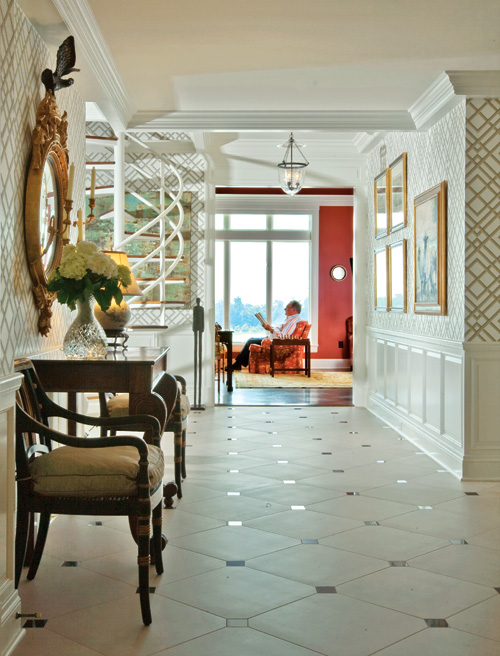
The foyer leads to a library decorated in rich, traditional hues, and a spiral staircase ascends to a small loft.

When Larry Owen first stepped inside the Riverfront Condominiums building behind the Old Post Office, he wasn’t looking to buy. He and his wife, Carol, loved their home in McCutchanville, and Larry merely was fulfilling a promise to a friend in Ohio who was interested in purchasing a condo in Evansville. But as Larry walked through the rooms, “the view just blew me away,” he says.

The prospect of downsizing and moving Downtown grew increasingly attractive to the Owens. Two years ago, when a sixth-floor unit in the Riverfront Condominiums was listed for sale, they purchased it right away. “We just wanted to simplify our lives,” Carol says. Moving into a smaller, two-bedroom condo suited that desire, and the space reflects the Owens’ sense of style: elegant yet comfortable, traditional yet eclectic. Art and antiques decorate the residence, and the pieces are made more dramatic by the backdrop: the Ohio River to the south, Old National Bank’s headquarters and the Riverside Historic District to the east, the Old Post Office to the north, and First Avenue to the west.

The Owens’ journey to Downtown Evansville began in Bloomington, Ind., where they met as Indiana University students. After the couple married 53 years ago, Larry brought Carol, an Evanston, Ill., native, back to his hometown of Evansville. Following the birth of their two sons, Brad and Steve (now grown, married, and living in Evansville with their families), the Owens settled in McCutchanville — most recently living in a spacious French Country-style home.

When they decided to move Downtown, they enlisted the help of numerous local professionals and businesses, including contractor Randy Elpers, who built the couple’s previous home; painter Jerry Loeffler; and cabinet company Fehrenbacher Cabinets. They also left most of their antique collection in the McCutchanville house (now home to their son Brad and his wife Mary-Beth) and teamed with interior designer Tay Ruthenburg, owner of Evaline Karges Interiors, to decorate their new condo. “They both really enjoy searching out things, learning about art, collecting furniture,” Ruthenburg says, “and they do it together. To both be interested is so special.”

“Tay has an eye for making things work,” says Larry, who’s retired from a career in the printing industry. The design sensibility is evident immediately upon entering the Owens’ condo, where a foyer opens to a living room decorated in chocolate brown, ivory, and turquoise. The seating area, with two 19th century French chairs, combines stripes, leaves, and zebra print patterns. Contemporary art decorates the wall above an English antique table. The contrasts, says Ruthenburg, show the Owens aren’t afraid to make a bold statement. “They’re traditional with a twist,” he says. “The twist is some of the things they collect.”[pagebreak]

Case in point: A cabinet above the wet bar in the living room showcases Delft pottery from the Netherlands, Japanese imari plates, and a 16th century statue of a Thai warrior missing his spear. (The Owens found the warrior in Bangkok on a trip for their 50th wedding anniversary.) The couple also collects pieces by Aurora, N.Y.-based MacKenzie-Childs, including a pedestal table base in the kitchen and a picture frame in the small library adjoining their bedroom. The company produces quirky, colorful furniture and home décor often covered in shards of broken pottery and glass.

One of the Owens’ simplest but most cherished pieces is a cognac leather sofa in the den adjacent to the dining room. Soon after they married, Carol ordered the sofa and didn’t tell Larry. She expected delivery to take four to six months, and she planned to save money each week from the couple’s grocery funds to cover the bill. To her surprise, the sofa was finished in one month, and the newlywed panicked. “I have something to tell you,” she nervously told Larry. He laughed when he found out her secret was a sofa, but still, “I’ll die with this sofa,” Carol jokes.

The sofa has been a fixture in the Owens’ lives from the early days of their marriage into the quieter years of their retirement, and their home in the Riverfront Condominiums suits their desire for a simpler life. They love watching Downtown happenings from their windows — from arena construction to the sea of pink at Race for the Cure — and they love the convenience of living Downtown. “It’s 10 minutes to anywhere,” Carol says. “We’re so close to everything.”

On the Rebound

0
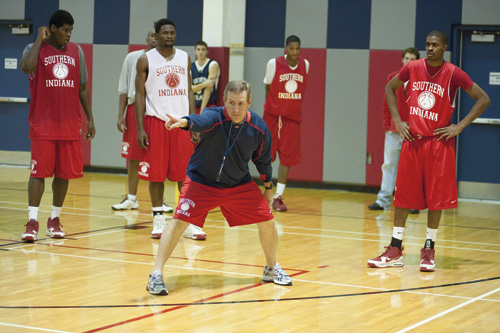
Rodney Watson prepares his team for the 2009-10 season.

In early May 2009, a huge storm moved north from the Gulf of Mexico, knocking out power in southern Illinois and leaving Rodney Watson in a no-contact zone for days. Around the same time, the University of Southern Indiana men’s basketball program began a tumultuous summer when the then-University of Southern Indiana men’s basketball coach, Rick Herdes, resigned in the wake of alleged NCAA rule violations.

“The day the job came open, we lived through an inland hurricane,” says Watson. “I had never lived without electricity before.” Watson was an assistant men’s basketball coach at Southern Illinois University in Carbondale, Ill., 90 minutes from the River City and a rival of University of Evansville basketball. Without power, Watson learned of USI’s woes from his boss, Evansville native and SIU coach Chris Lowery, who told him: “I just got a call from Evansville, and they’re interested in you.”

The feeling was mutual for Watson, but he had to wait for the power to return to replenish his drained cell phone in order to call Jon Mark Hall, USI’s athletic director. “I got the answering machine and didn’t expect a call back because that’s the way it’s been for about 20 years,” Watson says. “Make those calls and no call back.”

In the wake of the storm, Watson’s family loaded into their mini-van searching for gasoline in the southern Illinois countryside when he received a call from Hall. Two weeks later, Watson was at a press conference in Evansville when Hall introduced him as the man who would lead USI through its current difficult circumstances, and as the basketball season launches this November, his efforts mark the beginning of the Watson era.

Watson wasn’t put off by the potential of sanctions from the Great Lakes Valley Conference or the NCAA. “In those situations, I looked at this job, and I had to ask, ‘Where is the ceiling?’” Watson says. “I didn’t know a whole lot about what had gone on. I knew it had an enormously high ceiling.”

When Watson was hired, public knowledge about USI’s violations were (and still are) unclear, but it was the university that reported five infractions to the NCAA, including their academic indiscretions and violations regarding transportation for student-athletes under Herdes and his staff. Then, school officials imposed a punishment: They vacated last season’s wins and repaid money earned by reaching the NCAA Division II Regional tournament.

For Watson, the job had many upsides. “I know this program competes on a national level. The more I got involved, started checking things out, I found that the scholarships are outstanding, the room and board are outstanding, the facilities are outstanding, the school is so strong,” he says. “These jobs are so difficult to come by. Even though there’s a glitch, the reward far outweighs the risk.”

Those rewards also include a history of success: This is a program that’s won 432 games since 1992, been to the NCAA Division II tournament 20 times, and won a Division II national championship once in 1995.

But, the “glitch,” as Watson calls it, is a challenge no other USI coach has faced. A week before basketball practice started in October, the 49-year-old from Paris, Ill., learned the Great Lakes Valley Conference banned USI from postseason tournament play for the 2009-10 academic year. He broke the news to his team in an emotional meeting, but Hall was impressed with how the new coach handled that difficult assignment.

“He told them there will be tougher times than this in your life,” Hall says. “He just has such a positive attitude, and he thinks of the young men first, how it is going to affect them. It would be easy for him to be moping around Evansville, moping around campus, and he’s not. He’s a perfect leader for this kind of unfortunate situation. He’s looking at it as, ‘How do we make the best of this and move forward?’”[pagebreak]

Watson has followed that path throughout his career, one that started at Coulterville (Ill.) High School and then Madison (Ill.) High School with regional and sectional titles before becoming an assistant at the University of Nebraska-Omaha, a Division II program.

He joined SIU under Coach Rich Herrin. From this position, he worked with (current University of Illinois men’s basketball coach) Bruce Weber, (current Purdue University men’s basketball coach) Matt Painter, and Lowery. Watson received ringing endorsements from all three of those coaches, which left an impression with Hall. “The thing that stuck out to me was that a lot of times, almost every time, when there’s a coaching change, the guys coming in don’t keep any of the former staff,” Hall says. “But he stayed with all three, and you’re talking about some of the most respected individuals in the profession. That meant a lot to me. He showed a lot of commitment to the program, and he was somebody I thought we could rally around.”

Watson thought his career as an assistant coach would be his destiny. It wasn’t one he minded. “I was OK with that,” Watson says. “I think about how many coaches, especially at the high school level, deserved to be in the situation I was in more than I did.”

To excel at the new position, he leans on the varied tasks of his assistant coaching position at SIU, a small but extremely successful Division I program, but his new position requires some adjustments. “I never had kept a calendar in my life until I got here,” Watson says. “If I don’t keep a calendar now, you’d be knocking on my door, and I’d be doing something else. Literally, I look at my watch, and it’s noon on Friday. The funny thing is, I thought I was busy when I was an assistant coach.”

His wife, Carol, who still works at Marion Junior High School in Illinois as a guidance counselor, has eased the stress of his increased workload. In just more than a year, she’ll retire with full benefits, but the Watsons couldn’t pass on the opportunity with USI. Before he accepted the job, she knew Watson, who now lives in student housing on campus during the week, would work long hours on the court. The compromise is simple: “She said, ‘You can go to work early and stay as late as you want. Just get home one or two nights a week,’” Watson says.

He travels the 86 miles from Evansville to southern Illinois. When he’s home for the weekend, he devotes his full time to his family, including his youngest children, twin seventh-graders Olivia and Blake. He visits his oldest daughter, Ashley, at the SIU campus, where she performs with the Saluki Shakers dance team, and helps his son Zach, a high school junior, with basketball. “My kids see way more of me than they did the last 13 years,” Watson says. When he’s not spending time with family or focused on basketball, he follows the Chicago Cubs or works in the yard. “I talk to myself when the mower is running,” Watson says. “I can yell at the referees when I’m mowing the lawn, and nobody gets their feelings hurt.”

He’d have more time for his hobbies, too, but as the new coach, he’s out in the community, rebuilding the USI tradition and earning local support from USI alumni and fans. “I have found our community to be extremely gracious, open, and honest about their feelings,” Watson says. “Those three things strike me every time I go somewhere. The loyalty to individuals, to the community, and to our campus is quite impressive.”

So too is the attitude that this lifelong assistant coach has brought to what will be, for at least one season, a difficult situation, but he’s embraced it full speed since that weekend in early May when winds of change blew into his career. After the interviews with USI, he received a call back later that month just as he was headed out to a St. Louis Cardinals baseball game in Missouri with friends. “I was on the phone. They were waiting for me. I told them, ‘I can’t go,’” Watson says. And then they knew. “I’ll trade Cardinal tickets for this job any day.”

Lofts in Translation

0
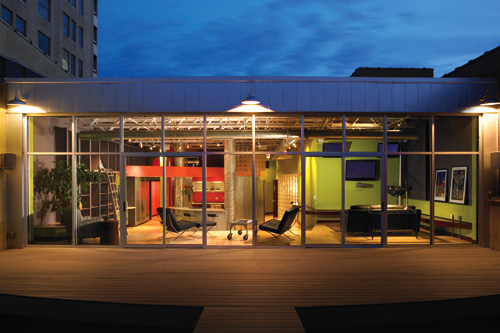
An interior view of the Marlocon penthouse is seen from the front deck, which faces Main Street.

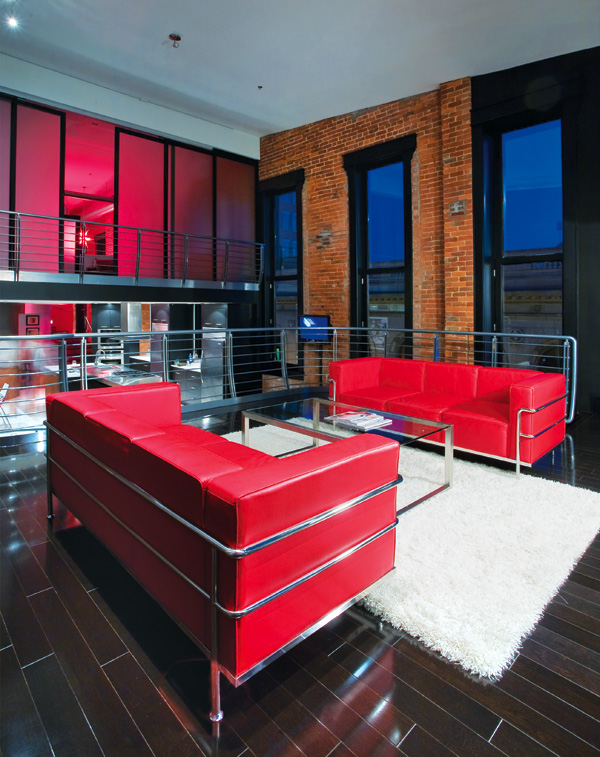
The 2,000-square-foot penthouse, the only condo on the fourth floor (and as of print date, still unsold), shines with personality. The open-ceiling concept exposes metal girders. Shelves line the living-area wall with a stainless-steel, rolling library ladder. A skylight towers above the half bath. (Even on a rainy day, the skylight supplies sufficient lighting for the bathroom.) Batik wood acts as the multi-headed shower’s floor. Pocket doors between rooms allow for more space. The front rooftop area has a raised patio over a rock bed, giving an illusion of a creek.

Mike Martin, whose company Architectural Renovators restores historic homes, developed the five lofts at The Marlocon. The Boonville native, who now lives in a home in the Riverside Historic District, liked the open spaces of loft living and followed the efforts of developers in Chicago and St. Louis. “It made me more interested in that ultra-modern feel of open space and having it in an old building,” Martin says. “You have a mix of old and new together.”

Martin is not alone. In late 2006, after transforming the old J.C. Penney store on Main Street into a 23 unit condo development, The Kunkel Group pumped in nearly $5 million to renovate the former deJong’s building into a 31-condo complex. Before the first construction worker stepped foot on site, nine condos were already sold. With a first floor housing a one-story drug store, John Stratman transformed the second floor of his Main Street building into five loft apartments. Pat Rayburn and Bill Bussing Jr. renovated the former Permanent Federal Building on Third Street, creating 21 condos. In May 2007, Mayor Jonathan Weinzapfel announced the historic McCurdy Hotel will undergo a $7.2 million transformation, turning the then retirement home into an 80-unit, upscale apartment building.

The last time Downtown Evansville saw this much action, Harry S. Truman was president. Turning a slumping Downtown into an economically prosperous area has been a source of debate that is decades old. Even when 42-year-old, Evansville-native Mayor Jonathan Weinzapfel describes his memories of Downtown, he says with a laugh, “Tumbleweeds blowing down Main Street.” Nearly 200 condos and lofts have been built since 2004, and interest in the Downtown is blossoming. Loft developments are proof Downtown living is back, Chuck Harper, vice president of The Kunkel Group says. Has the moment come when years of bar arguments, newspaper rantings, and city council meetings about the dilapidating Downtown end? For these Evansvillians — developers Ben Kunkel, Mike Martin, Pat Rayburn, Bill Bussing Jr., John Stratman, Mayor Jonathan Weinzapfel — they don’t debate how to revitalize. They act. They believe.[pagebreak]

The Mayor
The dwindling Downtown has been a constant concern for the city because visitors’ perceptions of Evansville is linked to the Downtown, Weinzapfel contends. “When people think of Evansville, they’re going to think about the Downtown and its riverfront,” he says. “When you have a decaying Downtown, they are going to think negatively of your community.”

When the Downtown is in need of a big boost, where do you start? Weinzapfel says four areas need improvement: transportation, employment, entertainment, and housing. In March 2008, the state government will accept construction bids for a new interchange at Lloyd Expressway and Fulton Avenue, providing easier access into Downtown. Since 2003, more than 3,000 jobs have boosted the Downtown economy and American General and Berry Plastics are both now expanding, adding 400 new jobs. In December 2006, Casino Aztar opened a new entertainment area, The District, with three new bars: Blush Ultralounge and Tapas Bar, Ri Ra Irish Pub, and Jillian’s Billiards Club. To boost residential housing, the mayor instituted a loft-incentive program in 2004. The city offered a $20,000 grant for loft developers per unit. Developers accepted the incentives. Since then, through various loft programs, the city has provided nearly $2.5 million in grants and loans. That’s translated into $21 million of Downtown housing projects, Weinzapfel says.

The Developers
The Kunkel Group’s Harper, admits constructing their first condominium building “did take a leap of faith.” And Ben Kunkel isn’t sure why 2006 was the time to start their loft development efforts. “We just saw an incredible need for housing Downtown,” he says. “We jumped in and gave people an option.” That option began with the Renaissance on Main, a 24-unit complex that was the former J.C. Penney building, abandoned in 1981. The building had no windows on its perimeter walls, except for the storefront. The condos needed views, however, so The Kunkel Group removed 100 tons of bricks from the exterior walls. “This is what made it financially feasible,” Ben says. “Otherwise, it just would have been 5,000-square-foot condominiums.

“Plus it put a stamp on the period of time that we renovated the building. We didn’t want to go back and just recreate what it looked like when it was built.” Nearly 50 windows later, the facade of the former Penney’s has a new look and incredible views of the Old Courthouse, an 1890 colossal building of 19th century German Baroque architecture.

In February 2007, The Kunkel Group began construction on the Meridian Plaza, a renovation of the building once housed by the former Evansville-based clothing retailer deJong’s. The plans for the building, which included 15,500 square feet of commercial space, is scheduled for completion in the spring of 2008. The Meridian Plaza will usher a new look with a five-story annex tower, topped with a 2,500-square-foot penthouse.

The interior designs for both Kunkel Group projects vary between condos. Open-floor plans include 10-12-foot ceilings with bamboo, slate, and travertine flooring options. Granite countertops shine in the kitchen, highlighted by stainless steel appliances and cherry and maple cabinetry. The bathrooms’ whirlpool or Jacuzzi® tubs are reasons to relax. Ben Kunkel expects construction to be completed by spring 2008.

In 2006, developers Pat Rayburn and W.C. Bud Bussing sold the penthouse of their 21-condo complex before construction began on the former, 43-year-old Permanent Federal Building at Third and Locust Streets. One of the complex’s most alluring features: the 9,000-square-foot rooftop with a spectacular view. The gazebo creates a comfortable resting place between strokes on the roof’s putting greens. The view reveals the bend in the river and stretches southeast to encompass the twin bridges. The condos of The Plaza Downtown display a modern and digital sensibility with Italian and Greek bathroom fixtures, full glass frontages, and pre-wired capabilities for surround-sound systems.[pagebreak]

The Ultra-Modern Developer
Mike Martin’s efforts ignited in 1999, beginning a series of loft projects for the next nine years. His first project was the former Gottam Building (615 Main St.). With 16-foot high ceilings for the second-floor loft apartment, the Gottam, built in 1890, was a mixed-use building with retail space on the first floor. Next, utilizing the mayor’s loft incentive program, Martin tackled a corner building on Third Street, creating two new loft apartments and a rooftop sun-porch. Martin then converted the second floor of Maxine’s Antiques on Main Street into a loft apartment.

“(All of our buildings) stand out in their own way,” Martin says, “because we try to develop not only the interior but the exterior as well.” This is most evident in Martin’s first condo development, The Marlocon, a building vacant for nearly 20 years. Completed in 2007, the four-story building now has five ultra-modern condos (with two still unsold) and two retail spaces on the first floor, including longtime retail stalwart The Rug Merchant on the first level.

With a building this old (more than 100 years), construction plans called for an interior demolition because Martin discovered rotted roof and floor systems caused by water damage throughout the years. Through the renovations, the condos range in size and character. A third-floor condo, for example, has 21-foot high ceilings with a Japanese bath in the mezzanine hallway.

The Entrepreneur
The debate over the decaying Downtown has raged for more than 30 years when the city first prohibited traffic on Main Street between Martin Luther King Jr. Boulevard and Riverside Drive. It was an effort to compete with growing East-Side shopping developments. Their 1971 decision created a Main Street pedestrian mall. Interest in the Downtown slowly trickled away because, as John Stratman, owner of Stratman’s Pharmacy on Main Street said, “People don’t want to walk.” When the Main Street Walkway was opened to cars in 2002, parking for Stratman’s Pharmacy more than tripled, he says.

It was the boost he needed. In 2006, the pharmacy — a convenience and drug store with a restaurant, the Garden Café — continued its growth when John and his son Nick Stratman completed their five loft apartments on the second floor. Exposed brick throughout each apartment, the ambiance feels unique to Evansville, says Stratman’s resident Andrew Michel, a quality that attracted the Evansville native to the Downtown. “It’s a city-feel even though we’re in Evansville,” says Michel, who’s lived in a two-bed unit for more than a year with roommate Alex Clayton. From the 2,500-seat auditorium, The Centre, to the numerous bars down Main Street, his apartment’s proximity to the Downtown nightlife is an added bonus.

And the unique character of each apartment is the main attraction. A glass and brick shower in one unit provides a peaceful experience while a renovated elevator shaft is the perfect reading alcove. Rooftop access offers a grill and a river view.

Downtown Visions
Can you believe in the revitalization of the Downtown, though?

“What you see today is not what you will see five years from now,” Weinzapfel says, “I think the train has left the station, and more change is on the horizon.”

What the Downtown needs now is storefronts bustling, neighbors chatting on the street, restaurant patios filled with patrons, and a grocery packed with all the amenities. The Downtown is more retail-ready now than it’s been in years, Martin says, because of the creation of these mixed-use loft complexes.

It’s a start. He believes.

Presidential Mission

0
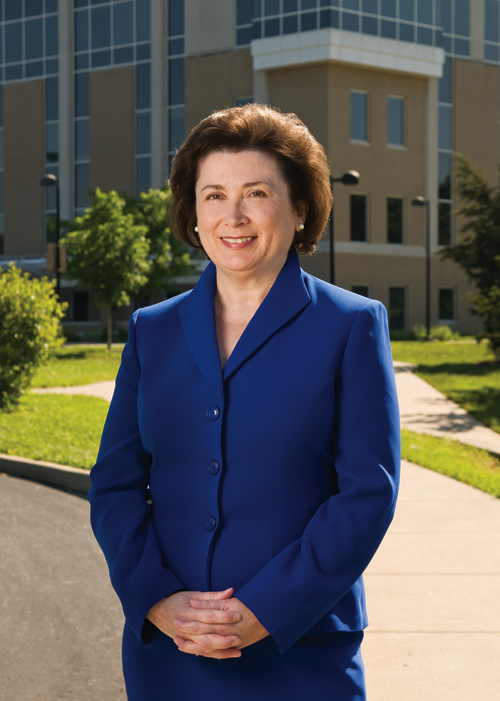
USI President, Linda Bennett

When student leaders joined Linda L. M. Bennett on the University of Southern Indiana campus this April, they learned the new USI president wasn’t just there to answer questions. She was there to listen.

What she heard was the students “want their university to be more visible,” she says. “Our students say more people need to know just how strong a university this is.” The feeling is mutual for Bennett, who enjoyed a similar campus-wide enthusiasm at Northern Kentucky University where she once served as chair of the political science department. When she left NKU in 1999, she mentioned to the dean, “If I ever have a chance to get back to an institution that is young and hungry the way Northern Kentucky was, I would do it.” When a position opened at USI in 2003, he called Bennett: “This is the one.” As she was leaving from her on-campus interview for the role of USI’s provost and vice president for academic affairs — a job she landed — she informed her husband, “If they call, we’re coming.”

What Bennett saw at USI had nothing to do with rankings, she says. She’s never followed school rankings. In 1994, she began her higher education career at Wittenberg University — a liberal arts school in Ohio with a rich 167-year history. When she left there for NKU, a young public university just south of Cincinnati, “I had folks questioning my sanity,” she says. But, “it’s not about the rankings,” she says. “It’s about the quality of what’s happening at the institution, and young institutions always are at the beginning of building that reputation and building that tradition.”

When she officially began as USI’s third president in the school’s history on July 1, she followed a productive predecessor, H. Ray Hoops. His numerous accomplishments include quadrupling the university’s annual operating budget from $22 million to $100 million, constructing $219 million in new or expanded facilities, and growing enrollment by 34 percent to a more diverse student body of 10,000.

While it’s easy to quantify his achievements, Bennett believes Hoops’ strongest asset was his wisdom. To follow his leadership is “a privilege and a bit humbling,” she says. “Dr. Hoops has been a tremendous mentor. He was very helpful in the course of the transition — both in terms of offering advice and, at times, in terms of just saying, ‘You’re on your own.’”

With his encouragement, Bennett looks to the future without forgetting USI’s humble beginnings. “The creation of this university was about serving the region,” she says, “so we were truly ‘of the people.’ We were created with their interests at heart.” One flagship effort for cultural outreach Bennett points to is USI’s stewardship role in New Harmony, which includes a branch of theatrical programs in the small community rich in artful success stories.

To achieve sustained success, she’ll continue to rely on her USI peers. “One of the most rewarding things has been the quality of the teams I’ve been able to work with,” she says. “The vice presidential team here is outstanding.” Even as president, she says, “You never accomplish anything by yourself.”

A New Import

0
Seared ahi tuna entree, pictured with fried rice and crab rangoon.

On occasion, Jayson Munoz sports a chic, leather designer belt. He bought it for a generously discounted price in a small Nashville boutique owned by a friend. The belt is a simple item, but it matches the design sense Munoz showcases in the revamped Kanpai, a longtime Evansville restaurant he bought from Sun Wortman in early 2010. He wears it while working the dining room. He doesn’t force conversation on patrons who clearly came just to eat, but should someone take interest in the menu, he’s delightful and chatty.

Kanpai (4593 Washington Ave.) came to Evansville 14 years ago when longtime local sushi chefs Mitsuko Schafer and Hiromi Adams opened the restaurant. A few years later, Munoz, a St. Louis native, learned of Evansville when his parents, Julie and Ed Munoz, moved to Newburgh when their son was in college. The couple loved Kanpai, and when an opportunity arose to buy the restaurant, they convinced their son to own it with them. With 12 years in the industry, Munoz made chic changes to the founders’ interior. Glow from the modern light fixtures bounces off the hardy green on the restaurant’s walls. The floor is a dark wood, and a stainless steel wall from the open sushi kitchen extends into the dining area.

He also revamped the menu, which feels new but not unfamiliar. The Asian bistro dishes, made with organic vegetables, have international flavor: tempura and sushi from Japan, General Tso’s chicken from China, bulgogi from Korea, and pho soup from Vietnam. The latter was the reason I ate at Kanpai, and Munoz’s version doesn’t disappoint: Inside a large bowl comes thinly sliced steak swimming above a bounty of rice noodles, and jalapenos, bean sprouts, and onions give the piping hot broth flavor. The bulgogi is a Korean staple, and here, the smoky sweet beef comes served atop stir-fried vegetables. The spring rolls, which Evansville Living named the Best Healthy Dish in the 2010 Best Of Awards, now are super-sized, but the dish — sliced beef wrapped in rice paper with shrimp, lettuce, onions, and cilantro — still makes a light appetizer despite the expansive size.

Just as varied as the culinary dishes is the beer menu. Munoz began in the restaurant industry at age 16. For the Macaroni Grill, he worked in the human resources department with a former head chef at Asian restaurants (Munoz credits this relationship for inspiring new recipes offered at Kanpai), and in Clarksville, Tenn., he managed an Old Chicago, a chain known for its 110-beer menu. Munoz’s list at Kanpai runs about 40 deep and changes as often as the seasons. This fall, expect nut brown ales or amber beers such as Schlafly’s Pumpkin Ale, a deep reddish amber spiced with cinnamon, clove, and nutmeg and made with pumpkin and butternut squash. Munoz has wine — but no wine list. This conundrum comes from his desire to rotate the wine selection. This is not the restaurant to pair wine with meals, but for wine at $15 a bottle and $8 every Wednesday offered as a ladies’ night special, it is the restaurant to find good wine at an inexpensive price.

Ladies’ night also brings live music. Munoz — a former resident of Nashville, a city with a big music scene — invites in acts from the nearby Southern city. “If you live in Nashville for long enough,” Munoz says, “you know everybody sings, everybody plays, everybody writes.” One monthly performer is Josh Doyle, who was one of Rolling Stone magazine’s best guitarists of all time when he played in the rock band the Dum Dums years ago. The United Kingdom native, as he admits in an interview on his website, “kind of went crazy” and decided “to sell all my possessions” and move to Nashville. (His wife is American.) Because of the proximity to Nashville, Doyle, who tours throughout the country and records albums, comes to Evansville and plays an acoustic set of original songs in the corner at Kanpai. “He does it more because he is a friend of mine,” Munoz says, “and he’s helping my dream.”

Within sight of the bistro is the upscale casual restaurant Lorenzo’s Bistro & Bakery (972 S. Hebron Ave.), a welcomed neighbor for Munoz, who loves locally owned restaurants. He’s confident that Evansville customers can create a loyal following for such establishments. “In any other market I’ve been in,” he says, “the power of word of mouth never has worked as well as it has in Evansville.”

Location: 4593 Washington Ave.  •  Phone: 812-471-7076
Hours: 11 a.m.-10 p.m. Mon.-Fri., 3-10 p.m. Sat. Closed Sun.
Adult Beverages: Yes  •  Prices: Average lunch is $5-$10; average dinner is $10-$15
Reservations: Yes
  •  Payment: Major credit cards accepted

Our New Clothes

0
URBAN CRAWL: Does this alley lead to ghost town or party city?

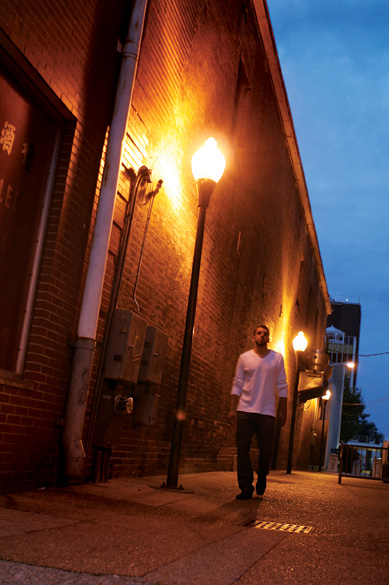
After a Saturday night at Downtown bars, my girlfriend and I almost are to my apartment. We just need to cross Main Street. An easy mission — except here’s a shirtless middle-aged man clad only in cut-off jean shorts straddling a stone lion across from the Peephole Bar & Grill. He has my girlfriend nervous, and if I were brave enough to look him in the eye, I’d share her concern. He gawks at patrons leaving the bar, so we do what nervous people do when confronted with an awkward situation: We look over our shoulders and walk hurriedly until we have put a comfortable head-start between us and the would-be attacker. We were paranoid but fine. We walked to my apartment, and for all I know, the man headed to Stephan G. Sanders Custom Clothiers to buy a shirt and a decent pair of pants.

Stories like this often are told about the Downtown. I’ve lived and worked in that area for years, and encounters with crazy kooks, crazy drunks, and the just plain crazy are rare. These stories are told more than anecdotes on the daily humdrum that is my life Downtown because tales of lion-riding men — along with the convenience of living close to work, bars, restaurants, and entertainment venues — are reasons to live here. But, the crazy stories don’t define Downtown.

The casino, Riverfront, and loft developments give meaning to the Downtown, and with the current construction of the stadium, talk abounds about what the area will become. Unlike the unwavering definitions in the Merriam-Webster Dictionary, the definition of Downtown fluctuates depending on the source (more like Wikipedia).

What also appears to fluctuate: Downtown complaints. In the last few months, news reports proliferated about traffic and loud noise, and when I heard those two grievances, I thought, “Burkhardt Road is a beast.” Then I learned these were problems Downtown.

Two years ago I wrote a story about the influx of loft projects, and when I asked Mayor Jonathan Weinzapfel, an Evansville native, his memories of Downtown, he replied, “Tumbleweeds blowing down Main Street.” Now, it’s gone from ghost town to party city.

I’ve watched great improvements made Downtown: Patrons socializing at the renovated Peephole park up Main Street between Second and Third streets almost nightly, and Ri Ra Irish Pub on Riverside Drive has a deejay who attracts 20-somethings on weekends. I know this too well. I live a few buildings from the Peephole, and I’d love to be able to park on Main Street after work. Ri Ra — filled with bar tops imported from across the Atlantic — was my favorite hangout until American dance beats replaced Irish authenticity.

Traffic and loud noise? This is progress. I’d like to park on Main Street, but when I can’t, I’m glad my neighbors are making money. I’d like to go to Ri Ra and have an Irish experience, but when I can’t, I’m glad customers fill the two-story bar — shoulder to shoulder — enjoying themselves under the multicolored lights on the dance floor.I strive to think positively about any achievement because when Downtown dwellers look around, they still see so much need for improvements: buildings slowly crumbling after years of abandonment; black awnings (the remnants of a failed 1980s Downtown revitalization project) cracked, rusted, and overgrown with weeds; and, dang, that man needing a shirt. With lofts, a stadium, and an entertainment district, those changes will follow, and for now, I’m stuck in the middle of a story the next generation won’t believe because they’ll only know of a prosperous Downtown.

Mom’s Recipe

0

One Thanksgiving in the mid-1990s, Larry “Bubbles” Pollock’s mother whipped up a three-layer dessert topped with whipped cream. Bubbles loved it and asked for the recipe to serve in his restaurant, The Pub (1348 E. Division St.).

Fifteen years later, the sweet dessert, known as the Pumpkin Delight, still is a perennial favorite for Pub-goers. On a foundation of buttery-sweet graham crackers rests a dense, velvety cream cheese. The title layer is spongy with flecks of dark brown throughout the giveaway orange pumpkin. A spicy, almost liquor-like flavor adds a dimension to the bite. When topped with whipped cream, the overall effect of the chilled dessert is light.

In the fall, The Pub sells around 70 whole-sized pans of Pumpkin Delight ($4 a slice) for customers to take home to their families, but it’s available year-round. “It’s just yummy,” Bubbles says. “It doesn’t make any difference what time of year it is.” Below, he shares the recipe with readers.
   
Crust:
1 1/2 cup graham cracker crumbs
1/3 cup sugar
1/2 cup butter
Mix these ingredients and spread in a 9×13” pan for crust.

First Layer:
2 eggs
3/4 cup sugar
8 ounces Philadelphia cream cheese
1/2 cup milk
Mix these and pour over the crust. Bake for 20 minutes at 350 degrees.

Second Layer:
2 cups pumpkin
3 egg yolks
1/2 cup sugar
1/2 cup milk
1/2 teaspoon salt
1/2 tablespoon cinnamon
Cook these until thickened.
1 envelope plain gelatin
1/4 cup cold water

Dissolve the gelatin. Beat three egg whites with 1/2 cup of sugar until they’re fluffy. Add gelatin to pumpkin. Add pumpkin to egg whites and fold. Spread on top of cream cheese mixture and refrigerate.

Hometown Gyro

0

Housed in a former Lee’s Famous Recipe Chicken joint on Lincoln Avenue, Manna Mediterranean Grill still carries a few trappings of the building’s fast-food past: Diners order and pay at the counter, drink from Styrofoam cups, and carry their meals on plastic trays. But a restaurant’s atmosphere doesn’t define its food, and since opening their Mediterranean eatery last summer, owners Amjad and Kristi Manna have crafted a menu that’s unfailingly fresh.

When the Newburgh couple searched for a place to buy gyro meat, nearby options just weren’t good enough, says Amjad, who credits his uncle Raffi Manna (owner of Raffi’s Restaurant on Burkhardt Road) for teaching him how to succeed in the business. So the Mannas turned to a Chicago vendor that provides “more tender meat and better quality of meat itself,” says Amjad. The meat also is halal, or acceptable under Islamic dietary laws. That’s crucial for much of the restaurant’s clientele, Amjad says, including local Muslims and international students attending the University of Evansville.

The lamb and beef gyro plate ($9.95) features slices of gyro meat layered atop a fragrant bed of aromatic basmati rice, tinted yellow from turmeric and other seasonings. The meat is tender but not greasy, and delicately charred edges add a contrast of crispness. The entree also comes with a choice of salad (I tried the Mediterranean salad: romaine lettuce, chopped tomatoes, and cucumbers with a dressing of lemon juice, olive oil, and salt), pita bread, and tangy tzatziki sauce, a blend of yogurt and cucumber made in-house.

Like the rest of the menu, the items on the gyro plate don’t contain preservatives or come from cans, says Amjad. Fast food, this isn’t. Instead, he says, “we’re trying to be the neighborhood restaurant.”

Fun with Fiddlers

0

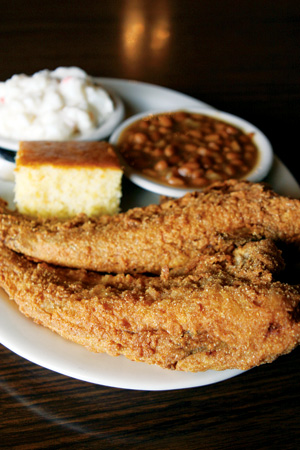
My goal was to eat eight catfish fiddlers in one sitting. The arena for such an undertaking was KT’s Fire Grill in Wadesville, Ind., where weekends kick off at 4:30 p.m. for “All U Can Eat Catfish Fiddler Friday” ($9.95). The final tally was (mostly) three, and a fourth fiddler sat on my plate taunting me.

One patron boasted to owners Keith and Teri Kelley he could eat 40 fiddlers for dinner. His final tally: eight. Don’t laugh. These are honking fiddlers, and every Friday, the Kelleys serve an average of 160 catfish to a packed house.

The fiddler entree sits on a menu highlighted with meaty meals, including numerous smoked plates with rich hickory and apple wood flavors, in a restaurant best known for steaks and prime ribs. The recipe, which the Kelleys keep secret, came by accident. A former cook “just started throwing stuff in the batter,” Teri says. What luck because the fiddlers’ moist and tender meat has a wonderful cornmeal, flaky crust that doesn’t seem like an accident. “Everybody loved it,” she says, “so we just stuck with it.”
 

Chew On this

0

American Pit Bosses (1113 E. Riverside Drive) has opened with a menu of what co-operator Mandy Crabtree calls “Indiana-style barbecue.” That style comes from co-operator Donald Osborne’s grandfather. “Everybody loves Grandpa’s barbecue,” Crabtree says. “We couldn’t wait for summer picnics when he would make it.” While they smoke meat, a dry rub is added until right before completion when a wet sauce is added. … Food with Flair (112 Martin Luther King Jr. Blvd.) has opened in the former WHVI radio station. Owners John and Kim Daleiden hope to bring in business from the Downtown arena crowd. The restaurant’s menu combines Asian, American, Mexican, and Italian recipes, including the Sardinia pasta. After living in Italy, Paul Krack, director of kitchen operations, brought the sauce back to Evansville: Italian sausage, tomato, garlic, fennel seed, red crushed pepper, bay leaf, and parsley. … Expected to open this fall is a new, 200-seat Roca Bar North Restaurant. The joint collaboration from Michael and Piper Conati, Randy and Andrea Sheffer, and Vernon and Jennifer Stevens comes from the original pizza joint on the South Side. “We are focused on keeping with the tradition of the original Roca Bar Restaurant on Kentucky Avenue,” says Vernon Stevens. The story of success, he says, is “one we want to emulate.”

Nibbles:

Archie and Clyde’s Restaurant & Bar (8309 Bell Oaks Drive, Newburgh) no longer is partnered with Roca Bar Pizza. Owned by Danny and Dianne Bradley and Ted and Anne Holderbaugh, the new pizza sauce now is “thinner and sweeter,” says Danny. The owners rely on a menu honed in Danny’s Deli, a restaurant Danny owned in Newburgh from 1981 to 1996. One addition to Archie and Clyde’s menu: Danny’s gyros. …In Mount Vernon, Ind., the Roca Bar now is Boogie’s Pizza (506 E. Fourth St., Mount Vernon). Owned by Dennis and Diana Uebelhack and managed by their daughter Erika Schmitt, the name comes from Schmitt’s baby nickname, “Boogie,” earned by her wiggling — almost dancing — diaper when she crawled. The menu includes pizza, sandwiches, pasta, soups, and desserts.  … Angelo Jawabreh opened his remodeled, 100-seat banquet hall, the Gondola Room, in the late summer. The new expansion is for large groups, and on the weekends, he’ll open it for nightly patrons of his Downtown Italian restaurant Angelo’s (305 Main St.).

Dearly Departed:

Tootie’s (3 Market St., Newburgh), Taste … A Wine and Dessert House (323 Main St.), and Firefly Southern Grill (6636 Logan Drive) have closed.

Margaret McMullan

0

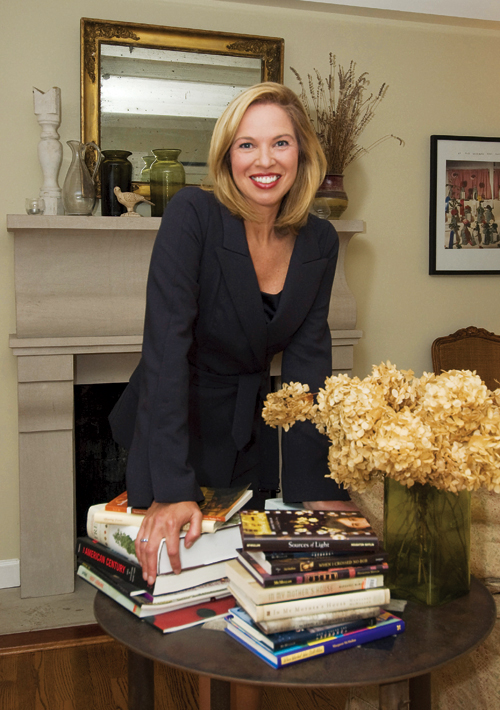
Years ago, in a high school in Jackson, Miss., Margaret McMullan’s sister ran for school president. She gave a speech that riveted students and teachers. Impressed, McMullan’s seventh grade English teacher told McMullan she would never write as well as her older sister. McMullan’s secret: She had penned her sister’s speech. From that moment, McMullan knew she wanted to be a writer. Six award-winning novels later, McMullan, a University of Evansville English professor, shows how wrong her former teacher was. She also has written for Glamour, The Indianapolis Star, the Chicago Tribune, and National Geographic for Kids — to name a few. Did we mention her teacher was wrong?

Sources of Light, her latest book, joins The Help by Kathryn Stockett as a piece for One Book/One Community, a community program bringing together readers throughout the Tri-State to share their experiences reading the same book during October culminating with a visit from Stockett on Nov. 4. McMullan’s novel is the young adult companion piece, and each author explores race relations in the South during the 1960s. The topic is close to home for McMullan, a Newton, Miss., native who lives in Evansville with her husband, Pat O’Connor, and their son, James. “Race issues are in the history of our state,” McMullan says, “and they also reflect the history of our nation. I still think it’s one of the biggest issues today.”

— McMullan and her husband Pat O’Connor once were contributors to Evansville Living. Find their archived “He Said, She Said” columns.

When did you know you could be a writer?
I had a wonderful high school teacher named Alva Lowey. She was from Alabama, and we connected when I took her class at Lake Forest High School in Lake Forest, Ill., a northern suburb of Chicago. She gave these great assignments, and she typed out all of her responses and comments. She was a very wise, dignified older woman, and she was very professional. She would not allow me to get overly sentimental about missing Mississippi. She submitted my short story, “Bees,” to a contest sponsored by Scholastic Magazines. It won. I got a gold pen and Mrs. Lowey’s approval. I was hooked.

Sources of Light deals with race relations in the South during the civil rights movement. Why does this book feel so relevant today?
The legal issues for the civil rights movement have been settled; however, the sociological, educational, and economic issues remain with us, and are, in many ways, more difficult to sort out.

I think it’s important to all of us that we understand all the sides to any issue. Most issues in life that people feel deeply about are not clear-cut. There are so many gray areas, and those gray areas interest me the most, as a writer and as a human being. It worries me when some people are so sure of their own opinions or their own brilliance.

Did you ever expect you’d write novels for young adults?
Writing for young adults was a happy accident. I wrote How I Found the Strong, which my agent sold in a week. When she told me she sold it as a young adult novel, she had to explain to me what a young adult novel was. Then, she immediately told me to forget what she said. She told me not to think about categories when I write because what the editors liked so much about the book was that I didn’t condescend to the reader. It was great advice. Just tell the story in the best way you know how. Take the reader through the experience. It’s the same advice (American author) Eudora Welty gave, and it’s what I constantly tell my students.

What separates good writing from bad writing?
Vivid scenes and great sentences go a long way. Most good writing is just mechanics. I happen to be a big fan of complete and clear sentences. Careful word choice, punctuation, and syntax show a real craftsman at work. And it’s not that a sentence has to be fancy or long. There’s nothing wrong with a short, well-placed, subject-verb sentence. “Jesus wept” packs a lot of punch.

That said, if the story is riveting, the reader might forgive a host of mechanical sins.

This fall semester, you’ll be a Fulbright professor of English at the University of Pécs in Pécs, Hungary. Founded in 1367, it is Hungary’s oldest university. What do you hope you take away from the experience?
My mother’s family, the Engel de Janosis, originally is from Pécs, beginning about 1820. I’ll be researching two particular family members for a new book. I was both surprised and thrilled to discover that one of the family’s estates is still there. My son James also will be conducting his own research into his family’s history. The take-aways from this experience are endless.

Power of the Pen

0

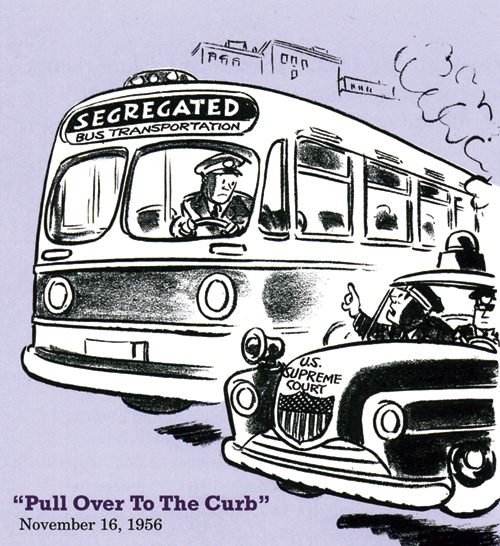
In 1929, a young Chicago man named Herbert Block dropped out of college to take a job at the now-defunct Chicago Daily News. The 19-year-old editorial cartoonist needed a catchy pen name, suggested his father, and “Herblock” was born. Soon, his cartoons were syndicated across the nation, and Block would go on to win four Pulitzer Prizes, spend more than half a century working at The Washington Post, and skyrocket to fame for his razor-sharp take on domestic and foreign affairs.

Block died in 2001, but his work has been immortalized through exhibitions in the National Portrait Gallery and the Library of Congress — and the Evansville African American Museum. Through Oct. 2, the local museum hosts “The Long March,” a civil rights movement-themed exhibition of Block’s cartoons. The exhibit, on loan from the Herb Block Foundation in Washington, D.C., consists of a series of eight-foot panels that combine historical information with Block’s interpretations. 

Block was a white man, but he was a firm believer in equal rights for all Americans — a belief that he credited to his parents. One of the cartoons on display at the Evansville African American Museum shows two scowling white physicians scrutinizing a black doctor. The piece reads, “Sorry, but you have an incurable skin condition.”

According to the Library of Congress, the cartoon was Block’s pointed response to the exclusion of black doctors from medical facilities — an injustice that once was pervasive. “He was the kind of individual,” says Ron Lyles, docent trainer at the Evansville African American Museum, “who took on causes with courage and conviction.”

Circus Act

0

When the fledgling Evansville Philharmonic Orchestra took the stage in a former YWCA building in 1934, they played classical music. The concept was not revolutionary, but the informal group of musicians proved Evansville was ready for a professional series. What was absent from the performance: flying acrobatics. This year, those acrobats take the EPO to new heights, and that’s the difference 76 years of concerts make.

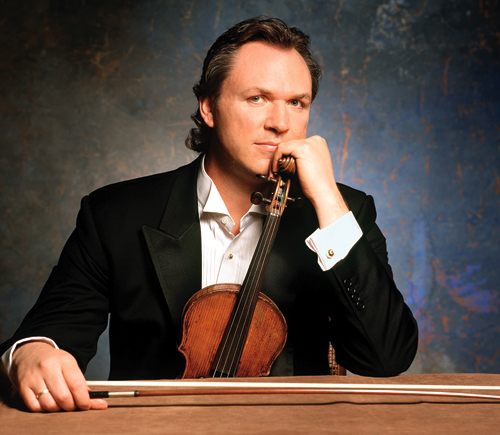
When the new EPO season opens Sept. 11, 80 orchestra members bring a night of American music (such as George Gershwin’s “An American in Paris”), and guest musician Mark O’Connor, a violinist renowned in America’s aural folk tradition, joins the performance. Two months later, music from Russian composers makes the night (Nov. 13). Then comes “Heavenly Mozart” (Jan. 22) — an evening of music from the 18th century composer. And so goes the beginning of the classics season with the theme, “Out of This World.”

In spring 2011, Cirque de la Symphonie acrobats join the EPO at the Victory Theatre for two nights (April 9-10). Eight entertainers from the French Canadian troupe, which performs in nearly 300 cities a year, bring a show Alfred Savia, the EPO’s conductor, expects to wow the audience. “We’re combining wonderful circus artists with challenging repertoire for the orchestra,” Savia says. “This show is totally different from anything we’ve done before.” If you expect Savia to join the high-flying circus performers in a stunt, Carrie Marrett, EPO’s director of marketing, hasn’t ruled it out: “Anything can happen.”

Throwing Punches

0

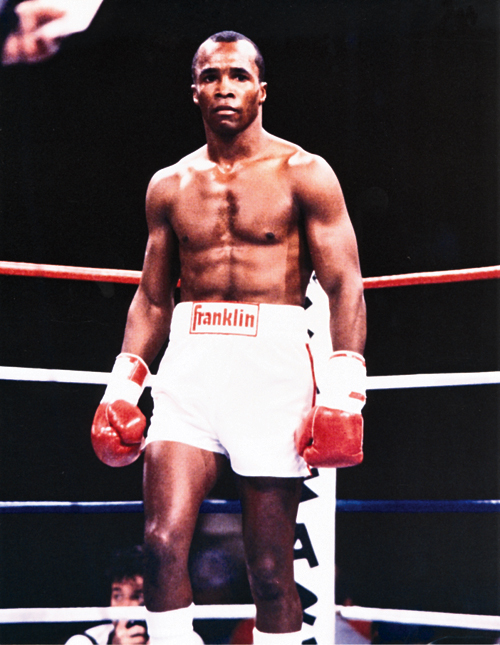
The last time boxing great Sugar Ray Leonard fought in the ring, he lost after a storied career with one Olympic gold medal, boxing titles in five weight divisions, and numerous retirements and comebacks.

That was 1997, and on Sept. 11, Leonard wants a different result when he returns to the ring — or near it — to fight prostate cancer in Evansville at “A Knock Out Night for Men with Sugar Ray Leonard.” His mission: raise awareness for the second most common cancer in American men, according to the American Cancer Society.

“One of the reasons that Sugar Ray Leonard was such a beloved figure,” wrote Yahoo Sports reporter Kevin Iole, “was that beneath the glitz and glamour, he was a hard-nosed, scrappy fighter.” Leonard, who is not a prostate cancer survivor, uses that attitude when supporting numerous causes, and he believes prostate cancer is an important battle: African-American men have a greater risk of being diagnosed than any other ethnic group. His speech, “POWER to Win,” addresses that issue and more.

Leonard isn’t the first big name to speak at this annual event — organized by the radiation centers of Evansville Cancer Center, Deaconess Chancellor Center, and Therapy Associates — that has a history of bringing celebrities to the Tri-State. (Charlie Daniels, a country music legend and prostate cancer survivor, attended last year’s event.) After Leonard’s speech, officers and firefighters from the Evansville Police and Fire Department hit the boxing ring — and each other — for three bouts. Inspiration for the friendly competition comes from the annual Guns & Hoses fundraising event. Their help is vital: Leonard may have knocked out numerous boxers by himself, but when the opponent is prostate cancer, he needs a community of support to land the final blow.

Open Doors

0

In the early morning hours of Sept. 14, 2001, on a quiet Lincoln Avenue street corner, an Evansville man rammed his car into the Islamic Center. He later told police that his actions symbolized retaliation against the Sept. 11 terrorist attacks, which killed nearly 3,000 people.

No members of the local mosque were injured, but the incident was a painful reminder that although the Sept. 11 tragedies occurred hundreds of miles away, the backlash against Muslims was happening in Evansville. But the 200 Tri-State families who belong to the Islamic Center didn’t retreat in fear. “After Sept. 11, there was so much negative press about Islam,” says Bushra Saqib, a native of Pakistan who lives in Carmi, Ill. “We wanted to do something positive that would be good for us and for the community.”

In 2002, the Islamic Center opened its doors for the first annual International Food Festival. The event features mostly Indian and Middle Eastern dishes, including biryani (a chicken and rice dish), falafel (ground chickpeas formed into patties and fried), hummus, and baklava. In a small bazaar near the food booths, artists paint henna designs and write visitors’ names in Arabic calligraphy, and members offer free English translations of the Quran.

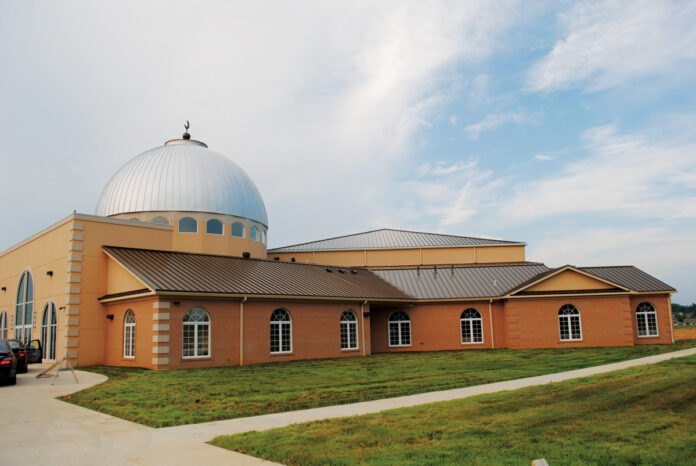
Serving the poor is one of the five pillars, or core values, of Islam, and the Islamic Center donates festival proceeds to the Tri-State Food Bank. Saqib estimates the event has raised more than $15,000 for the nonprofit, and the total will grow at this year’s festival (Oct. 3), when Islamic Center members welcome visitors to their majestic new building in Newburgh. “We’re really proud of it,” Saqib says. “We think it’s beautiful.”

Stringing Along

0
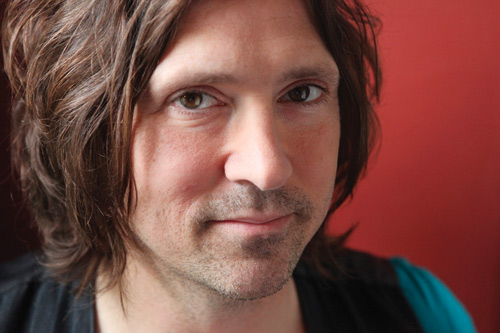
Will Kimbrough (above), John Flynn, Sarah Siskind, and the Rachael Davis Band are signed on for the Ferdinand Folk Festival.

Depending on which music lover you ask, the definition of folk music varies. Is it a centuries-old tune passed down through the rolling hills and small towns of Appalachia? A pacifist’s fervent response to the Vietnam War? A guitarist’s solo acoustic performance at a coffee shop?

Whatever the definition, the earnest, down-to-earth sound of folk music feels right at home in places like Ferdinand, Ind. On Sept. 18, the rural town of 2,300 residents takes its place on the national music scene when it welcomes folk musicians John Flynn, Sarah Siskind, Will Kimbrough, and the Rachael Davis Band for the first annual Ferdinand Folk Festival.

The event is part of a 10-year strategic plan to increase the artistic and cultural opportunities in Ferdinand, says Marc Steczyk, Ferdinand’s town manager. “We’ve made baby steps in the form of community movie nights,” he says, “but we’ve been trying to find a way to make a bigger impact.”

The idea of a folk festival with nationally acclaimed artists seemed to strike the right note. When the festival committee began forming the musical lineup, they wanted to disprove the stereotypes that plague the genre of folk music: that folk musicians wear flowers in their hair and refuse to shave; that they’re rabble-rousing protesters who wield acoustic guitars like axes. Instead, to make the festival appropriate for young patrons, they opted for a lineup with a clean-cut image. (Bull Island, this isn’t.) “The artists that we have,” says Steczyk, “are more of an Americana style of music.”

One performer signed on is Will Kimbrough, who co-wrote four songs for Jimmy Buffett’s 2009 album Buffett Hotel. Five years earlier, the guitar ace was named Instrumentalist of the Year by the Americana Music Association. In winning the title, Kimbrough ousted defending champ Jerry Douglas, a renowned Dobro player and a member of bluegrass group Alison Krauss and Union Station.

Steczyk turned to the Nashville-based Kimbrough for suggestions of other artists. “We asked him, ‘If we had this dollar amount, Will, who do you think we could get to come out of Nashville?’” Steczyk recalls. “One of his first suggestions was Sarah Siskind.”

Siskind’s music has been covered and recorded by the likes of Alison Krauss and Bon Iver. When she performed on NPR last summer, the awestruck reviewer Stephen Thompson called one song “so wrenching, so infused with wounded grace, that it’s essentially untouchable.” Likewise, when Steczyk first listened to Siskind’s wistful single “Falling Stars,” “it was one of those songs that the first time you hear it,” he says, “you know you’re going to spend the next three to four weeks just listening to that song, over and over.”

The Ferdinand Folk Festival kicks off at noon Sept. 18 (that’s Eastern Standard Time, Evansvillians) at 18th Street Park. The free event also includes art booths, pottery demonstrations, nature walks, a songwriters’ workshop, a “jam tent” for musicians, a children’s concert, and more. To see a schedule of events and learn more about the music lineup, visit www.ferdinandfolkfestival.com or see our Guide.

Crown Jewels

0

As the air cools and the leaves change colors, summer’s bright shades deepen to muted jewel tones: rich purples, cool blues, and bold teals inspired by precious gemstones.


Path to Preservation

0

“In its heyday, Washington Avenue was a grand residential corridor. It was a gateway into our city.”
— Dennis Au, Evansville historic preservation officer, “Withering Heights,” Evansville Living, May/June 2007

“There was a lot of preservation activity in the mid to late ’70s, because things had finally gotten to the point where it was either going to get better or it was going to get worse in a hurry. They were probably fearful in the way that a lot of Evansvillians are fearful today that Washington Avenue is in trouble.”
— Dr. Tim Crowley, former Evansville Preservation Commission member, “Price of Preservation,” Evansville Living, March/April 2002

“It’s going to take people who are willing to invest in the neighborhood again. We’ll be there to help, but we need partners in this project.”
–Mayor Jonathan Weinzapfel, “Withering Heights,” Evansville Living, May/June 2007

Not long ago, the vacant house at 620 Washington Ave. was on the verge of heading to the landfill — a once-grand Colonial Revival home chopped into five apartments and crumbling into ruin. Thanks to a creative partnership and this magazine’s ongoing interest in historic preservation, the meticulously restored house opens Sept. 17 as Evansville Living’s first Downtown Idea Home.

While the 2010 Idea Home is the fifth show home produced by Evansville Living, previous homes featured new constructions in suburban developments. At the suggestion of Mayor Jonathan Weinzapfel and with encouragement from local preservation supporters, we instead agreed to seek a Downtown landmark as the Idea Home. Indiana Landmarks’ southwest field office director, Stewart Sebree, toured us through 620 Washington Ave. (flashlights on and noses held) and offered it up as the perfect candidate.

A collaborative partnership of Tucker Publishing Group, the City of Evansville, Indiana Landmarks, and the Junior League of Evansville was formed to tackle the daunting rehabilitation. Visitors to the Idea Home will tour a showcase for cost- and energy-efficient renovation and a model for rehabilitation in Evansville’s Washington Avenue Historic District. Since 2007, the corridor has been on Indiana Landmarks’ 10 Most Endangered list, threatened by demolitions and inappropriate remodeling of its grand homes from the late 19th and early 20th centuries.

Though most interior features were destroyed when the home was divided into multiple apartments, an Arts and Crafts stairway and Rookwood fireplace remain. The renovation relied heavily on donated and salvaged materials, including a slab of granite salvaged from the old Press Box building on Main Street, demolished to make way for the new arena. Contractor Architectural Renovators led the restoration, with consultation from Sebree. Fifth Third Bank stepped up immediately to serve as the 2010 Idea Home presenting sponsor.

The home, returned to a single-family dwelling, boasts high-efficiency systems and appliances and an interior transformed by Idea Home sponsors, accenting the home’s historic character and 21st-century amenities.

I invite you to come on Downtown! Tickets for the Sept. 17 Evansville Living Downtown Idea Home preview party are $50 and can be purchased online, as can $10 tickets for the tours, offered Sept. 18-26. Proceeds from the tours benefit Indiana Landmarks’ mission to revitalize communities, reconnect to our heritage, and save meaningful places.

As always, I look forward to hearing from you.

Sincerely,
Kristen K Tucker
Kristen K. Tucker
Publisher & Editor

Who are the Southern Indiana Paranormal Investigators?

0

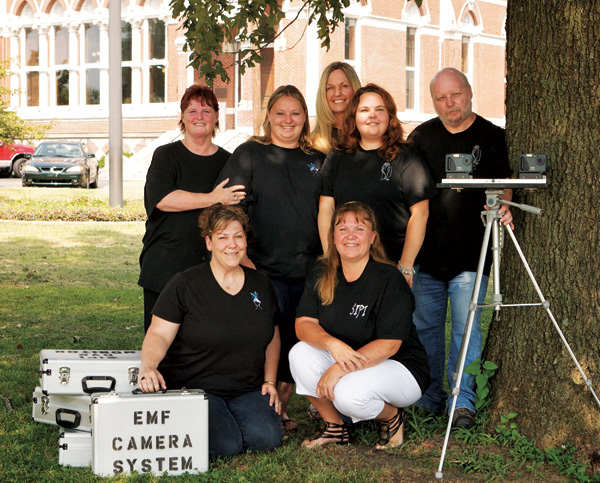
When Billy Miller was nine years old, his parents left the care of their only son in the hands of his two older sisters. As the siblings played on the porch of the more than 150-year-old Indiana farmhouse, Miller heard a crack inside. Through the large window in the front door, Miller saw a young woman — “as solid as we are,” he says — in a white dress walking down the steps of the empty house. When she reached the bottom, she vanished: an apparition, Miller believes, of a woman he later learned had died in the house after she fell down the stairs and broke her neck. That moment instilled Miller’s curiosity about the paranormal, and in 2000, he launched the Newburgh-based Southern Indiana Paranormal Investigators.

Ten years later, Miller, who has had numerous careers including an EMS first responder, has assembled a 15-member bunch of psychiatrists, nurses, and hospital workers who share a fascination with the paranormal. The team members, holding titles such as equipment tech and electronic voice phenomena specialist, use a smorgasbord of high-tech equipment found in electronics stores
to investigate the great beyond.

They rig several cameras throughout rumored haunting grounds — in private homes, businesses, historic sites, and public facilities locally and nationally. Stainless steel temperature probes, motion sensors, and several other devices assist a computer-based system that detects physical changes in the environment such as unusual elevations of electromagnetic energy and fluctuations in temperature. Paranormal investigators believe abnormal spikes in these readings point to possible paranormal activity, alerting Miller’s team to take still photos.

This Halloween weekend, they’ll perform a three-day investigation at the Willard Carpenter House. Completed in 1849, the building — once home to Evansville philanthropist Willard Carpenter and now the offices of local public radio and television station WNIN — long has been rumored as haunted grounds. The group’s work isn’t busting ghosts or banishing apparitions, though. Most people who ask for an investigation, he says, want assurance they’re not crazy. Miller encourages those who co-inhabit a space with apparitions learn to live with them.

To follow Miller’s findings on the Willard Carpenter House, visit his blog, millersspooks.blogspot.com.

Behind the Scenes

0
Stephen Plunkett performs in Shanklin Theatre’s 2001 production of the musical Jekyll & Hyde.

On a quiet city block on Evansville’s East Side, 750 miles from the bright lights of Broadway, lies a renowned training ground for actors, stage managers, set and lighting designers, and other ingénues hoping to break into the theater business. Despite its unassuming Midwestern locale, the University of Evansville’s theater department has earned high praise: Its students have been invited to perform at Washington, D.C.’s John F. Kennedy Center for the Performing Arts more often than any other school in the nation, and the department has participated in the Kennedy Center’s American College Theatre Festival program since its inception in 1968.

UE’s 2010-11 theater season opens Sept. 24 with Stephen Sondheim’s Assassins, a musical glimpse into the minds and motives of history’s most notorious killers. For tickets, call 812-488-2031; for more information, visit theatre.evansville.edu or see our Guide.

The Cast
Every year, theater faculty members interview more than 1,700 prospective students with a goal of inviting 40 to join the freshman class. This year’s theater department includes 154 students from 29 states and South Korea. Nearly one in four students hail from Texas.

The Stage
In a traditional proscenium theater, the audience directly faces the stage. The 482-seat Shanklin Theatre at UE features a thrust stage design, which extends into the audience on three sides to “create a more intimate connection with the performer,” says John David Lutz, director of UE’s theater department and a professor of acting and directing. Before Shanklin Theatre opened in 1966, UE used thrust staging in the East Classroom Building: a wartime, prefabricated venue used for performances in the early 1960s.

The Improv
In live theater, there are no second takes. Errors aren’t encouraged, but the most notorious blunders go down in good-natured infamy among students and faculty. “In recent memory, I guess the one mistake that stands out is during our 2003 production of Othello,” Lutz says. “The actor playing Othello couldn’t reach his knife to stab himself, so he broke his own neck. The problem was that he had more lines to say after that choice was made.”

The Stars
Countless UE alumni work on stage or behind the scenes in theater, TV, and film. They include Crista Flanagan, who plays Lois on the Emmy-nominated Mad Men; Jack McBrayer, a cheerful studio page on NBC’s hit sitcom 30 Rock; and Rutina Wesley, a spirited bartender on HBO’s True Blood.

The Season
After Assassins closes on Oct. 3, the 2010-11 season continues with William Shakespeare’s A Midsummer Night’s Dream, Lanford Wilson’s The Hot L Baltimore, and Aaron Sorkin’s The Farnsworth Invention. The Shakespeare play holds special significance as the university’s 70th play directed by Lutz, a UE alum who turned 70 earlier this year.

Karen Smith

0

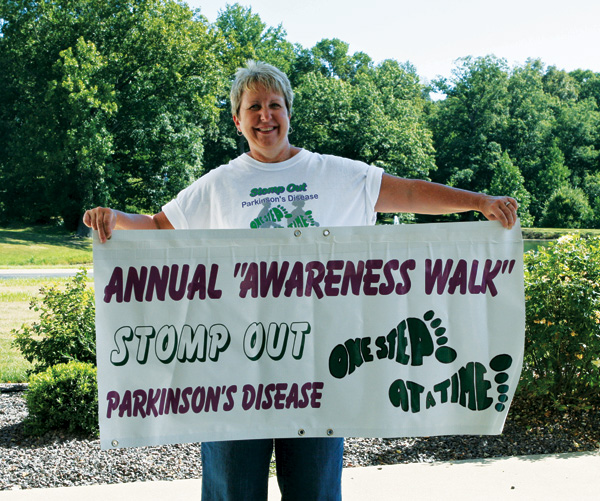
When Karen Smith’s left ring finger started to tremble, she simply ignored it. But after the tremor worsened, Smith was diagnosed nine years ago with Parkinson’s disease at age 42.

The progressive motor system disorder, which affects around a million Americans, eventually forced Smith to leave her career in pharmaceutical quality control. Still, the mother of three tries “to focus on the positive every day,” she says, “not the fact that I’m living with this disease and what the future might hold.”

Since her diagnosis, Smith — a West Side resident with her husband, Steve — has started a support group for patients with young-onset Parkinson’s disease and volunteered as a congressional coordinator for the national Parkinson’s Action Network. In 2006, she launched Evansville’s Stomp Out Parkinson’s Disease Awareness Walk. She’ll rally friends and family for the fifth annual walk Oct. 16 at The Communities of Solarbron. (See our Guide for details.)

I have a family history of Parkinson’s, so I guess I had that in the back of my mind, but I really didn’t think it could happen to me. Other than my grandma, I didn’t think it happened to young people that much. After my diagnosis, I learned that Parkinson’s is not a disease of just the elderly.

I felt like I either could sit back and wait for the worst to happen, or I could become active in the Parkinson’s community and try to make a difference. Because of the family history, I’m very concerned about raising money for a cure. I do not want my children or my grandchildren to have to deal with the disease.

I received a lot of my validation from the workplace; you feel validated when you can be successful at something. In many ways, the walk has replaced work for me, as far as feeling like I’m doing something proactive.

With Parkinson’s, the brain is changing daily, and it affects your ability to accomplish the things you used to do. Just being active and involved keeps you as healthy as you can be. Also, as you lose dopamine, your serotonin level decreases — which, in many people, leads to depression. The more I feel like I’m making a difference, the less I have to struggle with that.

The Chance to Connect

0
Kip Farmer’s teenage son Jackson, who has autism, inspired his father to help create a community resource for other families.

When Jackson Farmer was born in August 1994, first-time parents Kip and Maria Farmer were elated. But months before they celebrated Jackson’s first birthday, the couple couldn’t silence the nagging thought that something was wrong with their son.

Red-faced, the baby would cry for hours as his parents strapped him into a car seat and drove around Evansville, trying to calm him. He was angry, anxious, and inconsolable, and the Farmers didn’t know why.

At age 2, Jackson was diagnosed with autism, a developmental disorder that affects his ability to communicate and interact with other people. The news blindsided his parents, who knew little about autism and virtually nothing about raising a child with the disorder. “We didn’t know where to go,” says Kip Farmer, an Evansville interior designer who owns the firm Kip Farmer Design. “We were knocking on so many doors at a time when we still were reeling from the diagnosis.”

The couple felt isolated and overwhelmed as they called hospitals, schools, and nonprofit organizations seeking help for Jackson. More than a decade later, Farmer reasons that maybe, if they could have browsed one website or called one phone number to learn about regional autism resources, the learning curve may have been that much gentler.

The desire to create a one-stop resource for families dealing with autism led to the formation of the Evansville Regional Autism Coalition (ERAC), founded during the national Autism Awareness Month in April 2008. The organization recently changed the word “Coalition” to “Community,” reflecting a shift from a professional association to a group that welcomes families. This October, ERAC prepares to host its first major event: the Autism, Asperger’s and Social Skills Conference, featuring professor and animal scientist Temple Grandin and autism expert Jed Baker.

“(Autism) is an emerging crisis,” says Farmer. “The time is now.” (The Farmers also have two boys, ages 13 and 10, who do not have autism; Evansville Living profiled the family when Jackson was 8 in “Especially Needed,” January/February 2003). When Jackson was diagnosed 14 years ago, the Farmers learned their son was one in 2,000 children with the developmental disability. Now, the Centers for Disease Control and Prevention estimate that autism spectrum disorders (ASDs) affect one in 110 children, and they’re four times more likely to occur in boys than in girls.

ASDs range from Asperger’s syndrome, characterized by social awkwardness and fixations on narrow topics, to severe autism, often marked by behavioral problems and a complete inability to communicate. There is no cure, and no one knows what causes the disorder.

Before ERAC, “there wasn’t anything happening for autism in a big way,” Farmer says. He and three community-minded friends — Cindi Beeler, Lisa Jones, and Patricia Weinzapfel — wanted to change that, and together they launched the coalition. Its purpose is to educate families and the community about autism spectrum disorders while connecting them with resources — whether it’s a speech therapist, a patient photographer willing to take family photos, or another local family facing autism. They brought various skills to the task: “Cindi’s the consummate event planner and organizer. Lisa is a great researcher and communicator,” says Farmer. “And Patricia is the extrovert, the PR link — not just to the media but to the public.”[pagebreak]

The ERAC launch committee came together around the idea that local agencies could benefit from discussing their challenges and successes. “We had a lot of organizations doing incredible things for families with autism,” Weinzapfel says. “What we didn’t have was a way they could talk together.” For a year and a half, ERAC has hosted monthly meetings that unite leaders of more than 20 agencies, including nonprofit organizations, health systems, school corporations, and universities.

The coalition also raises awareness of autism with events such as an Aug. 3 Web conference with Eustacia Cutler, Temple Grandin’s mother. That day, people nationwide watched Cutler speak from Washington State University. Approximately 80 Evansvillians — healthcare workers, therapists, caregivers, and relatives — tuned in from the Crescent Room at Milestones to hear Cutler’s take on raising a child with autism.

Her insights were inspiring yet disturbing. The 83-year-old Cutler recalled the days when many psychiatrists believed autism was caused by “refrigerator mothers” who were cold and distant. (The theory prevailed through the 1970s, and Grandin, who didn’t speak until age 4 and threw frequent tantrums, initially was thought to have brain damage, epilepsy, or mental retardation.) Cutler felt judged by her neighbors and even her husband after Grandin’s diagnosis, but at a time when children with autism frequently were committed to institutions, Cutler fought to keep her daughter in mainstream schools.

Her candid reflections resonated with the local audience, and the webinar was a prelude for Grandin’s appearance in Evansville. Grandin, the subject of an HBO biopic nominated for 15 Emmy Awards, has autism. She also has a doctoral degree, has authored or co-written more than half a dozen books, and has redesigned many of the nation’s livestock handling facilities to be more humane and efficient. Grandin, named to Time Magazine’s 2010 list of the world’s most influential people, often is recognized as the first person to tell the general public what it’s like to live with autism. (“I live by concrete rules instead of abstract beliefs,” she wrote in a commentary that aired on NPR’s This I Believe in 2006. “And because I have autism, I think in pictures and sounds.”)

Before HBO’s Temple Grandin, starring Claire Danes, premiered in February, ERAC had planned to bring the high-profile speaker to Evansville. “I’m a former reporter,” Weinzapfel says, “so I have this mindset: ‘Why can’t I call someone?’” She tracked down Grandin’s administrative assistant at Colorado State University (where Grandin teaches in the animal sciences department), sent an e-mail, and soon received a voicemail from Grandin. Weinzapfel admits she was starstruck: “She’s like a rock star in the field of autism,” she says. “One of our goals is to bring awareness to the challenges families face. Who better to do that?”

ERAC leaders hope to make the fall conference an annual event. Also ahead for the coalition: updates to its website (www.evansvilleautism.org), which launched in 2009. The goal isn’t to provide the Internet’s definitive source of autism information. It’s to be “the inside track that’s local and specific,” Farmer says. Currently, the volunteer-built website includes features such as a directory of local service providers, ranging from adult day services to dietary counseling to recreation opportunities. Farmer envisions the site expanding to include a timeline of ages and services in the area. A 4-year-old with Asperger’s syndrome, for example, has different needs than Jackson Farmer, a 16-year-old with severe autism who attends a residential school in Indianapolis.

ERAC also plans to establish an online message board to connect Evansville-area families coping with ASDs. While nothing can eliminate the fear that accompanies an autism diagnosis, connecting with others just may comfort the families struggling with monumental daily challenges. “It’s not about having all the answers,” says Farmer. “It’s about talking to someone who’s been there.”

To learn more about the Evansville Regional Autism Community or register for Oct. 1’s conference featuring Temple Grandin and Jed Baker, visit www.evansvilleautism.org.

On Thick Ice

0
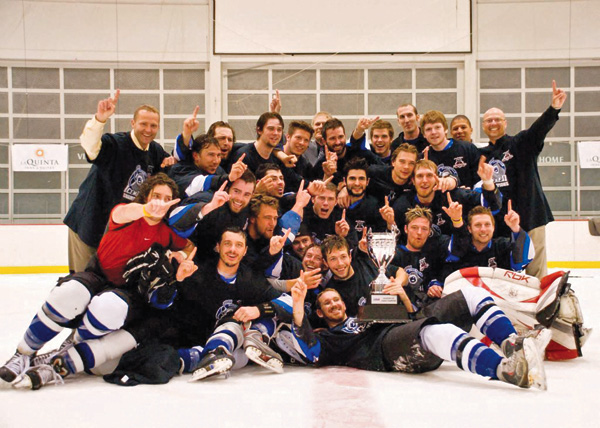
At the end of the second season, the Evansville IceMen gather around the Davidson Cup.

Last April, Ron Geary joined his wife Linda, son Mark, daughter Wendy, a couple of grandchildren, and some family friends at Evansville’s Swonder Ice Arena. Also at the rink were more than 1,000 hockey fans attending the fifth game of the All American Hockey League’s best-of-seven championship series. The longtime Louisville businessman, who also owns horseracing track Ellis Park in Henderson, Ky., remembers, “That was a very exciting evening.”

Exciting because this was Geary’s first chance to be the owner of a championship team. Exciting, too, because his IceMen — a team he bought two years ago — had a high-powered offense that already had scored 25 goals in the first four games of the series to take a commanding 3-1 series lead. The fledgling team even took two games from their opponents, the West Michigan Blizzard, on that team’s home ice in Muskegon.

The Icemen needed four more goals in game five to win the Davidson Cup, the trophy for the Single A hockey league. Geary was all smiles, but he wasn’t the only fan: “Our average attendance was more than most of the other teams put together (in the AAHL),” says Geary. Inspired by the outpouring of support from fans in the IceMen’s second season, Geary made moves in the off-season to aim higher with his championship-caliber hockey players. This October, the team debuts as a Double A franchise.

The departure of the Muskegon Lumberjacks from the International Hockey League left an opening for a new team. The IHL merged into the Central Hockey League to form an 18-team, Double A league. Geary secured the IceMen a spot to play with teams across America. “It was a combination of being in the right place at the right time,” Geary says. “Because of the attendance here, our support, and the commitment to try and build a first-class program, we were adopted to be the official expansion team.”

With Muskegon out of the IHL, Geary bought the players’ contracts and hired Terry Ficorelli, the longtime voice of the Muskegon franchise, to be the IceMen’s vice president of communications and broadcasting. He’ll be the radio play-by-play announcer, work in media relations and publicity, and assist in corporate sales. The mustached, well-dressed Ficorelli has a fervent following, and 300 people joined a Facebook page dedicated to voice support to keep Ficorelli in Michigan.

The passionate Muskegon fans know Ficorelli brings with him a part of the 50-year tradition of a hockey-happy town. “Bringing the Muskegon history to Evansville creates instant credibility to the IceMen organization,” said Dennis Hextall, the IHL commissioner, during the summer. That history helps make the IceMen feel more familiar than a typical expansion team would.

Geary also drew Rich Kromm to Evansville to act as the general manager and coach of the IceMen. The 46-year-old Kromm, a veteran professional hockey coach and player, led the Muskegon Lumberjacks to a 51-20-5 record last year, and they were the IHL’s regular-season champions. Kromm played more than 400 games in the National Hockey League with the Calgary Flames and the New York Islanders. His hockey enthusiasm comes from his late father, Bobby, a former head coach for the Detroit Red Wings and a onetime NHL coach of the year. “This represents a great opportunity to build a strong foundation for a successful organization that we hope will be here for many years to come,” Kromm says.

“He knows the game, has a great record, and is passionate about hockey,” Geary says. “If you’re going to move into Double A, you want to come in as first class as you can. With a lot of expansion teams, it usually takes several years to get competitive.”

Geary, the former president and chief executive officer of Louisville-based human service company ResCare, believes Kromm and Ficorelli shorten the time needed to become competitive. But, most importantly, that competitive spirit comes from Evansville fans, whom Geary credits for faithful support the last two years. “As we moved through the first year, we found we had all kinds of rabid hockey fans, and it made for some good hockey in Evansville,” Geary says. “We tried to get some first-time hockey fans, and they ended up coming back many times.”

That Evansville is a hockey hotbed seems apparent for a number of hockey owners. The new 11,000-seat arena under construction in Downtown Evansville has received several proposals from leagues and teams, including the IceMen, that are interested in being the home team for the stadium expected to open in late 2011. Among them are the Double A, 20-team East Coast Hockey League; the 16-team United States Hockey League for college-bound athletes; and the 26-team, junior hockey North American Hockey League.

Swonder Ice Arena remains the IceMen’s home this season, and with the changes he made this year, Geary expects the IceMen fan base to grow larger. “I really think the citizens of Evansville and western Kentucky will fall in love with the IceMen,” Geary says. “The level of play is very exciting. I’m sold on it.”

For more information on the Evansville IceMen’s season, visit www.centralhockeyleague.com.

Welcome to Illinois Wine Country

0
Blue Sky Vineyard feels like wine’s temple.

Between Highways 127 and 57 is a gravel road looping by one-bedroom, red-roofed cabins next to a large lake. The road ends at an impressive building, complete with a wraparound patio, peaked ceiling, brick bar, stained glass windows, and a loft with cathedral-esque chandeliers. Inside, John Patrick Russell is all smiles, and why shouldn’t he be? It’s a Thursday afternoon in June, and patrons casually are drinking inside his winery in Southern Illinois. It’s busy, and the weekend has yet to begin. Russell opened Rustle Hill Winery (a play on his last name) in 2008, and today, a group of retired businessmen already are several beers deep inside while local college students sip wine on the patio. The tiny stage across from the bar is empty for now, but Russell promises five concerts happen every weekend.

That was his original idea: to create a music venue in the middle of Southern Illinois wine country two hours west of Evansville. “We’ll do Woodstock,” he jokes of his vision now. The reality of Rustle Hills is bigger than that. Russell sells an experience: live music at an outdoor amphitheater, locally produced wine, breathtaking views, and cozy, lakeside accommodations.

He’s the latest to discover the power of wine to attract tourists to Southern Illinois. Alto Vineyards was the first to open in the region in 1984. What followed were 11 more entrepreneurs capitalizing on the ideal landscape and climate for grape growing — rolling hills, a regular breeze, and soil with limestone bedrock. Every winery feels familiar in the sense that wine is produced at each location, but each winery has a unique character stemming from the owner. StarView Vineyards comes from co-owner Scott Sensmeier, a Cobden, Ill., native who worked for several years in Atlanta’s upscale neighborhood Buckhead, and the interior design reflects this sensibility. Anders Hedman, though, is from Sweden, and if his thick accent isn’t enough to tip you off, his business, Hedman Vineyards, also has a restaurant with a Scandinavian-influenced menu: featuring Swedish meatballs and wiener schnitzel.

Sensmeier and Hedman join 10 other wineries to form the Shawnee Hills Wine Trail, a collaborative effort to attract tourists to Southern Illinois. While wine is the key product, Shawnee Hills offers picturesque scenery filled with sandstone canyons and forests deep and dense running from the highways.

Wineries

Alto Vineyards

You’re drinking: The owners describe Heartland Blush as “reminiscent of grandma’s grape jelly.”

Two decades is a long time to perfect winemaking, and experience is one reason Alto Vineyards is the largest producer on the trail (around 34,000 gallons a year). After releasing its first wine in 1987, founders Guy Renzaglia and Ted Wichmann sold 2,000 bottles. Today, Alto Vineyards sells around 10,000 bottles a year of the most popular sweet red wine, Heartland Blush.[pagebreak]

Inheritance Valley

You’re drinking: The Cobden Cream, a rich, flavorful Spanish sherry, is blended for five years before bottling.

Owners Tim and Kendall Waller have a small winery — that’s by design. The focus is on “personal attention,” Tim says, and with a facility that seats 12, an intimate atmosphere is possible. The Wallers have an understated wit, apparent in their wine list: Big Diesel Whine; Oh My, Cherry Pie; and Blackberry Boogie. So popular are the latter two, the Wallers were sold out by June. The Big Diesel Whine is a sweet red with a name inspired by RognboB, two local musicians who play parody songs such as “I Want to Be a Walmart Greeter.” (Bonus: RognboB albums are available for purchase at Inheritance Valley.)

Hedman Vineyards

You’re drinking: The chambourcin, a dry red aged in an American oak barrel with cherry and berry flavors, is the highest seller.

Outside this winery, baby barn swallows relax in a nest, and hummingbirds flutter near the gazebo. The décor inside this winery and restaurant is a reflection of owner Anders Hedman’s home country. Atop the checkered tablecloths are laminated placemats depicting Swedish landscapes: Swedes in boats overgrown with vegetation, Swedes in cottages overgrown with vegetation, and Swedes in tree houses, you guessed it, overgrown with vegetation. One menu highlight: The Swedish meatballs come drizzled in a sweet berry sauce.

Pomona Winery

You’re drinking: The award-winning, semi-dry Jonathan, made from Jonathan apples, is crisp and tart and pairs well with light cheeses.

Owners George Majka and Jane Payne bought land in Southern Illinois almost four decades ago. They built a temporary house and lived without utilities for years. Their claim to fame: None of their wines are made from grapes. They use only blueberries, strawberries, peaches, and apples.

StarView Vineyards

You’re drinking: The semi-dry red, Red Giant, an award winner, has a raspberry and licorice taste.

When brainstorming for winery names with his wife Kate Sensmeier, Scott admits they weren’t very creative: Far from big city lights, the land offered a great view of the stars. The young couple has been much more creative with their products. Known for giving drinkers a simultaneous buzz and brain freeze, their wine slushies — made with Venus, Concord, or SilverStar wines — are just plain fun.

Orlandini Vineyard

You’re drinking: The signature wine is the Saluki Red, named for the mascot of nearby Southern Illinois University. Produced from chambourcin grapes, the wine is sophisticated and sweet.

On more than four acres of grape farm is a tiny peach-colored building with a patio overlooking a pond. Inside, owner Gary Orlandini plays classical music softly. His great-grandfather and grandfather used to make wine in their basements. Orlandini helped and learned, “It’s hard work pulling feet out of grapes.” He no longer smashes grapes with his feet to make wine, but his wine menu still is worth a look.[pagebreak]

Blue Sky Vineyard

You’re drinking: The medium-bodied white wine, Chardonnay Silver, boasts soft floral aromas.

The prominent building at Blue Sky Vineyard has an Italian renaissance vibe. The ceiling stretches (blue) sky high, leaving enough room for a Nebraskan windmill to act as the ceiling fan. Below, local artists painted the tables where patrons sit and enjoy a large wine selection. As impressive as the facilities look, Karen Hand, Blue Sky’s winemaker, believes, “We’re only as successful as our neighbors,” she says. “We’re in this together.” That’s why she heads the Shawnee Hills Wine-Grape Association, a collaborative effort to set wine quality standards in Southern Illinois.

Dining, Attractions, and Lodging

The Palace Pizzeria

From Pabst Blue Ribbon to Blue Moon, a wide-ranging amount of beers is on tap. Pictures of local youth soccer championship teams haphazardly hang on the walls next to photos of jazz and blues musicians who play at the Palace Pizzeria. “Can you tell the owner likes Beale Street?” a patron asks while I stare too long at the photos. The ambiance of this restaurant feels like Dave’s Sports Den in Evansville.

The pizza, however, is uniquely brilliant. The Grecian delight, for example, offers no sauce but comes topped with feta cheese, tomatoes, black olives, broccoli, and onions all tossed in a fine house dressing. The gyro meat tastes like a Greek prepared it, and spinach leaves decorate the top of the pie with a perfectly blistered crust.

Giant City State Park

The tall sandstone bluffs earned the 4,000-acre Giant City State Park its name because the paths between the bluffs look like giants could use them as streets. The park’s lodge restaurant serves family-style meals, much like the Log Inn in nearby Haubstadt, Ind., with a menu of golden brown fried chicken, mashed potatoes, country milk gravy, scratch dumplings, green beans, buttered corn, creamy coleslaw, and biscuits. I feel stuffed just writing about the meal, but my most memorable attraction at the restaurant was the Fat Man’s Squeeze, a dessert named after one of the park’s rock formations. The post-dinner option came with three scoops of vanilla ice cream atop chunks of moist brownies, covered in hot chocolate syrup, and a mountain of whipped cream completes the dish. After eating, my waistline was gigantic. And I’m ready for more.

Davie School Inn

In 2002, Gary and Andrea Dahmer transformed eight classrooms into spacious hotel rooms loaded with character to create the Davie School Inn in Anna, Ill. Elements of the 1910 schoolhouse still are present such as old desks lining the stairwell and blackboards in the rooms, but modern amenities (microwave, mini-fridge, satellite TV, air-conditioning) make the stay comfortable. So successful was the renovation that owners developed three new rooms, and plans have begun on turning the basement into a “man cave.”[pagebreak]

If You Go:

Alto Vineyards – Alto Pass, Ill. – www.altovineyards.net – (618) 893-4898

Blue Sky Vineyard – Makanda, Ill. – www.blueskyvineyard.com – (618) 995-9463

Davie School Inn – Anna, Ill. – www.davieschoolinn.com – (618) 833-2377

Giant City State Park – Makanda, Ill. – www.giantcitylodge.com – (618) 457-4836

Hedman Vineyards – Alto Pass, Ill. – www.peachbarn.com – (618) 893-4923

Inheritance Valley Vineyards – Cobden, Ill. – www.inheritancevalley.com – (618) 893-6141

Orlandini Vineyard – Makanda, Ill. – www.orlandinivineyard.com – (618) 995-2307

Palace Pizzeria – Cobden, Ill. – (618) 893- 4415

Pomona Winery – Pomona, Ill. – www.pomonawinery.com – (618) 893-2623

Rustle Hill Winery – Cobden, Ill. – www.rustlehillwinery.com – (618) 893-2700

StarView Vineyards – Cobden, Ill. – www.starviewvineyards.com – (618) 893-9463

Big City Cool

0
The matching couches on the main floor's living room pop with color.

A swank New York restaurant uses the name Arabelle. It also is the name of an upscale United Kingdom jeweler, and a high-class fabrics company has the name Arabelle. Attaching “Arabelle” to describe something as upper crust is no coincidence: In Dutch, “arabella” means “beautiful.”

In Evansville, the building named Arabelle once held a bank and a drug store until, like most Downtown edifices, it experienced neglect and decay as the population gradually moved from the center of the city for decades. The three-story, mostly brick building, constructed in the 1800s, sat unoccupied on Main Street until the mid-2000s when Debra Talley and Mike Martin of Architectural Renovators bought the Arabelle.

On the Arabelle’s first floor is a Subway, the national sub sandwich shop that is not the pricey Arabelle Restaurant in New York (five-dollar foot-longs!), but for those in the Downtown business district, the quick eatery is a welcomed neighbor. The smells of the sandwiches occasionally do waft upstairs, however, to Jason English’s condo. The upscale atmosphere of this ultramodern living space is a perfect reflection of the world’s other Arabelles.

Talley and Martin’s decision to renovate came after a series of successful building rehabs spurred Martin to focus on the Arabelle. Talley watched Club Fitness Zone, a bright blue workout facility owned by her son Heath grow after that business — just a half block away from the Arabelle — opened in a building renovated by Martin.

Loft developments in Chicago and St. Louis sparked Martin’s interest in Downtown renovations. He adds modern touches to historic structures in need of tender loving care. Martin revamped the former Gottam Building (615 Main St.) in 1999. With 16-foot high ceilings for the second-floor loft apartment, the 1890-built Gottam became a mixed-use facility with retail space on the first floor. Earlier this year, that building became rubble as demolition crews made way for the new arena, expected to be completed by the end of 2011.

To boost residential housing Downtown, Mayor Jonathan Weinzapfel — then in his first term — instituted a loft incentive program in 2004. The city offered a $20,000 grant for loft developers per unit. Since then, through various loft programs, the city has provided nearly $2.5 million in grants and loans. That’s translated into $21 million of Downtown housing projects.

Private investment continues long after the government incentive eroded. In August 2010, officials from The Kunkel Group, a construction company that used the incentive program to create condo complexes in the former Main Street deJong’s and J.C. Penney retail stores, announced they’d transform the former Hilliard Lyons headquarters into 44 apartments — a project across the street from the Arabelle, which also was renovated without the financial aide of the loft program.[pagebreak]

English owns Icon, an East Side nightclub big on atmosphere. Inside the club, white marble floor greets visitors, the open-ceiling concept exposes metal girders, and the plush furniture invites mingling. English, an Evansville native, worked with local interior designer Marjorie Bergen to create the nightclub’s big-city feel, but his condo is a creation straight from his mind. “I just click and point,” says English on his penchant to finding furniture on the Internet.

For a bachelor, the three-story condo with four balconies has a masculine feel with a cohesive color scheme of black, silver, and dark brown with occasional bold, brilliant pops of color. The open living concept gives the owner the space to host parties, and the exposed brick walls are thick, creating a sound barrier.

A safe door, crafted by Martin, greets English’s guests. The idea came after English toured lofts in Miami. It was fun, he says, and this safe door is light and warm, a contrast to the heavy, bulky designs of safes. The kitchen and dining room are small, which is fine with English, who likes to dine out. On the main floor’s living room, a large disco ball looms above red leather couches and a shaggy white rug. Upstairs, English’s simple bedroom has one piece of furniture, a black bed in the center of the room built atop an old elevator shaft. The floors are black bamboo, which English loves, though, he admits, the surface is hard to keep clean.

Along the walls are paintings and photographs of his favorite musicians, actors, and icons such as Elvis Presley, Marilyn Monroe, and Frank Sinatra. Track lighting spotlights the artwork, but often, large flat-screen televisions are the centerpieces of English’s living rooms. Down the spiraling steel staircase, the bottom floor’s television room boasts a pivotal flat screen, able to turn from the big, black couches to face the nearby balcony where friends sit outside to watch pay-per-view fights.

The interior is spacious and comfortable, but English says the location was a motivating factor for the purchase. The convenience to walk to restaurants, bars, and work (English also owns an adult nightclub near Casino Aztar) is a good reason to leave his condo every once in a while. “I’ve had four or five condos,” says English. Most recently, he lived in the penthouse of Main Street’s Marlocon, another of Martin’s ultramodern creations. “I think this is the first one I’d have separation anxiety (if I left it),” he says. “It’s a lot of fun.”

He Said, She Said

Creative director Partrick O’Connor and English professor and novelist Margaret McMullan

The life of letters: Being married with a vocation in common is hard work — and tons of fun, as screenwriter and creative director Partrick O’Connor and English professor and novelist Margaret McMullan continue to prove. “He Said, She Said” are excerpts from their writerly exchanges — daily e-mails to each other.

Patrick: Hey M., another Youth First auction is coming up.Do I hear $500 for the puppy? If you recall, we came pretty close to picking up an extra hound last year, with you handling the paddle.

Margaret: Haven’t we bid on a few too many items that we don’t need at various auctions throughout our fair city?

Patrick: Sure,we’ve bid on lots of interesting things we don’t need, but isn’t that what the charity auction is all about? Bidding on things we don’t need, to help out a good non-profit? I mean, if we really needed the things,we’d probably just go buy them at the store. Auctions are all about IMPULSE, baby!

Margaret: That’s true.

Patrick: And we’ve “won” lots of things that we never even used, like that Amsterdam trip we “won” last year at the Evansville
Day School gala.

Margaret: Admittedly, you didn’t talk me into that – Tay Ruthenburg did.

Patrick: I believe I was in the car, on my way to the event, when you pulled the trigger on the Amsterdam trip. And remember the four-day stay in the New Orleans hotel that was destroyed by Katrina before we got around to staying there? That was the WNIN Gala auction.

Margaret: Yes – some of our auction adventures have turned out to be busts. But you have to admit, a new puppy is the LAST thing we need. Think of our camel-hair rugs from the deserts of Afghanistan. They’ve been through war AND Samantha, our resident four-legger. Not sure if they’d survive a puppy.

Patrick: We could roll up the carpets for a few months. Besides, people have told me that the older dog teaches the new puppy how things work, so they’re not as much trouble. Samantha could teach this new puppy about her favorite potty spots in the yard and where to find the best sticks on which to chew.

Margaret: And she’d teach her where to find the smelliest dead things in the woods in which to roll, and where to hide when she thinks you’re going to give her a bath. Another dog? Have you lost your mind?

Patrick: I’ve reached an age where I’m beginning to accept my shortcomings – one of them is a strong affinity for dogs. Two dogs would be twice the fun!

Margaret: Let’s consider getting “stuck” with what we’ve won in the past. There are the vacations we never took, the artwork we’ve never hung, the dinners we’ve never eaten… Oh, and the lamp we got for $50 in Bay St. Louis, the one with all those trinkets you get from gumball machines glued over the base. You love to haul that one out at the end of dinner parties for the last good laugh. So here’s a simple question: what if our second dog is a dud?

Patrick: I suppose that’s possible. I wonder if you can get an additional tax deduction if the puppy you “won” at a charity auction tears up your rug and furniture? If that’s the case,we might be able to deduct all the destruction that normally occurs with a new puppy. I’ll ask our accountant.

Margaret: I feel as though we should seek counseling.Maybe we should contact Cesar Millan, the Dog Whisperer.

Patrick: Ah! And you know he says there’s no such thing as a bad dog. Just bad owners. If you stay calm and assertive, the dog turns out perfect. Every time.

Margaret: By the way, Sam climbed up on the counter and ate an entire loaf of bread this morning.

Patrick: What kind?

Margaret: The whole grain with flax seed. Oddly, she left the bag of cookies.

Patrick: Good dog!

He Said, She Said

Creative director Partrick O’Connor and English professor and novelist Margaret McMullan

The life of letters: Being married with a vocation in common is hard work — and tons of fun, as screenwriter and creative director Partrick O’Connor and English professor and novelist Margaret McMullan continue to prove. “He Said, She Said” are excerpts from their writerly exchanges — daily e-mails to each other.

Margaret: Now that I’m in New York and have a little time between literary panel discussions at the writer’s conference and everything is 75 percent off, what do you want for your birthday? March 17 is just around the corner.

Patrick: Glad you arrived safely. Why is everything 75 percent off in New York?

Margaret: I want to say, “It’s the economy, stupid,” but that’s just so rude to say to one’s husband. Evidently there weren’t enough people getting and spending over the holidays, hence the sales to make way for more stuff. Now, when people get that fat government refund check, they’ll buy a whole bunch of junk in Spring. Never mind more debt. We’re living right smack dab in the middle of Vanity Fair – the novel, not the magazine.

Patrick: Last time you bought my birthday present while on a trip to New York, I had to go on a diet and a rigorous fitness regimen so I wouldn’t look like a lumpy sausage while wearing it. I think I’ve outgrown, literally, trendy New York men’s fashion. I don’t have the abs. Or the pecs. Or the guns. I do love the rugelach from Zabar’s, though!

Margaret: How about a pair of green corduroys? You can wear them on St. Paddy’s Day.

Patrick: Already have a pair.

Margaret: How about something more …exotic? I’m headed for The Village Saturday morning.

Patrick: Exotic? How exotic? Clothing or food?

Margaret: There is the baker on Christopher Street who sells cakes and cookies shaped like …well, various body parts.

Patrick: I love cakes and cookies! What body parts are we talking about?

Margaret: Never mind. How about lime green snakeskin slippers from Barney’s?

Patrick: You gave me red slippers from the Land’s End catalogue last year. They’re still in service. In fact, I’m wearing them right now.

Margaret: How about an orange desk blotter to highlight your office colors?

Patrick: Where did you see an orange desk blotter?

Margaret: In the ûber-trendy Barney’s Home section.

Patrick: Barney’s is dangerous, you know. They have a strange power over you. Your credit card is not safe at Barney’s.

Margaret: That’s why I have a new Barney’s card! They promised me points. Toward my next purchase! I’m going back tomorrow!

Patrick: Uh-oh. It’s too late.

Margaret: Okay, it doesn’t have to be from Barney’s.

Patrick: Sorry I’m being so difficult. You don’t have to get me anything. Really. I don’t need a thing. Honestly. I’ve got everything I need. No kidding. I just want everyone to be happy (that’s what my dad always said when we asked him what he wanted for his birthday or for Christmas).

Margaret: God bless your dad, but I want everyone to be happy AND have a gift! I’m serious –  there are sales everywhere, so in between the readings from Joyce Carol Oates, John Irving, and Russell Banks, I’m determined to bring you back something from the Big Apple. Hey, I know. How about a BOOK?

Patrick: You know I love books. You can probably get one cheaper at Amazon.com, though…

Margaret: But not one made out to you, Patrick Joseph Thomas O’Connor, born on St. Paddy’s Day, signed by your fellow Irishman, Frank (Angela’s Ashes) McCourt. Wrap that up in a green bow with a package of raspberry rugelach from Zabar’s, a loaf of chocolate babka and three spinach knishes and we’ll have a multi-cultural feeding extravaganza, thereby ensuring that we’ll never ever be able to squeeze into any more trendy clothes
from Barney’s.

Patrick: Well …I don’t know …I really don’t need anything…

Margaret: C’mon…

Patrick: Okay. Surprise me.

He Said, She Said

Screenwriter and creative director Patrick O’Connor and English professor and novelist Margaret McMullan.

Screenwriter and creative director Patrick O’Connor and English professor and novelist Margaret McMullan return with their column, “He Said, She Said,” based on excerpts from their e-mail exchanges. They also happen to be married to each other and are the parents of a young son, James.

Margaret: I’m thinking of writing a couple’s cookbook.

Patrick: You mean, as in recipes that couples like? Or recipes couples can
cook together, i.e. peel the carrots while your spouse minces the garlic … Or is this a recipe book written by a couple (which would mean that I have to write it, too)? And then there’s this question: Does the world really need another cookbook? Especially one written by us?

Margaret: To answer your first question, it would be a collection of recipes by couples for couples to cook. Together. And yes, you would have to write it too and include your “Non-Stop, No-Chop Chili with Sirloin Beef.” I would include all that we do with squash and that raspberry chocolate torte I made for your birthday. So much of a couple’s history is wrapped up, burrito-style, in food. As you may or may not recall, cooking and food were major parts of our courtship.

Patrick: My contribution to this cookbook will be minor. Chili and jambalaya –– which are really the same thing with different ingredients.

Margaret: Think back. You opened cans before we married.

Patrick: I still open cans. So do you. I opened about 40 cans yesterday to make the chili.

Margaret: Yes, but you ONLY opened cans when we first started dating. The chili was already IN the can.

Patrick: That’s true – I’d never even seen a real garlic clove before I met you.

Margaret: Very sad. So you see, cooking and food were big parts of our courtship. Remember the sesame noodles with shredded chicken and peeled cucumber, hand-fed to you in the car on the way to, where was it? Chicago? Mexico?

Patrick: I do remember the sesame noodles. Very clearly. It was an important juncture in our courtship. Perhaps the recipe for your sesame noodles should include serving suggestions: Hand-feed your future spouse while driving…somewhere.

Margaret: We’ve gotten way past our salad days when chicken Marsala was all we made for dinner parties. For so long, when we first married, I worried that our house would have too many books and papers and eyeglasses and typewriters (now laptops) and not enough food in the refrigerator. Remember how we set out to cook?

Patrick: I will admit that I was a trailblazer in the area of layered Mexican bean dips. I was making bean dips with at least seven layers in the late ‘80s. Now you can pick one up at Schnucks easy-as-you-please.

Margaret: Ah, the bean dip! Which brings us back to all those cans. I prefer the kind of cooking that leaves something for the compost heap. But let’s not forget your grilled steaks, your barbequed chicken, and grilled corn. Your potatoes, your gumbo, your grilled Alder-planked salmon. You’ve got more than jambalaya and bean dip in your repertoire, Sweetie.

Patrick: Okay, you’ve convinced me. I’ll start: Chapter One: Garlic (and other ingredients your husband has never actually met).

Margaret: Excellent. By the way, what’s for dinner? Risotto primavera and spicy slaw? Brunswick stew and baked apples? Pork with curried orange sauce?

Patrick: I don’t know. Sounds like a lot of dishes to wash. How about Los Bravos?

A Troublesome Process

0

Don’t tell Robin Church Wolf that the only time homeowners run into trouble with the Historic Preservation Commission is when approval is sought after the fact.

Church Wolf, who is treasurer of the Preservation Alliance of Evansville, a not-for-profit group dedicated to historic preservation, thought she was doing everything right when she and her husband, Michael, moved into their home at Southeast First and Mulberry streets in March 1998.

The first year was spent upgrading the wiring, plumbing, heating and air conditioning, patching minor leaks, and doing interior cosmetic work. None of that had to be approved by the Preservation Commission, which has no jurisdiction over interior work.

By the end of their first year in the home, built in 1869, Robin, a special education assistant at Glenwood School, and Michael, a golf pro, were able to lease the second floor as an apartment for visiting executives. Soon they had saved enough money to replace a front porch that had been removed more than 50 years earlier. For the porch, they needed a Certificate of Appropriate-ness from the Preservation Commission.

“We had heard rumors from various downtown people that going before the Commission could be a horrendous experience. We didn’t want to do anything inappropriate,” said Church Wolf, who had a photograph of their home and its porch as it appeared in an Evansville newspaper on Feb. 4, 1906. When the Wolfs took their proposal to the Preservation Commission in early 1999, they thought they had filled every requirement. They had the photograph taken in 1906, a blueprint of the proposed porch by a respected local preservation construction company, and what they thought might be the original porch posts and brackets in their cellar.

“Everyone was very friendly and encouraging, with the exception of Tim Crowley who grilled us on every teeny detail in great degree,” Church Wolf said. When she told the commissioners she had discovered old porch posts and brackets that looked like those in the newspaper photo in her cellar, Crowley expressed doubt that they were from the original porch. He said he could not agree to approve the porch until an expert had inspected the posts.

City Preservation Officer Dennis Au and then-Commission member Rick Tremont volunteered to look at the posts. They did so the following day and pronounced the posts “fine, more than fine.”

“So we ended up getting the porch built, but I understood why people warned us about the meetings. You feel as if you’re at an inquisition, as if you are being interrogated for a crime,” Church Wolf said.

The Wolfs’ second encounter with the Preservation Commission didn’t end as happily. A month or two after the porch incident, a small house at 512 S.E. Second St. was put up for sale. The couple had done so well leasing their second floor that they decided to purchase the little house to fix up as rental property. They had the house inspected and learned that the more-than-a-century-old slate roof had major leakage.

“I couldn’t make an offer on the house until I found out what the Historic Preservation Commission’s policy is on replacing slate roofs, so I called the City Preservation Officer, Dennis Au,” Church Wolf said.

Au told her that while the commissioners would prefer that the slate roof be replaced with slate, they could not force her to do so because of the expense involved. He said the only requirement was that she replace the slate with shingles of the same color. The Wolfs signed a contract to buy the house. [pagebreak]

A couple of days before Church Wolf was scheduled to appear before the Preservation Commission in the spring of 1999, Au called to warn her that the Commission planned to “try to set a precedent” concerning her roof. It wasn’t until she arrived at the meeting that she fully understood what he meant.Crowley, who chaired the meeting, announced that because so many commissioners were absent, every proposal would have to be unanimously approved. When it came time for a vote on the Wolfs’ Certificate of Appropriateness, only Crowley voted against it.

Church Wolf protested that the City Preservation Officer had told her all she had to do was replace the slate shingles with shingles of the same color, that she would not have purchased the house if he had said otherwise. Au remained silent, and Crowley remained adamant, describing the loss of slate roofs in the preservation area as a travesty and compromising only to the extent of insisting upon dimensional slate line shingles, less expensive than slate but double or triple the cost of the roof the Wolfs’ budget allowed for.

“Other people on the commission pleaded my case for me,” said Church Wolf, who was being held to a higher standard than owners of much more expensive homes on the same block. She was left with the choice of replacing the slate shingles with shingles she couldn’t afford or “letting the house rot.”

“I had to bite the bullet and put on the slate line roof,” said Church Wolf, who “barely broke even” when she sold the Second Street house last fall.

She said she hesitated to speak out after hearing about the slander suit with which Kathy Oliver was threatened.

“I decided I had to speak out to support Kathy. Nothing will change if people are afraid to get involved,” she said.

Church Wolf wrote to the mayor’s office last November, complaining of the Preservation Commission’s treatment of homeowners and its negative effect on the preservation area and Evansville’s downtown. After more than two months, she hadn’t received a response from Mayor Russell Lloyd, Jr.

However, the mayor told Evansville Living he was going to make a point of seeing if the Preservation Commission had been acting “in keeping with its mission.”

“I think it has, but I will see what others have to say,” he said.

The mayor emphasized the need for “balance,” adding that “You often can’t use the same building materials – such as slate roofs.”

Church Wolf said that as long as the Commission continues to function as it has, she will buy no more property downtown.

“I would like to put a back porch on our home, but I’m not going to touch that with a 10-foot-pole,” she said.

The Way We Were

0
Dr. Timothy Crowley, Past President of Historic Preservation Commission

Historic Preservation Commission members want to be friends with their community, according to commission member Dr. Timothy Crowley.

“We’re not there as an adversary. I think most commissioners feel we are there to help people through the process and to help them make what everybody in the end will think is the right decision whenever there are questions about what should be done to a property,” said Crowley.

“The commission exists to help protect and preserve the original fabric and look of the buildings,” he said. “There are those applications that fall outside the norm – like the rare application to demolish a building. However, most of the time, people want to change the color of their house or change their roof or that sort of thing, and those are fairly easy applications to take people through.”

Crowley, who has lived in the preservation area since 1983, has been a member of the Historic Preservation Commission since the mid-1980s. He recently completed his second year as chairman and was succeeded by new chair Kathleen Manicke at the commission’s January meeting. A self-described “idealist” when it comes to preservation, Crowley said the commission works best through compromise.

“At times, I have been disappointed because I thought one or more items in an application should not have passed and that it was not ideal, but I understood that compromise is necessary,” he said. “I think if the commission was manned only by idealists, the system probably wouldn’t work. Property owners probably wouldn’t be able to tolerate the decisions of the commission. They would feel it was too strict or too onerous, that the decisions were too expensive to act on. It might end up being the eventual destruction of the ordinance and the commission, which I think would be bad for the neighborhood.”

Evansville’s first preservation ordinance, based on Indianapolis’ Meridian Street ordinance, established the Historic Preservation Commission in December of 1974. That’s also when the Riverside District was designated as a National Register Historic District, the core of which is the Original Evansville Preservation Area.

The original preservation ordinance was partially a reaction to the urban renewal movement of the late 1960s and ’70s during which “federal money was used to tear down large tracts of Evansville,” Crowley said.

“There was a lot of preservation activity in the mid to late ’70s, because things had finally gotten to the point where it was either going to get better or it was going to get a whole lot worse in a hurry. They were probably fearful in the way that a lot of Evansvillians are fearful today that Washington Avenue is in trouble,” he said.

The current preservation ordinance, based on new state enabling legislation, was passed in November 1998, bringing Evansville’s ordinance more in line with those of other cities in Indiana and allowing the establishment of another preservation district in the Lincolnshire area. [pagebreak]

“Lincolnshire residents wanted some oversight to preserve the character of their neighborhood, and the old ordinance didn’t allow for another preservation district,” said City Preservation Officer Dennis Au. Currently, oversight of Lincolnshire is limited to “the razing of a structure, the moving of a structure and any major additions to buildings that are on view from a public way,” Au said. He said Lincolnshire residents will choose later this year whether or not to become “a full historic district.”

The Original Evansville Preservation Area is roughly bounded by parts of Southeast Second and Third streets, Blackford Avenue, Shawnee Drive, Riverside Drive, Veteran’s Parkway, and Walnut and Oak streets. It meanders along streets and through alleys, resulting in blocks in which one side of the street is within the protected area and the other is not.

The Riverside Historic District encompasses 413 structures, the Original Evansville Preservation Area 223, and those 223 structures are under the Historic Preservation Commission’s protection. The preservation ordinance limits the commission’s jurisdiction to what is visible from a public way and states that commissioners “may not make any requirement except for the purpose of preventing development, alteration, or demolition in the historic district obviously incongruous with the historic district.”

“You never know what terrible things could have happened, because a lot of things may never have gotten started because people know there is a preservation ordinance,” Crowley said. “Terrible things may never have come to our commission meetings because they already know there is some protection there. It’s hard to know what the area may have been like if it hadn’t been for the last 25 years of historic preservation protection.”

Only one building has been razed in the preservation area during Crowley’s tenure, a “shotgun” house at Chandler Avenue and First Street that had sustained significant termite damage, slipped off its foundation, and developed a terrible lean. Crowley acknowledged that the value of the house, even restored, would not have justified the expense of restoring it. Nevertheless, he considered the house an “interesting example of the diversity of the Riverside Historic District,” where a shotgun house could exist alongside mansions, and homes date from 1838 to 1950.

“That’s why standard subdivision covenants wouldn’t work here. The diversity of the structures themselves would mandate that some opinion be used as to whether or not certain things were appropriate,” he said.

However, commission members have been working on a set of guidelines, which Manicke is anxious to distribute to residents of the preservation area.

“We need to get to the point where people are re-educated about coming to us before work is done. … Animosity is caused by dealing with things after the fact,” she said at January’s meeting.

Price of Preservation II

0
The Preservation Commission is tasked with protecting the appropriateness of work allowed on exterior historic properties.

It is, perhaps, unfortunate when well-meaning people disagree.

Especially when those disagreements turn bitter and when that bitterness begins to involve lawyers and threats of lawsuits and seeps inexorably into the daily news.

Yet that is what has happened among friends and neighbors in the Original Evansville Preservation District.

First of all it should be understood that no one with a vested interest in this matter wants to see Evansville’s oldest residential neighborhood revert to the run-down, multi-family absentee landlord strip that it had become as recently as 30 years ago. The kind of neighborhood that Washington Avenue between Second Street and South Kentucky Avenue still is.

At issue is what measure of control an unpaid, appointed group of preservation-minded citizens should be allowed to exercise over homeowners’ rights to manage their properties as they see fit.

Several property owners in the Original Evansville Historic Preservation District (which includes S.E. First Street and the Reitz Home Museum) have expressed dismay over what they believe to be Historic Preservation Commission members bullying individual homeowners with unreasonable and inequitable enforcement of existing guidelines, stymieing their efforts to maintain and upgrade their properties, and contributing, ultimately, to a public perception that buying property in the historic district is just not worth the hassles.

This, they claim, is ultimately detrimental to the very cause preservation commissioners are charged with serving – the long-term future and protection of Evansville’s historic neighborhoods.

The qualifications and responsibilities conveyed on members of the preservation commission also are in question.

Since 1974 when the Original Evans-ville Historic District was designated, preservation commission members (there are nine) have been appointed by the mayor.

Qualifications for appointment include having an interest and/or background in historic preservation and living in the city of Evansville. Realistically, Historic Preservation Officer Dennis Au says, an effort is made to include at least one architect and one attorney in the mix, as well as residents who live in the historic district.

Some homeowners have expressed their concerns over the makeup of the commission — citing “outsiders” (anyone who does not live in the historic preservation district) as inappropriate for having the authority to demand measures of upkeep that they do not themselves practice on their own properties.

There are concerns over term limits for commissioners (there currently are none) and attendance (or the lack thereof) at meetings where decisions are rendered that affect homeowners’ decisions about property maintenance choices — the controversial process of obtaining “certificates of appropriateness” from the commissioners before work is begun. [pagebreak]

The above concerns, among others, were vigorously voiced at a public meeting last November when a new “Guidelines and Procedures for Certificates of Appropriateness” document was unveiled.

The document was drawn up by the Evansville Historic Preservation Services office and current members of the Historic Preservation Commission. It was nearly three years in the making.

The guidelines define and therefore protect the appropriateness of all work allowed on the exterior portions of historic properties, including homes, commercial buildings, garages, fencing and similar landscape issues.

There is no attempt to control the interiors of these buildings.

The guidelines are based on documents already in place in other Indiana cities and, indeed, across the country, says Au, who explains its language is consistent with national standards for the protection of historic properties established by the Secretary of the Interior, and all of its enforcement tenets follow the language of existing legislation, namely, Indiana Code 36-7-11, the enabling legislation that allows the designation of local historic districts. This code dates to 1977.

But the new document is a work in progress, Au adds. Final approval, while ultimately within the purview of the preservation commission, will not be acted upon until March 1. In the meantime, copies of the document are available to the general public and comments on its language and content will be received through Jan. 31 (see sidebar on page 46).

This is something J. Reid Williamson Jr., director of Indiana’s Historic Landmarks Foundation, says “should have been done years ago.”

The new set of guidelines has been drafted in an effort to overcome the problems — some real, some perceived — that have plagued the preservation commission and the neighbors it serves for several years.

A lot of the language is consistent with Evansville City codes dating to 1985 and based on the language of the Meridian Street (Indianapolis) preservation code (IC 14-3-3.2-1) first adopted locally in 1974.

The language in the 1985 document says, in essence, that the preservation commission “is enjoined to maintain the long-standing character of the (preservation) area … (that is) the most important collection of 19th and early 20th Century homes in the city.”

The preservation commission is further charged with making “generous allowance for individual preferences consistent with the harmonious aspect of the area. (Commissioners should) cooperate and possibly advise these property owners who want to replace or remodel so that other residents are not outraged by incongruities or encroachments on the comfortable uses of their neighbors.”

The new guidelines currently under review do not alter the tenor of the previous guidelines as they concern specific issues relating to what is and what is not “appropriate” to historic properties within the district.

What the new guidelines will do, says Au, is streamline the process by which homeowners are granted the “certificates of appropriateness” required by law before work is begun on a project that affects the exterior of their homes.

“A lot of the frustration homeowners are expressing is related to their not understanding the process,” Au says, explaining that incomplete applications are not acted upon and this alone can set back a project for weeks and even months at a time. These new guidelines explain in great detail how to complete an application for certificates of appropriateness before coming before the preservation commission, he says.  The proposed new guidelines are exhaustive in their detail.

They outline the kinds of maintenance issues that require no advanced approval and include repairs or replacements that fall under the category of “like for like” where there are no planned changes in the materials or colors selected — for roofing or painting, for example. [pagebreak]

The guidelines make provisions for “staff approval” for many other home maintenance upkeep issues. These can be handled by the historic preservation officer at the Department of Metropolitan Development, bypassing the need to gain approval from the preservation commission.

These projects would cover such issues as choosing new paint colors within established “color pallets.”

“This is new,” Au says, “and it should further streamline the process.”

Bottom line? The goal for the new guidelines is to be very user friendly, he says.

The guidelines do, however, have teeth.

Preservation commissioners have the ability to issue and enforce stop-work orders and levy fines against homeowners who attempt to bypass the regulations governing historic buildings in a preservation district.

This alone has caused a great deal of consternation among rank and file homeowners. And it is an area where better education and communication are necessary, says Michael Osborne, who until Dec. 20 was director of Evansville’s Department of Metropoli-tan Development.

Preservation Commissioner Larry Bristow points out, however, that fines have only been levied one time and that incident occurred when previously approved blueprints for a project were altered by the property owner after-the-fact. Even then, Bristow says, it was a judge, not the preservation commission, who approved the fine.

“We are very, very cautious about this,” he says.

Buying into an historic preservation district presents a unique set of conditions that everyone needs to understand and embrace before they decide to proceed. It is not a good fit for every temperament.

“You have to be willing to give up some of your rights for the betterment of the neighborhood,” says Stuart Sebree, local representative for Indiana’s Historic Landmarks Foundation.

“Owning these homes is a public trust,” says Preservation Commissioner Barbie Garrison.

“These are ‘special needs’ homes,” adds Preservation Commission Vice Chairman Pam Guthrie, who allows that the commission has at times been overly cautious in demanding homeowners choose between doing a project “right” (i.e. to the highest standard of “pure preservation”) and not doing the project at all.

The public perception, she says, is that the commission would prefer to see a structure “fall down around your feet” before attempting a repair that falls short of pure preservation standards. “And that doesn’t help the neighborhood at all,” she says. “I maintain that we need guidelines, but we need to be more flexible.”

“A fine line needs to be walked respecting property rights and not over- controlling what people do with their homes,” Osborne says. “The guidelines are about the protection for you and about what your neighbors do,” he explains. “It’s about setting the standards that you want to achieve and then walking that line.”

“When everyone is held to the same regulations, it is a protection,” Sebree adds. “Property values (in a well-maintained historic preservation neighborhood) NEVER go down.”

Best of Evansville 2011

0

Vote for the Best of Evansville – your opportunity to name the best of the best in Evansville!

The tenth annual Best of Evansville competition is your chance to vote for your favorites. So, what people, places, and restaurants really stand out to you?  Best of Evansville winners are decided strictly by our readers’ votes and will be announced in the annual Best of Evansville issue – January/February 2011.

Click here to complete our online ballot!
(Voting is over Friday, October 29, 2010)

Rules:
•  Only one ballot per person.
•  Must be at least 14 years old to enter.
•  Ballots must be signed and include a phone number and/or e-mail address to be eligible.
•  Only original ballots accepted – no copies or faxes.
•  You must complete at least 20 categories to be eligible.
•  Ballots are the property of Tucker Publishing Group.
    Tucker Publishing Group reserves the right to disqualify any ballot considered to be stuffed.

Special note to local businesses:
You are welcome to encourage your customers to vote for your business through in-store signage (available through Evansville Living magazine), e-mail blasts, advertising, newsletters, or word-of-mouth. However, mass distribution of actual or copied ballots will be considered ballot stuffing, and if verified, the business will be disqualified.

Privacy Policy:
We will never sell the information you give us to anyone else. Click here for our privacy policy.

The Arms of Love

0
Randy Moore and Ken Ellspermann, Julie Clayton, and Kim Fields joined community efforts to bring a Gilda’s Club to Evansville.

In July 2009, Randy Moore, longtime anchor for WTVW Fox 7’s weeknight newscasts, lost his wife, Ann, to pancreatic cancer. The public figure was open and honest about the family’s two-year fight against a disease that will claim the lives of an estimated 36,800 Americans this year. From his hardship, Moore connected with Gilda’s Club, a national cancer support network, and contributes to efforts to establish a local chapter of the organization. The mission, as Moore says, is to help “people living with cancer and their loved ones from diagnosis, throughout treatment, and beyond — the whole family, the whole time.” A little more than a year after his wife’s death, Moore shares the tales of a community bonded together to raise funds for Gilda’s Club Evansville, a nonresidential, homelike clubhouse providing a welcoming environment away from medical facilities.

Cancer has tentacles that stretch out and latch on to those closest to the one with the disease. But thank God, love has tentacles too.

The tentacles of Ann’s cancer sank their hooks into me about four months after the diagnosis came in May 2007. That’s when the surgeon told us that he still wouldn’t be able to cut the tumor out of her pancreas despite five weeks of daily radiation and a course of chemotherapy. Even though we didn’t give voice to it, we knew then that she was doomed just like everyone else this monster attacks. Making matters worse, I thought Ann’s death sentence might kill me too.

That’s the way it is with cancer. Its sticky arms stuck to me and our children and everyone who loved her. The awful impact on those she loved is why Ann decided to bring a Gilda’s Club to Evansville.

Ann died on July 3, 2009, but the people she inspired are working with passion to realize her dream. Yes, love has long arms too.

Ken Ellspermann

I first met Ken Ellspermann in the infusion room at Oncology Hematology Associates where he and Ann were undergoing chemotherapy. He is the president of Old National Investments, the brokerage arm of Old National Bank.

Ken was diagnosed with stage 3 non-Hodgkin’s lymphoma in 2009. His cancer is slow growing, and at this time, there is no cure. He and his wife, Carrie, have two boys (ages 4 and 5), and Ken has two adult daughters from a previous marriage.

Ken says agreeing to serve on the Gilda’s Club board of directors was an easy decision. Like Ann, he most looks forward to the children’s room at Gilda’s Club called “Noogieland.”

“If I get sicker, I want a place my boys can turn to for support,” Ken says. “There really wasn’t a place like that when my diagnosis hit us right between the eyes.”

Ken’s cancer is in remission right now, and my prayer is that medical science will make the advances that will give him a long life. I expect Ken to be there with me when we celebrate Gilda’s Club Evansville’s 25th anniversary.

Julie Clayton

Julie Clayton is the director of administration and project management at Regency Properties at Cross Pointe in Evansville. She also lived next door to my parents for eight years. That really was her only connection to Ann, but Julie became an avid reader of Ann’s blog (www.annmoore.org).

“I can’t really explain why,” Julie says, “but I felt compelled to go to her website daily, sometimes numerous times, wanting to know how she was doing, what she was thinking, and how she was dealing with this horrible thing called cancer.”

When the staff at Regency started planning for a community service project in 2009, Julie thought of Ann. That was the genesis of our signature event, the Cross Pointe Gala and Family Fair. The inaugural event raised more than $30,000, and Julie has taken over leadership for the second annual event.

“Before becoming involved with the Gilda’s Club Evansville group, I didn’t truly realize the number of people in our community whose lives are now being touched, or have in the past been touched, by cancer,” she says. “It also helped me to better understand the genuine need to have this safe haven of emotional support right here in our community.”

Kim Fields

When Kim Fields found out that her mother, Karen Conger, had pancreatic cancer, she stayed up late researching the disease on the Internet. I did the same thing when Ann was diagnosed, so I can relate when Kim says she found nothing positive. But through mutual acquaintances, she met me, and she admits, I told her one thing that might give others hope: She saw that Gilda’s Club Evansville was in development.

Karen Conger died on Jan. 1 this year at age 58, only three months after her diagnosis. During her short illness, Kim says her mother and the family often felt isolated and helpless. After Karen’s death, they decided to make sure other families didn’t have to go through what they did alone.

“I knew that I had to do something,” Kim says. “I tried so hard to help her fight against cancer and failed. I needed to do something that would make a difference in someone else’s life.”

Kim organized the first annual Miles for Mom 5K. On July 10, 425 runners and walkers helped Kim raise $10,500 for Gilda’s Club Evansville.

These are just three of the people who have been reached by the tentacles of cancer, but responded by reaching back and wrapping their loving arms around me and my fellow “Gildamites.” Ann is smiling.

Expected to open in May 2011, Gilda’s Club Evansville will be a place where people living with cancer can meet and talk with others and share their experiences in networking and support groups. They can attend exercise and nutrition classes and read about the latest cancer treatments in the resource library. Workshops and lectures by local cancer specialists and other professionals will be offered, as will art and craft classes. All services are offered at no cost. For more information on Gilda’s Club Evansville, visit www.gildasclubevansville.org or www.gildasclubfamilyfair.com. To learn about upcoming fundraising events, see our Event Calendar.

Price of Preservation

0
The offending replacement window is seen on the lower left of the facade of the home.

In a word: Windows. That’s what it has come down to. The future of a bed and breakfast slated to open in Evansville’s Riverside Historic District is tied up in court – over windows.

What began three years ago as the retirement renovation project for a transplanted Louisville couple has landed in the Vanderburgh Superior Court. Harsh words have been spoken, a slander suit has been threatened, more than $1 million has been spent, and a battle line has been drawn between the homeowners and the city’s Historic Preser-vation Commission.

“It’s really silly,” says Kathy Oliver, owner of the home at 420 S.E. Riverside Drive. “Here we are with our country in a very tenuous situation and we’re talking about a window.”

Twenty-six windows to be exact — 26 windows out of 70 in the historic home, which Oliver is renovating as a bed and breakfast. They are 26 windows, which Oliver, with testimony from local contractors and pressure from city fire code inspectors, says cannot be repaired and must be replaced.

Oliver’s troubles began when she didn’t ask Preservation Commission permission before ordering 26 hardwood-framed replacement windows, custom built to replicate the originals, at $1,600 per window. A belated request for a Certificate of Appropriateness was denied by the Commission last Sep-tember and a lawsuit was subsequently filed.

Citing the advice of their attorney, Commission representatives declined to comment specifically on the Oliver case.

“I have lots of thoughts … but our attorney tells us that since there is litigation in process on that, we as Commis-sion members can say nothing. So, we’re just muted,” says Dr. Timothy Crowley, chairman of the Commission when the lawsuit was filed.

The Preservation Commission’s stance, however, is a matter of public record in the minutes of the contentious Sept. 27 meeting, obtained from the Department of Metropolitan Develop-ment. At that meeting, Crowley and fellow commission members Larry Bristow and Gwen Koch each expressed the opinion that it was possible to save much of the deteriorated windows’ original fabric, including individual sashes and the original “wavy glass.”

“I think Larry and my interest is in maintaining as much of the original fabric as possible. …This house doesn’t have any particular problems that many of our own houses haven’t suffered and that we’ve been living with for a couple of decades. In our opinion, his and mine anyway, most of these windows could be salvaged by restoring those worst pieces or elements within the windows, thereby maintaining probably at least 85 percent of the original fabric of the window,” Crowley said during the September meeting.

As quoted in the minutes, Bristow said the visual quality of the original glass “is one of the main features that defines that house.”

“When you walk down the side street, the row of windows there on the ground floor, where the reflection is most obvious, contains unspeakable charm. That’s lost completely with the new windows,” he said, declaring that the original windows could be restored and replicated on a window-by-window basis and urging that cost should not be a factor in the commission’s decision.

“When I bought my house, I didn’t know that it was going to cost $30,000 to replace a slate roof. I cashed my life insurance to do it, but I did it,” Bristow noted.

The vote was 5 to 2 to deny Oliver’s application, with one Commission member abstaining.

For Kathy Oliver, who already had spent $1.1 million on the Riverside home, it was the last straw after three years of frustrating setbacks.[pagebreak]

The Front Door to the Riverside Historic District

Kathy Oliver’s saga began about five years ago when she and her husband, Orson, president of the Bank of Louisville, were looking for a change. Their daughter was leaving for college and Kathy felt the time was right to sell her business, Not Just Dancewear, a provider of hand-painted attire to the Louisville Ballet. Although she had never before operated a bed and breakfast or renovated a house, Kathy was attracted to the idea.

“I had a friend in Princeton, Ky., who operated a beautiful B & B,” Oliver says. “The idea appealed to me as we were looking for retirement income and decided to pursue the idea.”

The Olivers first looked in Louisville, where there are plenty of B & Bs in the city’s historic areas. However, they couldn’t get the zoning approved for the homes in which they were most interested.

Then, in 1998, their niece, Linda O’Riskey, of Evansville, told them she had found their home – the historic Hughes home at the corner of Southeast Riverside Drive and Oak Street.

“We drove over here to humor Linda,” Oliver says. “But once we got here, everything about the house seemed to fit.”

Built by Evansville grocer John G. Venneman in 1870, it was designed in the Italianate style by Henry Mursinna, a prominent architect who also drew plans for the Reitz Home.

The house became known as the Hughes home when Reuben Hughes bought it around 1896. A 1965 newspaper article in the Evansville Courier described how Hughes put down a double red carpet over the entire front porch and steps every afternoon, except when it rained. The story called the home the “last word in elegance.”

“It is indeed one of the finest homes in the district without question,” says Dennis Au, City Preservation Officer and liaison to the Preservation Commission. “Perhaps its most delightful feature – its architecturally defining feature – is its campanile (tower).”

Au describes the home as the front door to the Riverside Historic District. “It’s not just the architecture you have here,” he says. “The home is intertwined in the development of Evansville.”

In January 1999 the Olivers purchased the home with plans to open it by Thanksgiving of that year as Oliver House Bed & Breakfast.

They missed that deadline. “But we felt sure we could have it open in another six months or so,” Oliver says.

One Step Forward, Two Steps Back

Working with Rick Hancock of Yankee Builders, the Olivers set about renovating the interior of the home to the standards they desired – both for their personal residence and the B & B. The B & B would have four guest rooms, all with private baths.

“Then, we got the idea of tearing out a first floor bath and bringing back the original staircase – restoring the home to how it should have been,” Oliver says.

Oliver believed that since the restoration of the staircase was interior work, she did not have to file for what is known as a Certificate of Appropriateness with the Department of Metropolitan Development’s Historic Preservation Commission.

However, when commissioners noticed that an exterior door – albeit the original, restored exterior door – was going up, they intervened and halted construction.[pagebreak]

“I believed I was replacing ‘like for like,’” Oliver says. (According to the Preservation Ordinance, a Certificate of Appropriateness is not required when the homeowner is replacing “like for like.”) “Why would I need the Commission’s permission to put back on the home the original door?”

When the application for the Certificate of Appropriateness was finally approved and work commenced, the ordeal had set the Olivers back another two or three months on the project.

“As much as possible, I try to work with the neighbors,” Au says. “I try to work with them very early in the process. And, in almost every complaint from a homeowner against the Preservation Commission, it is because the homeowner did not come to us first. If you have the slightest doubt if you need a Certificate of Appropriateness – even if it’s a wild conception – call me.”

Au would not comment specifically on Kathy Oliver’s complaints. He would, however, talk about a success story – the Olivers’ paint selection process.

When the Olivers purchased the Hughes home, it was painted in tonal variations of salmon. Kathy Oliver worked extensively with Au to come up with a palette of historically accurate colors.

“I was very excited about the painting project,” Au says, “because this was one of the first times in my tenure that the color of the home was based on research.”

Au says that although some people may find the sunny yellow home — trimmed with soft green and creamy orange colors — garish, the paint selections sailed through the Preservation Commission because of the research involved.

Such elaborate and extensive painting comes at a price — $60,000 and still rising, says Oliver, as they are not completely finished with the project.

The Case of the Missing Window

While the home was being painted, the Olivers decided to replace 26 of the 70 windows in their home – windows that would not meet the fire code for a B & B because they were rotten and inoperable.

“The scaffolding was up for the paint and we thought that would be the best time to put in the windows,” Oliver says.

According to Oliver, these windows weren’t your ordinary replacement windows. They were hardwood-framed windows, custom built to be exact replicas of the original windows and priced at $1,600 per window.

“Again, I believed I was replacing ‘like for like,’” Oliver says. “My windows were rotten and leaky. We were replacing them with custom-built windows that would operate, satisfy the fire code, and improve the aesthetics of the home.”

Before the Olivers took delivery of all 26 windows, a sample was provided to ensure they met the purchasers’ specifications.

Midwest Contractors was hired to install the sample window and the old window was removed.

“I wasn’t trying to hide anything,” Kathy Oliver says. “I left the tag on the window. Any passerby could see that it was a new window.”[pagebreak]

Not just any passerby took note of the window. According to Oliver, a few days after the window was installed, Au came to her home and told her that members of the Preservation Commission were very upset about the window. They believed the rotten windows could be restored and required her to apply to the Commission for a Certificate of Appropriateness.

According to Oliver, Au did not find a problem with the replacement window. He came out to take measurements and, she says, indicated that the “worst case scenario” would be that the Commission would require she store the original sashes on site.

Following that advice, Oliver set the original window out by their carriage house to be put away.

Then, Oliver says, Au returned to take more measurements. When she checked on the original window by the carriage house, it was gone.

The Olivers filed a police report about the stolen window.

On September 14 of last year, the Olivers’ attorney, Krista Lockyear, submitted an application for a Certificate of Appropriateness, asking to replace the 26 windows. At the Commission’s Sept. 27 meeting, Lockyear offered photographs of windows “in a state of absolute rot” and a letter from local preservation expert Scott Anderson along with testimony from the Olivers’ contractor concerning the condition of the windows.

Anderson’s letter stated that restoring the badly deteriorated windows would be cost prohibitive and described the replacement windows as very similar to the originals. Au told the commissioners that the replacement windows were “very high quality replacement windows” but said the question before the commission was whether it was necessary to replace the originals.

After being bombarded with questions about the original windows by Crowley, Bristow and Koch, Lockyear asked to “appeal a little bit to reasonableness.”

“I agree that in a perfect world you keep all 26 of those windows,” Lockyear said. “But when you set the barrier so high that everything has to be done in a perfect world in Downtown Evansville, you’re not going to get a lot of the renovation that you have.”

During the course of the hearing, Oliver had disclosed to the Commission that one of the original windows was stolen, that a police report had been filed and that she was very interested in recovering the window.

The application was denied and, about seven days later, the Olivers learned from police detective Dan Winters that Commission member Larry Bristow had the missing window. Not long after that, Bristow returned the window to the Olivers, saying he had rescued it because he believed Kathy Oliver had set the window out for trash pickup.

See You in Court

Nearly three years after purchasing the home, with no immediate remedy in sight for the window situation, the Olivers believed they had no choice but to appeal the decision of the Preservation Commission to Vanderburgh Superior Court.

“We had no choice,” Oliver says. “We can’t meet the fire code and open the B & B without operable windows, and we can’t have operable windows unless we replace these 26 rotten windows.”

Au says the Preservation Commission looks at applications strictly from a design perspective – it cannot be involved in building codes and fire codes.

The lawsuit, filed Oct. 26, 2001, lists 36 counts relating to the windows, including that the action of the Commission, in denying the Certificate of Appropriateness, was arbitrary and capricious, and that the Olivers have been damaged by the denial.

As of press time, the Commission’s attorney had filed a motion for the suit to be dismissed on the grounds that the petition was signed by attorney Lockyear and not Oliver and that Oliver had not exhausted other appeals and remedies before taking her case to the courts.

“To go back to the Commission would be futile,” Oliver says. “They called me an outsider and were extremely contentious. We would rather have a jury of our peers.”[pagebreak]

In the meantime, Crowley has threatened his own lawsuit. Oliver received a letter from Crowley’s attorney, Alan Shovers, threatening a slander suit if she continued to “malign” his client’s name and reputation. Shovers is a managing partner in the firm of Kahn Dees Donovan & Kahn, the firm retained by the city to represent the Preservation Commission. The letter asked that the Olivers notify their homeowner’s insurance provider of the possible litigation. Subsequently, their policy was not renewed this year. (Most homeowner’s policies cover libel and slander under the personal injury clause.)

Oliver maintains she hasn’t slandered Dr. Crowley or any Commission member, but she readily admits she is angry and has eagerly told her side of the story.

Although there was no mention of either lawsuit, the Oliver house came up again during the Commission’s January meeting. Au said a commissioner, whom he did not name, had questioned whether an awning on the home had received a Certificate of Appropriateness. Au said the Certificate of Appropriateness granted during the paint selection process covered the awning.

Downtown Development versus Preservation?

“Every day that goes by that I’m not open is lost income,” Oliver says. With four guest rooms available that will eventually command up to $175 per night, the income loss is significant.

Beyond that, Oliver says, is the unbelievable notion that the city would actually support efforts to hinder positive downtown development and preservation.

“It’s disappointing when someone wants to invest in a community and we put up roadblocks,” says Kathleen Lane, president of Downtown Evansville, Inc. Her organization is charged with the promotion and implementation of the Downtown Master Plan.

Mayor Russell Lloyd, Jr., says he hopes the situation can be resolved “amicably so the Olivers can get their business going.”

“The Preservation Commission has been here since the ’70s, and I think it’s a valuable tool for downtown preservation. I think the intent always was to preserve the wonderful First Street and Riverside neighborhoods as they were at the turn of the century. But there needs to be a balance. You want people to move into those homes. …We need balance and reasonableness.”

Crowley says the Riverside Historic District has done very well in recent years, attracting fewer investors who want to buy homes and divide them into rental apartments and more “people who say I want to live there.”

“That’s a sign to me of a healthy historic area,” he says.

“I don’t think the Commission has ever interpreted the preservation ordinance in such a strict manner that it would chase off potential buyers – not to any great degree,” Crowley says. “I’ve known people who couldn’t even stand the subdivision covenants that they had to live under in a brand new subdivision. … I suspect if somebody said ‘I would like to live in an old home, but there is absolutely, positively no way I’m going to have anybody telling me what to do with my property,’ they may not buy down here. They may look for something somewhere else where there isn’t that control. But this is an awfully nice place to live if you’re interested in a historic structure in an urban environment.”

Oliver, who hasn’t found it such a nice place to live lately, says she finds it hard to believe she is involved in this situation. “This has been a labor of love,” she says. “All we want to do is share this house. We bought it to fix it up and to share.”

The Oliver House – with or without 26 new windows – will be included in the Evansville Philharmonic Guild’s “Homes of Note” Tour, April 27 from 9 a.m. to 4 p.m. All five homes on the self-guided tour are located in the Riverside Historic District. For more information about the tour, call the Philharmonic office at 425-5050.


Football Flashbacks

0
Harrison returns kickoff against Reitz before 12,000 spectators in the Reitz Bowl in 1966.

In 1966, the Warrior was the mascot of the high school surrounded by cornfields on what was then considered the far East Side of Evansville. In its fifth year, the Harrison High School football team headed to the Reitz Bowl to play perennial West Side powerhouse Reitz High School in front of 12,000 spectators. After losing to Reitz every year since its inception, Harrison harnessed a warrior spirit that night and pulled out the victory (14-7).

This August, Ross Atkin, now a staff reporter with The Christian Science Monitor in Boston, reflected on his sweat-soaked, humidity-high, two-a-day practices in late summer as a linebacker on that Harrison squad by contacting old teammates, who shared their memories of this annual rite of passage for teenagers on the gridiron. “Cold showers never felt so good,” Atkin says. “And, there were some greater crooners sometimes in the shower room, belting out Sonny and Cher hits and other top 20 fare.” With the current high school football season underway, we pass their experiences on to our readers.  (Read more on Page 2)[pagebreak]

Dave Davies

Then: Offensive guard
Now:
Director, Structural 
Products Division, Electronics Research, Inc., in Chandler, Ind.

Even today the mention of the date August 15 [editor’s note: the former official start date of high school football practice] still has the emotional effect of hearing the death toll: Dong… Dong… Dong. But, to fully appreciate the dread, you also have to remember what August is like in Evansville. For example, today, the high is 98 degrees with about 80 percent humidity and a heat index of 105 to 110. Thankfully, we didn’t have heat indexes in the ’60s. We just knew it was hot.
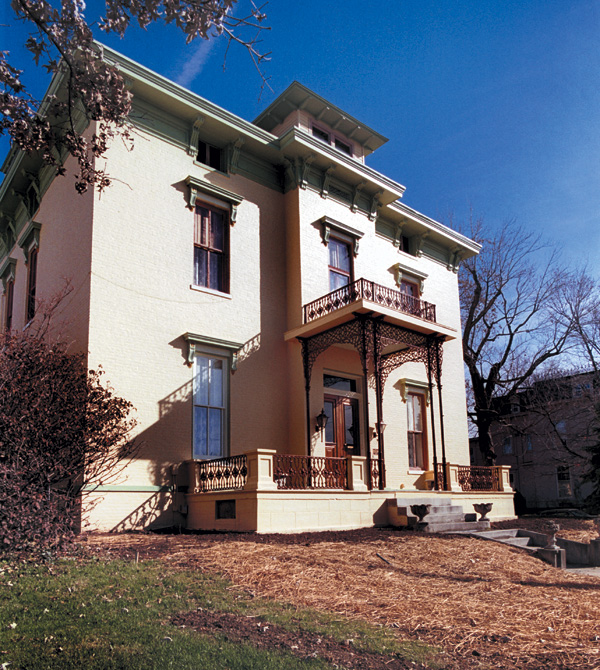
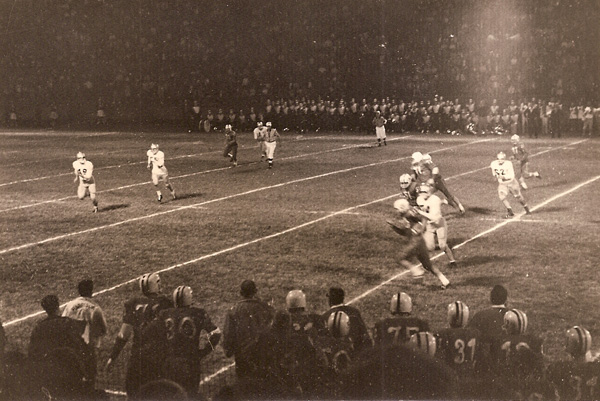
Now they caution everyone to drink lots of water. Back then, we were cautioned about drinking too much water and were given one water break during a two- to three-hour practice and force fed salt pills. What water we contained was quickly transferred to the heavy cotton jerseys and then caked with dust to form mud patches. At the end of practice, I can remember watching guys doing wind sprints with mud sailing off of them as they ran. Unfortunately, I never ran fast enough to generate that effect.

[pagebreak]

Mike Shoulders

Then: Offensive end and defensive back
Now: President and CEO of VPS Architecture in Evansville

One of my fondest memories involved both Steve Barnett and Coach Lowell Galloway. Now, Steve and I were notorious during summer practices, in particular, for being screw-offs during calisthenics. We were always in the way-back rows, halfway hiding from the coaches and cheating as much as we could. Our jumping jacks were more like flapjacks; our pushups looked like girls’ with knees often touching the ground. We would get in about one pushup for everybody else’s three or four.

One time in summer practice, we were way in the back, facing each other during pushups and laughing at everybody else when I saw Coach Galloway coming our way. He was dead ahead and directly behind Barnett, who couldn’t see him coming. All of a sudden, I started pumping out pushups like there was no tomorrow, like a jackhammer or some other machine, which made Barnett laugh even harder because he thought I was putting everybody on. So he just kept laying low and laughing, when all of a sudden Coach Galloway’s big size 13 was driven straight up Barnett’s rectal area, and Steve was driven forward, smashing helmets with me. The outcome of it all was 10 laps for Barnett and a good football story that I’ve told for many years.

[pagebreak]

Greg Fenner

Then: Offensive end and middle linebacker
Now:
Owner, WriteAway! Group in Nevada City, Calif.

I remember one time, when we were assembled right before practice, Mr. Mays came into the locker room. He got everyone’s attention. Then he said, “We are losing a lot of practice jerseys, and it has come to my attention that some of you have stolen them and are wearing them around town. We paid a lot of money for those jerseys, and I’m taking this theft thing VERY SERIOUSLY.”

His voice raised louder and louder. “AND DO YOU KNOW WHAT I AM GOING TO DO IF I CATCH YOU WEARING ONE OF THESE JERSEYS OFF THE PRACTICE FIELD?” Silence and big-time trepidation among the team. “I AM GOING TO MAKE YOU GIVE IT BACK!”

[pagebreak]

Richard Leibundguth

Then: Offensive center
Now:
Retired corporate pilot for the Black Beauty Coal Company in Evansville

How much did I love the two-a-day practices?
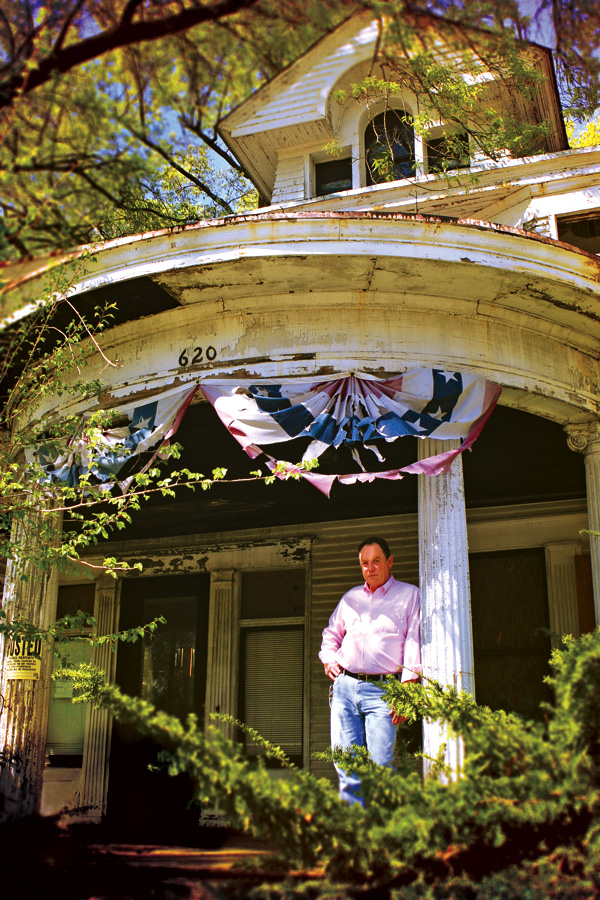
Let me count the ways:

1. Like any teenage boy, I loved waking up at 5:30 a.m. during the summer break.

2. I loved the nose-burning, eye-watering fragrant aroma of the stale locker room early in the morning.

3. How could I not love the elastic straps of the shoulder pads after they rolled up like piano wire from the sweat and the scars I still bear to remind me?

4. I loved doing those cut-away drills [editor’s note: a player in elevated push-up position threw his arms to his side and crashed to the ground, supposedly to toughen up the stomach] so soon after breakfast.

5. Who didn’t love running the tires near the end of practice after taking a lap around the track? That alone was fun, but when I tripped and fell flat on my face with the next guy or two running up my back with their cleats, now that was fun!

6. I loved hitting the seven-man blocking sled and pushing it up field with the extra weight of two coaches and [Assistant] Coach Harwood kicking our helmets while screaming, “Drive! Drive! Drive!” I think that’s what happened to my hearing.

7. I loved it when Coach Claybourne would yell at me, “Leebungoof, don’t do as I do; do as I say!”

8. The most fun for me in those two-a-day practices was the two-man tackling drill where we started on our backs helmet to helmet. Coach would yell, “Go!” Then, he would toss the ball to one player, and the other would have to take him down. I looked forward to being paired with steamroller [Dave] Davies, especially when he got the ball.

Enough said!

Withering Heights

0
Indiana Landmarks staff member Stewart Sebree is spearheading the effort to save this historic home at 620 Washington Ave.

Kerry Postlewaite measures progress in his neighborhood in small but significant changes. Last year the decision by his next-door neighbor to invest in a new roof made Postlewaite “a very happy man.” The new roof stands out, given that several homes surrounding his have roofs with gaping holes, tumbling chimneys, rotting porches, or broken windows.

But Postlewaite stands outside the door of his home on Washington Avenue and is optimistic. Two dilapidated homes south of his were torn down last year by the city, ridding his block of a notorious crack house as a result. “The neighborhood still has a long way to go,’’ says Postlewaite, a 30-year-old carpenter. “But I see progress. I used to be approached by hookers every other day. It’s been four or five months since that’s happened.”

The evidence of progress isn’t just the fact that the nearby vacant grocery store has been bought by Downtown entrepreneur Tim Mills with plans to transform it into a high-end catering center. Nor is it the fact that two homes on his block have been transformed from multi-unit apartment houses into duplexes for middle-income residents, a move mirrored throughout the neighborhood. And, it’s not even the news that the city has declared a portion of Postlewaite’s neighborhood a “redevelopment zone” as a first major step into turning it into an artists’ colony.

For Postlewaite, who bought his house a few years ago after the city’s building inspector condemned it, the best evidence of progress may be just a block away on Second Street, along the southern border of the Washington Avenue Historic District. It’s the home of Mike Martin, who bought the near-collapsing century-old structure in 1991 for $11,000. Martin spent years restoring the house in his off-work hours, investing money and sweat-equity gutting and then rebuilding the structure, which needed, among other things, 5,000 bricks and 57 floor joists replaced. In early April, when Martin invested in another neighborhood property, he had his home appraised before putting it on the market. The listing price? $324,900.

The figure bolsters Postlewaite’s optimism and pleases Martin, who remembers a discouraging moment early in the renovation, when he tumbled from second-story scaffolding after he was stung 22 times by hornets nesting in a rotting window frame. “It takes somebody with a lot of energy to take on one of these houses,” says Martin. “But it also takes somebody with some vision. Somebody who can walk into one of these houses and imagine the grandeur that was once there.”

It will take more than energy and  vision to save the Washington Avenue Historic District, city officials say. Earlier this year, the Historic Landmarks Foundation of Indiana named the district to its annual “10 Most Endangered” list of significant Hoosier landmarks in jeopardy—marking it on the verge of extinction—and vows to keep it there until it’s saved or deteriorates beyond hope. Foundation officials say the neighborhood was chosen among hundreds of threatened landmarks in Indiana because it is plagued by demolition, neglect, and accelerating decline.

That’s the bad news. The good news is that the list calls renewed attention to what was once one of the city’s most prosperous neighborhoods. Evansville Mayor Jonathan Weinzapfel lobbied to put the neighborhood on the list, hoping it would serve as a call for community action to save a defining chapter in Evansville’s history.

The district, bounded roughly by Madison and Grand Avenues and East Gum and Parrett Streets, sprang up in the late 19th century, during an economic boom here when the population went from 29,200 in 1880 to more than 59,000 by 1900. The growth, according to an 1889 history book, marked the transformation of Evansville “from a humble hamlet of (founder) Hugh McGary into one of the leading manufacturing cities in the United States.”  (Continued on Page 2)[pagebreak]

When the neighborhood was nominated to the National Register of Historic Places in 1980, local preservationists cited the district’s “important collection of late-Victorian frame houses” – grand styles, from Gothic Revival to French Second Empire, designed by the city’s leading architects for some of its leading citizens. Among those who built stately homes on Washington Avenue were Max deJong, an importer and fine clothing retailer; Antonio Sierra, superintendent of the Fendrich Cigar Company; and William Akin Jr., a well-to-do meatpacker who later became mayor of Evansville.

The neighborhood is adjacent to the Riverside Historic District, filled with the well-restored former estates of the titans of Evansville’s 19th century industries. But as preservationists have noted, the Washington Avenue Historic District is a world away from the Riverside neighborhood in terms of recognition and protection. The Washington Avenue district – where 23 percent of the houses have been demolished in the last quarter-century – never attracted the investment that Riverside did. Local and state preservation experts fear the demolition of structures in the Washington Avenue district along with the accelerating decline of what remains could jeopardize the area’s status on the National Register of Historic Places.

Evansville Historic Preservation Officer Dennis Au thinks that’s a crime. “In its heyday, Washington Avenue was a grand residential corridor. It was a gateway into our city,” he says. “We need to get people to recognize that it was once part of the core of our city. And you know what happens when the core of a city goes bad? The whole city rots from the inside out.”

Just what happened to the Washington Avenue neighborhood? A multitude of things, Au says, beginning with World War II. In the 1940s, the city’s population exploded when it became a wartime manufacturing center. In 1942, an additional 15,000 workers alone were needed just to build the Landing Ship Tanks in the city’s new shipyard. Patriotic homeowners along Washington Avenue rented rooms to wartime workers. “There was such a demand for housing that some workers were renting rooms by the shift,” Au says. “One worker would rent the room to sleep at night; a worker on the night shift would rent the same room to sleep in during the day.” After the war, new housing sprang up around the outskirts of the city, fueled by low-interest mortgages and a surge in automobiles and cheap gas that made Evansville’s streetcar lines, including the one that ran down Washington Avenue, obsolete.

Prosperous homeowners in the Washington Avenue neighborhood moved out, leaving behind houses that continued to be divided into apartments. The housing stock, predominantly wood frame, didn’t weather with age as well as the brick and masonry homes in the Riverside neighborhood. As the houses deteriorated, so did the perception of the neighborhood.

There have been efforts to stop the decline. In the late 1970s, the city promoted a concept known as re-gentrification to lure affluent homebuyers back. In a controversial move in 1978, the city bought a house in the 200 block of Washington Avenue and spent more than $310,000 in community development funds to renovate it. The intent was to showcase the house as evidence of the city’s commitment to the neighborhood. But the effort backfired; the costs, once published in the newspaper, ignited an uproar of criticism from those who thought the money would have been better spent assisting low-income homeowners already in the neighborhood.

The neighborhood continued to deteriorate despite efforts of individual homeowners and neighborhood associations who, among other things, lobbied the city to crack down on absentee landlords. In 1999, the Preservation Alliance of Evansville named the Washington Avenue Historic District to its “10 Most Endangered List.” In 2002, it became the focus of the local Historic Preservation Week events. The attention again triggered efforts to save the neighborhood. Among them was the creation by Weinzapfel of the city’s Front Door Pride program, which provides matching grants up to $5,000 to property owners in older neighborhoods for exterior renovations.  (Continued on Page 3)[pagebreak]

The Historic Landmarks Foundation of Indiana also teamed with the city to purchase an abandoned house in the 400 block of Washington Avenue through an innovative partnership that has worked well in other cities. Contractors were hired to repair the home’s exterior from the foundation up to give it “protective coverage” and then painted the exterior in historically accurate colors to give it curb appeal. It worked. Last year, the Foundation sold the house, recovering its money, and then re-invested it in another home in the neighborhood at 620 Washington Ave.

“This is more about community revitalization than historic preservation,’’ says Foundation staff member Stewart Sebree. “It’s about making an investment that will lure homebuyers who may have been reluctant before to move into the neighborhood.” Will it work? Not on its own, both Sebree and Weinzapfel say.

“What’s happened to the Washington Avenue Historic District was decades in the making,” Weinzapfel says. “We can’t buy up every home in the neighborhood. It’s going to take people who are willing to invest in the neighborhood again. We’ll be there to help, but we need partners in this project.”

Historic Landmarks Foundation Vice President Mark Dollase says it takes intentional effort and significant sums of public and private money to salvage a decaying neighborhood. A success he points to is the Fall Creek neighborhood in Indianapolis. Once known as “Dodge City,” the 26-block inner-city neighborhood was known for its high crime rate and boarded-up properties. With a $4 million federal grant and $15 million in city money for major infrastructure improvements, the project leaders lured builders and developers into the area with incentives to renovate old homes and build new homes that closely mirrored the architectural details of existing houses. The city worked with banks to create special financing packages for homebuyers in an effort to make Fall Creek a mixed-income neighborhood with homes selling from $94,000 to $400,000. In five years, more than 400 new families have moved in. The crime rate has plummeted, the property tax base has soared, and significant private investment in adjacent historic neighborhoods has increased.

It worked, says Dollase, because a number of key players, from bankers to politicians, realized the larger benefit from the massive infusion of money into a single neighborhood. While a project the size and scope of Fall Creek can’t be easily duplicated, Dollase says, “the lessons learned at Fall Creek, about how to put together a project and how to build the partnerships to execute it, are invaluable. That can be replicated.”

After years of starts and stops, Weinzapfel says the revival of the Washington Avenue Historic District is close to the tipping point. He likens it to the slow process involved in the Main Street loft projects. “At first, it took a few investors who acted on faith. Then people liked what they saw, and the project turned a corner,” Weinzapfel says. “Now there’s a kind of ‘buzz.’ We need to create that same kind of buzz for the Washington Avenue district.”

Teacher Chris Brown is doing her best to do just that. She and her husband, David, have bought several houses in the Washington Avenue district, investing significant capital to transforming them from decaying multi-unit apartment houses into well-kept duplexes rented out by college students and young professionals who think a historic neighborhood is a hip place to live. University of Southern  Indiana students Melissa Clark and Ashley Robertson are two of her tenants, who share the bottom half of a house on Washington Avenue. “I heard some kids in class talking about this lady who had some awesome houses,” Clark says. “I think it’s cool what she’s doing to these old houses.”

Brown, who lives in an historic home near Downtown Evansville, has a reason for making her houses in the Washington Avenue district so appealing. “If I can get these middle-class kids to fall in love with this neighborhood now,” she says, “hopefully, they’ll eventually want to buy a home in this neighborhood.”

A Tale of Our City

0
Indiana Supreme Court Chief Justice Randall T. Shepard poses in the courtroom of the Old Courthouse

Why do those old buildings matter, anyway? For the same reasons business travelers say they sometimes wake up in hotel rooms wondering briefly what city they’re in.

To be sure, the miracles of mass production and modern American prosperity confer upon more of us than ever before a range of material goods and services that make our lives more comfortable and convenient. On the other hand, the mass market has also created a society in which many consumer goods tend to seem the same, the store names are identical wherever we go, and the ambience of even high-end retailing and dining is more predictable than enticing.

In this homogenized environment, there is a premium on things that remind us of the specialness of our time and place, things that help give daily life greater spice than the wait for the end of the same old commercial break.

Old or historic buildings do just that. Much of what we call today historic architecture came long before the era of mass production in housing, so it is the product of individual design and construction. Great old houses, churches, and commercial buildings stand as landmarks to the excitement of quality, individuality, and ingenuity.

When we talk about historic architecture in Evansville, we commonly think of the Riverside Historic District. There is good reason for this, as that neighborhood of old homes near the Ohio River is as rich a place of history and design and urban living as any city could hope for. And most people recognize a few other monuments as being special to our past and present, like the Old Post Office, the Old Courthouse, and the Willard Library.

But there are scores of other places that anchor us to our history and enrich our lives by making Evansville stand distinct from, say, Des Moines, Iowa, or Lexington, Ky.

Like the country’s third-oldest professional baseball park, Bosse Field. Or Mayor Boehne’s house at 1119 Lincoln Ave., or Trinity Methodist Church on Third Street, built during the Civil War. The full block of splendid workers’ cottages miraculously still standing near Lincoln Elementary School.

Some of the city’s jewels sit just off the beaten track. Who could ask for a lovelier neighborhood than the one surrounding Akin Park, though tens of thousands pass nearby each day without gaining the experience. Not far away on streets like east Adams and Madison, there are hosts of attractive 19th Century homes and churches that make the area a special place to live.

Even more hidden are some archaeological remnants, like the odd diamond-shaped parcel near the Southwestern Indiana Mental Health Center that represents Evansville’s earliest cemetery. And the very occasional diagonal labels on Main Street that reflect the city’s role as a leading manufacturer of cast-iron storefronts, produced by the craftsmen at Mesker Steel.[pagebreak]

Other landmarks connect us to great national movements in American history. The twin libraries on West Franklin and in Bayard Park reflect the monumental effort of Andrew Carnegie to extend book lending to millions of Americans for whom it was not previously available. Likewise, Garvin Park represents a respectable sculpted landscape from the “City Beautiful” movement of the early 20th Century, of which New York’s Central Park is the most famous example.

Some Evansville corners have been reused multiple times in multiple styles and purposes. The new Koch Family Children’s Museum of Evansville, of course, formerly served as the Central Library in one of our best Art Deco buildings (the Greyhound bus station is our other gem from that era, though it’s Art Moderne). This was previously the site of Evans Hall, a Gothic headquarters for the temperance movement, which in turn stood on the ground of a tavern where Colonel Evans’ sons engaged in a fatal argument. Mrs. Evans bought the place, tore it down, and offered it for temperance purposes.

Like history in general, of course, history in architecture is an ongoing story. The story of Evansville’s tomorrow will rest in part on whether present generations make the effort to build distinctively rather than settle for the mundane. We do in fact sometimes get this right. Mayor Frank McDonald Sr. went the extra mile during the 1960s to engage the famous Chicago firm of Skidmore, Owings, & Merrill for the new campus of local government. The resulting Civic Center Complex is plainly superior to similar installations built contemporaneously in South Bend, Fort Wayne, and Indianapolis.

Other modern entries to our public architecture are good candidates for long-run acclaim. The new Central Library, the recent David L. Rice Library at the University of Southern Indiana, and the interiors, at least, of The Centre. On the private side, the headquarters of Integra Bank stands well above the crowd. Evansville will be a better place if we value and encourage more such endeavors.

And whether Evansville will continue to be a good place to live is really the point of it all.

Yes, we historic preservationists are often led to ask ourselves, “What will future generations say of us if we let this landmark or that one disappear under the wrecking ball?” But the most important question is whether the city will be a good place to live. Will it be a spot where one can get a good education, find a decent job, and raise a family?

And more than that, will it be a city rich in places to live and visit? Will it put value on the special aspects of life, like quality education and the arts and fine architecture and great neighborhoods?  Will it do all this in a way that helps our children envision how far their own futures can take them?

Preserving our city’s great historic architecture and building great new landmarks are an important part of
assuring that Evansville will be all that it can be.

Shepard is an Evansville native and former deputy to the late Mayor Russell Lloyd Sr. He’s a nationally known advocate of historic preservation. In March, he was sworn in for his fifth term as the Indiana Supreme Court Chief Justice.

The Dukes of Evansville

0

The idea came from David Burke’s mother: Sing Gene Chandler’s “Duke of Earl.” Burke accepted her advice and convinced his three best friends — Tim Eli, Rick Morris, and Rob Daniels — to perform the 1962 doo wop song for their North High School variety show. The timing was right, says Burke; it was August 1980, and nostalgia for 1950s and 1960s music was high. The four juniors practiced in the choir room and in the boys’ bathroom. (“The sound in there was amazing,” Burke says.) The costume-clad musicians completed the song with choreography, and the show was a success. They started singing at pep assemblies, and North administrators organized a sockhop, starring the group of friends whom students called “The Duke Boys” as in “those boys who sing ‘Duke of Earl.’” The performance began an “unexpected treasure” for Burke, he says — a treasure that’s lasted three decades this August.

The North graduates attended the University of Southern Indiana, racked up gigs, and added new members. Sweeney’s on the Green (a bar in the former Ramada Inn, now a Holiday Inn on Highway 41) became their hot spot, regularly playing Sundays before packed houses despite a major challenge: They were young and performing music before their time, admits Burke.

They found The Vandals, an older Ohio-based band with a similar style. “For a while, we stole a lot from them,” Burke jokes. At a Vandals show, “we were awestruck by the shenanigans and the comedy,” says Burke. The two groups met, and for the next few years, each was booked throughout the Tri-State. Once, the bands played at separate events at the former Executive Inn in Owensboro, Ky., on the same night. “They would steal glances at us,” Burke says, “and we would steal glances at them.” On mutual breaks, they’d hang out like they were touring together.

While Burke credits The Vandals as a performance influence, their music has taken The Duke Boys beyond Evansville. In 2005, they played in front of thousands at the Surf Ballroom in Clear Lake, Iowa, where music legends Buddy Holly, Ritchie Valens, and J.P. “The Big Bopper” Richardson performed their last concert before their untimely deaths in a plane crash. Built in 1948, the Surf has retained its original ocean beach club atmosphere. There, The Duke Boys performed with rock stars Jason D. Williams and Matthew and Gunnar Nelson, late rock heartthrob Ricky Nelson’s musical twin sons. “It was hallowed ground,” Burke says. “We were asked to perform there, and it was an honor to even be asked.”

What Burke loves about this music is, vocally, these 1950s and 1960s songs have an amazing sound, he says. Burke, the only original member still performing regularly, appreciates the roots of this music, and his love of that fuels him today. But his driving factor is his band mates: singers Kerry “Flounder” Sinclair and John “Hoot” Urbina and musicians Bob “Bobcat” Green (keyboard/sax), Dave “Doc” Matthews (drums), Rickie “Trickie Rickie” Byrne (guitar and vocals), and Ed “Mr. Ed” Ward (bass). (“Everyone who’s been in the band has gotten a nickname,” says Burke, aka “Gomer.” “It’s like a little fraternity.”) They’re the reasons Burke still has a passion to perform, he says: “You have to hang out with the goofballs I hang out with on the weekends to understand.”

The Duke Boys have two public performances this summer:
July 24 at Wilson’s General Store & Café and August 27-28 at Casino Aztar.

Jane Owen

0

When Jane Owen first arrived at Montana State University, she had her eyes on a degree in business administration. Her freshman class catalog showed a list of television electives, which was the influence Owen needed. The Oregon native ditched business administration (much to her mother’s dismay) and focused on a degree in film and television production.

In college, she landed a job at KUSM, the first public broadcasting station in the Rocky Mountains. Then, she headed to San Diego and took on a range of industry jobs — camera operation, audio controls, and editing services — for documentaries and magazine shows.

“I’m more interested in people,” she says. “I think life has an interesting story most of the time.” Six years ago, her husband Steve became an attorney for Evansville-based Traylor Bros., a construction company he had worked with in California. Here, the mother of three (Bryn, 12; Blake, 10; and Laurel, 5) launched One Chick Productions, creating videos for nonprofits such as the Welborn Baptist Foundation, the Boys & Girls Club of Evansville, and the Junior League of Evansville. The latter’s series of public service announcements aired on WNIN and earned a regional Emmy nomination. Her current project, expected this spring, shares the beats of a popular drum line, the Boom Squad.

I watched MTV when it first came on the air. I think that was 1982. (MTV first aired on Aug. 1, 1982, with The Buggles’ “Video Killed the Radio Star.”) I was in high school. I don’t remember the first music video I watched, but I bought a music video compilation for $80. Can you believe VHS tapes were $80? I had to special-order it, and it was Duran Duran’s (self-titled) album. They had done videos of the entire album, and it was one of the first times that music videos had taken on more than a bunch of guys jumping around in a public access studio. They actually made a story out of their songs with nice cinematography and lighting. It fascinated me.

The stuff I was doing in college and some of the stuff I was doing for KUSM were stories about people. My senior project, which won an award, was called A Place to Rest: A Story of Hospice. I’ve filmed cattle brandings from the back of a truck on a ranch where they’re catching the cattle and branding them.

In California, I was pulling cable for a live show with Dana Carvey. He was at the height of his career with Saturday Night Live. Luckily, I wasn’t doing camera; I was just helping the camera guy. I couldn’t stop laughing, so he started to tell the jokes to me, and it made it hard to do my job. I was losing it.

When we moved here, I was so out of my element. I’ve been east of the Rockies, but I’ve never spent a whole lot of time. I had taken a 10-year hiatus raising my children, and I didn’t know what I was going to do here after the kids had gone into school. I had even looked at going back to college for interior decorating. Finally, I landed at the Junior League — this group of women who are just powerhouses. I thought, “I used to be good at something.”

The world behind the lens changes me. It changes my personality. It may not seem like it here, but I’m absolutely petrified to walk into a room full of people. I don’t know what to say to people. I usually say the wrong things, and I feel like an idiot. If I have a camera with me, I’m confident, I’ve got a purpose, and I’m fearless. I can ask just about any question. I can go up and talk to anybody.

Good stories are everywhere. They’re absolutely everywhere. I don’t feel like I need to look that hard. For example, I was sitting in a Junior League meeting once, and they brought in the Boom Squad. Just sitting in that performance, I thought, “That’s a story.”

To learn more about Jane Owen’s videos, visit www.onechickproductions.com.

The Nashville Sound

0
The Country Music Hall shines in downtown Nashville, Tenn.

Until I read Harlan Howard’s quote inscribed on a wall in Nashville, the reason for country music’s popularity had been a mystery to me. “Country music is three chords and the truth,” Howard once said, and his definition fit so perfectly, leaders at the Country Music Hall of Fame and Museum placed his words on a prominent 20-foot wall for guests to read at the $37 million complex. The music legend’s words were exactly what I needed during my four-day trip to the Country Music Capital of the World in Tennessee: The quote was strikingly succinct, and I looked for Howard’s idea to define the city.

A quick trip south brings Evansvillians to Nashville, a place locals claim was birthed by music as soon as settlers whipped out their fiddles for jigs in the early 1700s. Davy Crockett — a congressman, “king of the wild frontier,” and fantastic fiddler — was Nashville’s first celebrity, they also say. Many others followed, including 20th century icons such as Hank Williams, Patsy Cline, and Roy Rogers. With such a rich history, the city celebrates its music daily: From tours of the former RCA studio to barbecue ribs so tender the meat falls straight from the bone, country music feels somehow ingrained in every aspect of the city’s culture.

The staple attraction epitomizing that culture is the Country Music Hall of Fame and Museum. In 2009, more than 80,000 visitors passed through the hall’s doors. A leading reason was Family Tradition: The Williams Family Legacy, an exhibition that felt like I was stepping into a Web site. Williams’ videos and music played, and touch-screens led me through a pictorial life of the famous music family, which includes Hank Williams and his son Hank Williams Jr. The family granted intimate access to their story, and the effect was warm and inspiring.

The exhibit runs through 2011, and the impact shaped a remarkable 2010 season, says Tina Wright, director of media relations: “We feel like we are hitting our stride.” Museum staples also deserve attention: Inside is the library of country music — a 1 million song archive. Video screens dot the floors recalling special musical moments, and musicians’ personal items are displayed. (Check out bluegrass legend Bill Monroe’s Bible and the joker card he always used a bookmark.)

Bookmarked on my trip was a visit to Historic RCA Studio B for a public tour and history lesson about the local music scene. Elvis Presley recorded 250 songs at this studio that was open for three decades until it closed the day after his death in 1977 (pure coincidence). Scores of other famous artists established the studio as the place for the “Nashville sound” — a 1950s mixing of country music with pop sounds. Today, photographs of artists such as Dolly Parton, Willie Nelson, Chet Atkins, and numerous others reveal the history of the studio, and the ending of the tour includes the option to record your voice to Presley’s romantic and smooth “I Can’t Help Falling in Love with You.” I sang with my tour group and received a CD of my recording. My style is called the “monotone sound.”

I was steps away from up-and-coming country stars; perennial favorites; and current country, bluegrass, and western music superstars when I caught a show at the Grand Ole Opry, a venue for live music performances that have been broadcast on the radio for more than 60 years. I saw Rascal Flatts — a multi-platinum country music trio — end the show, but the highlight was Little Jimmy Dickens, who, at less than five feet, commanded attention on stage when he opened the show. Dickens set the tone with upbeat songs and fantastic jokes about his life as a septuagenarian. With 60 years performing at the Grand Ole Opry, he still is a regular and worth the trip.[pagebreak]

With a seating capacity of 4,372, the Grand Ole Opry is fun, but it’s hardly intimate. The Bluebird Cafe, on the other hand, demands intimacy from patrons, and if musicians don’t receive silent attention, the distracting patrons are booted. The policy is strict, and the bar and restaurant’s motto is “Shhh!” Since 1982, venue owners have boasted they have showcased songwriters before they became stars, including Garth Brooks, Kenny Chesney, and Taylor Swift. Often, those who launch their careers at Bluebird become reoccurring guests, and original acoustic music is heard seven days a week.

Filled with country music, I headed to downtown Nashville to become filled with country culinary staples at Jack’s Bar-B-Que restaurant. The New York Times, Los Angeles Times, and Southern Living call owner Jack Cawthon’s hickory-flavored barbecue the best in Nashville, and with 420 pounds of pork prepared each day, Cawthon’s recipe lives up to a big reputation. He began his career as a caterer, but Cawthon wanted a more casual earning. He opened his eatery in 1976, and now “I get to wear a hat,” says Cawthon in his trademark cowboy hat. So popular has his barbecue become that talk show host Oprah Winfrey, who went to high school in Nashville, asks for Jack’s barbecue on her private jet.

The accommodation offering a refreshing respite from the country music scene is the Gaylord Opryland Resort & Convention Center. On Thanksgiving Day in 1977, Opryland was 580 rooms and a ballroom used to support the nearby Grand Ole Opry. More than 2,000 rooms, 8,200 tropical plants, and a three-and-a-half story waterfall later, the resort feels like its own city, and Opryland guests, who have included celebrities such as poet Maya Angelou, actor Jim Carrey, and former President George H.W. Bush, need maps to find their way to the resort’s amenities and attractions, including the 20,000-square-foot, European-inspired spa, salon, and fitness center — known as Relache — and the 14,000-square-foot, upscale Fuse Nightclub, which plays dance music.

Refreshing as the dance beats are, the town is about country music, and after my trip, I still am not a yeehawing fan. I am a fan of country music’s city, Nashville, for the live music, history, and food. It would take more than three chords to express what I mean in song, but it would be the truth.

When You Go:

•  The Bluebird Cafe – (615) 383-1461 – www.bluebirdcafe.com
•  Country Music Hall of Fame and Museum – (615) 416-2001 – www.countrymusichalloffame.com
•  Gaylord Opryland Resort & Convention Center – (888) 777-6779 – www.gaylordhotels.com
•  Grand Ole Opry – (615) 871-6779 – www.opry.com
•  Historic RCA Studio B – (615) 416-2001 – www.countrymusichalloffame.com
•  Jack’s Bar-B-Que – (615) 254-5715 – www.jacksbarbeque.com

ICON

0
Inspired by big-city nightclubs, the design of the new ICON bar on the East Side has a sleek, sophisticated feel.

The leather is sleek, the lighting is warm, the metal is hard, and the tile is smooth. The interior of the new East Side bar/nightclub ICON has a classic modern feel. “Visually,” says designer Marjorie Bergen, “it should be a playground.”

The white marble floor greets visitors, the open-ceiling concept exposes metal girders, and the plush seating is warm and inviting. The $45,000 audio and visual system, which pumps the best hits from the ‘80s and ‘70s, controls the Bulgaria-imported, 10-foot-high, multi-colored wall of lights, bordering the dance floor. Five, single, unisex bathrooms are ideas borrowed from Las Vegas and Indianapolis clubs. When the Belgium-made, glass-bathroom doors lock, the glass “fogs,” allowing for privacy. Suits, cocktail dresses, designer jeans, and dress shoes are the norm for this over-30 crowd.

The idea for the bar came from Dean Brinker, co-owner of Brinker’s Jewelers. Brinker plans to make the former Harrison-Village shopping complex a “one-stop-shopping area,” now known as 111 South. In 2007, he has added a café, a home store, and, most recently, ICON.

To do this, he tapped longtime family friend Jason English, owner of an adult nightclub. English, who frequents clubs in Miami and Las Vegas, wanted to bring a “big-city” club atmosphere to Evansville. On a Friday, his white limo can be seen parked in front of ICON while English mingles inside, surrounded by a beautiful entourage.

The re-designed Breaker’s Billards space gives ICON patrons that big-city atmosphere, says Bergen because the interior is so unique to Evansville. “It’s like going on vacation,” she says. Using a blue, white, and silver color palette, Bergen used leather like it’s the world’s only material, covering most of the furniture with it.

The club offers seating for 100, a dance floor, and a stage where bands like the recently reunited cover band, The Pits, perform. United in 1983, The Pits never actually broke up, says lead guitarist and vocalist Gene Baker. When original bass player Fred Schultheis moved to Knoxville, Tenn., in the mid-1990s, The Pits played in Evansville only sporadically. In August 2006, original drummer George Barnett (an attorney), keyboard player Ray Prichett (a business development firm’s project manager), and Baker (a sales consultant) replaced Schultheis with Jon Hyneman (a high school band director). His addition allows the band to play more often in Evansville clubs like ICON in January and F’s Steakhouse in February. Despite their 24-year history, The Pits are not an oldies band, Baker stresses. They love playing the classics, he says, like The Rolling Stones and The Knack but also enjoy current bands like the Red Hot Chili Peppers and Weezer. They’ve also added a video production to their stage shows with an 8-foot tall screen, displaying crowd reactions and television montages. It’s a great fit for the trendy ICON, where Baker likes to play. “It’s great to see the 30 and above crowd out and dancing,” he says.

In operation for just one month when we went to press, English is still adjusting ICON’s hours of operation. Closed only on Mondays, the club is typically open from 3 p.m.-3 a.m. Tues.-Sat. On Sunday, the bar opens at 3 p.m., and English is still unsure when to close this night.

But there’s no question about what English hopes the bar will be. “It’s just a matter if Evansville supports it,” he says. “Everyone comes back from big cities, saying, ‘They have this and that.’ Well, you build them a big-city bar, let’s see if they like that.”

The Power of Giving Becomes the Power to Inspire

0
Feature from the May/June 2006 issue of Evansville Living

In January 2006, two Owensboro businesswomen, Martha Clark and Marianne Smith Edge, dreamed of bringing together 100 women who would each agree to pay $1,000 to their organization, Impact 100 Owensboro, but their goal changed when, in three months, 150 women joined and raised $150,000 to donate to a charity of their choice. Their feature in Evansville Living (“The Power of Giving Women,” May/June 2006) bolstered the imagination and spirits of Evansville women as a similar organization begins to form. But, what has Impact 100 Owensboro done since raising the money?

After receiving 50 grant applications, the group voted on Oct. 26, 2006, to donate to Grandma’s Corner, an Owensboro crisis daycare center. The center plans to use the money to enclose the kitchen, install child-size toilets, and renovate and expand its playground. Impact 100 also established a $40,000 endowment for the use of Grandma’s Corner in six years to fulfill future updates, renovations, and expansions.

The group is currently accepting applications for this year, and the organization’s successful 2006 has brought higher but obtainable goals, according to Clark. Impact 100 wants to expand its membership total to 200 women, which would raise $200,000. With a minimum donation of $100,000, the group can donate to two different nonprofits or grant all efforts to one group.

Clark is modest when she reflects on her organization’s achievements, but she knows Impact 100 “empowers women through philanthropy.”

“There’s a lot of positive response from the community,” Clark says, and this response has influenced a new beginning in Evansville. Barbara Dicken, foundation coordinator for the Vanderburgh Community Foundation, along with VCF president Allison Comstock and trustees Lisa Jones, Cindy Fine, Lynn Miller Pease, and Kristen K. Tucker, and committee members Jan Davies, Jingle Hagey, and Lu Porter, became inspired by the Owensboro women and have founded a similar fund in Evansville. The Women’s Fund of Vanderburgh County will kick off its fundraising this year. To become involved or to donate, please contact the Vanderburgh Community Foundation at (812) 422-1245.

Barbecue Season

0
Pancetta Peach Pasta

For years, “organic” has been a buzzword among foodies. But how about “local”? The reasons for eating locally grown food are numerous: supporting the area’s economy, meeting the growers face-to-face, and enjoying fresher-than-supermarket tastes. In a 2007 Time Magazine article called “Eating Better Than Organic,” writer John Cloud pointed out, “It makes sense that a snow pea grown by a local farmer and never refrigerated will retain more of its delicate leguminous flavor than one shipped in a frigid plane from Guatemala.”

Within a 20-mile radius of Evansville, opportunities abound to purchase fresh, locally grown ingredients. One booth I frequent at the Downtown Farmers’ Market belongs to Joe Engelbrecht Fourth Generation Orchard. Engelbrecht sells wonderfully ripe, juicy peaches and vegetables including heirloom tomatoes, peppers, and squash.

The Evansville area also has a few specialty food shops, and I recently discovered Vecchio’s Italian Market and Delicatessen in Newburgh. What most impresses me is the array of meats and cheeses that employees slice by hand and let customers sample. The peppery pancetta (a dry, cured meat) I purchased from Vecchio’s beautifully contrasts with the sweet, caramelized peaches in this recipe. Made entirely from locally sourced goods, this dish is perfect for a summer barbecue.

— Eli Haddix of McCutchanville has worked in the restaurant business for 12 years.

Pancetta Peach Pasta

Ingredients:
1/2 pound pancetta 1/4 inch thick, cubed
1 pound whole-wheat pasta (Pancetta and pasta purchased from Vecchio’s in Newburgh)
1/4 cup extra-virgin olive oil
3 tablespoons raw honey (Oil and honey purchased at River City Food Co-op)
1/2 red bell pepper, finely diced
1/3 red onion, minced
4 ounces baby spinach
6 medium peaches, cut into wedges (purchased from Joe Engelbrecht Fourth Generation Orchard)
1 bunch cilantro
(All other produce purchased at the Downtown Farmers’ Market)

Directions:
Heat a medium skillet, preheat the grill, and boil water for pasta. (Add about a tablespoon of salt to the pasta water.) Cook pasta according to package directions. While the pasta cooks, place the cubed pancetta into the skillet and begin to render the fat. Once the pancetta begins to crisp, add olive oil, bell pepper, and onion. Simmer over low heat for five to seven minutes, stirring occasionally.

Brush the peach wedges with melted butter and grill three minutes per side until firm and warm. Drain the pasta and toss it in the skillet after turning off the heat, gently folding in spinach and cilantro. Drizzle with honey and lightly sprinkle some Parmesan cheese over pasta. Serve topped with grilled peaches.

On the Top

0
Photo by Louis La Plante

Though derived from the saying “Everything but the kitchen sink,” the nine toppings on the Kitchen Sink pizza from 2 Daddy’s Pizza were no accident. Co-owner Andrew Klipsch, a veteran chef, chose ingredients that work harmoniously together: For example, the sweet pineapple pairs wonderfully with the sour banana pepper. Such is the case of the pizza covered with yin and yang options: sausage, mushrooms, ham, onion, green peppers, black olives, banana peppers, pineapple, and pepperoni. Even with ample cheese and numerous toppings, the flavorful, thick crust — cooked to a rich brown — perfects the signature pie.

The dish has been prepared and delivered from The Little Cheers kitchen (329 Main St.) for more than a year, and this July, Klipsch and his partners open a 250-seat, outdoor 2 Daddy’s Pizza at Marina Pointe (1801 Waterworks Road). The restaurant’s events pavilion, designed for music performances, seats 1,000. The space is “almost the size of a football field,” Klipsch says, and the focus is on food as much as it is on fun.

Athletic Advantage

0
Alan Tomczykowski, DPT, CSCS, a physical therapist for ProRehab, is a 2009 graduate of the sports residency program.

Every four years, the World Cup is a global sensation, soccer’s premier spectacle. Thirty-two countries compete in the world’s most popular sport. The last World Cup in 2006 generated 73,072 hours of televised matches in 214 countries and territories during the monthlong event, according to FIFA, the World Cup’s organizing body, and more than 715 million people worldwide watched the final match between Italy and France. What sports analysts ask in 2010: Will Americans, who typically find soccer much less appealing than the rest of the world, watch?

By the time this issue of Evansville Living reaches our readers, the World Cup will be halfway finished, and at least one local man, University of Evansville assistant professor of physical therapy Phil Plisky, will have had his eye on a few matches. Plisky’s interest in soccer piqued three years ago when a former UE student, Skylar Richards, called. Richards had landed a spot as an assistant athletic trainer for the Columbus Crew, a Major League Soccer team in Ohio’s state capital, and he wanted his alma mater’s help.

He knew UE partnered with ProRehab, an Evansville-based physical and occupational therapy clinic, to create a 15-month sports residency program “similar to what physicians go through to get their specialized training,” says Plisky, ProRehab’s vice president of clinical excellence and residency program director. At any one time, two to four physical therapists work in the program (one of nine in the country accredited by the American Physical Therapy Association), and Richards wasn’t looking for their help caring for injuries. He needed aid preventing injuries for professional players.

Columbus, Ohio, is home to The Ohio State University, a 50,000-student urban campus, and Richards still pooled talent from UE. “The distance is a little bit of a barrier, but what the really neat thing is,” says Plisky, “with large universities in the Crew’s backyard, it’s a real feather in Evansville’s cap to go there to test them.” Richards knew Plisky uses advanced research techniques to determine an athlete’s risk for injury.

Take, for instance, the Y-balance test first used on seven local high school teams. The test, one in a series of several, requires an athlete to stand on one leg and reach with the other as far as possible in three different directions, revealing various body attributes — strength, flexibility, range of motion, and balance.

The residents look for differences in the left and right sides of the body. If there is a large difference between the two sides, the athlete is more susceptible to injury since the weaker side is compensated by the stronger side. If an athlete performs poorly on the tests compared to the other players in the sport, a greater risk of injury exists because the athlete must compete at the same intense level as his or her competitors with a body closer to breaking down. The series of tests enables sports residents to “not only help identify who’s at risk for injury but also prescribe exercises based on the results of that test,” Plisky says. The individual results are unique since most preventive programs are team oriented, he says; “that’s not necessarily going to help everyone if they don’t need that particular activity.”

UE residents perform the testing in a one-day period before the start of the season and then train the Crew’s athletic staff to test athletes and prevent injury once UE residents leave. Consulting continues throughout the season, usually via e-mail.

Shortly after UE sports residents began their tests, the Crew captured the 2008 MLS championship cup and boasted one of the lowest injury rates in the league in 2009. Of course, Plisky admits numerous factors contributed to the Crew’s championship. (Passion is one example; Columbus was one of the first American cities to erect a stadium as a primarily professional soccer venue). But, “if you can keep your players on the field, you can win more games,” says Plisky.

That success from the tests has other teams interested. “It’s a good combination of seeing all the research that the university and ProRehab put out on the subject and then by word of mouth by sports teams at national conventions,” says Plisky, who’s spoken at the Professional Soccer Athletic Trainers’ Society and the American Medical Society for Sports Medicine meetings and seminars. National Football League’s Indianapolis Colts and Atlanta Falcons, National Basketball Association’s Oklahoma City Thunder, and Major League Baseball’s Texas Rangers have used the tests. Plus, international organizations, including England’s Arsenal Football Club and the Chinese Olympic team, administer these tests. The U.S. Army and the New Zealand military are among those finding the benefits of injury prevention.

For Plisky, those results spur the passion of his career. The onetime high school soccer center halfback from Highland, Ind., tore his ACL, an injury that ended his athletic dreams. “It’s just great to see that we can impact so many people internationally,” he says. “It’s a wonderful thing to help them keep their careers going.”