Face the Music

0
Cale and Rachael Schnaus

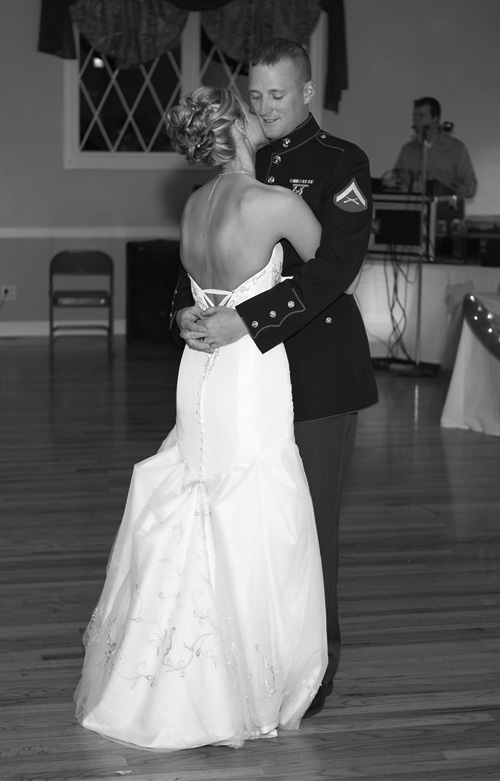
Band or DJ? It’s a timeless question of reception planning, and today’s cost-conscious brides increasingly are choosing a third option: an MP3 player.

Of course, each choice has its pros and cons. DJs are more affordable than live music, and an experienced DJ will keep your reception moving. The top reason to choose a band? Live music is more dramatic and emotional, says Brides magazine. If you opt for the do-it-yourself approach by using an MP3 player, you’ll save some money, and you’re guaranteed to like the music that plays — no “Chicken Dance” surprises for you. This option is better for smaller gatherings, advises Martha Stewart Weddings magazine. A word of caution: Borrow a backup device or two, preloaded with your playlist. Let’s face it, gadgets crash, and they don’t make exceptions for your wedding day.

Whichever music-maker you choose for your wedding reception, pick tunes that reflect your tastes. Communicate with your band or DJ: What are your all-time favorite songs? What kind of music do you listen to for everyday enjoyment? Are there songs or styles of music you simply can’t stand?

Your answers will guide your song selections. Although your musical preferences are important, so are your guests’ — and at weddings, the crowd often is diverse. Your college friends may love dancing to “Get Low,” but silver-haired Aunt Ida from Iowa may not be so enthused. Your playlist should include diverse genres of music that appeal to several generations of partygoers. One surefire way to please everyone? On your RSVP cards, include a line for each person to request a song. Guests are guaranteed to hit the dance floor for their own picks — even Aunt Ida.

Speech Therapy

0
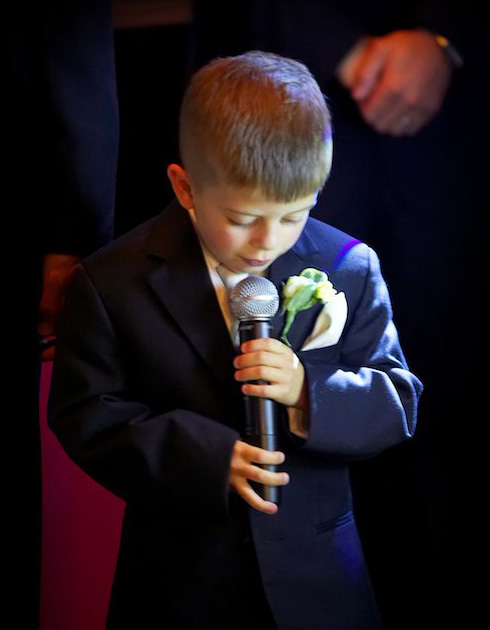
Giving a great speech or toast requires preparation, and the best ones engage the wedding guests with both humor and emotion.

At a summer wedding last year, the groom’s best man told me how he and the groom used to watch a lizard crawl up the side of a terrarium during their biology class in high school. The story’s one and only “highlight” came when the lizard reached the terrarium’s top to escape, only to have his plan spoiled by the terrarium’s lid. I wasn’t the only person who listened to that story. He also told a 300-person wedding reception.

That was his best man speech — no mention of the bride, love, or happiness. Just lizards. Try again, Best Man. Try again.

His failure reminded me of wisdom a former boss frequently reiterated: “Everybody needs an editor.” Best men and maids of honor need editors, too, because those speeches, which should each be five minutes (tops), should be sharp and witty yet meaningful and poignant. A good wedding speech has guests rolling with laughter one moment, and the next sentence makes their eyes water with happiness.

I might be laying the pressure on too thick, but great best-man and maid-of-honor speeches can set a subconscious tone for the rest of the reception. Though the best man and maid of honor don’t serve as the reception’s cheerleaders or ring announcers, their speeches can make wedding guests feel upbeat enough to hit the dance floor or cause guests to look at their watches and wonder how long they could politely stay.

Take the advice of an editor, and make a speech that defines the reception.

Speak clearly.
You have the microphone so announce to everyone that the bride is the prettiest woman in the room — even if she isn’t. Everyone will nod in agreement because they have to, and you already have them on your side.

Engage.
The next part is tricky: You have to make the guests laugh. That includes the great-aunt with the hearing aid and the teenage nephew with the short attention span. If you’re the best man, a good-natured jab at the groom is in order. For example, “I’ve known the groom for 10 years, and our colorful history shouldn’t be shared at a family event. So … good night, everyone.” For the maid of honor, try, “Well, I guess the bride is finished with all the bad blind dates.” The key to making an audience laugh is to find shared experiences. We’ve all had too much to drink with a close friend or been on a bad blind date. These jokes engage the audience.

Send a message.
Hit them with a funny story. Ex-lovers shouldn’t be mentioned, especially the one who got away, and the story needs to show who the groom or the bride is. Inside jokes don’t work either. Again, people want to relate. Keep it around two minutes; otherwise you risk losing the nephew’s attention to a shiny object. Anything less than two minutes and the story will be too vague and no fun.

Take it home.
You’re almost out. Wrap it up with a meaningful remark about love. Feel free to borrow a famous quote, or simply raise a glass and wish them the best. Cue applause.

A Way to Vow Them

0
Rev. Kevin Fleming leads Jason and Britta Pate through their vows during their wedding at First Presbyterian Church.

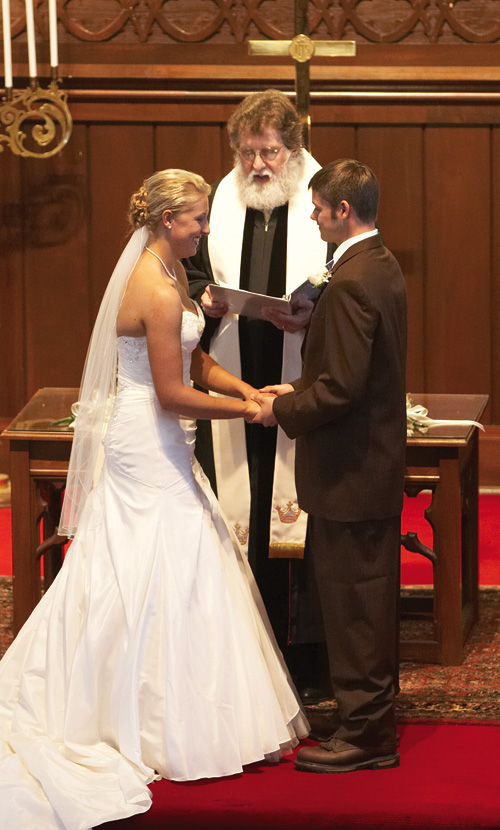
Every wedding begins with a ceremony — whether it’s traditional black-tie or laid-back beach fun. No matter which style, couples are finding ways to add a personal touch. Martha Stewart Weddings magazine recently noted a new wedding trend: A clergy member or a judge has the experience to wed a bride and groom, but many couples are asking a close family member or friend to pronounce them “man and wife.”

This DIY approach to wedding ceremonies means more work for the bride and groom, and though your choice knows how to say, “I now pronounce you man and wife,” it doesn’t mean he or she is legally qualified. With Martha Stewart Weddings as our guide, we found a few tips for customizing your wedding officiant.

Be selective.
The person you choose should be comfortable speaking in public. No mumbling allowed. Humor is an added bonus, but the ceremony shouldn’t become a Bill Cosby stand-up act. Tell your pick your expectations before he or she agrees. The ceremony may not be traditional, but it should be meaningful.

Legalize it.
Call the county clerk’s office where you’re getting your marriage license to find out what documentation is needed to ordain your officiant. Then, the officiant needs to be ordained or deputized. It’s free and easy: The officiant hits the Web, finds the most widely used source to obtain a certification of ordination (the Universal Life Church, www.themonastery.org), and fills out the forms. Ordained!

In Vanderburgh County, you’ll have 60 days from the time you’re issued a marriage license to have a valid wedding. From the Vanderburgh County Clerk’s marriage department, you’ll receive a marriage license, duplicate marriage certificate, and record of marriage:

The marriage license comes with a “pretty” document to be signed during the ceremony and a real one that looks like a pretty darn unromantic tax form. The latter is what you and your new spouse — and the officiant — sign after the ceremony and mail to the county clerk’s office within 30 days.

Research and create.
You’ll need an outline for your officiant. After all, it’s your wedding, not an improv class. Think about tone — fun, romantic, or sweet? — and discuss it with your officiant. The Internet offers numerous wedding examples: traditional, nondenominational, contemporary, even Medieval. Pick the pieces you like from each and give your ceremony structure. With tone in mind, here are some elements to consider: a welcoming procession, readings, vows, an exchange of rings, and — of course — the first kiss.

Best Dressed

0
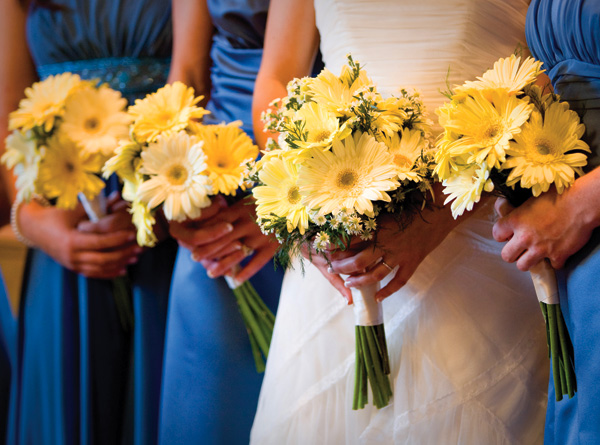
Your wedding dress sets the tone for your big day, and a figure-flattering gown looks timelessly elegant.

As a longtime fan of The Learning Channel’s fashion-focused reality show What Not to Wear, I’ve learned one fail-safe lesson from hosts Stacy London and Clinton Kelly: To flatter your figure, accentuate the narrowest part of your body. When I started shopping for wedding dresses after getting engaged in the fall of 2007, I learned that the same rule holds true for wedding dresses.

Brides should consider several factors before hitting the dress shops — their budget, the season and setting of their wedding, and possible dress codes at religious ceremony sites. But once you’re ready to shop, follow these tips from wedding experts for a fit that flatters.

Curvy girls can show off their hourglass figures with a contrasting sash around a small waist, advises The Knot (www.theknot.com), the country’s most popular wedding Web site. One style to avoid: Empire waistlines that start just under your bust, obscuring a narrow midsection. However, thick-waisted (or “apple-shaped”) women may find this style flattering. Remember that rule from Stacy and Clinton? The narrowest part of your body may well be the top of the rib cage, so an empire waistline accentuates this while skimming over your stomach. Decorative necklines, textured bodices, and a V neckline also “will draw eyes toward the vertical, not the horizontal,” says Real Simple magazine (www.realsimple.com).

Empire waistlines can work for plus-sized women, too, provided the dress fits just right. Avoid pleating, cautions Real Simple, which is “reminiscent of maternity wear.”

If you’re petite, you’ll look like a tall drink of water in a slim, straight-cut sheath. The biggest concern is overpowering your small frame with a voluminous style. Tall brides, on the other hand, can pull off poufy ball gowns. (This silhouette downplays height, while a clingy sheath plays it up, says The Knot.) A high neckline gives you classic elegance, The Knot adds, but overly embellished dresses may look frilly or cartoonish.

Big-busted brides can pull off a ball gown silhouette with a voluminous skirt. If you’re daring, you can pull off a V neckline, provided it isn’t too severe. (Your wedding day is no time for a wardrobe malfunction.) Watch out for strapless styles with straight necklines: Real Simple warns this “will make your bust appear even larger and more shelflike.”

In contrast, if you’re bigger on the bottom (or “pear-shaped”), a surefire solution is to look for details that draw the eye upward — for example, a beaded neckline. A fitted bodice emphasizes your narrow upper body, and ruching adds volume to a small chest. A classic A-line skirt minimizes your hips and thighs. If you want to downplay your lower half, stay away from straight sheath styles and mermaid skirts that cling all the way down to the knee.

Another rule when you’re dress shopping? Keep an open mind. Two years ago, when I headed to a small, locally owned wedding boutique in my hometown of Columbus, Ind., I spotted a dress that looked promising: an ivory A-line gown with a definite vintage flair. It never would have caught my eye on a Web site or in a catalog, but once I stood in front of the store’s mirror wearing it, I was sold. A few rounds of alterations later, I learned the most important rule of all: “The single most important factor when it comes to clothing is the way it fits,” says Real Simple. “If a gown is perfectly fitted to your body, it will look like it was made for you by a Parisian couturier, no matter what it cost.”

Remembering Will

0

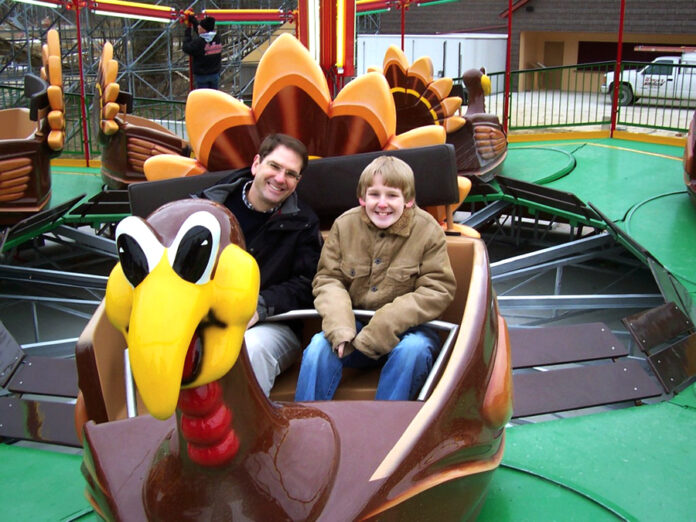
As president of Holiday World & Splashin’ Safari in Santa Claus, Ind., Will Koch’s career was dedicated to providing a fun, safe getaway for families. That career ended on Sunday, June 13, when Koch died at age 48 from what his family believes to be complications of Type 1 diabetes. As Koch’s family mourned, the park continued his mission by remaining open the day after his death. “We know that’s what Will would have wanted,” says Holiday World spokeswoman Paula Werne.

Evansville Living also remembers Koch for providing a different, more sobering kind of refuge for families: the Ronald McDonald House in Evansville. Koch lent his time and talents to the grueling $4 million capital campaign for the city’s Ronald McDonald House, which opened in January.

The home provides free or low-cost accommodations to Tri-State families who travel to Evansville, seeking medical care for their ill or injured children. The cause was close to home for Koch, whose young niece, Marie George of Indianapolis, underwent treatment for lymphoma and an immune deficiency disorder several years ago at Cincinnati Children’s Hospital. Her family found comfort and companionship at a nearby Ronald McDonald House.

Koch was known for embracing Holiday World guests as family, too. “At Holiday World, we often have visitors who are facing major challenges,” Koch told Evansville Living. “These stories touch our hearts very deeply.” His caring nature was part of the leadership philosophy that helped him propel the amusement park to record attendance numbers, several world records, and national accolades.

Lenny Leibowitz

0
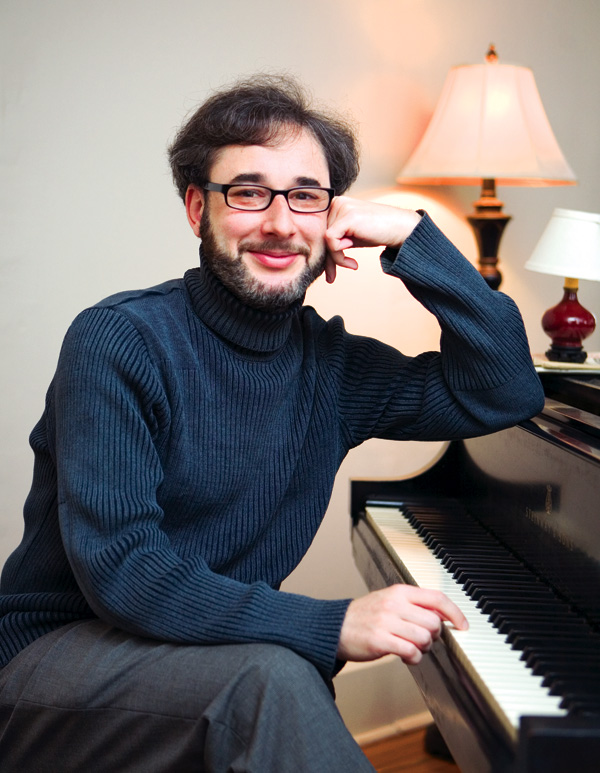
New Harmony Theatre artistic director Lenny Leibowitz.

Philadelphia native Lenny Leibowitz joined the University of Southern Indiana theater faculty last summer, after building an impressive list of directing credits. They include productions in off-Broadway venues in New York City (including the Rockefeller Center) and in some of the nation’s leading regional theaters, including the Tony Award-winning Intiman Theatre in Seattle. There, he co-wrote and directed Before the Rain, a new gospel musical inspired by Stephen Vincent Benet’s classic short story, “The Devil and Daniel Webster.”

Before he turned to theater, Leibowitz was a musical prodigy, making his solo debut as a pianist with the Philadelphia Orchestra at the age of 16. A graduate of Columbia University and Boston University, he also worked as a music director on the first European tours of On the Town and Grease. In June, Leibowitz will make his debut as artistic director of the New Harmony Theatre, described by Leibowitz as a cultural landmark and a regional treasure. The season’s lineup so far includes Amadeus, which carries an “adult language” warning on the theater’s Web site; Oscar Wilde’s The Importance of Being Earnest; and the Broadway classic romantic romp I Do, I Do!.

What do you miss most and least about living on the East Coast?
The most: old and dear friends, Philly cheese steaks, and spectacular New England autumns. Although I must say, the magnificent tree-scape in my Downtown Evansville neighborhood absolutely bristled with ardent colors this fall. The least: the city traffic. Oy vey!

How old were you when you discovered you loved theater?
Pretty young. I opened up my dad’s tattered old anthology of Shakespeare plays and read some passages from The Merchant of Venice. I may not have understood it on a literal level, but I responded on an emotional one. The power and beauty of the language — its rhythm and melody — haunted me and continues to haunt me.

What was your first acting experience?
I believe my first play experience was my third grade holiday show in which I was actually enlisted to play a part. I played Sam Swift, a fast-talking salesman trying to persuade Santa to upgrade to a spiffier, speedier sleigh that came equipped with all the latest technological amenities. Suffice it to say, the walls are not still ringing with ovations.

What is your source of inspiration?
This is a hard one because I draw inspiration from so many sources: from my actors, from my students, from a spontaneous act of kindness that I witness, from a brilliant mistake that someone makes in rehearsal, from perfectly fluffy mashed potatoes. And from my cultural heroes, of course: Shakespeare, Beethoven, Jan van Eyck, Arthur Rubinstein, Max Ophuls, Pauline Kael, Camille Paglia. I think the key for me is to pay attention and remain open — to search for inspiration outside of myself.

What do you do when your creative well runs dry?
Eat.

What was it about the New Harmony Theatre position that enticed you?
The opportunity to lead one of the nation’s landmark regional theaters into a new era of growth, the graciousness of the community, the rich history and bewitching serenity of New Harmony, Southern Indiana’s cultural vitality, Evansville’s magnificent old Downtown homes, and of course, the opportunity to be a part of USI’s theater department, one of the fastest growing and most creatively fertile in the region.

If you weren’t a theater director, what would you be doing?
Playing third base for the Phillies. Well, I can dream.

Finish this sentence: When I am not working, you can find me…
At the movies. Especially if there’s a revival of an old Hollywood film noir — something with Barbara Stanwyck or Gene Tierney.

Is there something special that you make sure to add to every play you direct?
I try to bring an unabashed, full-blooded sense of theatricality to each production. I’m drawn to theater’s elemental storytelling power — its ability to invoke ritual, myth, and the transformative power of the imagination. It’s important to me that theater feels different than television. Only theater can truly engage the audience as witnesses rather than passive spectators. That almost congregational energy excites me.

Award Season

0
Evansville City View 2009

(Updated June 8, 2010)

This spring, Evansville Living magazine once again earned a national nomination for the City and Regional Magazine Awards. Last year’s City View, our annual visitors’ and relocation guide, is among other publications praised at the 2010 awards ceremony held June 7 in Rhode Island.

City View competed in the ancillary publications category against magazines produced by Berkshire Living in Massachusetts; Inside Columbia in Missouri; and Martha’s Vineyard Magazine in Massachusetts. The category is one of 29, and Evansville Living has won several awards from CRMA in the past few years.

In 2008, we took home a silver award for Ancillary Publications 1 for City View 2007 and the bronze award in the multi-media extensions category. In 2007, we won the gold award for multi-media extensions and a gold for community service. In 2006, our July/August 2006 cover earned a bronze award in the cover category in which regional magazine Texas Monthly won the gold and Los Angeles magazine had the silver.

Evansville Living is proud to have been named a finalist in the ancillary publications category. This year, our peers at Berkshire Living won for their Berkshire Business Quarterly, and we offer them a well-deserved congratulations.

“While our most important measure of success is the affirmation we receive from readers that our magazines are a necessary part of the community, we again are thrilled to receive national recognition for City View,” says Kristen K. Tucker, publisher and editor. “The high quality standards for content and design upheld by the judges of the CRMA competition help our staff strive to improve our magazines constantly.”

A Watchful Eye

0
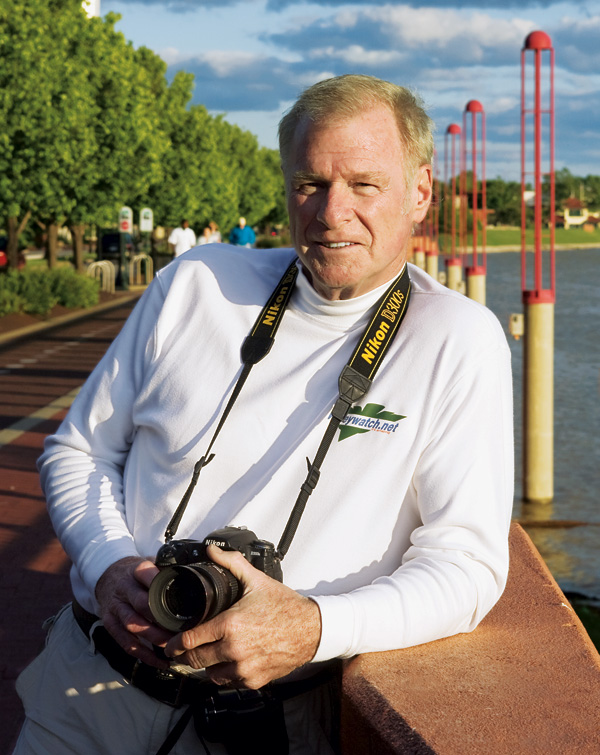
John Blair worries about the effects of the Rockport Power Plant and other power plants on the health of Tri-State residents.

Aloft over Henderson County in a small Cessna, John Blair points out the windows in each direction and out to the horizon, identifying the power plants visible from 3,000 feet. He locates nearly a dozen plants, including the Rockport Power Plant with one of the tallest stacks in the world (1,038 feet) and Gibson Station, operated by Duke Energy, 2008’s third largest power plant in the United States for generating capacity, according to Electric Light & Power magazine.

Blair is on assignment to produce aerial photographs of a large construction project of an Evansville-based firm and has hired a pilot from Don Davis Aviation out of Henderson, Ky., to fly him up the Ohio River. The bird’s eye views he creates pay the bills and stoke his passion: the health of the citizens of the Ohio Valley. For around three decades, Blair and the organization he co-founded, Valley Watch, have been the most vocal and active area advocates for clean air and water.

“I, personally, and Valley Watch have had tremendous victories,” Blair says, claiming a record of 33 wins and four losses against projects and endeavors that his organization claims would cause serious harm to the public health of the Ohio Valley.

“Three fights have lasted more than seven years; that wears you out,” Blair says, referring to the lengthy battles of the Marble Hill nuclear power plant near Madison, Ind., in the late 1970s and early ’80s and Peabody Energy’s Thoroughbred plant (Muhlenberg County, Ky.) from 2001 to 2008.

“I lost most of my friends during Marble Hill,” Blair says. “They didn’t want to hang around me; I learned how to back off. It’s how I keep my sanity.”

Born in Winchester, Ind., Blair, the son of an entrepreneurial father and a mother who worked in health care, came to Evansville in 1974 to teach photojournalism at the University of Evansville. (Today, he teaches photography classes at the University of Southern Indiana.) He has a bachelor’s degree in economics and public policy from Indiana University and a master’s degree in journalism from Ball State University. “I use both of my degrees every day,” Blair says.

“My instincts about environmental issues are pretty good now. I’m a quick learner and pretty good at research, too,” Blair says.

A fight in his backyard quickly was resolved earlier this year. Blair worked behind the scenes, talking with city and state agencies to stop the U.S. Environmental Protection Agency from storing lead- and arsenic-contaminated soil from the Superfund environmental cleanup of the Jacobsville neighborhood at a site near Glenwood Middle School.

“We met on a Saturday with the EVSC (Evansville Vanderburgh School Corporation) and the Glenwood Neighborhood Association, and by the following Friday, the EPA had changed its plans,” Blair says, stating the contaminated soil would be hauled to the Laubscher Meadows landfill in Vanderburgh County.

Grassroots Strategy

Kim Sherman was introduced to Blair’s grassroots methods soon after moving to Evansville in 2002 from Omaha, Neb., when her husband, Pete, joined the faculty of the University of Evansville. The Shermans live in Warrick County with their three children. Kim Sherman has a degree in political science from Oklahoma State University.

Sherman had lived in Omaha (population 419,545) and Lincoln, Neb. (population 241,167), and “neither of those towns had ozone alerts,” Sherman says. “I was naïve.”

“Evansville’s a great community; we love it here,” Sherman adds. The frequency of the area’s ozone alerts, however, alarmed her. Sherman began to seek information and quickly learned Blair’s name. “To have done what he’s done all these years — that’s where John is really a standout,” she says.

As a result of Blair’s outreach, Sherman and several friends formed Air Aware, an informal advocacy group that shares information on environmental hearings, attends events such as Alcoa’s environmental open houses, and collaborates on letter-writing campaigns. A primary focus of Sherman’s group has been air quality in Warrick County schools. She’s made a presentation to the Warrick County school board seeking air purifiers and has requested the installation of air quality monitors in the schools; neither request has received action.

“(Blair) really opened my eyes. Coming here, I was completely uninformed about these things. I feel like John has made a difference,” she says. “He’s persistent, relentless. There’s never a time when he’s not thinking, ‘What’s next?’”

What is Next?

Though Blair clearly has more than a fight left in him, he has become increasingly distressed over his perception of local attitudes.

“I continue to hope that my efforts to protect the public’s health will catch on and grow around here,” he says. “But sometimes I think I have wasted my adult life in a region that doesn’t seem to care whether it lives or dies.”

This was a theme that played out at a meeting Blair addressed last August at Kentucky Wesleyan College in advance of a public hearing on Indiana Gasification LLC’s plans to develop a Southwest Indiana plant to convert coal to substitute natural gas. Blair was introduced by Lee Dew of Owensboro, Ky. Dew, a retired Kentucky Wesleyan history professor, is a part-time organizer for the Sierra Club’s Western Kentucky Water Sentinel, which bills itself as the first line of defense of America’s waters.

“I met John Blair 32 years ago fighting coal to gas plants. They still are not here, but their ghosts still stalk,” Dew said, introducing Blair. “I see John Blair as the primary champion of the environment of the Tri-State and of the lower Ohio Valley, against formidable odds.”

With a booming voice and animated gestures, Blair launched into his presentation:

“There are really only two issues that I am going to talk about. One of them is health. And the other one is economics. I’m really not sure if most Americans really give a damn about whether they live or die. I’m really not! I’ve come to that conclusion after 30 years of seeing people act like they’re resigned to their fate.”

Armed with a PowerPoint presentation of data compiled from the Toxics Release Inventory published by the U.S. Environmental Protection Agency, Blair produced slide after slide demonstrating Southwest Indiana is among the nation’s hottest “toxic hotspots.”

A student also of popular culture who admits to wishing every day since he turned 40 (Blair is 64) that he’d gone to law school, Blair threw in a reference to the lyrics of John Prine’s “Paradise” about Muhlenberg County, Ky.’s Paradise mine.

On The Same Side

Niel Ellerbrook, recently retired CEO of Vectren, who remains chairman of the utility’s board of directors, has formed a productive relationship with Blair.

“John Blair is a true believer, sincere,” Ellerbrook says. “I have never doubted his motives. Early on, I decided I didn’t have any personal wars with John. I knew the issues we deal with are important to him and gave him access. I always thought it was in Vectren’s best interest if he had the facts. Corporately, we share John’s view of clean air, and we have invested heavily in clean air. We have pursued a policy of investing capital to improve air quality.”

Ellerbrook and Blair have shared plane rides to Indianapolis for various testimonies on the Indiana Gasification plant, and on one occasion, Ellerbrook introduced Blair to Indianapolis Colts quarterback Peyton Manning. (Blair made a video of the encounter for Ellerbrook.)

Blair is among the numerous people whom Ellerbrook personally called prior to his public retirement announcement. Blair, a shareholder of Vectren Corp. stock, attends all Vectren annual meetings, and this year requested a seat on its board of directors but was denied.

On the proposed coal gasification plant in Southwest Indiana, Blair and Ellerbrook sit on the same side of the debate — but from differing perspectives. “John comes at this from an environmental perspective, and we look at it from an economic viewpoint,” Ellerbrook says. “Is it reasonable to believe that coal can be converted to pipeline-quality gas at a reasonable cost? In the capitalistic system we work in, this is where the coal is. John’s reasonably realistic about the use of coal. From a public policy standpoint, he wants to push as hard as he can.”

“I have found him to be an interesting guy,” Ellerbrook says. “He’s a substantive guy; he does his homework. I do think his tactics sometimes get in the way of his effectiveness.”

Civil Disobedience

John Blair has been twice arrested: only once for civil disobedience, though he expected to be arrested a third time, in Washington, D.C., in March 2009, for helping shut down the Capitol Power Plant, which heats and cools the halls of Congress.

His arrest on Dec. 19, 1985, for stealing a gold-painted shovel at Union Carbide’s groundbreaking ceremony, garnered Blair more attention than winning a Pulitzer Prize for photography seven years earlier (see “A Pulitzer Picture,” p. 33).

In an editorial published in the political newsletter CounterPunch (www.counterpunch.org) on Dec. 15, 2005, Blair wrote:

“Twenty years ago today, I was arrested for ‘stealing’ the gold painted groundbreaking shovels at the Union Carbide PCB facility in Henderson, Ky. In many ways, that cold morning defined my life since.

“First, committing an act of civil disobedience in a conservative community removed any obscurity I had enjoyed up to that time.”

Of great disappointment to Blair is that the plant did open — one of the four losses among 33 wins Valley Watch counts in its battle for a healthy environment. (The other losses are American Electric Power’s Rockport Power Plant, built in the late 1970s; a permit modification to the Browning-Ferris Industries Laubscher Meadows landfill in 1996; and Peabody Energy’s Prairie State power plant in Southern Illinois, which broke ground in 2007.)

Blair ultimately earned an award from the American Civil Liberties Union of Indiana for the circumstances surrounding his Feb. 6, 2002, arrest at the appearance of Vice President Dick Cheney in Evansville. He was arrested and charged with disorderly conduct as he silently stood across the street from The Centre, holding a sign that read: “Cheney, 19th Century Energy Man.” A federal judge ruled Blair’s arrest violated Blair’s constitutional rights and entitled him to monetary damages. While Blair collected a modest financial award, he believes what is most significant is that Blair v. Evansville now is part of the legal lexicon, and the opinion the judge wrote was strong in its upholding of both the First and Fourth Amendments of the Constitution.

Stashed in the entry of Valley Watch’s near-Downtown offices are stacks of bumper stickers promoting freedom of speech and pocket copies of the U.S. Constitution. Blair’s iPhone features an app of the Constitution, but he rarely refers to it anymore, he acknowledges, so great is his familiarity.

Blair’s arrests have shaped the public’s perception of him, he believes, saying, “I’m probably much more conservative than most people think. Conservation is conservative; I don’t understand how people can see it any other way.”

Twice Blair has run for public office, both times as a Democrat, and in 1996, he ran for the EVSC School Board.

A Modest Family

Married for 38 years, John and Mary Blair met when they were both working in Indianapolis. Crossing a downtown street, Mary’s shoe got caught in a chuckhole, and John caught her attention. Mary is the executive director of the Tri-State Food Bank.

“John always has been investigating things; it’s just his nature,” Mary says. “He’s pretty much made it his mission in life to educate the public about health. It takes a lot of his time; we’ve had to live most modestly. We’re not big consumers.”

For the past six years, Mary acknowledges, the family has gone without air conditioning. “There have been many times when I’ve been so ready to turn it on, then I think, just one more day, and we keep going.”

The Blairs have two grown children, Stephanie, 30, and Will, 27, both of Evansville. Stephanie has Down syndrome; she works at a Downtown deli and calls her dad frequently in the day to report her goings on. Blair always greets her call with an enthusiastic, “Hey, Steph.”

“She’s taught me more than I’ve ever taught her,” Blair says. “She’s taught me tolerance.”

Though he professes to be depressed over the public’s attitude toward its own health, the probability is high that in the next year tally marks will be recorded in Blair’s and Valley Watch’s win-loss stats as Indiana comes to grips with the high costs associated with coal gasification.

Blair says, “If I have something to add to the conversation, I’ll add it” — in a loud voice.

Almost

0

By the time you read, glance at, or flip right past this column, I will just have returned from a much-needed vacation. Yes, I actually do know you really could care less about my end of the school year and Memorial Day travel plans. But lately, I have been hearing with increasing frequency that it almost is too much trouble to handle the logistics that are required to take a vacation. Almost, I said.

As husband-and-wife business partners, I must admit it sometimes is difficult to shut the business conversation down during the best of times. We squeezed what I thought was going to be a three-day week now into two days, an additional surprise. The back-and-forth business conversations in the office, on the cell phone, and while in the shower seem relentless. (I have asked for a moment’s peace here … she simply does not listen.) So I thought I might share a laundry list of the last 16 hours of personal tasks that need to be accomplished. Only a partial list, I am confident that this is relatable to families everywhere.

1.  Take our dog, Jethro, to vet for boarding.

2.  Pick up prescriptions from doctor’s office to take to pharmacy, then pick up at pharmacy.

3.  Pick up missing fog light part from auto dealer.

4.  Pick up repaired spare tire with broken valve stem. Did I renew AAA?

5.  Go to bank to get vacation money — new debit card not arrived yet.

6.  Get boys to pack up DVD player, go to movie store, and gather headphones, Nintendo DS players, and all relevant charging systems. This will require much searching for what is missing. Asked them to start looking last Saturday (five days ago). They will start looking tonight!

7.  Take all Bronco League Baseball equipment to Coach Samila’s — can’t forget that or no baseball!

8.  Leave instructions for Grant, the house sitter and cat keeper. Needs to remember how to use the alarm, turn lights on and off, as well as adjust automatic sprinklers to weather. I must change cat litter as boys and wife will not touch.

9.  Get car cleaned and vacuumed; dusty baseball uniforms, cleats, and bags have not been kind.

10.  Drop everything and go to retirement dinner this evening — will not miss this.

11.  Resume speed and realize no clothes or sporting goods have been packed.

Enough already? Anyone see a bit of their family here? It almost just isn’t worth it. Almost.

As always, I look forward to hearing from you.

Regards,

Todd A. Tucker
Publisher

Recipe for Success

0
A Southwest Indiana couple savors the one-year anniversary of their gourmet popcorn shop

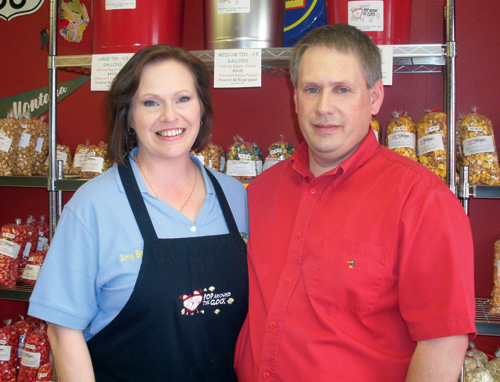
Several winters ago, in their kitchen in Vincennes, Ind., Amy and Chris Bruggeman whipped up batches of homemade caramel corn as holiday gifts for friends and family. “It was something we could make that was easy,” Amy says, “and people enjoyed it.” A coworker of Chris’s, in fact, enjoyed it so much that he encouraged the couple to turn the sweet treat into a business venture. This spring, the Bruggemans celebrated the one-year anniversary of Pop Around the Clock, their gourmet popcorn shop in Vincennes.

The base for the store’s 50-plus flavors is Weaver brand popcorn, grown by farmers around the nation, including one near Washington, Ind. All the flavors come from the couple’s original recipes and use only real ingredients— no artificial flavors, preservatives, or store-bought mixes.

While the Bruggemans both work full-time jobs outside the store (Chris works for Anderson Merchandisers, a media distribution company that sells music, books, and videos to Wal-Mart stores; and Amy is employed with Halter Tree Service, a utility line clearance company), they find time to tinker with new recipes. This spring, while mixing a batch of Cinn-A-Bun popcorn (which includes cinnamon, butter, vanilla, and pecans with a white chocolate drizzle), the lid flew off a container of cinnamon that Chris was shaking into the kettle. To compensate, he left out the nuts and bagged the popcorn. The next morning, his sister-in-law tasted it and declared, “This tastes like snickerdoodle cookies.” The Bruggemans agreed, and added the flavor into Pop Around the Clock’s regular inventory.

From the traditional (kettle corn and cheese) to the unusual (Mexican mocha and white chocolate strawberry), Pop Around the Clock’s creations are popping up around the globe. Customers have mailed bags to soldiers in Iraq. A local businessman has shipped the popcorn to his family in Taiwan, and exchange students from France and Germany have brought it home to their families.

The success reinforces the Bruggemans’ belief in their concept. “You’re never totally confident,” Chris admits, but as the couple researched the popcorn business before opening their store, they learned the industry’s two biggest names — Redenbacher and Weaver — had launched careers during the Great Depression. “We’re not selling a big-ticket item,” Chris says, “but we’re selling something unique, good, and wholesome. I like to say popcorn is the original whole-grain snack.”

Pop Around the Clock:
1725 Hart St., Vincennes, Ind.
(812) 882-0882
Online ordering available at www.poparoundtheclock.net

Zoo Crew

0

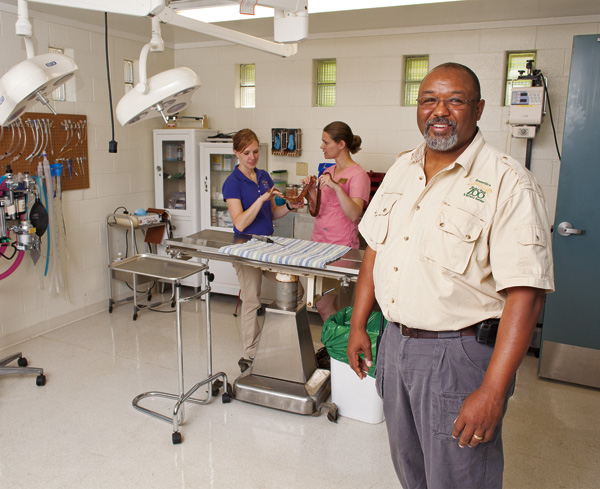
“The zoo is my office,” says Amos Morris, director of Mesker Park Zoo & Botanic Garden. While his actual office is located in the Discovery Center, the Missouri native’s job often leads him to the Donald W. McMurtry Veterinary Complex, nestled at the bottom of a hill near the Children’s Enchanted Forest.

Morris, who came to Evansville in late 2008 from the Pittsburgh Zoo & PPG Aquarium, began his career 23 years ago “in the trenches,” he says — working in the antelope barn at the St. Louis Zoo. For that reason, Mesker veterinarian Dr. Maria Spriggs sometimes enlists Morris’ help in the clinic, where various surgical, radiological, and dental procedures are performed to keep the zoo’s animals healthy.

1. Down the Tubes: These tubes deliver gas anesthesia to animals undergoing surgical procedures. The smallest ones could be used for a finch or mouse; the biggest could sedate a horse, jaguar, or small antelope. (Some well-mannered animals, such as certain monkeys, can be sedated with a face mask.)

2. Open Wide: The dental cart holds an ultrasonic scaler to remove tartar and plaque from the animals’ teeth during yearly cleanings. Like humans, some animals are more prone to dental problems than others — once, veterinary staff collaborated with a local oral surgeon to perform a tooth extraction on a howler monkey.

3. Tabled: The zoo’s largest animals, such as giraffes, tigers, or tapirs, are treated in the field. One of the strangest procedures performed on this table, says Spriggs, was shaving a South American porcupine before removing stone-like growths from its stomach. She calls the experience “prickly.”

4. Skin Deep: Spriggs and veterinary technician Kristine VanHoosier examine a corn snake after a keeper noticed a rough, scaly patch on its skin. (It was just a scar made more visible by shedding.) This even-tempered snake, native to North America, travels around the community with docents for educational programs.

What You Don’t See:
The 1990-built vet complex was remodeled several years ago to make way for the dozens of rainforest residents that now populate Amazonia. Before they’re transported to their homes, newly arrived animals undergo a 30-day period of isolation and careful monitoring. Behind the exam room is a series of quarantine rooms, including ones filled with branches and designed just for birds.

Added Value

0
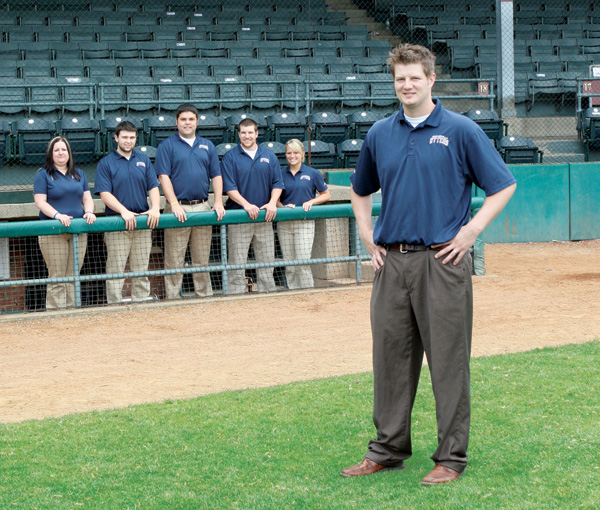
Brandon McClish, director of operations for the Evansville Otters, began his career with the baseball team as a summer intern.

A successful summer intern will add a new voice to your company and eventually could become a full-time employee. But, if managers aren’t careful from the start, they could spend the summer babysitting fresh-faced college students who habitually update Facebook and send text messages on the job.

Brandon McClish started his career with the Evansville Otters as a promotional intern in 2007. Now, at age 24, he’s employed as director of operations, and he oversees the 10 to 12 interns working for the baseball team each summer. We asked McClish for advice on hiring and managing interns.

Choose wisely. Many college students and recent graduates apply for internships. To broaden the pool, post your internship on your company’s Web site, trade association or professional Web sites, and college career department Web sites. Once the resumes flow in and interviews begin, look for relevant experience, high energy levels, attention to detail, and eagerness to learn.

Move fast. Since internships are short-term by nature, “I need all of my interns to hit the ground running and learn fast,” McClish says. “I allow them to get hands on right away, and I try and lead by example. The first few days, I try and feel them out as best as possible, then give them projects that they can excel with.”

Be patient. The biggest difference between managing interns and full-time staffers? “You have to be there to teach a lot more for the interns,” McClish says. “They are afraid to make the tough decisions, so one must be more patient with them.”

Still, that doesn’t give an intern license to waste company time or be unprofessional. Two common issues McClish runs into with interns are inappropriate dress and technology usage — “the mass amounts of texting that they feel they need to do,” he says.

Stay positive. The daily routine of managing interns can be exhausting, but remember that you’re there to help them gain experience to launch a future career. Numerous Otters staffers began as interns, and McClish recently spoke with a 2009 promotions intern who now is employed with the Atlanta Braves. She attributes her success to her internship in Evansville.

Healthcare Diagnosis

0
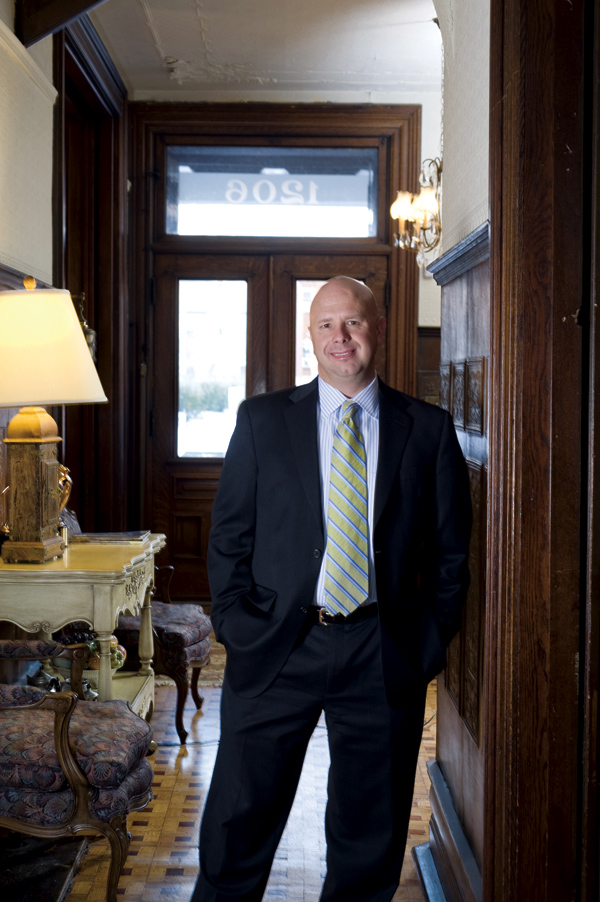
Jon Headlee stands inside the historic headquarters of his healthcare strategy firm.

Jack Headlee left Creative Press, an Evansville graphic design and printing firm, in 1985. The then-57-year-old Jack rented space in the Riverside Historic District near Downtown to open his graphic design business. The home at 10 Adams Ave. lasted long enough to provide the company a name, but after two years, Jack moved operations to 1112 S.E. First St. — an 1894-built historic home that at one time housed a fraternity for Indiana State University-Evansville (the precursor to the University of Southern Indiana) — just a few blocks from 10 Adams Ave.

His son, Jon Headlee, graduated from the University of Evansville in 1991. Armed with a marketing degree, Jon already owned and operated Precision Lawn Care, a venture he began as a teenager. Then, his business was small — Jon and another employee with a handful of private and commercial clients, which eventually grew to include two crews of eight employees who also installed Christmas lights in the winter until Jon sold the business in 2000 — but lawn care wasn’t Jon’s passion. He told his dad, “I want to wear a tie; I want to put a suit on.” Jack liked that his son owned a company; he thought Jon didn’t need a tie.

Undeterred, Jon gave his resume to the Ten Adams sales director and asked for networking advice. The director recognized Jon’s enthusiasm and told Jack to hire his son as a Ten Adams sales representative. Over dinner at an upscale restaurant, Jack informed a tie-clad Jon he was hired. Two years later, Jon was president. “I had no business, probably, being president of the firm at that time,” Jon admits. “Because I was the son, I was the president.”

Now, Jon leads 15 employees, and as he says, Ten Adams is not his father’s company any more. While graphic design still is a vital component of Jon’s business, the Ten Adams focus is helping healthcare clients with strategy, marketing, and company culture.

The shift from advertising expert to all-encompassing healthcare strategist came 10 years ago when Jon hired a consultant who determined Ten Adams possessed the resources to help healthcare providers. One major reason was Rachel Forbes, a longtime healthcare professional who joined Ten Adams in the 1990s until she retired last year. Ten Adams also had numerous portfolio pieces for hospitals. “We had some work to show off our abilities,” says Jon, “and I had someone who could walk and talk health care.”

That talk includes this premise: Advertising is effective, and if a hospital claims it’s the best, it better be the best. Ten Adams isn’t placing a false façade on a healthcare organization with cool ads; Jon and staff are improving how that company operates and showcasing those upgrades to the public. In its 25th year, Ten Adams does that with eight hospital clients in four states, including St. Mary’s.

As Joseph Miller says, “If the organization doesn’t honestly reflect the image it portrays, the advertising simply will not have its desired impact.” Miller is the vice president of strategic planning and marketing at Trover Health System, based in Madisonville, Ky. Trover is more than 50 years old, and four years ago, E. Berton Whitaker became Trover’s president and CEO. Recently, Thomson Reuters named Trover one of the top 100 hospitals in the United States based on their healthcare services before Ten Adams helped them. Though successful, Whitaker knew improvements were possible, Miller says.

Ten Adams arrived at Trover, the largest employer in its six-county service area, in 2008. They interviewed Trover’s board of directors, physicians, and patients. Ten Adams employees spent time with nurses as they made rounds. Their third-party observation was the hospital’s “opportunity to define Trover in the marketplace,” Miller says.

That opportunity meant Trover needed not only to market itself to patients but also to its employees. Ten Adams recommended the Pathway Champions initiative. They recruited a group of 18 department heads, supervisors, and nurses — a team Miller calls “fire starters,” who were “charged and empowered to bring change.” The idea was to improve morale, and Miller says it worked: He saw it in the way employees carried themselves. The Kentucky Hospital Association saw it, too, in the way Trover health professionals interacted with patients, and the organization presented Trover a quality award for patient safety in late May.

The way Ten Adams helped Trover shows one example of how Ten Adams helps clients, and 25 years after Jack started the business, his son knows there still is work to do — even though the passing decades have brought numerous changes in the healthcare industry. Most recently, when President Barack Obama signed the new healthcare bill, Jon knew his business still would be relevant. “How much money hospitals get and how much hospitals get reimbursed probably is still unknown, but there still is a need,” Jon says. “The way services are delivered may be altered going forward, but there still is a huge percentage of the population that is going to be utilizing healthcare services more and more in the next 10, 15, or 20 years.”

Ten Adams recently unveiled a new Web site. To learn more about the locally headquartered healthcare strategist, visit www.tenadams.com.

The Laws of Science

0
Steve Bohleber complements his career as an Evansville attorney by volunteering in scientific research projects around the world

Born to a blue-collar family on Evansville’s West Side, Steve Bohleber had few opportunities to travel. He didn’t mind. Armed with his grandfather’s camera and an affinity for what he calls “creepy, crawly things,” Bohleber explored his backyard, his neighborhood, and the newly developing East Side with a child’s curiosity.

A teenage Bohleber dreamed of becoming a research biologist. His career plan shifted, but Bohleber — a practicing attorney for 35 years — never lost his passion for the natural world. The citizen scientist has conducted bat research in the Amazon with a team from the Smithsonian Institution, played with pandas in China, and had a newly discovered species — Bohleber’s water bear — named after him in Great Smoky Mountains National Park. His proudest accomplishment is his role in a quest to document all forms of wildlife in the park, which straddles the border between Tennessee and North Carolina. The ongoing project will serve as a model for other scientific surveys and could lead to astounding medical breakthroughs — but it could be in danger of ending before it’s complete.

Growing up as the only child of a Faultless Caster factory worker and a stay-at-home mother, Bohleber loved the outdoors. He caught insects, frogs, snakes, and turtles and photographed plants and animals with a camera from his grandfather, an amateur photographer who taught Bohleber the basics.

When he was 8 or 9, his parents took him on vacation to the Smoky Mountains. Seeing the streams and waterfalls — plus the occasional black bear in the parking lot begging for food — “inspired me to always want to have a connection with that place,” he recalls. Later, as a Reitz High School student, he studied under biology teachers Simon Krueger and Larry Lyons (the late father of 14 WFIE chief meteorologist Jeff Lyons). Both were inspiring educators and “guys who thought outside the box,” Bohleber says; one class researched the effects of radiation and growth hormones on living organisms.

Bohleber thought he was destined for a career as a research biologist. A school counselor had other ideas. “My guidance counselor called me in after he reviewed my SAT tests and told me he didn’t think I was college material,” Bohleber says. The counselor offered another suggestion: Bohleber should consider auto mechanics. “It was the last thing on earth I wanted to do,” he says.

He enrolled as a biology student at Indiana State University – Evansville, the predecessor to the University of Southern Indiana, but struggled with the required mathematics classes. “I quickly realized I probably would be in Vietnam if I didn’t change my major,” Bohleber says, “because I absolutely flunked those classes.” Mesmerized by the political turmoil of the late ’60s — “I was a long-haired hippie” — he changed his focus to political science and history. (His law office’s “on hold” music still includes Donovan’s ’60s hit “Mellow Yellow.”)

After graduating magna cum laude, Bohleber attended Indiana University School of Law – Indianapolis and became a practicing attorney in 1975. Although his law practice requires him to clock significant time indoors, his love of the natural world continues to influence him. He decorates his fifth-floor Court Building office with dozens of framed photographs shot around the world, from polar bears in Manitoba, Canada, to pandas in China’s Szechwan province. He has volunteered as a docent at Mesker Park Zoo & Botanic Garden for more than 25 years, has served on the Board of Park Commissioners for 17 years, and sits on the zoo’s advisory board. Farther from home, he has conducted bat research in the Amazon rainforest canopy and in the caves of Kentucky, and around 20 of his nature photographs have been published in a guidebook for Great Smoky Mountains National Park. He’s owned a condo in the Smokies since 1985 and has hiked nearly half of the park’s 800-plus miles of trails.

Still, of all Bohleber’s accomplishments, he says participating in the All Taxa Biodiversity Inventory (ATBI) in the Smokies has been most rewarding. The project, coordinated by the nonprofit Discover Life in America (DLIA), draws hundreds of researchers, citizen scientist volunteers, teachers, and students from around the world, all with a single mission: surveying all plant and animal life forms in the more than half a million acres of the park.

Bohleber began volunteering as a citizen scientist in 2002 after the project launched in the late 1990s, helping researchers collect species and taking photographs. He serves on the DLIA board of directors and was one of the first non-scientists asked to assume a leadership role.

As of January 2010, researchers have discovered 907 species previously unknown to science. They’ve identified 6,582 species new to the park, and one — a type of tardigrade — will be named after Bohleber. The microscopic, water-dwelling invertebrate commonly is called a water bear “because it sort of lumbers along,” he says, “and looks like a little fat, furry bear.” Once the new species is confirmed to be previously undiscovered, the Ramazzotius bohleberi will be known as “Bohleber’s water bear.” (Bohleber did not discover the species, but requested to have a new discovery named for him. Scientists agreed due to his contributions to the project.)

The ATBI has been ongoing for more than a decade, thanks to partnerships with the National Park Service, Great Smoky Mountains National Park, the Great Smoky Mountains Association, and other nonprofits, plus funding from nonprofit and corporate donors. But the money is dwindling, says Bohleber, due to the economic downturn. Still, even if the survey ends prematurely, it has set a precedent for more than a dozen state and national park systems — including Wyoming’s Yellowstone National Park — that Bohleber says have expressed interest in conducting a similar study.

Why is such an inventory so important? “The more we learn about life on the planet,” Bohleber says, “the more we have a chance of saving ourselves. We’ve synthesized almost half our pharmaceuticals from the tropical rainforest, but we only understand a small percentage of those plants. This project could result in the discovery of a new organism that may be a cure for cancer or AIDS or other maladies of mankind. We won’t know until we find it and until people do research on it.”

Bohleber acknowledges he’d like to live closer to the Smokies — one of his favorite places since childhood — but says the area shapes his everyday life in Evansville. “I try to do things the green way, even the practice of law,” he says. While he finds the career satisfying, he also finds happiness in the activities that engrossed him as a child: exploring and photographing the natural world. “I probably spend as much time volunteering as working in my profession,” Bohleber says. “That’s just what makes life fulfilling. You always can find time for the things you love.”

A Pulitzer Picture

0

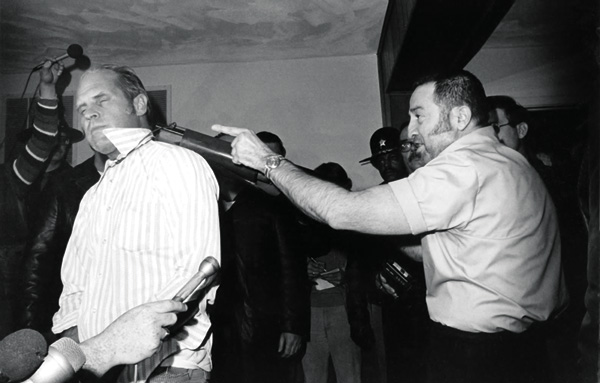
On Feb. 10, 1977, a 30-year-old John Blair was called to Indianapolis by United Press International to cover Anthony Kiritsis’ kidnapping of Indianapolis mortgage executive Richard Hall. Kiritsis had fallen behind on mortgage payments on property he financed with Hall’s company, and Hall refused to extend payment terms.

Kiritsis became convinced that Hall (and his father) wanted the property, which had increased in value, and kidnapped him from his office, where he also called police to tell them what he’d done. Kiritsis wired a sawed-off shotgun to Hall’s neck; the wire was connected to the trigger and then to Kiritsis’ finger — a dead man’s line. If police shot Kiritsis, the shotgun would go off and shoot Hall in the head.

Kiritsis held Hall hostage for 63 hours. During this time, most of which was spent in Kiritsis’ apartment, he called Indianapolis WIBC radio host Fred Heckman, who broadcast what Kiritsis said. Finally, negotiators said Hall had signed a document stating that he had mistreated Kiritsis and would pay him $5 million and that Kiritsis would not be arrested and prosecuted. The obscenity-laced speech Kiritsis gave in front of live television cameras was so emotional media outlets terminated live coverage believing Kiritsis would shoot his hostage, but he released Hall alive. (Video of the kidnapping can be seen on YouTube with the keywords “Anthony Kiritsis.”) To prove the gun had been loaded, he fired it into the air and immediately was arrested. He was found not guilty by reason of insanity in a 1977 trial that helped define Indiana’s insanity defense. Kiritsis was released from a mental institution in January 1988, after the state could not prove he still was a danger to society. He died in 2005.

The picture which won Blair the Pulitzer Prize showed Kiritsis with the sawed-off shotgun at Hall’s neck. That the picture won the prize didn’t surprise Blair, though he was surprised when the UPI mistakenly credited another photographer for the image, an error that still bothers Blair today. A check of negatives cleared up the mistake, and Blair received the Pulitzer in 1978.

In a story on the 10-year anniversary of the incident in the Evansville Press on Feb. 11, 1987, Blair said several pictures taken during the kidnap-hostage situation were possible candidates for the Pulitzer. “But I’ve taken other pictures that have had impact. That’s the important thing to good photography, to have impact,” Blair said in the interview. “From a news photography standpoint, it’s in the top two or three. I had a couple of heavy-duty ones that night.”

Blair says winning the Pulitzer opened doors for him, giving him entry to some of the top photo markets in the country, including Time and Newsweek magazines.

Back Talk: Dona Bergman

0

The nine-year director of the Evansville Environmental Protection Agency still sits at the same office at the end of the hall inside the C.K. Newsome Community Center, but since April, Dona Bergman’s daily duties have changed. She’s the first director for the city’s recently created Department of Sustainability, Energy and Environmental Quality (SEEQ). Since 2005, Bergman’s searched for sustainability projects, but she says, “I already had a full-time job, so it was difficult to make much progress.”

The opportunity to use her talents for the position first surfaced in 2008 when the state pulled local contracts from air quality agencies, cutting the EEPA’s budget by a third. In 2009, the federal government told the city it would receive $1.2 million from a grant in the stimulus funds. This money, combined with the budget cut, created SEEQ. The EEPA now falls under the SEEQ umbrella; its new director, Derrick J. Ohning, the former compliance and enforcement manager for the Indiana Department of Environmental Management, gives Bergman more time to think “green.”

Bergman, a University of Southern Indiana graduate with a degree in humanities, says the focus on the city’s energy conservation and green initiatives helps the bottom line. “If we can save money on our utility or fuel bills,” Bergman says, “then we’ve got more money for filling potholes, putting cops on the streets, and keeping the parks nice.”

Environmental regulation is a field that’s grown up in the last 30 to 40 years. For the longest time, there wasn’t a curriculum; there wasn’t a degree. It’s opened up a lot of opportunities. A lot of geologists, engineers, and health professionals ended up involved in it.

I was working at a company doing transportation and logistics. The guy who was doing the air stuff got a promotion and didn’t have time to fool with it anymore. They asked me to take that on. That was about 1989, which was right about the time the Clean Air Act hit. All of a sudden, there were lots of companies that never had to deal with a state regulatory agency.

We’ve had LED stoplights since 2004-2005. Why? Because it saved money. It also reduced our electrical usage and carbon footprint. They last longer, and they’re brighter. We didn’t make a big deal about it. We just did it because it made sense economically and operationally. One of our wastewater treatment plants captures methane and uses it to generate electricity and help power the facility. Why? It made sense. There’s a lot of stuff we’ve done. My job’s to find more.

The first year, I’m going to be focusing 60 to 80 percent of my time on this federal grant. In the meantime, I’ll be looking at other grant opportunities. We’re going to be looking at some solar power and where it makes sense. We could look at wind turbines, although the wind profile isn’t real great around here. But, there are places — sort of an anomaly — where the wind is stronger. There’s opportunity to protect streambeds and habitats to encourage native planting and community gardens. 
It’s such a buzzword; you’re going to go “green.” I think it means something different to every person, and I think there’s a lot of organizations and products out there that are just using it to get positive attention or make money. I can sum it up in six words: Reduce, reuse, recycle, replenish, preserve, and protect.

Sometimes, I can carry it to ridiculous extremes: Is it better for me to use a paper or kitchen towel? I do this mental lifecycle analysis. Well, the paper towels come from trees, but the trees are farmed and quick-growing. But, the paper is bleached, and there’s landfill space, so maybe I should use a clean kitchen towel. Well, if I do that, then I have to wash and dry it … so it’s possible to get obsessive about it.

Honestly Halston

0
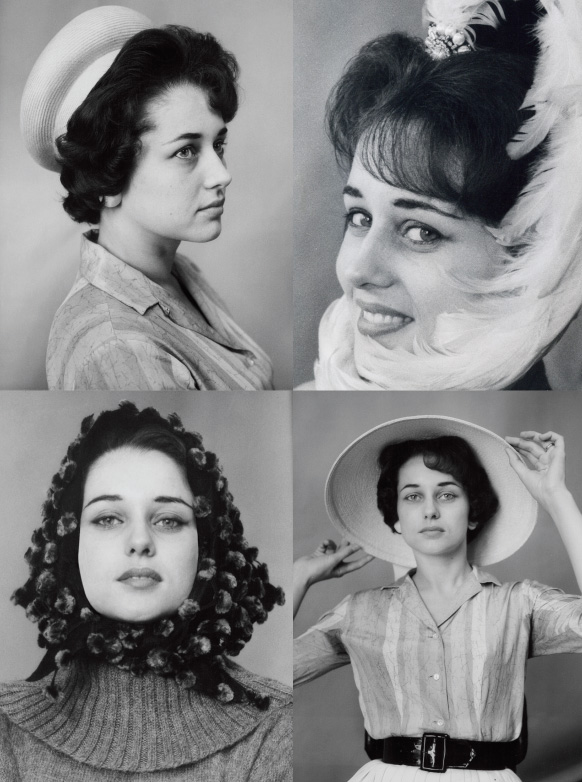
Halston’s sister Sue (Frowick) Watkins wears early 1960s Halston designed hats.

I sat in my kitchen on the phone for hours with Sue Watkins, the younger sister of late American fashion designer Roy Halston Frowick, who is most famously known as Halston. The Halston. The world-famous Halston. The designer who conquered the fashion world in the late 1960s and 1970s and who called Evansville his home, his roots. At the end of the conversation, Sue, who talked to me from her home in California, warned: “This is the third time I have opened up to someone about Halston, and I have been disappointed each time.” Perhaps the best way for me to tell this story is to not tell the story. Halston’s sister should. This is what she wrote.

Testing a memory of 60-plus years is a challenging endeavor, but certain memories don’t fade away easily. (Footnote 1) Evansville holds a great deal of good memories for my family, especially my two older brothers who have, sadly, left this life. I adored all my brothers. Bob (Footnote 2) and Roy (Footnote 3) (Halston) had many good things happen to them during their formative years in Evansville. My younger brother, Don, was the only one of us born in Evansville, but we moved when he was nine years old. Halston was five years older than I was, and during some of those years, that was a significant difference. One of my first memories before Evansville days was when I was just four, and we were visiting our family in Iowa. Halston, 9, made me a hat by covering a straw hat with chicken feathers. (Footnote 4)

We moved to Evansville from Des Moines, Iowa, (Footnote 5) when my dad (Footnote 6) took a job with Goad Equipment Company and later worked as an auditor for Republic Aviation. (Footnote 7) Our first home was on Villa Drive, and it was idyllic for having a family of four children. The neighborhood still has the same qualities I recall when I go back to visit. The homes are meticulously maintained and the mature landscaping shows pride of ownership.

It was in the early 1940s when no one felt threatened in his or her home. Doors were never locked; children could play in the neighborhood without fear and could walk to friends’ homes alone. Fashions for women were dresses, hats, (Footnote 8) gloves, and high heeled shoes when they would go out shopping. Estella Flach and her daughter, Sarah, still live in the same block where we lived. Estella had told me about a white felt hat she wore one day. Halston, 12, asked her how important the hat was to her, and she said he could have it. The next day he brought it back, and she was amazed at how he had changed it into a totally different and attractive design. (Footnote 9)

He would often redo our mother’s hats, and she would proudly wear them. They weren’t all award winners, but to her they were special and deemed worthy of exhibiting. She always encouraged his creativity and would marvel at his talent even at an early age.  He made me a skirt when I was about five, and he also would style my hair. I would complain because it was not always a pleasant experience, and our mother would say, “You should be happy your brother wants to do special things for you. One day it will mean something to you.” Now it does.

When World War II was over, the soldiers came home, and our landlady’s son would need our home. So we moved a couple of times before we ended up on Washington Avenue in 1950.

Bob and Halston started working their first jobs as soda jerks at the Merry-Go-Round. (Footnote 10) Mom, Dad, Don, and I would go often to watch them make our sundaes. Don recalls the fabulous pork tenderloin sandwiches. He also has good memories of Mac’s Barbeque. (Footnote 11) We would also have late night waffle parties at home. [pagebreak]

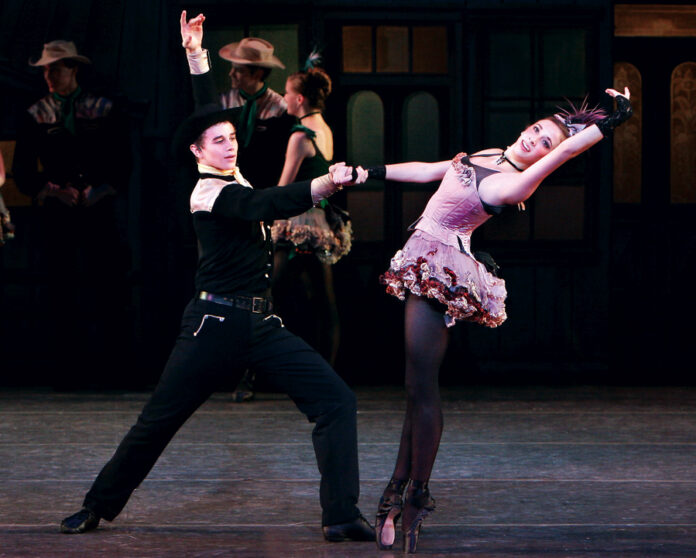
When Halston would ballroom dance (Footnote 12) on stage at Bosse High School for talent shows, (Footnote 13) we would all go to watch him. We likened him to Fred Astaire at the time.  He was so handsome and a great dancer. He always felt pride that Bosse High School was the most beautiful, stately high school with a great stadium and grounds that were maintained perfectly. (Footnote 14)

When I was approaching my thirteenth birthday, he said, “Susie, don’t tell Mom, but we’re going somewhere special today to sunbathe.” We caught a bus, transferred Downtown, and ended up at Duck Island. (Footnote 15) He would have me turn every 15 minutes, put lotion on me, and we would stay for a few hours. We did this same routine for a week. On my birthday, he took me Downtown to a department store and bought me a black and white quilted sleeveless dress with a scooped neck, empire waist, and circular skirt with three-inch, bright red shoes and told me to walk down Main Street. He followed behind to watch people’s reactions. It was taxing because I had tried on my mother’s shoes only a few times, but I made a valiant effort. Evidently, he was satisfied with the results because he couldn’t wait to go home and tell Mom. (Footnote 16)

We lived almost directly across from Washington Theatre. (Footnote 17) Halston would go to the movies and would critique the actors’ wardrobes. He was always style-conscious. He would go to his rich friends’ homes and come home to Mom who would stay up to hear his descriptions of how their homes were designed and decorated. He also got all of his friends to start wearing their fathers’ white dress shirts with rolled-up sleeves and blue jeans, something unheard of before.

Don remembers Halston would remind us on many occasions that he won the Iowa State Fair’s prettiest baby contest and “you didn’t.” He also recalls Halston coming home from Chicago with his big black poodle, Onka, and driving a black Mercedes convertible. He started turning heads when riding around Evansville with the top down and Onka leaning out the back window.

Some of my remembrances of times away from Evansville with Halston are walking down Fifth Avenue in New York with Bob, going to fabulous dinners, spending a week or so in Manhattan with him on different occasions for his fashion shows, evenings at Studio 54, receiving “care packages” from him with all the latest styles, and going out to Montauk, N.Y., where he rented a compound from Andy Warhol. (Footnote 18)

When Halston introduced Ultrasuede, he designed me a peach caftan dress, my daughter, Renee, a mini skirt, and a “skimp for a shrimp” for my baby daughter, Chelle. He also had a fashion show in Little Rock, Ark., where I was living in 1974. He designed gowns for my daughter, Renee, and me for the evening. In 1975, he designed Renee’s wedding dress, my dress, and dresses for my mother and my niece, Lesley.

Halston came back to Evansville when I married my childhood sweetheart, Bryant (Bud) Watkins, BHS Class of 1953. He was pleased we decided to marry in Evansville (Footnote 19) because he wanted to visit. He coordinated with Susan Enlow on our wedding, rehearsal dinner, and reception. He designed my wedding dress of pale green chiffon. We had family and old friends attending. It was a great mix of people, and some still consider it the best reunion they ever attended. Our wedding was in the Neu Chapel at the University of Evansville, rehearsal dinner at the River House, and our reception was at the Petroleum Club. Halston bought all the Dom Perignon in the Tri-State area for the occasion. It was a happening.

That was the last time in Evansville for Halston who always reminded the press that he was a Midwestern boy where his roots were deep, and he developed a hearty work ethic, good memories of his upbringing, and loyalty to his family and friends. (Footnote 20)

— Sue (Frowick) Watkins [pagebreak]

FOOTNOTES:

1 This is a story of the greatest fashion designer of all time and his roots in Evansville told primarily through one of the few people who knew him best, his sister Sue, for accuracy. She wrote every word, so she is accountable for it. Sue and her younger brother Don Frowick are uneasy about speaking to the press. Always.

Halston’s passion for fashion started at an early age and took him from a window dresser in Chicago to an upscale fashion luxe department store, Bergdorf Goodman, in New York to the launch of his first fashion line in 1966. His work distinguished him as the premier American fashion designer, who “evolutionized” the fashion world. “Evolutionized,” not “revolutionized.” He made this clear when he first began his line: “Evolution, that’s what keeps fashion in flux today. Revolution is out. Life’s too active to be pinned down by one revolution or another. Too often, revolution means going back to things past.”

His evolution is an impressive resume influencing today’s latest fashions: Ultrasuede (a fabric known for its alluring elegance, soft plush, and wear-resistance), the halter dress, shirtwaist, spiral skirt, or knee-length pants. He credited his Midwestern roots for his fashion design. His design—described by freelance fashion writer, Elaine Gross, and former Halston workroom supervisor, Fred Rottman, in their book Halston: An American Original—was an “uncomplicated formula—simple by day, simply extravagant by night.” He developed a sensual interpretation: how clothes felt was as important as how they looked. His Midwestern charisma pushed his designs forward, too; he built relationships with the women he dressed. His motto: There are no fashion designers, only fashionable clients. If this is true, his fashionable clients like Liza Minnelli or Anjelica Huston are the reasons for his four Coty Awards—the fashion world’s Academy Awards.

His fashion was evolutionary, and so was his business. He was the first designer to expand beyond clothing: luggage, bed linens, uniforms for Braniff Airways, cosmetics, and Halston—his own fragrance which raked in $1.5 million in its first three months. His fashion was a multi-million dollar empire. He graced countless magazine covers, and in 1973, his dominance was so consuming, Esquire magazine asked, “Will Halston take over the world?”

In a 1977 article in The Washington Post, Halston was called “undeniably the heaviest hitter of American fashion design for half a decade.” He skyrocketed to a fashion superstar with an elegant lifestyle to match, and the same Post article focused more on his following than his fashion: “He arrived yesterday—flying first-class, of course—with an entourage of eight and two more shifts of six each arriving later, for press interviews and a television appearance…Palling with Elizabeth Taylor (who was due at last night’s ball)…is a far cry from Des Monies, where Halston was born, and Evansville, Ind., where he grew up.”

He had his own team of models, the Halstonettes, which included Huston and Karen Bjornson. His friends were also  famous—Minnelli, Andy Warhol, and Bianca Jagger—and the media, at times, was more obsessed with Halston’s jet-setting crowd than his fashion. His social nights were next morning’s headlines.

When the gossip of his evenings trumped the fashion of his days, the truth about Halston became an unclear composition. A Halston biography is suspect, Sue maintains, because some stories are so erroneous Evansville is in Illinois.

Seventeen years after Halston died of AIDS, his elegant lifestyle lingers in memory, but with his clothing on display in museums throughout America including the Metropolitan Museum of Art, the Indianapolis Museum of Art, and in February 2008, an exhibition at the Evansville Museum of Arts, History and Science, it is his fashion that will be remembered because his fashion is art.

His fashion is so revered today that movie moguls Bob and Harvey Weinstein’s The Weinstein Company acquired the Halston name for nearly $20 million in March 2007, on the recommendation of Jimmy Choo shoe founder Tamara Mellon, who will advise the brand. After several companies have failed to resurrect the name, the Weinsteins plan to dress actors in their movies in Halston fashions, hold a fashion show at 2008’s Cannes Film Festival, and possibly open a stand-alone store in Manhattan.

Manhattan is where Halston’s fashion blossomed, but Evansville is where Halston grew. As Sue said, “He learned everything there. It’s where we knew he was going to make it.”

2 Bob Frowick is the oldest of the four Frowick children (Bob, Halston, Sue, and Don). He had an impressive career as an ambassador. Don, 16 years younger than Bob, remembers having to follow behind two successful older brothers. “It’s just amazing,” he said. “You get out of the gate, and they’ve already won the Kentucky Derby.”

3 With hours spent talking with Sue, this is the first I had heard her refer to her brother as Roy. Don, too, frequently referred to their brother as “Halston” because Halston was born Roy Halston Frowick.  “We had an uncle Roy,” Don said. “We had a brother Halston. He loved the name.”

4 Halston was a milliner long before he was a fashion designer. While working at Bergdorf Goodman in New York, he designed the pillbox hat—a flat crown with straight, upright sides—worn by Jackie Kennedy on the 1960 Inauguration Day. The hat sparked a national trend and accelerated Halston’s career.

5 The Frowicks moved to Evansville in 1943; Halston was 10, attending Washington and Hebron Elementary and Bosse High School, where he graduated in 1950.

6 James Edward (Ed) and Hallie Mae Frowick were Halston’s parents. Ed was a certified public accountant; Hallie Mae was a dedicated housewife, Halston’s first model, and biggest supporter of his creativity.

Hallie Mae wore Halston hats to church long before Halston was something everyone wanted. Once, she wore a Halston hat made from Chore Boys—the scouring pads, Don recalled. The hat was so interesting, a woman approached Hallie Mae and said, “That’s a very unique hat. If I didn’t know any better, I’d say it was made out of Chore Boy.”

Causally, Hallie Mae replied, “Oh, it is.”

7 The Goad Equipment Company was a manufacturer of equipment for hotels, restaurants, and various other businesses. The Farmingdale, N.Y.-based Republic Aviation Corporation located in Evansville during World War II to produce P-47 fighters because the East Coast, according to the owners, was too vulnerable to attack.

8 Halston’s first passion was millinery. This part of his life he shared mostly with his family.

“I would have never guessed that he would turn out to be a major fashion designer because I didn’t know he was designing anything,” Ron Grimm, one of Halston’s closest friends at Bosse, said. “He had the personality, but there was no way to know.”

But, Grimm admitted, Halston was always well-dressed. Late in his career, Halston consistently wore a black turtleneck, sometimes, with a sweater draped around the shoulders. “The sweater,” Grimm remembered. “He was doing that in high school.”

Ann Partridge—another close friend of Halston at Bosse—knew, however, about his passion. When her mother, Hester Holsclaw, visited Chicago, Halston was the first in line to see Holsclaw’s new wardrobe: “She wore very simple tailored clothes, and I often thought he may have had that in his mind.” Decades later, Holsclaw bought one of the first jackets from Halston’s Ultrasuede collection. When she died in 2005 at the age of 94, she still owned the jacket.

9  This—according to the 91-year-old Estella Hart Flach, who has lived in her Villa Drive home for 57 years—was Halston’s first pillbox hat, complete with a feather and other minute adorations. “It was astounding,” Flach agreed. “It really was. He was still playing in the sandbox at the time.”

The Frowicks were neighbors to Estella and her husband Raymond “Spike” Flach. Ed and Hallie Mae, Flach said, “were two of the finest people I’ve ever known.” Flach’s parents died when she was 16, and during the 1940s when she lived near the Frowicks and Spike was serving overseas, Hallie Mae would hold and comfort Flach. “They took my darkest days and made them bright.”

Years later, Flach visited New York during Halston’s success. Halston was listed in the phone book under his name, Roy Frowick. When she called, “the houseboy answered, I asked for Roy Frowick, and he stopped breathing,” Flach said. Halston answered immediately and told Flach he was sending a car and dinner was on him. Already with dinner plans, she declined, much to Halston’s disappointment, who said, “The next time you’re in New York, you put me down for a date.” [pagebreak]

10 The Merry-Go-Round Restaurant opened in 1947 on what is now old U.S. Hwy 41, where, today, the restaurant serves country cuisine.

11 In 1946, Kenneth A. “Mac” McKinney took possession of a restaurant at 1409 E. Maryland St. to create Mac’s. The restaurant was sold to Wolf’s Bar-B-Q Restaurant in 1983.

12  Halston was an incredible dancer. Grimm, who frequently double dated with Halston and his high school girlfriend Dana Jo (Scism) Holleman, remembered Halston agreed to take Scism to prom on the condition she would learn to lindy. “Dana Jo could dance, and Roy could dance,” Grimm recalled. “But, Roy was a much better dancer and knew a lot of steps.”

This was Halston’s nature: comically inspiring. During high school, Partridge was a passenger during a fender bender with friend Pat McConnell, and she was worried about testifying in court. Halston stepped in with distraction. He picked out her clothes for the trial, and Partridge, McConnell, and Halston rehearsed for court. Halston acted as the plaintiff’s attorney while Partridge and McConnell practiced their lines. “Instead of us sitting around, wringing our hands,” Partridge said, “we made fun out of it.”

13 Bud Watkins, Sue’s high school sweetheart and husband of 20 years, saw many of Halston’s performances in high school and years later told Halston, “You could have been a good actor.”

He replied, “Of course, I could have; I just didn’t want to.”

14 Halston’s charisma grew at Bosse. Describing Halston the high schooler, Partridge remembered he was “very cheerful, very pleasant, delightful to be around.” She then paused to ask her husband Don, “Am I exaggerating?” Don, who also knew Halston at Bosse, confirmed she is, indeed, not exaggerating, and Partridge continued, “He accuses me of exaggerating sometimes.”

15 Duck Island was a three-mile long beach, the source of weekend relaxation or social gatherings during the 1940s and 1950s. In 1972, new dams raised the river’s water level, sinking Duck Island. The historic LST-325—a World War II military vessel—now floats above it.

16 This was one of Sue’s fondest memories and also one of her biggest regrets: “I wish someone had taken my picture that day. I looked fabulous.”

17 Located at Washington Avenue near Kentucky Avenue, Washington Theater, which opened in 1936, still stood throughout the 1940s despite the great flood of 1937, in which the theater was so engulfed only the marquee could be seen.

18 Warhol painted portraits of several Frowicks but not Sue. When Halston asked his family for photographs so Warhol could paint their likenesses, Sue sent an entire roll of film in different outfits and poses. Halston later called to say her pictures were unusable because she smiled in every shot.

“Ever since he did Marilyn Monroe, Andy doesn’t do teeth,” Halston laughed, referring to Warhol’s famous portrait of the iconic actress. Sue sent a new roll of film, but Warhol unexpectedly died of a heart attack in 1987 before he could finish.

19 Halston was influential in the high school sweethearts’ decision to wed in Evansville in 1987. It had been more than 30 years since Halston last had a chance to visit. Halston added his legendary charisma to the wedding. On the marquee of the River House Hotel, Halston posted these words: “Hey Sue, This Bud’s for You,” a play on the popular Budweiser slogan.

While the wedding was cause for celebration, it was also a reunion, and during the reception, Sue saw Halston for a moment away from the gathering on the top floor of the former Old National Bank building where the Petroleum Club sat, overlooking Downtown. It was as though you could see his memories of Evansville washing against his face. “He was having a moment,” Sue said.

20 “When (the Frowicks) have a friend,” Sue said, “we call them ‘lifers.’” Halston never forgot his friends in Evansville, and Grimm attested to that.

Years after high school graduation, Grimm contacted Halston for a high school reunion, but Halston was introducing his new luggage line in Europe. Disappointed, Grimm received Halston perfume in the mail—enough bottles of perfume for every woman in his Bosse class attending the reunion. Distance doesn’t end friendships, just the regular practice of it.

And distance never stopped the Frowicks from recalling Evansville in one of Don’s favorite memories: “I had the dubious honor of burning my brother’s bedroom down.” As a child, Don discovered fire by playing with matches. In reality, “it was mostly smoke damage,” Don said.

During Halston’s years in New York, Halston gathered his siblings as often as he could at his Manhattan home with a 50-foot glass wall, Andy Warhol paintings, a sunken living room, bamboo flooring: the ambiance of the world’s best fashion designer. The entire place was lit with 100 candles, and “No,” Don joked, “Halston never did ask me to light a candle.” (Footnote 21)

21 I sat at my desk, working on the Halston story late in the evening, when Sue called. After our initial interview three days earlier, she had “a list” of concerns, but as soon as we began to talk, she said, “Well, I can’t remember what they were.”

I asked her if she wanted to write the story, to tell people everything she wished they knew about Halston. And she did. What’s important about Halston—the fashion designer, the businessman, the brother, the friend, the Evansvillian—was said best by his brother Don: “He had a big heart. He wanted us to have a special time when we were with him. He did quite a bit for us, and we miss him terribly.”


Memorialized

0
Four Freedoms Monument

This Memorial Day, we’re featuring three pieces of Evansville’s public art that honor those who died in service to our country and remind us what soldiers fought for.

Four Freedoms Monument, 1976
Located on the Evansville Riverfront

The four towering ionic columns looming over the Evansville riverfront, each standing 26 feet tall, serve as visible testament to the foundations of our nation. The pillars of the Four Freedoms Monument represent freedom of speech, freedom of religion, freedom from oppression and freedom from fear. These distinctly American values are enshrined in the monument, which serve as the city’s most visible form of public art.

Erected in 1976 based on a design by Evansville architect Rupert Condict to celebrate the nation’s bicentennial, the monument is also rooted in Evansville’s history. The limestone columns once adorned the C&EI Railroad depot near Downtown Evansville. The building was designed by architect Daniel Burnham (who also designed the Flat Iron Building in New York City and Union Station in Washington, D.C.) The train station was torn down in 1961, but the columns were spared. Now they loom above 50 limestone pedestals that symbolize the states of the union. The 13 steps leading to the monument represent the 13 original colonies. The monument has long been one of the most recognizable landmarks in the city, but it is much more. Looming large on the riverfront, it is a gathering spot for both solemn and celebratory events.

Korean War Memorial, 1992
Located on the Evansville Riverfront near the Four Freedoms Monument

The sculpture, shaped from scrap copper and wire, captures the intimacy and camaraderie of war as two weary and fatigue-clad soldiers support one of their wounded brethren. The sculpture is mounted on a staggered base that resembles rocky terrain. Steve Shields, who also created the Desert Shield-Desert Storm Monument in Evansville, first began working in copper while he and his wife were living in Egypt for a year.

He returned to his home in Hopkinsville, Ky., and began work on his first public piece using welded copper – a pioneer figure created for Hopkinsville’s Pioneer park. Shields went on to create a series of life-size characters – Native Americans, mythological figures, a coal miner, a country fiddler, children, and the soldiers for the monuments in Evansville. The Korean War Memorial was erected in 1992 – almost 40 years after the war’s end – with money raised by Marine veterans.

Desert Shield-Desert Storm Monument, 1993
Located on Martin Luther King Jr. Boulevard across from the Civic Center Complex

Two soldiers – a man and a woman – are caught in a candid moment of weariness from war in this tribute to the veterans of the Persian Gulf War. Both are clad in full combat gear; the male soldier rests an upright rifle at his side while the female soldier pulls a gas mask from her face.

This monument is believed to be among the first of its magnitude in the United States dedicated to Persian Gulf War veterans and may be the first modern war memorial depicting a woman in combat. Steve Shields of Hopkinsville, Ky. used Desert Storm veterans as models for the monument. It is dedicated to those who served in the Persian Gulf War.

Place Value

0
Coliseum in 1917

Inside the Soldiers and Sailors Memorial Coliseum, fierce roller derby women throw elbows at competitors, charismatic pro wrestlers drop elbows on bulked-up opponents, and businesspeople rub elbows. The Coliseum events bring a wide-ranging clientele, and this May, the auditorium with a Grecian portico facade turns 93, a seemingly insignificant year were it not the oldest currently operating entertainment venue Downtown. Here’s a look back at its history.

Finished for nearly $250,000, the Coliseum honored veterans of the Spanish-American War (1898) and the Civil War (1861-1865). Two meeting rooms accommodated gatherings of each war’s vets, but the facility also housed trade shows and sporting events, creating a multi-functional building.

In the 1960s-1980s, Johnny Cash performed. The Steve Miller Band and Molly Hatchet also played. Comedians such as the late Sam Kinison and Steven Wright followed.

The city gave money for restoration and upkeep, but interest in events steadily declined.

Today, Rotary Club of Evansville holds its weekly meetings at the Coliseum when grapplers of Coliseum Championship Wrestling aren’t pounding the mats or the Demolition City Roller Derby women aren’t spinning in circles.

Al Perry

0

Whether he’s taking pictures of wildlife in the backyard of his McCutchanville home or exploring the Amazon rain forest to photograph bullet ants, Al Perry doesn’t leave home without his camera.

He’s known for his nature photography now, but to pay his way through college at Purdue University years ago, Perry snapped pictures at fraternity and sorority events. His advertising slogan back then? “Think Negative — Al’s Photo Service.” Perry put away his camera to pursue a career in mining management, spending 30 years in coal sales and marketing. He still works as a consultant in the coal industry but now spends about half his time traveling the world as a professional nature photographer. His work can often be seen at the Bower-Suhrheinrich Foundation Gallery in Downtown Evansville and on his Web site, www.alperry.com.

How has your career in the mining industry overlapped with your profession as a nature photographer?
Some people wonder about my association with the coal business and nature photography — like one is evil, and the other is good. But coal provides more than 50 percent of electrical energy used in the United States, and I have a lot of respect for coal miners. There are safety issues and environmental concerns that are being addressed, but even though the burning of coal has become cleaner, more needs to be done. Being a nature photographer has caused me to perceive how delicate nature is and how powerful man has become.

How do you look for photographic opportunities in the Tri-State?
Recently, I got up early on a Saturday morning, and from my kitchen window I saw a Cooper’s hawk chase a cardinal into the window. So I went out to my car and gathered up my equipment. I shot 400 images of the hawk eating the cardinal and filmed the event for 25 minutes at a distance of 10 feet through my kitchen window.

The Evansville Regional Airport recently commissioned four of your prints to be used in the airport terminal, including a 15-foot panorama of Evansville on the Ohio River. Tell us about that experience.
To get the night shot of Evansville on the river, I drove over to Henderson, followed a dirt road for six miles, then parked and walked a half-mile through a cornfield. I slid down the bank of the river where water moccasin snakes are prolific and, finally, walked one-eighth of a mile along the shoreline to center my camera on the Riverfront with the reflections of the lights, buildings, and sky on the Ohio River. Then, I walked back in the dark.

Have you always been in-tune with nature?
Not always. I was born and raised on my great-grandfather’s farm in North Central Indiana. We worked the soil but had little time to sit back and admire nature as we do today. Our time was spent praying for rain when it was dry, pulling weeds that grew faster than corn, and picking up rocks from the fields. 

What’s the best part about being a nature photographer?
Observing nature unfold in front of you and your camera and sharing it with others through your images. Photography forces me to slow down and observe more than I otherwise would.
 
What goes through your mind when you’re taking pictures?
Shutter speeds, f-stops, depth of field, image stabilization. … After the technical stuff is out of the way, I start thinking about composition, background, color, contrast, and most importantly, the light.  It has taken me 40 years to understand the importance of light in photography.

Have you and your camera ever been in a dangerous situation?
Once I was photographing a six-foot-long western diamondback rattlesnake in Texas that was aggressive. I like to shoot wildlife at eye level, so I laid down on the ground about four feet away from this coiled, ready-to-strike rattler. The local assistant working with me reminded me that rattlesnakes can strike about half their body length. Then he said that even though the snake couldn’t get me on the first strike, he could strike twice before I could get up off the ground and move away. So I got up, moved back and cut a hole in a piece of cardboard. I stuck my lens through the hole and used the cardboard as a shield in finishing the shoot.

What’s your favorite photograph in your collection?
The one of a 90-year-old man. Technically, the photograph is not so good, but he’s my father.

Snapshots

0

Check out photos submitted by our readers, featuring them with a copy of Evansville Living in an interesting place…

Piece By Piece

0
The impressive atrium towers 110 feet above guests inside the West Baden Springs Hotel in French Lick, Ind.

After 19th century Indiana lawmaker Tom Taggart bought the French Lick Springs Hotel — an impressive structure less than 100 miles from Evansville — in 1901, prominent politicians soon were socializing at this Southern Indiana landmark. There, Franklin D. Roosevelt, then a New York governor, announced he’d be the 1932 presidential candidate.

Soon, big-name celebrities — singer Bing Crosby and actor Groucho Marx — and mega mobsters such as Al Capone were captivated by the grandeur at French Lick and its competing opulent rival, the West Baden Springs Hotel. Above West Baden’s Pompeian-style floor and atop the building’s Corinthian columns is a remarkable domed ceiling 110 feet high and 200 feet in diameter, then the world’s largest free-standing dome and known as “The Eighth Wonder of the World.”

As longtime Bloomington, Ind., newspaper writer Bob Hammel explains in his book, The Bill Cook Story: Ready, Fire, Aim! (Indiana University Press, 2008), the prosperous hotels began a dismal decline after World War II “when the winking stopped from the state government.” The hotels shuffled through owners, and from the 1960s through the 1980s, West Baden was a Jesuit seminary. “All the while, decay was decomposing ‘The Eighth Wonder,’” Hammel writes.
Rescuing these historic marvels needed a man with an equally impressive stature. Enter Bill Cook.

This southern Hoosier billionaire’s business ventures in medical devices, pharmaceuticals, genetics, real estate, retail management, and travel services began with just a $1,500 investment in Cook’s spare apartment bedroom in Bloomington, Ind., 46 years ago. His drive has pushed him toward success, and with it, he and his wife Gayle, who was born in Evansville, have been committed to causes — from marching bands to historic preservation. The latter, at least for the hotel restorations in French Lick, adds up to $450 million — $272 million in bonds and $178 million from the Cooks.

Their impact has been a major economic boost for Southern Indiana: Along with the hotels, golf courses, upscale restaurants, swimming pools, spas, and a casino on the lake add to French Lick’s ambiance. The workforce for the hotels created 1,600 jobs when they opened in 2007. With Cook’s efforts, the long-abandoned hotels have prospered for two years.

The following excerpt adapted for Evansville Business from Hammel’s biography of Cook tells the story of Cook’s efforts to save French Lick.     (Continued on Page 2)

[pagebreak]

On the night of June 23, 2007, the grandest of all the Cooks’ restorations glistened in its considerable glory. Gala was the word used for the event that brought 1,000 people out that night to celebrate the return to life of the West Baden Springs Hotel. Gala fits that event, but understates. “It was the highlight of my life,” said Bill Cook.

That’s some highlight. Because Bill Cook has had some life. And so have the grand old hotels of the Orange County area that blends the communities of French Lick and West Baden into “The Valley” — Springs Valley, the natives call it. The name came for the unusually high sulfur content in spring water around the area, great for what ails you, the pitch of the early 1900s ran. And for a good while, it worked — oh, did that sales pitch work, a whole lot better commercially than medicinally. Then came the bad days.

Originally, Bill and Gayle Cook had no Valley thoughts at all. They had seen the two magnificent though ancient hotels, admired them, and included them in their 1960s Sunday auto trips with their son, Carl, and their Guide to Southern Indiana.

That was about the extent of what the Cooks could do with the hotels then. It took a lot of things over the next 30 years to pull them more deeply into effective involvement, including accumulation of a lot of personal wealth.

Wealth and the Valley have had a peek-a-boo relationship. Look elsewhere around French Lick and West Baden, and there aren’t many signs of opulence except for the two oases of it on the grounds of the two hotels that sprang up in rivalry.

In January 1991, a section of the hotel’s exterior collapsed, laying bare — as World War II bombs cleaved open buildings — hotel rooms that hadn’t been used for six decades. “A huge section from the sixth floor just pan-caked down,” Gayle Cook remembers. The grand old structure’s death knell was in the air. Marsh Davis, president of the Historic Landmarks Foundation of Indiana, says even a well-known preservationist said: “Time is up on the building. We should declare it a ruin and let people crawl on it.” Instead, Davis said, in last-gasp desperation, the Indiana landmarks group “bought the whole place for a quarter of a million dollars, with no exit strategy in sight.”

J. Reid Williamson Jr. had Davis’s job then, and in trying to raise funds just to keep the building standing, Williamson came to Bloomington and met with Bill and Gayle Cook and Steve Ferguson in a room at Fountain Square.

“He came down looking for a much smaller sum of money, to help them buy the building so they could stabilize it,” Gayle said. “Bill surprised him. He said, ‘Oh, yeah, we’ll do it.’ And he shook Reid’s hand.”     (Continued on Page 3)

[pagebreak]

Chuck Franz was working at the time in a room next to where the meeting took place. “I couldn’t hear the small talk,” he said, but he got the basic dialogue — which, almost 20 years later, he can’t relate without laughing. “Bill asked the distinguished-looking man with him (Williamson), ‘So what kind of money are you looking for?’ He said they needed a million dollars to stabilize the back wall. They talk for about five minutes, and then I hear, bam, Bill’s fist bang down on the table, and he says, ‘Well, Steve, what the heck? We’ll go a million.’ I’m sitting there laughing — I can only imagine what the gentleman’s face looks like. The conversation goes on for five or ten minutes, and bang, Bill’s hand slams down again, and ‘Two million, Steve. We can do that.’ A little bit later, Steve walks the guy out, and he looks stunned. Then Bill opens the door, comes out, and says to me, ‘Did you hear what Ferguson’s got me into now?’ Gayle said, ‘Oh, no, Bill, that was all you.’”

“I think we all surprised ourselves,” Gayle says. “We were all saying, ‘Oh, let’s do it.’ We knew it was worth saving. It’s a National Historic landmark, not just on the National Register. And it was on the National Trust’s list of the 11 most endangered historic properties in the United States.” This led to what preservationists nationally call “The Save of the Century.” At that point, even the Cooks were just thinking survival. “It was a rescue attempt,” architect George Ridgway said.

“When Bill started in 1996, he was just shoring it up and cleaning it up,” Joe Pritchett said. “It was supposed to be about an 8- or 12-month project, and we were there two and a half years. It kept going from there. You just always hoped it would.”

Ridgway says, “Once we completed the first phase — $30 million plus — the project was for sale.” The sellers found no bidders but lots of suggesters, Gayle says. “People would say, ‘Oh, it would make a great religious retreat.’  Or ‘a great health retreat.’ Or ‘a great performing arts center.’ There was a feasibility study for a performing arts high school — very elaborate, very bizarre. We saw the plans for it. But there was never any money offered.”

The Cooks had a $30-million white elephant on their hands. “That building was a wreck,” Bill said. “We had stabilized it. And nobody wanted to buy it.”

And then one October night in 2000, accepting the year’s Outstanding Hoosier Preservationist Award at the French Lick hotel, Bill Cook for the first time personally said the G-word. “Gayle and I have run the gamut of the usage of the West Baden hotel,” he said, “and about the only use we can find would be as an adjunct to gambling.”

It was a thunderbolt that surprised even Gayle, but only in its timing. Bill had previewed his surprise in conversation with her — “a little bit,” he said, “and it was kind of distasteful to her. We never spent any time talking about it. We were both just enamored with making this thing work.”

Even that night at French Lick, after dropping the casino bombshell, Bill followed it by saying, “Gayle and I will not be a part of that.” That in-character disassociation was included in the news coverage of an event which, except for his surprise gambling comment, wouldn’t have been the statewide story it became. But, he says, “Gaming was never a moral issue with me. The moral issue was to save the hotel. It could have been done as a donation or a gift, but I never like to do any kind of building and not have a prospect of making a profit. Just having a living history is not good enough. The building should be alive and doing its thing. You can’t make every building a museum.”(Continued on Page 4)

[pagebreak]

What had flashed into Bill Cook’s head that night was, “Hey! There is a way to save that building — and not just that building but a whole lot more. But it all has to fit together, and it starts with gambling.”

Starts is a key word. What he saw in that “Eureka” moment was that just gambling wasn’t enough, and just an astonishingly beautiful hotel wasn’t enough, considering the remote location. A bigger, broader enticement was needed to pull enough people in, somehow making a visit to the Valley a grand and unmatchable experience.

That meant upping his own ante a lot by buying the French Lick hotel, too, and giving it the same expensive, wholesale preservation and luxury update as West Baden — to three-and-a-half to four-star status for both. That meant making championship-level golf part of the experience to be offered. And first-class restaurants, swimming pools, spas, and shops to go with the magnificently groomed and historic gardens and grounds already at both places. And, of course, a casino, which by Indiana law couldn’t be inside either hotel but had to be — for quaint reasons — floating on water. So a moat-sized lake had to go in, with a casino in it.

On May 23, 2007, more than seven years after the tower-placing, a ribbon was cut in front of the main entrance, and the West Baden Springs Hotel officially opened to its first paid occupants in 75 years.

That, too, was a neat occasion. State and local officials were there. Architect George Ridgway, the son of a small southern Indiana community himself, was the speaker who best charmed the audience, with its blend of townsfolk wearing T-shirts and outsiders in suits and ties. The man who designed and supervised every act of the storied hotel’s recovery from the brink of demolition to its radiance of old was almost a full-time resident on-site through it all. And his love after all that intimacy showed in his closing line: “Some people call it ‘The Eighth Wonder of the World.’ I call it home.”

Lt. Gov. Becky Skillman, from nearby Bedford, headed the line of ribbon-cutters, which did not include Bill or Gayle Cook. They intentionally arrived about 45 minutes afterward. “That was a day for other people to be in the spotlight,” said Cook, who was represented in snipping and speaking by aide Steve Ferguson. By their arrival, the crowd had spilled through the doors to see from inside the reborn “Eighth Wonder.” The Cooks casually blended in with the milling mix of celebrators.

Jon Prichett, the construction engineer for the entire West Baden-French Lick project laughed as he recalled, “We were at lunch one time with Bill and some other guys, and a newspaper guy asked how financially he came up with what to do on something. Bill started to explain, then just said, ‘You either have the money or you don’t.’”

Bill Cook, who does have it, was asked when this whole project had begun, when the West Baden hotel that triggered it all was in its worst shape, did even he look at that wreckage and see such a total return? He thought and mused — about what he saw then, how he felt along the way.

“Aw,” he said, “if you throw enough money at anything, you can make it work.”

Bob Hammel’s book, The Bill Cook Story: Ready, Fire, Aim! ($24) is available at Barnes and Noble (624 S. Green River Road), Borders (6401 E. Lloyd Expressway), and online at www.iupress.indiana.edu. For more information about West Baden Springs Hotel and French Lick Resort Casino, visit www.frenchlick.com.

Get Wet

0
Rochelle-Landers Pool at Bellemeade Park, brings updated technology — and fun — to a dilapidated system.

In his annual address to the Chamber of Commerce of Southwest Indiana, Mayor Jonathan Weinzapfel acknowledged the city was facing what he called “some tough decisions” about how and where to spend city funds. Among those decisions were the antiquated neighborhood pools: Tepe, Howell, Anthony Oates, Garvin, Helfrich, and Lorraine. “What happens to them in the future will have a huge impact on our quality of life,” Weinzapfel said at the chamber breakfast on Oct. 24, 2007. That impact, Weinzapfel contended, would occur after the city’s business community worked with him “to create an Evansville that future generations will be excited to call home.”

Weinzapfel’s words came after Tepe and Howell pools were closed in 2006 due to their poor condition. (Tepe leaked more than 706,000 gallons monthly.) The pools sat closed for three years as local leaders tossed around ideas. Weinzapfel appointed an aquatics task force, a group of business leaders charged to find the best spots for two new regional pools. 2010 marks the first full summer the new pools, one on the West Side at Howell Park and a second on the South Side at Bellemeade Park, will make a splash.

The city allotted $5.8 million in 2008 for the construction of those new, identical pools — $2.9 million each — featuring a 150-foot waterslide, eight swimming lanes, and a zero-depth beach entry. The former locations closed due to outdated technology, but these pools were built with the future in mind. For example, each pool has an ultraviolet disinfection system — a means to clear micro-organisms that are difficult or impossible to destroy with chemicals. “I am pleased we are incorporating state-of-the-art technology in these new pools,” said Weinzapfel at the 2008 groundbreaking, “which is more environmentally friendly.” The pool technology works to make swimming facilities healthy environments, giving citizens another reason to relax poolside.

For more information on the city’s pools, visit www.evansvillegov.org.

Real Life

0
In his Henderson, Ky., studio, Chris Thomas crafts the intricate oil paintings that have earned him national acclaim.

Henderson, Ky., artist Chris Thomas’ small painting of a silvery-shelled nautilus arranged against a luxurious piece of blue silken fabric is striking. As in many of Thomas’ paintings, “Blue Nautilus” shows a concise mastery of composition and detail, reflecting the smallest beauty through controlled but organic brushstrokes, a sense of intense depth, and rich, glowing color. In fact, the work is so lush and evocative that it reminds a person of a Velvet Elvis painting.

Well, at least one person. A comparison to the Velvet Elvis genre — the King rendered in paint upon black velvet — isn’t quite what Thomas expected to hear when he showed the painting to his high-school sweetheart and wife of 13 years, Shakira. But it’s exactly the comparison she offered. “Well, sometimes she’s wrong,” he laughs.

He quickly notes that Shakira is generally a superb critic, and she liked “Blue Nautilus” much better once it was framed and hanging in the John Pence Gallery in San Francisco –– one of the premier academic realist galleries in the United States. In October, a major exhibit featuring Thomas’ work opened at the gallery to an appreciative crowd of collectors and patrons.

It’s a long way from a makeshift painting studio in a garage in Henderson, Ky., where Thomas, 38, began his painting career in the early 1990s, to San Francisco’s largest gallery. Though he’s blessed with both luck and talent, Thomas followed a focused, determined path to where he now finds himself: selling his work in galleries around the country, supporting his family with his art, and sharing his hard-earned knowledge of drawing and painting with his students as the founder of The Art Academy in Henderson.

Although Thomas was voted “Most Likely to Be An Artist” in kindergarten, he insists, “People didn’t look at my drawings and think ‘prodigy.’” In high school, he took every art class available, yet his art and drawing remained only a hobby “because,” as he notes with a half-smile, “everyone knows you can’t make a living as an artist unless you teach. And I didn’t want to teach.” He took a year of classes at Henderson Community College, but the general education courses and long lectures bored him. He quit school, worked odd jobs, continued painting, and entered regional juried shows.

In 1992 –– when he was 22 –– Thomas’ talent and efforts first converged with opportunity, when Curt Nance, owner and curator of Nance Galleries in Evansville, invited Thomas to sell his work through Nance Galleries after he chose one of Thomas’ paintings as “best of show” in a local juried exhibit. The conversation was a watershed for Thomas, who began believing he could someday make real money with his art. Not long afterward, when another established artist assured Thomas his artistic abilities were exceptional, Thomas knew he was ready to work full-time at his art. “I decided then,” Thomas recalls, “to just be an artist.”

A month later, Thomas arrived in New York City for a brief summer session at the Art Students League, where he immersed himself in art and the intensive study of figure drawing and composition. The venerable art school, formed in 1875, counts stalwarts of the art world such as Thomas Hart Benton, Alexander Calder, Georgia O’Keeffe, Norman Rockwell, and Mark Rothko among its past students, lecturers, and instructors.

Back home in Henderson later that year, he converted his parents’ garage into a painting studio, where he pored over painting books and emulated the techniques of 19th century painters William Bouguereau and John Singer Sargent as well as renowned Swedish artist Anders Zorn. “I would paint what I could at the best level I could,” says Thomas, “and I just tried to make it better all the time.”

[pagebreak]

Within three years of beginning this rigorous self-direction, Thomas’ own style and techniques began to emerge. After attending the Art Students League, he converted from watercolor to oil: “Oil is more forgiving than watercolor — though I wouldn’t say easier,” says Thomas. In this period, he began practicing a process he still follows today: He begins with sight-size drawings of his compositions, the foundations upon which the painting is built. Sight-size method is a visual measuring approach ensuring accurate proportions and perspective, both key to achieving the kind of trompe l’oeil –– French for “trick of the eye” –– realism for which his work is known. The painting itself begins with a traditional underpainting, then Thomas begins building the appearance of light and mass with confident layers of paint. Details are added last, and he’s learned not to paint what he calls “every stitch.” “I’ve become much more economical with my brushstrokes,” says Thomas. “My paintings can read as very detailed, even when they’re not.”

In this period, his painting became more prolific and profitable, as his works began selling well — “for good amounts of money,” he humbly notes. The sales enabled him to become the sole breadwinner for his new family: He and Shakira were married in 1995. By 2000, Nance Galleries represented him as well as galleries in Indianapolis and Cincinnati, and that year, the couple’s son Aaron was born. In 2004 –– after Thomas won an award at the Evansville Museum of Arts, History and Science’s 52nd Mid-States Art Exhibition — his work was brought to the attention of John Pence, owner and curator of the John Pence Gallery. Pence invited Thomas to participate in several group shows at his gallery; impressed with what he saw, he encouraged Thomas to assemble a show to introduce his work to a local and national audience. The result is the October exhibition of 30 pieces of Thomas’ work, introduced with an article in the October issue of the prestigious American Art Collector magazine.

As Pence notes, Thomas is “especially good at subject matter, coloration, the use of light, unique compositions as well as design and proportion.” These gifts are evident in pieces such as “Peonies in Crimson,” “Avocado,” and “Summertime.” Each is painstakingly composed and elegantly rendered in rich colors and textures, displaying Thomas’ able and precise handling of paint.

But Thomas also offers darkly whimsical commentary through elaborate, dramatically lit setups and clever titles. “Sometimes I think realism can be almost too ‘sweet,’” explains Thomas. “So I like to look for the visual pun.” He’s spent countless hours through the years scouring antique stores and thrift stores for unusual props to combine in his tableaus. In works such as “Going Bananas,” “Afterhours,” and “Pucker Up,” Thomas creates subtle, tongue-in-cheek narratives: a cymbal-banging monkey toy balanced atop a bunch of vividly yellow bananas, a cadre of vintage toys cavorting among miniature bottles of liquor, a bowl of luscious lemons and limes punctuated with an open tube of red lipstick.  “His sense of humor,” says Pence, “is marvelous.”

Pence predicts greater success for Thomas in years to come, but for now, Thomas’ life as a working artist has brought him full-circle: Once a young artist who didn’t want to teach, Thomas now understands the importance of good instruction. Although he’s proof that art can be self-taught, he admits now, “Looking back, I would have been better off with more formal study.”
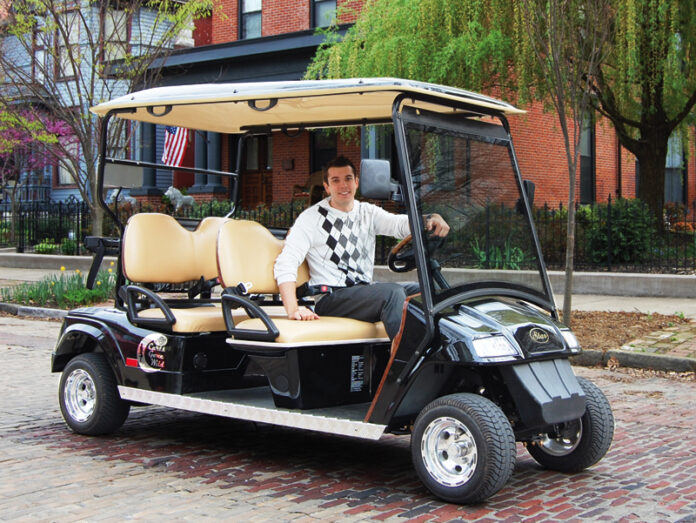
This one minor regret was the impetus for Thomas to open The Art Academy (www.theartacademy.org) in 2005, a drawing and painting school located in downtown Henderson. At The Art Academy, beginners, aspiring professional artists, and hobbyists alike receive attentive individual training from Thomas in a group setting. Among his students is Beth Storms, who studied fine art and painting more than 40 years ago. She was lured to The Art Academy when she was in Wellington’s Frame Shop and noticed the unassuming artist creating extraordinary work in a small studio next door. “I was overwhelmed by his work, and it reminded me of Jesus saying, ‘Can anything good come out of Nazareth?’” Storms recalls. “I realized I was a snob regarding painting and had no idea that quietly in Henderson worked a young man with all the ability of many well recognized artists.”
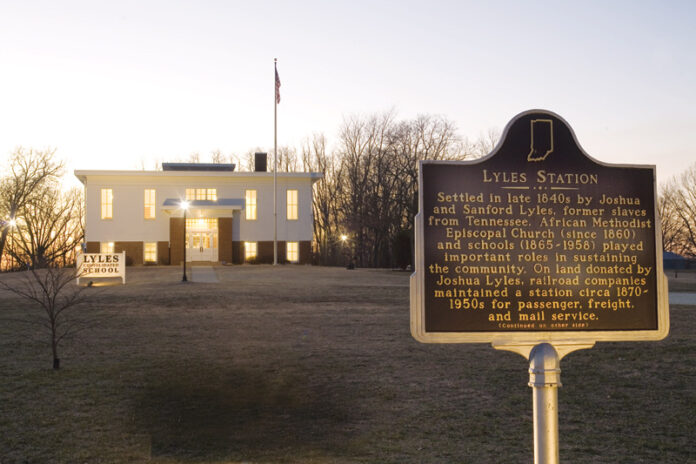
Then there is John Israel, a retired Evansville businessman who put down the brush 30 years ago to pursue a career in construction and who has returned to painting after selling his interest in the business earlier this year. Israel has become Thomas’ first full-time student with a larger individual workspace and access to the studio — and Thomas — five days a week. “Chris Thomas deserves all of our support, and especially mine, because I see him achieving something I would have liked to accomplish over 30 years ago,” says Israel. “But it’s never too late to catch a dream.”
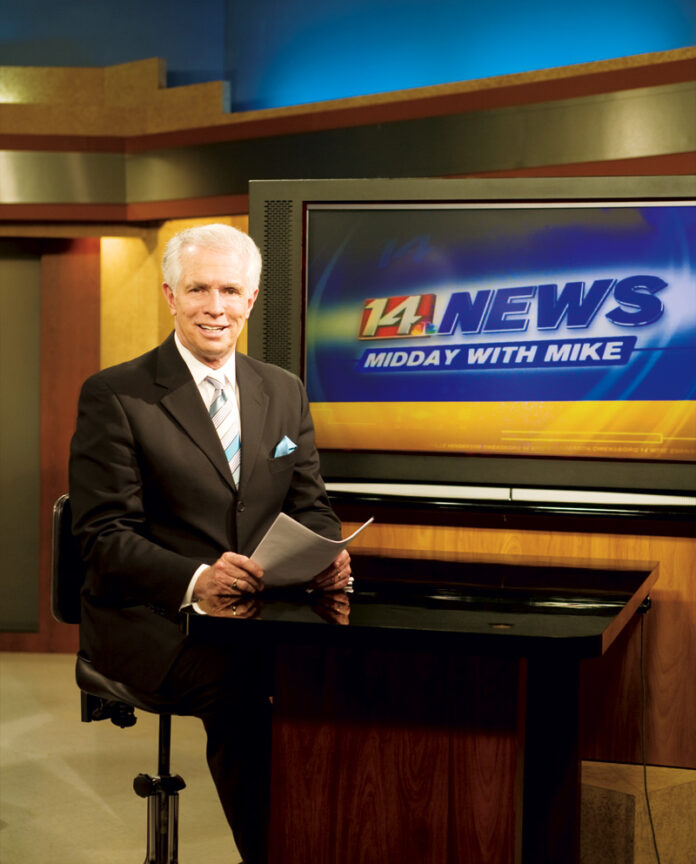
Smooth Operator

0
Growing up in a family of entrepreneurs inspired Roy Whetstine to launch his own small business at the age of 15.

It’s common for a kid to set up a neighborhood lemonade stand to earn some pocket change, but 15-year-old Roy Whetstine had much bigger aspirations before he even reached puberty. “When he was little,” says Roy’s mother, Brenda Whetstine, “he would wake up every morning and say, ‘What are we going to do today, Dad?’ He always said sleeping was a waste of time, and there was so much to do.” Roy’s never-sleep, can-do attitude has transformed into a keen business sense as his shaved ice stand, the aptly titled Roy Boy Shaved Ice — on the corner of Morgan Avenue and North Green River Road next to Bud’s Harley-Davidson — entered its second year in operation this summer.

Ask Roy, a sophomore at Memorial High School, if he has found the recipe for success, and he’ll tell you the ingredients are family support and a quality product. His first influence to open a shaved ice stand came from a family friend, Casey Todd, owner of Nick’s Shaved Ice in Henderson, Ky. “I saw how he ran his business and wanted to open one of my own,” says Roy.

He learned from Todd that not all shaved ices — the simple mixture of ice and flavored syrup — are created equal. Ice texture varies, and the richer ices feel more like snow than ice. To achieve the fluffy, snowy feeling, Roy went to Newburgh-based Hypothermias, a supplier of shaved ice machines. The ice is enriched with flavorful syrups, from the classic vanilla to the more exotic tiger’s blood (a combination of strawberry and coconut).

The flavor and texture has had much to do with bringing in nearly 100 customers daily, says Roy, but the atmosphere completes the experience. On weekdays, the radio plays as patrons savor the soothing treat at the outdoor picnic tables, and on weekends, reggae plays, evoking a beachfront atmosphere.

Entrepreneurship is a family trait. His parents, Brenda and Mike Whetstine of Newburgh, founded Comfort Sunrooms, building the business with hard work and sweat equity. Roy’s older brothers, Luke and Mark, who both studied business in college, have given him sound business advice. His sisters, Maria and Rose, designed and painted his shaved-ice shack, and youngest sister Clara is an employee.

Roy has a bank of five employees, but he’s learned what every small business owner knows: working for yourself still means you have to be a tough boss. It’s Roy who wakes up early every morning to “harvest the ice,” which he makes by freezing water in molds, then letting them thaw out a little, creating a solid block of ice to be “shaved.” Still, he’s enjoyed some of the perks of entrepreneurship such as getting to name your own business — Roy Boy is the nickname given to him by his parents at birth — and being top dog. “It’s kind of awkward because I tell some of my employees who are older than me how to act and what to do,” Roy says. “At the same time, it’s kind of nice because I don’t have anyone telling me what to do.”

Face Value

0

After losing a substantial amount of weight, Tim Holt had more energy, felt better, and was healthier. But something was nagging at him. The more weight he lost, the older he looked. As he slimmed down, his face began to show wrinkles. His cheeks appeared hollowed, and the fine lines were more pronounced. Holt wanted his outward appearance to match the way he felt on the inside. “There was no light bulb moment when I decided to get some work done,” says Holt, an oral surgeon in Henderson, Ky. “I just knew that I wanted to look how I felt.”

Holt (not pictured) is not alone. These days many men are seeking ways to look youthful, more energetic, and for some, to get an edge in the workplace.

Not that long ago, those wrinkles and lines on a man’s face were considered to be masculine and distinguished. For men, “aging gracefully” no longer is a popular option, says Dr. Alina Sholar, an Evansville plastic surgeon specializing in surgical and non-surgical cosmetic procedures. She’s seen a dramatic increase in the number of men seeking Botox or other cosmetic procedures — more this year than ever before.

“No question there’s been an increase in men seeking cosmetic procedures,” says Sholar. “In my practice alone, men account for 20 percent of my patients.” She has a section of her Web site dedicated to men and directly markets toward potential male patients at Evansville-area gyms. “We market differently to men because their concerns differ from women. Men do not want it to look overly obvious,” says Sholar.

According to the American Society for Aesthetic Plastic Surgery (ASAPS), men had more than 900,000 cosmetic procedures (250,000 of which were Botox injections, a procedure that freezes the facial muscles that produce wrinkles and fine lines). That accounts for more than 9 percent of the total in 2009. The number of all cosmetic procedures for men increased more than 8 percent from 2008.

Also of interest in the latest ASAPS report is the male approval rating of cosmetic surgery. Seventeen percent of men are more favorable toward cosmetic surgery compared to only five years ago, indicating a possible continued increase in future years.

Sholar says that the most popular outpatient procedures among her male patients are Botox injections, followed by microdermabrasion, Juvéderm, and chemical peels. These stats also mirror nationwide trends. The reasons men tell Sholar they want cosmetic procedures include wanting to look more youthful, appease a wife’s suggestion, and maintain a competitive edge in the workplace. Those especially interested in regaining their once youthful appearance are businessmen.

“The two professions I see the most are CEOs and salesman,” says Sholar. “For the CEO, they’ve made it to the top and want to stay young-looking. If employees perceive they are working for a fresh, energetic boss, it has a positive effect.”

Just as the reasons differ of why men and women elect to get cosmetic procedures, Sholar says that she also administers Botox differently to a man. A man’s facial anatomy differs from a woman’s and should be factored in when injecting Botox. While men need higher doses of Botox because of denser muscle tone, Sholar is careful not to overdo it. “Men are definitely more cautious,” she says. “Typically, men take more steps than women. Women are a lot more educated about procedures than they used to be, so they come in knowing what they want. Initially, men come to my office to seek more information, to be educated; then they pick and choose what’s right for them.”

To maintain the youthful glow, it’s recommended that men come back for injections every three to four months. Once the muscles have relaxed, it’s okay to push it back to a couple of visits a year (which average a cost of $300-$600 per visit nationwide).

Sholar says many of her male patients, like Holt, start off in her practice’s age management program. Patients first discuss concerns about their overall well-being. After a full lab work-up of things such as blood pressure and hormone levels, a fitness and nutrition plan is recommended. Once patients start seeing the benefits of the program, many begin to explore cosmetic procedures to match how they feel on the inside. Not surprisingly, men are a large percentage of this group.

“It’s not about getting older; that doesn’t bother me,” says Holt. “I want to feel good. It doesn’t matter if you’re 39, 49, or 59. Why not maximize this one life we have? Why not?”

River Myths

0

Swimming happily along the Ohio River like the queen of fresh water is a carp bigger than a truck. That’s how the myth goes anyway, and wouldn’t it be great if the next time the Ohio River waters receded, we’d see a one-ton carp lying on the Riverfront Dress Plaza like a beached whale? Not possible, say the biologists at the Ohio River Valley Water Sanitation Commission (ORSANCO). The biggest carp doesn’t weigh much more than 40 pounds. Though fellow river dwellers such as paddlefish and catfish can exceed 100 pounds, no Ohio River fish species reaches the size of a truck. We asked the ORSANCO experts about other river myths in need of busting.

Myth: Flesh-eating fish are in the water.
Reality: There have been a few piranha found in the Ohio River but only because someone released them from a home fish aquarium. It is very unlikely these fish could survive throughout the winter.

Myth: It’s safe to swim in the Ohio River.
Reality: We advise caution when swimming in the Ohio River, not because of the water quality but because of barge traffic, floating debris, and possibly submerged branches and trees.

Myth: Don’t swim in the river after it rains.      
Reality: Bacteria levels usually are elevated after a heavy rainfall, especially downstream of large metropolitan areas. A good rule of thumb is to wait at least 24 hours after a heavy rainfall.

Myth: The river’s fish are not edible due to pollution.
Reality: It is safe to eat fish as long as state advisories are followed. Check with state health departments for advisories on fish in the Ohio River. (For Indiana’s guidelines, visit www.in.gov/isdh/files/2009_FCA_Booklet.pdf. One piece of helpful advice from the government: “…keep in mind that larger fish are likely to be as contaminated, or more, than any that were tested.”)

Our River

0

When my family moved from Melcher, Iowa, to Evansville in 1971, I recall my parents talking to me about the Ohio River. Moving to Evansville was very exciting to a second-grade Kristen for several reasons: We were building a new brick house on the far East Side of town (our home in Melcher — population 1,298 — was a large, old, wooden structure); I was told children of diverse backgrounds would attend my school, Caze Elementary (rural Melcher was not diverse); my grandparents were here; and Evansville had a river.

My father had grown up in Evansville on West Florida Street. I’d heard plenty of stories from him (fish tales?) about the truancy of the neighborhood rat pack and days spent fishing the river and Pigeon Creek.

We never owned a boat, though my family quickly was immersed in our city’s river culture. My favorite restaurant at the time was Robby’s Barge, along the river where Marina Pointe now sits. When the Delta Queen or Mississippi Queen steamed into town, the Reeder family hustled down to Dress Plaza to gawk. (If my dad wasn’t around, we’d catch the bus down Riverside Drive because my mother didn’t drive until she was in her 40s.) If we drove Downtown to the river, my dad would take the car onto the flood wall boat launch, which was considerably steeper then; my sisters and I thought that was pretty neat and a bit scary.

A big Saturday often was a drive to Newburgh, where we’d picnic at the “new” or “old” locks and dam, or have lunch at the Calliope. (Eventually, we moved to Newburgh in the late 1970s.) I never missed a Thunder on the Ohio in the early years — or any river festival. If there was activity on our Riverfront, my family was there having a good time.

As a mother with an infant in a baby jogger, I was thrilled to run over one of the Twin Bridges in the enormously popular and now defunct Arts Fest River Run. Still, I think, “How cool is that?”

Now, my office window looks out to slivers of blue river (yes, it’s blue from my office) on either side of Vectren’s headquarters. And today, I made a point to visit the Pagoda, Evansville’s official visitors’ center, now in its height of color. From its observation deck, I admired the view below of the massive plantings of colorful spring tulips and beyond, the shimmering Ohio River.

I hope you enjoy the summer packages we’ve put together for you. “The Bend in the River” (p. 46) examines our life on the Ohio River and how that horseshoe bend has shaped us. If your summer plans lead you to other river cities (Louisville, Ky.; Chattanooga, Tenn.; Knoxville, Tenn.; or Indianapolis), our feature “Destination Dining” (p. 53) will point you to innovative, fresh food experiences.

As always, I look forward to hearing from you.

Sincerely,
Kristen K Tucker
Kristen K. Tucker
Publisher & Editor

Wild Thing

0

That guy in the picture? That’s me. I normally don’t look so cool, but the vehicle I’m driving makes anyone instantly more fun.

The Scoop
For five days in April, Evansville Living borrowed an electric low speed vehicle (LSV) from Carts Gone Wild, but despite what it looks like in the photo, an LSV isn’t a golf cart. An LSV must reach speeds between 20 and 25 mph and is equipped with headlights, turn signals, an automotive windshield, and more.

Late last year, Carts Gone Wild — based in Haubstadt, Ind. — capitalized on a big federal tax incentive for LSV purchasers, and owners Dana and Tony Hallam sold nearly 300 in four months.

I’m a Downtown dweller and live only two blocks from work. I never have minded the walk, but with an LSV, I looked forward to my 30-second commute. When I cruised to my girlfriend’s office for a lunchtime date, her eyes lit up at my unexpected choice of vehicle.

The LSV didn’t just impress the opposite sex. Todd Tucker, president of Tucker Publishing Group, used the LSV for three days and also saw enthusiasm from adults and children for his borrowed wheels. He picked up his sons, Maxwell and Jackson, from grade school on a Friday afternoon and received much admiration from students. Tucker’s friends begged for rides in the LSV, too, and several trips to Sonic were in order. With a casserole in tow, the Tuckers headed from their East Side home into Newburgh for an Easter celebration at Todd’s parents’ house.

The Verdict
I was limited with the LSV. The electric vehicle needs to be recharged at night by simply plugging it into an outlet. My second-floor apartment wasn’t the ideal location for such an issue, and I kept it overnight in a friend’s garage. The Tuckers didn’t have the same problem and discovered — like I did — that having an LSV makes you instantly more popular.

More importantly, it’s practical. If I owned an LSV and a Downtown home, I’m not sure I’d ever drive my car in the spring, summer, or fall, unless it rained. Residing on the East Side, the Tuckers felt there were no distance limitations, and after three days, they could see the savings at the gas pump.

Need to Know
LSVs only can travel on roads with speed limits of 35 mph or less and can cross major highways. LSV drivers have the same legal requirements as other motorists on the road. They need a driver’s license, vehicle insurance, and a registration. A current federal tax credit of up to 10 percent of the cost of any LSV up to $2,500 is available until the end of 2011. For more information, contact Carts Gone Wild at (812) 632-8514 or visit www.cartsgonewild.com.

A Lasting Legacy

0

On June 19, 1865, Union troops arrived in Galveston, Texas, bringing important news from the North: President Abraham Lincoln had declared that all slaves were free. Dubbed “Juneteenth,” that triumphant occasion inspires a celebration every summer at Lyles Station, Indiana’s last remaining black settlement from the Civil War era.

The story of Lyles Station, located near Princeton, Ind., began when Joshua and Sanford Lyles — brothers and freed Tennessee slaves — purchased land in Southwest Indiana in the late 1850s. When the Civil War ended, Joshua, who had become a successful farmer, rallied family and friends to head north and join him.

In 1886, the thriving settlement was named Lyles Station in his honor. At its peak near the turn of the century, the town boasted 800 residents, a railroad station, a post office, general stores, a lumber mill, a successful farming industry, and a school.

A tragic 1913 flood left much of Lyles Station in ruins, and many families fled the area. Few aspects of the settlement survived, but to protect its legacy, the nonprofit Lyles Station Historic Preservation Corporation formed in 1996. Three years later, the Historic Landmarks Foundation of Indiana (now Indiana Landmarks) named the 1919-built Lyles Consolidated School one of the state’s 10 most endangered places. After a renovation, the school reopened in 2003 as a museum and local history center — fitting for a community that deeply valued education.

Currently, approximately 15 families call Lyles Station home, and Stanley Madison, chairman of the Historic Preservation Corporation, estimates 65 percent of residents are descended from the original settlers. Last year, the community hosted a reunion of students who had attended Lyles Consolidated School. Nearly two dozen former residents — now in their 70s — showed up to reminisce.

Another joyful yet reflective occasion is the upcoming Juneteenth, celebrated around the nation. “We know the importance of freedom,” Madison says, “and how we struggled to get to that point.” Lyles Station’s public celebration includes a barbecue lunch, walking tours, and a guest speaker.

During June, July, and August, the historic site at Lyles Station (off Indiana State Road 64 near Princeton, Ind.) is open 1-4 p.m. Tuesdays, Thursdays, and Saturdays or by appointment. For driving directions and more information about Lyles Station, visit www.lylesstation.org. To learn more about the Juneteenth celebration, see our Guide.

The Voice of 40 Years

0
Inside the 14WFIE studio, Mike Blake continues to take on new challenges in the 40th year of his career.

Mike Blake’s voice — almost Barry White deep — commands attention. The smooth, clear voice sounds like it should give directions on a GPS. It’s upbeat and friendly but somber when necessary. His voice has all the qualities to report news — straight news — and what defines his voice most is what’s missing from it: a level of cynicism and a judgmental tone. Those two qualities are among the chief complaints of critics of today’s news industry who point out their frequent frustrations with anchors who blur the line between opinion and news in the era of the stuff-yourself-full, 24-hour cable and Internet news.

His poise matches his voice. The 5-foot-11-inch news anchor walks with his shoulders back, spine straight. He dresses like a character from Mad Men — with a touch more color. His suits are dark; his ties have a perfect Pratt knot. He isn’t afraid of business shirts with banker’s collars. For Blake, the pocket square isn’t an accessory; it’s the finishing touch of his look.

Blake celebrates his 40th year on 14WFIE in 2010 — four decades spent in local living rooms via broadcast news — and he still thinks he can do better.

Blake honed his voice in his childhood bedroom in Munster, Ind. Blake, the youngest of five children, sat hours on end pretending to give play-by-play commentary for imaginary sports games.

Blake loved sports. He was a natural athlete, and he played basketball and baseball in grade school. He lettered in the two sports in high school. In 1962, he left for Dubuque, Iowa, to major in political science at a small liberal arts school, Loras College. He minored in speech, became a vocal talent for campus radio, and won oratory contests as a freshman. “This had a profound effect on my life,” Blake says. His oratory skills led him to theater. Admittedly a jock in high school, Blake credits theater as a teaching tool for his broadcast career. From staging to lighting, he developed his on-air presence; he perfected his voice. A campus priest also recognized the talent of Blake’s voice. Blake says, “He told me, ‘You will make a living with your voice. If you’re smart, don’t smoke. Take care of yourself.’”

Blake’s been at WFIE for 40 years, but the first viewers to see Blake on the news were the armed forces overseas. He joined the U.S. Army in 1968 after earning a master’s degree in radio, TV, and film from the University of Iowa. The army sent him to the Far East where Blake was on air for the Armed Forces Vietnam Network during the Vietnam War. When Neil Armstrong was walking on the moon, Blake was anchoring a newscast on the South China Sea, 300 miles from Saigon. In the morning, he switched to radio. “I didn’t have to worry about the ratings,” Blake says. “I was just on, and my whole audience were guys from all over the country.” By May 1970, he returned to Munster — 30 miles south of Chicago where he was born — with a wealth of experience.

During his post-war job search, he landed an interview with WFIE where executives were scrambling to fill a void left by Marcia Yockey, a veteran local weatherwoman known for her wacky persona.

[pagebreak]

Blake, the mild-mannered young gun, was her polar opposite. For the next year, Blake was the weekly weatherman and weekend sports anchor — six days on, one day off. That’s a lot of facetime with the Evansville audience. Then, Yockey returned with her signature thick black marker and photos of her pet cat, “Bird.” Blake was named sports director, and ever so slowly, he covered more sports and less weather.

The peculiar thing about Blake’s longevity in Evansville is he never had any intention to stay. He wanted to be a play-by-play announcer. “I was told by my wise, old teachers, ‘Sometimes you have to do things you don’t want to do before you can do what you want to do most,’” Blake says. Plus, the River City was just a great training ground. “I was allowed to make mistakes,” he says. “I loved what I was doing.”

Then, he met the “love of his life,” Jenny. When they married in February 1973, he told her Evansville would be their home for only one more year. Blake had bigger cities on his mind. “In broadcasting,” Blake says, “you usually have to move out of a market to move up.”

Four years later, Blake — still in Evansville — received a job offer from a station in Miami, Fla. With two kids in tow, Blake packed his bags, and “my wife and I thought, ‘This is it,’” he says. But this was 1977, and the University of Evansville men’s basketball team, whose games were a favorite weekend activity, had entered its first year of Division I sports. WFIE executives decided to broadcast the games with Blake as the play-by-play man. “That was the hook,” he says; Blake stayed.

Four games into the season, a plane reached the Evansville airport three hours late on a foggy, dreary night, and the UE basketball team boarded for a game in Tennessee. Less than two minutes later, the plane crashed, and 29 people — including every team member — were dead. Blake’s stint as a UE sports commentator was over, which he adamantly confesses is ancillary compared to the tragedy that shook this city.

But it did change his career. Like many local news reporters, Blake was at the station for hours upon hours after the crash. Decades before the Internet and smartphones, Evansvillians relied on local news stations for updates on incoming reports from the crash site. Viewers sat in front of their boxy televisions, waiting for good news that never came.

Off camera, Blake exudes optimism. He calls men “Pal” with the same amount of enthusiasm as if Blake were out bowling strikes with his buds at Franklin Lanes. He uses phrases like “go jump in a lake” as a form of good-natured chiding. But on the night of the UE plane crash, Blake was stoic and straightforward. He connected to the emotional pains of the city. After arriving in Evansville seven years before, the northern Indiana transplant firmly was entrenched with the Southwest Indiana community. “Even 34 years later,” Blake says, “it’s something I’ve never gotten over.”

After the tragedy, Blake continued as a sports anchor on WFIE, and through the 1980s, Blake became a staple on local television broadcasts. He ventured into news reporting. He anchored WFIE’s first 5 p.m. news show in 1986 with Susan Hiland, later replaced by Ann Komis. That “certainly helped me extend my career,” Blake says, “but I haven’t shaken the sports tag.” In the 1990s, he became the host of Friday and Saturday night shows dedicated to high school football and basketball. Then, his own show, Midday with Mike, became a half-hour newscast, which grew into an hour-long show.

As Blake tells the story of his career, he acts as though he were just a character in his life’s story. From his wife to WFIE executives, others were responsible for the opportunities presented to him. He simply was there. “I was just grateful I could fit the bill,” he says.

[pagebreak]

The four decades Blake has spent with Evansvillians in their living rooms via his news broadcast is only one reason he is so connected to the community. Blake also offers his voice for charities — between 45 to 60 public appearances every year. He emcees auctions and fashion shows. “Everywhere we go,” says Bo McFall, a WFIE weekend sports anchor, “people come up to him like they’ve known him for 40 years. He’s a very approachable person.”

Blake makes passionate speeches for nonprofit organizations, including the Muscular Dystrophy Association. “That’s one aspect of the job that I truly do enjoy,” Blake says. Locally, no one can picture an MDA telethon without Blake because he’s been the fundraiser’s only host.

And he isn’t just hosting. Blake makes 300 phone calls from the beginning of the year until Labor Day. Over the years, Blake’s developed friendships with people used to his annual requests for funds. Once, a doctor and regular MDA supporter joked: “Go to hell, but send me an invoice anyway.”

So good is Blake’s voice that people love to imitate it — especially in front of him. WFIE meteorologist Jeff Lyons and former Evansville radio personality Sam Yates give Blake impersonations. But, the best just may be his son Michael Blake Jr., a WFIE account executive. “People will say to me, ‘Have you seen your son do you?’” Blake says. A peek at Blake’s outdated resume shows he’s a family man. He lists his children (Christine, Michael Jr., Billy, and Patrick) above his work experience. Patrick, his youngest, is 24 years old. So when Michael Jr., who sounds nothing like his father, does an impression of his father, it’s out of love. “I would never in a million years do it as a cut down,” Michael Jr. says.

The workday for a news anchor is long, yet Michael Jr. remembers Blake returning home after the 6 p.m. show for family dinners. He then would return to the studio for the 10 p.m. newscast. In the morning, there was Blake, waking his kids for school. Michael Jr. was in the second grade before he realized his dad’s popularity when classmates would ask, “Does your dad make a million dollars?”

Blake knows how much has changed since he began his broadcast career. When he started, he spliced film to edit news packages; computers still were the size of rooms. But he’s adapted to technology changes, and he passes his knowledge on to his younger news anchors. When the 25-year-old McFall was named WFIE’s weekend sports anchor in 2008, Blake watched McFall’s newscasts religiously. “It didn’t matter if it was crap or not,” McFall says. “He would call and compliment me every time. That would give me more confidence. He still does it.”

New technology also has brought new competition. “If someone would have said to me, ‘In 2000, we’ll have news from 4:30 to 7 a.m. before the Today show,’” Blake says. “I would have said, ‘You’re crazy.’” The anytime access of cable and Internet news is a driving influence for local programmers to reach new audiences, Blake says: “All of a sudden, (viewers) have too many choices.” But, despite a near half-century on television, Blake hasn’t shifted his on-air demeanor. On McFall’s first day at WFIE, Blake asked the upstart for advice on his most recent broadcast. He wanted feedback from a new viewpoint. “It shows even after all these years,” McFall says, “he’s still an absolute perfectionist.”

“My goal is to get to Chicago,” Blake jokes on a rainy March Monday afternoon after Midday with Mike finished. “I think I have to keep striving for that.” No, Blake isn’t leaving; the award-winning anchorman still is polishing his broadcast, striving to produce the level of professionalism in big-market cities for an Evansville audience. “I’ve always tried to say I want to be as good as my competitors locally,” Blake says, “but I want to be as good as anybody in the business.”

Ballet Beauty

0
Gretchen Smith performs in Western Symphony, a ballet created by New York City Ballet co-founder George Balanchine.

Tears welled up in the hazel eyes of 10-year-old Gretchen Smith as she scanned the casting sheet for the Evansville Dance Theatre’s annual production of The Nutcracker and didn’t see her name. Then her mother told her she was looking in the wrong place — her name was at the top, next to the role of Clara, the little girl who gets a toy nutcracker for Christmas that turns into a prince who takes her to the Land of the Sugar Plum Fairy.

From that moment on Gretchen was hooked, and ballet became her passion. Now 22 years old, for the past four years she has been a member of the New York City Ballet (NYCB), one of the nation’s most prestigious dance companies. This year’s spring season, which began April 29, consists of 40 ballets, including seven world premieres. The NYCB is unique in that it performs a different ballet every night, which means that Gretchen has moved from dancing as Clara to performing a different role on stage every week from Tuesday to Sunday. Those roles — in addition to dancing with the corps in almost every performance — have included featured or understudy positions in eight shows such as Rosalia in West Side Story Suite, the Tenderness Fairy in Sleeping Beauty, three roles in Swan Lake, and yes, a demi-soloist in The Nutcracker.

The tall, lithe, dark blonde Evansville native has pirouetted and jetéd not only at the ballet’s home at Lincoln Center but at acclaimed performances in London, Paris, Copenhagen, and Tokyo. But the longest journey was from Evansville to New York, and not an easy one either for Gretchen, or her parents, Will and Lori Smith, who agreed with pride, but trepidation, to allow their young daughter to leave home at 15 and enroll in the School of American Ballet (SAB), the official training academy of the NYCB.

Will Smith, a partner in Universal Operating, a family-owned independent oil producer with rigs throughout the Tri-State, says, “Letting her stay up there at 15 — losing her early — was the hardest decision I ever made. But I have no regrets.”

“It’s not like on the East Coast, where people are used to packing their kids off to boarding school,” says Lori Smith. The decision raised some eyebrows among friends and neighbors, but the Smiths, a family of faith, prayed on it and decided “God had given her a gift, and she had a right to pursue her dreams.”

By that time, Gretchen already had built a solid foundation for dance, thanks to excellent teachers at the Evansville Dance Theatre (EDT), who encouraged her (starting at age 12) to attend summer ballet camps in Indianapolis, Philadelphia, and San Francisco, where she also learned to live on her own.

Gretchen cites former EDT artistic director Don Tolj, ballet master Patrick Hinson, and ballet mistress Adahli Aranda-Corn for teaching her the fundamentals and encouraging her to go further.

Aranda-Corn, who now runs her own ballet school in Lexington, Ky., quickly realized that Gretchen was “very, very special. She put her heart into it every day. She always had a smile on her face, eager to learn and do more.” Aranda-Corn, who danced professionally in her native Mexico before being wooed to Evansville as a principal performer and teacher, says the life of a ballerina is very hard. “It almost chooses you,” she says of a career that from the audience appears all gracefulness and beauty but which results from long hours of grueling, sweating practice, including recovery from injuries.

[pagebreak]

“There was never doubt in my mind that Gretchen would make it,” says Aranda-Corn, who keeps up with Gretchen’s career via Facebook. “Her body is Balanchine,” she says, referring to the influential choreographer George Balanchine, a co-founder of the NYCB, known for favoring slender, long-limbed dancers.

After her freshman year at Harrison High School, during which she admits she was an “OK” student preoccupied with dance, 15-year-old Gretchen auditioned for summer classes at the SAB. Her mother accompanied her on her first trip to the Big Apple and was pleased to discover that the school was on the fifth floor of the building where her daughter would be housed. Gretchen was assigned to share a room on the 14th floor of the Rose Building, part of the Lincoln Center complex, which also serves as the dormitory for the famous Juilliard School.

Halfway through the five-week session the students were told they could apply to stay year-round. Gretchen signed up but didn’t tell her parents, believing there was “no chance” she would be selected.

Shortly thereafter Gretchen was offered a place in SAB’s full academic year program and given one week to decide. Gretchen never will forget the phone call she made to her parents that day. After explaining the deal to them, there was, she recalls, “no joke — a full minute of silence,” after which her mother said, “We really need to think about this.”

The next week Lori Smith flew to New York, sat in on the classes, talked to the registrar and after observing the tight security in the building felt assured about her daughter’s safety. (It’s the kind of tony neighborhood where Bed Bath & Beyond has a doorman.) The clincher was lunch with the ballet school’s director of development, Carrie Wenger Hinrichs, who also is from Evansville. She asked Mrs. Smith, “Do you know how much of a big deal this is?” (Yet another former Evansville resident, Dara Faust, works in the NYCB’s costume shop.)

Two days later Gretchen’s parents, in a decision accompanied by tears and cheers, told her she could stay. “You’ve got to let them go at some time,” Lori Smith reasoned. (The Smiths’ other children, two older boys, live in Santa Monica, Calif.)

Elizabeth Wallace, a friend of Gretchen’s since second grade, says she “always danced.” Gretchen’s move to New York was “a huge decision — like the end of the world — but a step she needed to take.” Wallace stays in touch with Gretchen and has visited her in New York. “She’s still the same person,” Wallace says, “but she grew up a little faster” than her peers and is more independent.

For her sophomore year Gretchen attended the Professional Performing Arts School, a New York City public school, and then switched to the private Professional Children’s School because of smaller classes and its location adjacent to Lincoln Center.

“It was surreal and exciting,” she says of the schools, whose students included up-and-coming singers, artists, actors, musicians, and even a tennis player. While the schools follow a regular academic schedule, they excuse students for practices, auditions, and performances.

One month into her senior year, Gretchen was offered an apprenticeship with the ballet, a vital stepping stone toward making the NYCB, as 90 percent of the company trained at SAB. For the next five months, Gretchen practiced with the NYCB and took a Saturday class with Peter Martins, the company’s ballet master-in-chief.  Then on Feb. 14, 2006, Gretchen received the best Valentine possible: a contract to become one of 20 new members of the company’s corps de ballet. (About half of the company’s 93 members are in the corps; 15 are ranked as soloists, and the top 29 are principals. The company has its own 65-piece orchestra.)

Gretchen received her high school diploma in the spring of 2005 in a ceremony that showed off the talents of its graduates. Among PCS’s many famous alumni are the legendary NYCB ballerina Suzanne Farrell, cellist Yo-Yo Ma, opera diva Beverly Sills, and actress Sarah Jessica Parker.

A downside of becoming a professional performer at such a young age is postponing, or forgoing, college. Gretchen hopes to enroll part-time at Fordham University or Columbia University in the future.

In the four years since joining the company, in addition to dancing with the corps in nearly every performance, she has earned featured or understudy roles in nearly a dozen shows. She also danced in NY Export: Opus Jazz, a film adaptation of choreographer Jerome Robbins’ famous “ballet in sneakers” that locally aired on WNIN earlier this spring. She’s living the fairy tale life and being paid well for it. (NYCB dancers start at about $50,000 a year and, with annual raises and overtime — it’s a union shop — can double that within several years.)

At such a high level, ballet requires the talent of an artist and stamina of an athlete, and the NYCB’s repertory is the largest in the world. To memorize and perfect the choreography, the company practices from 10:30 a.m. to 7 p.m. and then works 10:30 a.m. to 10:30 p.m. during the 150 performances.

Performances are held in the David H. Koch Theater, a stunningly grand 2,500-seat, five-level hall that it shares with the New York City Opera. (The other major buildings at Lincoln Center house the Metropolitan Opera and the New York Philharmonic.)

After living in the dorm four years, Gretchen moved to a one-bedroom apartment on the Upper West Side, a 10-minute walk from the theater. The proximity is valuable in keeping pace with the ballet’s rigid schedule, which includes an annual summer season at Saratoga Springs, N.Y., and foreign tours, making it difficult for Gretchen to come home often. “That’s hard,” her mother admits. The Smiths, who moved from the East Side to Newburgh a few years ago, make frequent trips to New York, including a Christmas tradition that includes bringing an artificial tree from Evansville for their hotel room.

When Will Smith brags about his daughter, he describes her achievement to his friends in a sports term: “I tell them she made the Yankees of the ballet world.”

Has Gretchen’s success made a ballet fan out of her father? He hedges: “The New York City Ballet is spectacular. The stage, the music, the scenery. I sit through the whole ballet the first time.” If his wife wants to go back a second or third time? “I’ll slip out for the parts Gretchen’s not in,” he says. “I guess I’m not a 100 percent fan, but I do appreciate it a lot more.”

Boxed Lunch

0
(clockwise from bottom) Miso soup, salad, tempura, a choice of entree, and sushi

In September 2006, Food Network star Rachael Ray arrived on the set of ABC’s Good Morning America to tell viewers about five of her favorite things. One of the novelties that made her list was a bento box, a traditional Japanese lunch box with small compartments or an assortment of dishes. Since Ray’s endorsement, bento boxes have attracted a diverse group of devotees. For dieters, they encourage portion control and variety. For picky kids, an artful bento lunch has a coolness factor far above the cafeteria special. And for working adults, bento boxes are an aesthetic alternative to brown bag lunches.

Many bento box owners invest serious time into packing lunches for themselves or their children, crafting elaborate displays of food. (Last fall, The New York Times featured a California mother who packs her 2-year-old daughter’s bento with flower-shaped sweet potatoes, rice formed into kitten shapes, and boiled eggs shaped like bunnies.) Evansville residents can enjoy the bento tradition without all the work in the kitchen: Several local Japanese eateries, including Iwataya Japanese Restaurant, serve bento box lunches. While they aren’t quite as elaborate as the ones enjoyed by that lucky toddler in California, they offer the opportunity to sample many Japanese foods in one meal — a bonus for those unfamiliar with the cuisine.

My husband and I headed to Iwataya, a North Side staple for more than a decade, on a sunny spring afternoon. A sign instructed us to seat ourselves, so we followed a smooth, black stone path into a private seating area. With a low table and bamboo mats, it resembled a peaceful shrine (and what’s better than a shrine where you can eat?).

A waitress soon informed us that we had, in fact, violated a sort of sacred space — a group dining area available by reservation. She led us to a smaller booth and instructed us to remove our shoes before sitting at the table, which was surrounded on three sides by wooden benches with thin blue cushions. (A note to our female readers: Iwataya also offers typical Western-style table seating, but if you plan to sit in a booth, resist your urge to channel Mad Men when you get dressed that morning. Swinging your legs under a table is far more elegant when you aren’t sporting a slim-fitting pencil skirt.)  (Continued on Page 2)

[pagebreak]

When Iwataya opened in 1999, the restaurant initially drew a crowd of Japanese executives from Toyota Motor Manufacturing, Indiana in Princeton. Since then, its loyal fan base has broadened, and when I visited, quiet fragments of conversation in English and Japanese floated around the small restaurant. A wooden divider separates each booth and table, creating a sense of intimacy without being oppressive. In the back of the restaurant is the sushi bar; although friends have called Iwataya’s sushi some of Evansville’s best, we focused our attention on the bento box menu. (Lunch entrees also are available, and the dinner menu includes seafood, meat, and vegetarian dishes.)

Mari Sakamoto, assistant manager at Iwataya, grew up in the major port city of Yokohama, Japan, where she ate bento lunches carefully prepared by her mother. “Most Japanese grow up with bento boxes,” she says, “because they take them to school.” One of Sakamoto’s favorite childhood dishes, yakiniku, is available at Iwataya. The restaurant offers five different bento boxes: chicken, salmon, or beef teriyaki; ginger pork; and yakiniku, a mix of stir-fried beef and vegetables. Each choice comes with miso soup, a small salad, tempura shrimp and vegetables, six sushi rolls, and a bowl of steamed rice.

Our order of hot green tea arrived first, served in large mugs with tea leaves swirling at the bottom. Miso soup with fragile slices of green onion followed. For our bento boxes, we chose chicken teriyaki and yakiniku, but paying too much focus to the meat choice seems an inappropriate description of a bento box. Unlike a typical American restaurant meal, the meat wasn’t the focal point — it filled just one of six compartments in the bento. (If you’ve been advised that a meat serving should be the same size as a deck of cards, this meat serving actually is.)

The teriyaki chicken bore little resemblance to the sodium-laden takeout version I happily consumed at midnight as a college student. The sauce was sweeter, lighter, and accented with cracked pepper. The accompanying items added diverse flavors to the meal, and our favorites were the crab salad rolls, served with a dab of wasabi and slices of pickled ginger, and tempura, fried in a light batter.

Glamour has called bento boxes “the super-cute way to eat healthier,” and Japan-born blogger Makiko Itoh claims the boxes helped her lose 30 pounds by controlling portions. (Itoh, who runs www.justbento.com, also told The New York Times that the boxes reflect Japan’s version of the food pyramid: that every meal should have five colors.) A restaurant’s bento isn’t exactly a light lunch — especially after my bowl of smooth, mellow green tea ice cream. Still, the small portions and numerous compartments demand slow, thoughtful eating. Or maybe that was just my clumsiness with chopsticks.

Next time I visit Iwataya, I may take home a bento of my own. Sakamoto says the restaurant keeps a small stock of lidded bento boxes that customers can purchase for around $30. Popularity of the boxes has increased, she says, and that doesn’t surprise her: Bento boxes have definite novelty allure, and they keep meals interesting. “(People) can eat a little bit of everything,” says Sakamoto, “not just one thing.”

What to Know:

Location: 8401 N. Kentucky Ave. (near U.S. 41 N. and Mount Pleasant Road)
Phone: (812) 868-0830
Prices: Lunch $8-$15, dinner $12-$25
Hours: Lunch, 11:30 a.m.-1:30 p.m. Tues.-Sat.; dinner, 5-9:20 p.m. Mon.-Sat.
Reservations: Yes
Payment: Major credit cards accepted

Hot Brown

0

If you can’t make it to The Brown Hotel, try the famed recipe to experience a true Louisville original.

The Legendary Hot Brown Recipe

The Brown Hotel, Executive Chef Laurent Géroli
335 W. Broadway, (502) 583-1234 or www.brownhotel.com

Ingredients (Makes Two Hot Browns):
•  2 ounces whole butter
•  2 ounces all-purpose flour
•  1 quart heavy cream
•  1/2 cup Pecorino Romano cheese,
   plus 1 tablespoon for garnish
•  Salt and pepper to taste
•  14 ounces sliced roasted turkey breast
•  2 slices Texas toast (crust trimmed)
•  4 slices crispy bacon
•  2 Roma tomatoes, sliced in half
•  Paprika and parsley

In a two-quart saucepan, melt butter and slowly whisk in flour until combined and forms a thick paste (roux). Continue to cook roux for two minutes over medium-low heat, stirring frequently. Whisk whipping cream into the roux and cook over medium heat until the cream begins to simmer, about 2-3 minutes. Remove sauce from heat and slowly whisk in Pecorino Romano cheese until the Mornay sauce is smooth. Add salt and pepper to taste.

For each Hot Brown, place one slice of toast in an oven-safe dish and cover with 7 ounces of turkey. Take the two halves of Roma tomato and set them alongside the base of turkey and toast. Next, pour one half of the Mornay sauce to completely cover the dish. Sprinkle with additional Pecorino Romano cheese. Place entire dish under a broiler until cheese begins to brown and bubble. Remove from broiler, cross two pieces of crispy bacon on top, sprinkle with paprika and parsley, and serve immediately.

Plaza Drive

0

In 1986, Robert Matthews, then executive director of the Center City Corp. (a predecessor to the Growth Alliance for Greater Evansville), published an editorial in the Evansville Press that encouraged Evansvillians to “put our dreaming caps on and look at our riverfront, keeping in mind that dreams can become reality if our attitude is positive.” His lofty visions — a mini-state park! An airstrip for ultralight planes! A steamboat museum! — may not have materialized, but his creative approach to riverfront development was exactly what transformed Dress Plaza.

Constructed in 1936 and named for two-term mayor William Dress, Dress Plaza was the subject of numerous proposed makeovers. In 1963, the Chamber of Commerce expressed a desire to beautify the elevated portion of the plaza; in a letter urging the group to take action, one local business leader wrote that the “drab wall … will be a depressing thing unless something is done about it.” Another Evansvillian proposed painting a mural of historic River City scenes on the lower retaining wall.

In the mid-1960s, a local “beautification committee” pondered where to put four 10-ton, 28-foot concrete columns (sound familiar?) that previously had adorned a community center at Eighth and Main streets. Those columns became the Four Freedoms Monument in 1976, but the finishing touches weren’t immediately completed. Passersby complained that the 50 unmarked stones surrounding the Four Freedoms Monument — now emblazoned with state seals — made the area resemble an unmarked graveyard.

Development in the plaza area surged again in the mid-1990s when Casino Aztar came to town, eventually bringing numerous restaurants and two hotels. In 2002, a $10 million renovation of Dress Plaza provided event seating and an attractive, updated esplanade.

The Bend in the River

0
Illustration by Wilkinson Brothers Hardworking Design

Last year, a multistate organization called hundreds of residents in the Ohio River basin to ask how they used the river. Then, the researchers conducted field surveys, and when they finished, the commissioners visited Ohio River cities with PowerPoint slides of information. Their findings showed how people used the river (to fish, swim, boat, and ship goods, of course) — and why they don’t (it’s polluted, muddy, and dirty).

The answers may seem obvious to Evansvillians, yet we wanted to know: Does the bend in the river — where Evansville was founded — shape who we are? Over the next pages, we determine our identity on the river.

Historic Haunts

Where there are river views, there are restaurants. We look back at a few historic haunts that surely are missed — and one that still is a can’t-miss.

Scuffletown Saloon

Through the 1980s, the Scuffletown Saloon was as close to the water as patrons could eat — next to the riverbanks in Newburgh. Now, the upscale-casual Edgewater Grille would partially block Scuffletown diners from seeing the water. When opened, the saloon was packed with Indiana University basketball fans who drank from Mason jars. The former location of Scuffletown now is part of various commerce buildings.

Fischerman’s Wharf

In 1987, Newburgh businessman George Corne — owner of Scuffletown Saloon, an ice cream shop, and condominium units, among other ventures — opened a restaurant called Fischerman’s Wharf on a barge once owned by the U.S. Army Corps of Engineers. On Christmas 1988, the barge sank in the Ohio River. Undaunted, Corne claimed he would renovate the barge and create a new restaurant, fittingly called Sinkers, which never opened.

The Barge

Last fall, the Tin Fish restaurant closed at Marina Pointe due to a fire. The building has held tenants since the 1960s, but the two-story space actually replaced The Barge, a restaurant constructed on an old river barge. Serving fiddlers, steaks, and seafood, The Barge affectionately was known as “Robby’s Barge” until it changed ownership in the late 1970s. The restaurant burned down in 1986.

After the Tin Fish fire created an uncertain future of Marina Pointe, the partners of Two Daddy’s Pizza announced plans to reopen the site with an open-air restaurant, tiki bar, and events plaza. They plan to open the new venture Fourth of July weekend.

Amanda Fenwick’s Riverboat

At the end of Main Street — just before the water — Amanda Fenwick’s Riverboat resembled just that: a riverboat. The popular haunt known for an upscale menu (one chef went on to prepare meals at the Petroleum Club) closed before that other riverboat (Casino Aztar) docked in 1995. In the early 1990s, the building became a gay bar, Teana Faye’s Riverboat Lounge. Ultimately, a succession of property ownership changes ended any restaurant’s run at the location. Today, Old National Bank’s headquarters, built this last decade, tower over the spot.

Dogtown Tavern

Unlike the other places mentioned in this story, Dogtown Tavern makes the list because it’s one of the few to survive. Established in the late 1800s as a post office and a saloon, Dogtown Tavern — well south of the bend in the Ohio River — has a reputation for fiddlers. With a family recipe that’s survived seven decades, it is a worthy destination for fried catfish. — Louis La Plante and Kristen Lund

Have a photo of one of our historic haunts? Send it to us!

[pagebreak]

Rollin on the River

Through parts of the 19th and 20th centuries, grand steamboats cruised the nation’s rivers, fueling commerce and housing overnight passengers. Farther from home, military ships embarked on dangerous missions to help the Allied powers in World War II. Many famous boats have perished, but several (and their modern counterparts) have made a splash in our area.

Delta Queen

After launching from Stockton, Calif., in the mid-1920s, the Delta Queen became known for carrying passengers on river cruises throughout the South and the Midwest. The ship was named a National Historic Landmark in 1989 and made frequent stopovers in Evansville, Newburgh, and Henderson, Ky., as recently as 2008.

That year marked a turning point for the 285-foot steamboat. Previously, it had been granted exemption from a federal law that banned boats largely made of wood from carrying more than 50 overnight passengers. (The Delta Queen’s passenger capacity was 176.) That exemption expired in October 2008, and Congress refused to grant another. In June 2009, the steamboat with the famous red paddlewheel permanently docked in downtown Chattanooga, Tenn., and has been converted into a boutique hotel.

Mississippi Queen

Like the Delta Queen, the majestic Mississippi Queen — the second largest paddlewheel steamboat ever built — frequently used to stop in the Tri-State. But unlike the other steamboat, the Mississippi Queen’s future remains uncertain.

The riverboat with twin smokestacks was built in 1976 at Jeffboat (the same Southeast Indiana company that built Casino Aztar’s riverboat). It offered overnight river cruises to passengers and often docked in Henderson, Ky.

Plagued by financial problems, the Mississippi Queen’s parent company ceased operations in late 2008. The steamboat’s planned renovation was canceled, and it currently is moored at Louisiana’s Perry Street Wharf in a state of disrepair.

The ship’s plight has drawn media attention around the world. Last July, a correspondent with London’s Daily Telegraph newspaper reported that ship was “tied up in New Orleans, where it has been stripped down and left to molder and be looted.”

USS LST 325

The Ohio River’s landscape changed with the advent of World War II. Evansville’s riverfront became a production hotspot for landing ship tanks (LSTs), employing 19,000 people and producing two of the 330-foot ships each week.

The Philadelphia-built LST 325 launched in 1942 and operated in Algeria and Tunisia, participating in invasions of several Italian cities. On June 6, 1944, the ship played a role in D-Day by joining the backup force for soldiers going ashore at Omaha Beach in France. Later, it made dozens of trips across the English Channel, carrying soldiers and supplies.

After the LST was decommissioned in 1946, it continued to serve in Canada, Greenland, and Greece until 1999. Then, a group of retired military members traveled to Greece and brought the LST back to the United States. During a 10-day stop in Evansville in 2003, the ship drew more than 35,000 visitors. Two years later, the LST 325 docked permanently in Evansville, where it now serves as a museum and memorial.

Spirit of Evansville

In 1981, a Wisconsin-built paddlewheeler dubbed the Spirit of Evansville sailed down the Mississippi River and arrived at its new home. For several years, it was a 150-passenger excursion boat that carried groups on Ohio River cruises. The boat moved to Little Rock, Ark., in 1985, where it was known as “The Spirit.”

City of Evansville

Better known as the Casino Aztar riverboat, this ship only looks historic. Built by Jeffboat in Jeffersonville, Ind. — the largest inland shipbuilder in the United States — the casino boat’s exterior mimics the Civil War-era Robert E. Lee sidewheel steamboat.

The actual name of Casino Aztar’s 2,700-passenger boat is City of Evansville. It opened in 1995 as Indiana’s first riverboat casino and required more than a year to build. While the exterior reflects an 1860s aesthetic, the interior was designed to evoke a sense of Vegas-like glitz and glamour. —  Kristen Lund

For more on these boats, visit:
www.deltaqueenhotel.com / www.lstmemorial.org / www.casinoaztar.com

[pagebreak]

Waves of Joy

Commerce? Sure. Recreation? Check. The proximity of the river provokes another opportunity for Evansvillians: celebrations. Here are a few remaining this year that show the river very much defines how we party.

Historic Newburgh and Evansville Living Wine, Art & Jazz Festival

Originally named Sprinklesburg, Newburgh’s fun name deserves a fun town, and much of the enjoyment comes from the river. Residents of this small town east of Evansville pack the annual Historic Newburgh and Evansville Living Wine, Art & Jazz Festival at the Old Lock and Dam Park each May. With a long list of contributing Indiana wineries and musicians (for details, see our festival guide, p. 33), the festival is a celebration for everyone from connoisseurs to novices and anyone who supports the local economy. What better backdrop, then, than the iconic Ohio River?

The river may give the festival its look, but the musicians give the festival its sound. On tap to play guitar tabs this year are The Duke Boys Band, who play rock like it was heard in its infancy. Joining this longtime local favorite on stage is another popular act: The Browne Sisters, Gina Moore and Joan Moore-Mobley. The powerful singers belt out ballads and infused with The Duke Boys’ rock music, the combination offers a fun sound.

Evening on the River

Riverside Drive didn’t always look so beautiful, but with the help of civic and city leaders the Riverfront is a recreation area. Now, the Evansville Parks Foundation celebrates wonderful waterfront views and tranquil woodland settings throughout Evansville with a one-mile “moveable” feast along the Riverfront from the Evansville Museum of Arts, History and Science to Casino Aztar’s events plaza. The June 4 event, Evening on the River, has food stations at six locations from local restaurants, and located throughout is a range of entertainers. While the event celebrates Evansville parks, the other goal is to raise money for continued maintenance on existing recreational spots. 

Ohio River Sweep

Evansville may be at the bend, but the Ohio is a major waterway shaping the lives of other river residents in several states. It’s why the Ohio River Valley Water Sanitation Commission started the Ohio River Sweep, a 21,000-volunteer movement to clear the river of debris. On June 19, the event comes to Evansville — an effort to make our Riverfront cleaner for everyday use and for festivals.

W.C. Handy Blues & Barbecue Festival and Bluegrass in the Park

Two Henderson, Ky., festivals celebrate significant milestones in 2010: the 20th annual W.C. Handy Blues & Barbecue Festival (June 12-19) and the 25th annual Bluegrass in the Park (Aug. 12-14). Sure, music inspired the events, but the river became the vital backdrop. Each brings national acts to a cozy setting where music is appreciated as artistic expression. The city’s deep roots in blues come from W.C. Handy, known as the father of the genre. He’s fabled to have sat in a Henderson park near the Ohio River creating the sound. This deep history combined with headlining acts such as Chubby Carrier and The Bayou Swamp Band (performing in June) mean these festivals hit all the right notes.

Thunder on the Ohio

Somehow, some way, Thunder on the Ohio once again will be a high-speed event thanks to the hydroplanes. For decades, the racing event was tied to the Freedom Festival. In 2008, organizers admitted they were deep in a financial hole, and little interest was found when the Growth Alliance for Greater Evansville stepped in with a revamped lineup of family-friendly events a year later. Now the Freedom Festival is a one-day event, the Freedom Festival Fourth, a traditional fireworks celebration to honor America’s independence (July 4). Under new leadership, Thunder on the Ohio (Aug. 20-22) includes a barbecue festival and a bierstube, but the highlight remains the hydroplane races. The high-powered boats glide across the water, creating a towering splash along their path.

30th Annual Newburgh Fiddler Fest

This celebration (Sept. 24-25) is a play on words — and it certainly has staying power. The Tri-State’s love of fiddlers (the fried catfish kind with bones intact) and fiddlers (the human kind with bows and strings in hand) are the reason for its longevity. Music, good eating, and the Ohio River backdrop at the Old Lock and Dam Park in Newburgh make for three good reasons to visit this fall event. — Louis La Plante and Kristen Lund

Washington Revisited

0
The Lincoln Memorial is a traditional stop on middle school trips

Many people traveling to Washington, D.C., for the first time are on some middle school band, chorus, history class, or junior honor society trip. Those junkets — with a need to fill numerous activities into a small educational window — can cram a schedule with monument, artifact, document and gemstone visits in our nation’s capital. But now that I’m older, I went back and appreciated the things that I had to sprint by as a child.

The three times my family and I have been to D.C. certainly involved the mainstays — the Lincoln Memorial, Smithsonian Museums, and the Washington Monument. But we also have found ways to focus on other great attractions. D.C., a very friendly walking city, has wonderful access to the Washington Metropolitan Area Transit Authority’s underground transit system (dubbed the “Metro”), which was built by Traylor Bros., an Evansville construction company.

The family journey started from the 834-room Hyatt Regency Washington on Capitol Hill, located on New Jersey Avenue and within walking distance of the Smithsonian and the National Mall. The Hyatt Regency Washington boasts a fantastic location near important government landmarks (the U.S. Capitol, Supreme Court, Library of Congress, and the House and Senate Office Buildings), and even its restaurant, Article One – American Grill, pays tribute to the nation’s history. (Article One of the U.S. Constitution established the framework of Congress.) The restaurant morphs from a casual breakfast and lunch location to a fine dining establishment with an American Grill menu of steaks, seafood, and chef’s specialties with a local focus.

The rooms, furnished in rich caramel and gold hues and dark wood furniture, were upscale and spacious, and the neighborhood was safe enough to visit the sights at night. All of the monuments hold significant importance in our history, but a beautiful way to see them is with a night tour via the Martz Gold Line and Gray Line bus service. Visiting the Jefferson and Lincoln Memorials awash in floodlights gives a different perspective to those and other great buildings.

At the Lincoln Memorial, I stood where Martin Luther King Jr. overlooked the Reflecting Pool to give his famous “I Have A Dream” speech. Even with middle school kids around, there was a quiet reverence observed within the memorial’s walls. That was especially true of those standing at Lincoln’s feet. With hundreds of other folks around, it was remarkable to sit on those steps and look out over the National Mall on a delightful spring afternoon.

[pagebreak]

If you are in D.C. during the National Cherry Blossom Festival (late March to mid-April), visit the Jefferson Memorial, which is within walking distance of the mall and surrounded by more than 3,700 cherry blossom trees — most were gifts from Japan.

Another addition to the mall is the National World War II Memorial. With a tremendous set of fountains, the memorial recognizes the branches of the U.S. military that served in the war and celebrates the support from the home front.

In the world’s largest museum complex, which includes the Natural History and Air and Space Museums, the Smithsonian Institution has a variety of the country’s treasures. The United States Holocaust Memorial Museum near the main Smithsonian campus is a somber place filled with images and artifacts that connect visitors to one of the greatest tragedies of World War II.

A few stops on the Metro outside the mall is the fantastic and fun Dupont Circle, a grouping of shops, stores, and restaurants, which acts as the gateway to Embassy Row. The urban, vibrant, and eclectic area has museums, historic homes, foreign embassies, ethnic restaurants, bookstores, and private art galleries, but it also is big on nightlife. Visit an independent bookstore, Kramerbooks & Afterwords, where first-edition originals and the latest bestsellers are available. (Bonus: Have a cold brew or mimosa with a sumptuous brunch.)

Past the embassy area with beautiful mansions and stunning architecture, take Massachusetts Avenue past the U.S. Naval Observatory (the grounds are home to Vice President Joe Biden) and the massive Washington National Cathedral, which brings Gothic undertones of the great European cathedrals to our nation’s capital.

Georgetown is another vibrant community in D.C. with upscale shops, bars, and restaurants along its cobblestone streets. Many of the homes along the tree-lined streets are 200-year-old restored row houses with beautiful gardens.

Across the Potomac River is the John F. Kennedy Center for the Performing Arts. The center offers the Millennium Stage series in one of the grand halls. Every day of the year, the series brings free music and entertainment to the public. My two daughters’ chorus, the Kentucky Youth Chorale from Owensboro, had the privilege of performing there and at the National Cathedral last year.

Visit the Arlington National Cemetery for the changing of the guard at the Tomb of the Unknowns. Also visit the eternal flame at John F. Kennedy’s gravesite. The Iwo Jima flag-raising memorial is just outside the main entrance to the cemetery.

See small parts of the government at work by making arrangements in advance with your congressman to get a capitol tour. White House tours are more difficult to come by, but take a stroll down Pennsylvania Avenue, which has been closed to vehicles since Sept. 11, 2001, to see the White House.

Washington, D.C., is a wonderful place to visit and discover more about this nation and its history. My return helped me more fully grasp and enjoy all D.C. has to offer.

Destination Dining

0

Recently, Evansville Living traveled to four cities to explore the culinary heritage of some of the region’s best-loved restaurants. From the world’s hottest shrimp cocktail sauce in Indianapolis to pie so sweet we almost wept in Chattanooga, here’s the best of what we found.

Destination: Louisville, Ky.

By Laura M. Mathis – I never have had problems finding a great restaurant in my native Louisville. Maybe because during the first weekend in May when Kentucky Derby revelers converge from all over the world, Louisville wants to make a good impression. The derby lasts one weekend, but for the rest of the year, the culinary gems remain.

The Brown Hotel

Famous find: The Brown Hotel’s Hot Brown (recipe available here).

Built in 1923, The Brown Hotel’s second story lobby is a place you could imagine Daisy Buchanan from The Great Gatsby taking up residence. The long and narrow setting is replete with luxury from its hand-painted coffered ceilings and carved columns to the antique furnishings arranged in conversational seating patterns. At the end of the hall is an intricately carved wood bar with an ample bourbon selection. Part of the newly formed Urban Bourbon Trail (www.justaddbourbon.com), the lobby bar serves a perfectly prepared Manhattan.

Across from the bar is the AAA Four-Diamond rated English Grill restaurant. In another elegant setting with rich wood-paneled walls and an equestrian flair, executive chef Laurent Géroli mixes his international culinary background at Ritz-Carlton properties with the best local ingredients. My husband, Mark, and I embarked on a decadent path of lobster macaroni and cheese prepared with Maine lobster, cavatappi pasta gratin, aged Vermont cheddar, and truffle oil; broiled diver sea scallops in a Riesling emulsion; pan-seared crab cakes drizzled with corn bourbon sauce; Kobe steak skewers; and tiramisu mousse. Secret ingredient: The crab cakes are infused with heavy whipping cream instead of the usual mayonnaise.

Since Mark and I spent our wedding night at The Brown Hotel, we would like to return for an anniversary and dine at the chef’s table at the English Grill. The table seats up to 16 guests directly in front of Géroli as he prepares seven courses of heavy appetizers complete with a bourbon cocktail and wine pairings ($150 per person).

335 W. Broadway, (502) 583-1234 or www.brownhotel.com

Seviche – A Latin Restaurant

Nation’s best: In 2009, USA Today named Seviche one of the 10 great places for Latino flavor and flair in the United States.

In the eclectic Highlands neighborhood, Bardstown Road offers some of city’s most adventurous dining opportunities. Seviche, which means “citrus-marinated fresh seafood,” serves creative Nuevo Latino cuisine in a stylish setting. Nationally acclaimed chef/owner Anthony Lamas produces flavorful and unique dishes: a blend of Latin and Kentucky cultures.

We started with Ostiones a la Lamas — a dish of oysters, spinach, smoked bacon, green chile crema, and manchego cheese baked to perfection. For our seviche, we chose a daily special: the wasabi-glazed seared salmon. The signature seviche is the ahi tuna with seasame, scallions, and ginger served in a fresh coconut.

For our entrees, I ordered the Churrascos De Argentina, a Black Angus skirt steak with chimichurri and new red potato mash. Hearty and flavorful, it was a welcome twist. Mark tried the Hawaiian tuna, prepared slightly seared on one side. We shared a piece of sinfully dense flourless chocolate cake.

1538 Bardstown Road, (502) 473-8560 or www.sevicherestaurant.com

[pagebreak]

Wild Eggs

Do the math: How many eggs has this restaurant served since opening in 2007? More than 1 million.

At Wild Eggs, executive chef J.J. Kingery offers a family and business-folk friendly meal that a grandmother on the farm would have made from scratch. With walls painted in robin’s egg blue and pale yellow and accented with hundreds of glass-encased wild eggs, the breakfast, brunch, and lunch restaurant feels like a sunshine-filled morning. I had Kalamity Katie’s Border Benedict, a Mexican version of the breakfast dish served with green chili cheddar corn cakes, topped with chorizo, two poached eggs, queso fundido, pico de gallo, sour cream, green onion, and avocado. This dish proves co-owner J.D. Rothberg is true to his mission: to continue his mother’s advice that no one should leave the house without breakfast, where you ate surrounded by family and friends. Bonus: I was full until dinner.

Along with the variety of egg dishes including omelets and frittatas, the restaurant serves French toast, waffles, and pancakes. For brunch, complement the rich flavors with a habañero Bloody Mary.

The success of this upscale breakfast establishment (a third opens this year) is due to Kingery. His egg recipes made him one of six “eggscellent” chef ambassadors for the American Egg Board.

3985 Dutchmans Lane, (502) 893-8005, and 1311 Herr Lane, (502) 618-2866 or www.crackinwildeggs.com

Winston’s Restaurant

Two for one: Aside from the award-winning restaurant, Sullivan University also operates an upscale bakery that teaches students pastry chef skills.

Sullivan University’s culinary program feeds Louisville’s fine dining experience. The nationally regarded training ground for top chefs counts Wild Eggs chef J.J. Kingery among its alumni. Attached to Sullivan’s is Winston’s Restaurant, where students train during their final semester. At the helm of this artfully appointed and intimate dining spot is executive chef John Castro. In 2007, the American Culinary Federation designated Winston’s as the nation’s best on-campus restaurant at a culinary school.

My evening began with an aromatic cocktail, “Leap of Faith,” a combination of vodka, blackberry liqueur, and St. Germain (a French liqueur made from elderflower blossoms). I had faith a delightful meal would follow.

Dinner at Winston’s consists of small and large plates. I indulged in the small plate, “Lobster Louis,” infused with hearts of palm and saffron aioli and presented sandwich-style between two slices of tomato. I paired this with the half-large plate, “Not Brown,” Castro’s playful take on the famous sandwich. The combination of fried green tomatoes, shrimp, crab, bacon, spinach, and Mornay sauce was creamy and luscious. My favorite dessert beckoned — crème brulée. It was the best I’ve yet to try.

3101 Bardstown Road, (502) 456-0980 or www.sullivan.edu/winstons

[pagebreak]

Corbett’s, An American Place

Menu surprise: Cinnamon ice cream.

Business development has been abundant at Old Brownsboro Crossing in far eastern Louisville around Corbett’s in the last few years, but stepping onto the veranda of this 150-year-old farm house on the National Register of Historic Places took me miles away as my family prepared to enjoy Sunday brunch.

One of Esquire magazine’s 2008 Best New Restaurants comes from the vision of Louisville culinary king Dean Corbett, who opened the elegant and comfortable dining space in 2007. Corbett, who also owns the celebrated Equus and Jack’s Lounge, hails from Louisville’s epic Casa Grisanti, a fine dining establishment that opened in the 1970s.

At Corbett’s, Sunday brunch includes a three-course, prix-fixe menu ($25) with a choice of a starter, main course, and dessert. The array of first course items at our table included oysters Rockefeller, steel cut oatmeal brulée, and organic yogurt with fresh fruit and almond granola. My favorite samplings from main courses were the corned beef fingerling potato hash with poached eggs and truffled Hollandaise sauce and the vanilla mascarpone stuffed French toast. For dessert, everyone delighted in the carrot cake with orange cream cheese icing and the unexpected cinnamon ice cream.

Corbett’s exhibits gourmet splendor, but it’s not pretentious. This especially was true of the attentive servers with Southern graciousness.

5050 Norton Healthcare Blvd., (502) 327-5058 or www.corbettsrestaurant.com

Destination: Indianapolis, Ind.

By Louis La Plante – The culinary attitude in Indianapolis isn’t too different from the tone resonating in Evansville: plenty of chains and plenty of locally owned powerhouses steeped in history. Two restaurants caught my eye — and fed my appetite.

The Rathskeller

Menu surprise: Penne pasta diablo.

To a half-German Southwest Indiana native like myself, the inside of this 19th-century building just off Massachusetts Avenue feels like a chapel. As Indianapolis’ oldest restaurant, The Rathskeller should have a historic feel. The ceiling in the narrow Kellerbar (literally, cellar bar) reaches toward the heavens (like a church), though I didn’t eat in the Kellerbar — stocked with 12 imported draft and 50 imported bottle beers.

I dined next to The Rathskeller’s banquet hall: less noisy than the Kellerbar but with the same ambiance. The menu reads like mouthwatering Deutsch poetry (sauerbraten, jaegerschnitzel, and brat ’n kraut balls). The beauty of The Rathskeller menu is its ability to blend German fare with international flavors. Order the schnitzel Parmesan as proof. The pan-fried center cut pork loin comes topped with a thick marinara sauce. It doesn’t taste like a natural combination (like peanut butter and jelly), but the schnitzel Parmesan still works as an off-the-beaten path entree with decidedly German origins.

Outside in the biergarten is a crowd of full-bellied people with draft beer in hand. The biergarten resembles Evansville’s Germania Maennerchor — except with an impressive amphitheater where local bands play. From 1950s rock to 1970s soul, these musicians aren’t necessarily the German variety, so you may not have to raise your glass and yell “Prost,” but no one will mind.

401 E. Michigan St., (317) 636-0396 or www.rathskeller.com

[pagebreak]

Harry & Izzy’s

Be advised: The shrimp cocktail sauce is hotter than a Honduran red chili.

The shrimp cocktail sauce from St. Elmo Steak House is legendary — and with a 108-year restaurant history, the powerful potion used as a plump shrimp dip should be. A travel blogger, whose job is to eat, was overcome by the experience, and she named it hotter than anything else on the planet.

When St. Elmo’s owners opened a sister restaurant, Harry & Izzy’s, three years ago, they placed the cocktail sauce on the menu, but this upscale restaurant in Downtown Indianapolis has a few differences with its St. Elmo’s counterpart.

The interior has the feel of a restaurant in a Prohibition-era Circle City — with a caveat: Patrons surround a dark-wooded bar centered in the 9,000-square-foot restaurant. The American Grille menu is inclusive. The Izzy-style New York strip is 14 ounces of pan-seared meat rolled in cracked peppercorn, while in the seafood section is an aquatic plate with two grilled 8-ounce Australian lobster tails. From the brick oven comes a variety of pizzas; one topping is roasted Indiana duck served with a campfire onion marmalade and smoked Gouda.

The Prohibition era may have inspired the décor, but the wine list is plentiful.

153 S. Illinois St., (317) 635-9594 or www.harryandizzys.com

Scholar’s Inn

Our original story on culinary hot spots in Indianapolis included the upscale, romantic restaurant Scholars Inn (725 Massachusetts Ave.) in downtown Indianapolis. After we finished the piece, we learned the restaurant was closing. The news was saddening, but in mid-April, the Indianapolis Star reported that restaurateur Mike Cunningham had purchased the restaurant’s assets and leased the space. He plans to open a new dining destination, Mesh, in August.

Destination: Chattanooga, Tenn.

By Kristen Lund – In 1969, the late CBS Evening News anchor Walter Cronkite declared Chattanooga the nation’s “dirtiest city.” The unflattering description marked a turning point for Chattanooga. Now dubbed the “Scenic City,” the mountainous destination prides itself on green initiatives, tourism development, and fabulous food.

Bald Headed Bistro

Notable Decor: Fossils inlaid in the bar, floor, and walls, thought to be more than 55 million years old.

Confession: This restaurant is located in Cleveland, Tenn., a 40-minute drive from Chattanooga, but it’s worth the haul. After all, a little distance makes the heart grow fonder. That’s what Bald Headed Bistro owner and creator Allan Jones learned when he became enamored with Jackson Hole, Wyo. Jones brought more than the spirit of the West home to Tennessee: He brought 283 fallen logs from his ranch and incorporated them into the restaurant’s walls.

Bald Headed Bistro bills itself as offering “fine Western dining in the heart of the South.” After an appetizer sampler of crab cakes, ahi tuna, and Kobe tenderloin and a rich crab bisque, I ordered a filet and rotisserie sea bass entree served with vegetable ragout and crab macaroni and cheese.

Over dinner, I chatted with the delightful Melissa Woody of Cleveland’s convention and visitors’ bureau. After a mouthwatering dessert of bananas Foster flamed at our table, my group of full-bellied journalists gave her several leftover filets to take home and joked that someone could mug her for the estimated $150 of steak she was carrying. The food was just that good.

201 Keith St. S.W., Cleveland, Tenn.; (423) 472-6000 or www.baldheadedbistro.com

[pagebreak]

Easy Bistro & Bar

Menu surprise: Cucumber-infused gin.

For a restaurant with a quirky connection to the beverage industry (Easy Bistro & Bar is located in the world’s first Coca-Cola bottling plant), it seems fitting that much of the restaurant’s appeal lies in the drink menu. This sleek, stylish spot in downtown Chattanooga is “cool as a cucumber” — at least, that’s the name of a popular cocktail served there, made with house-infused cucumber ginger gin. My dining companions loved the drink, but I opted for another creative (and refreshing) concoction: a blackberry margarita.

Decorated sparely in black, white, and lime green, Easy Bistro radiates big-city chic, but the friendly atmosphere and the food exude Southern charm. While many Chattanoogans come for cocktails, the dinner menu impresses, too. Aside from a tantalizing list of meat and seafood entrees, Easy Bistro offers some surprising pasta selections: lobster with potato-mascarpone ravioli and truffled risotto with king trumpet mushrooms. It also is known for its raw bar of oysters from the Gulf of Mexico and both coasts, a favorite choice of landlocked patrons.

203 Broad St., (423) 266-1121 or www.easybistro.com

Back Inn Café

Building history: A renovated Colonial Revival mansion.

In the late 1800s, the Bluff View neighborhood — modeled after a quaint European village — housed lawyers, doctors, and titans of industry. Nearly a century later, a Chattanooga couple with a passion for preservation transformed the area into a sensory feast. Bluff View now is a thriving art district (Chattanooga’s first) with three restaurants, including the upscale Back Inn Café.

The restaurant describes its menu as “upscale global cuisine,” and choices range from the exotic to the down-home Southern. Frog legs and sushi both appear on the appetizer menu, and entrees include everything from steak to shrimp and grits.

My dinner in one of Back Inn Café’s two sunrooms, awash in late-afternoon light, began with fresh-baked focaccia bread. The attention to quality ingredients showed in the day’s seafood special: turbot fish with a lemon emulsion and crispy parsnips, served with creamy lobster risotto. As for dessert, I solemnly believe that peanut butter and chocolate may be the world’s finest ingredients, especially together — and Back Inn Café’s peanut butter pie, served atop a crumbled Oreo crust, has me plotting a return trip to Chattanooga.

411 E. Second St., (423) 265-5033, ext. 1 or www.bluffviewartdistrict.com

[pagebreak]

Destination: Knoxville, Tenn.

By Kristen Lund – Tennessee’s third largest city is cultivating a reputation as a culinary haven, thanks in part to East Tennessee farms — many of which produce the fresh meats, dairy products, and veggies that end up on your plate.

Seasons Café

Menu surprise: Cucumber slices in the water.

Seasons Café takes the “farm-to-table” concept seriously. On Saturdays, chefs step outside the restaurant to browse a farmers’ market in the parking lot. The seasonal produce, herbs, and cheeses they find become the alchemic ingredients in that night’s specials.

When I visited Knoxville last October, the cozy restaurant with a brick-and-wood interior — tucked away in a suburban strip plaza setting — seemed a perfect place for a fall indulgence. Seasonal ingredients created a bounty of earthy dishes: applewood smoked duck breast, braised venison, and sundried tomato-encrusted salmon. My hearty grilled pear and balsamic chicken entree was accompanied by a slice of pumpkin leek bread, an unexpected, savory twist on a sweet treat.

Of course, college football season demanded that Tennesseans show support for the University of Tennessee Volunteers (“Vols”). In addition to “Game Day Brulée,” a Cointreau and white chocolate crème brulée special, the fall menu (which changes seasonally) featured a thick, rich pumpkin bisque topped with fresh cream. The soup is an autumn classic, but in East Tennessee, the orange-and-white dish practically is patriotic.

12740 Kingston Pike, Suite 106; (865) 671-3679 or www.seasons-cafe.com

Le Parigo

Be advised: Serves $5 appetizers until 2 a.m. Fridays and Saturdays.

The University of Tennessee gives Knoxville a youthful vibe. This city’s culinary appeal stretches far beyond college haunts, though: One decidedly grown-up destination is Le Parigo, an upscale French restaurant.
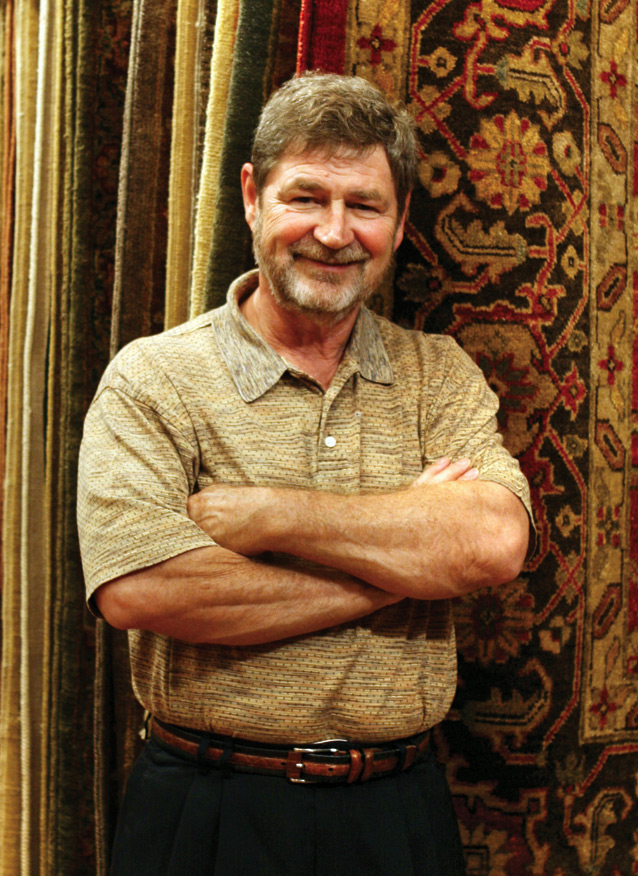
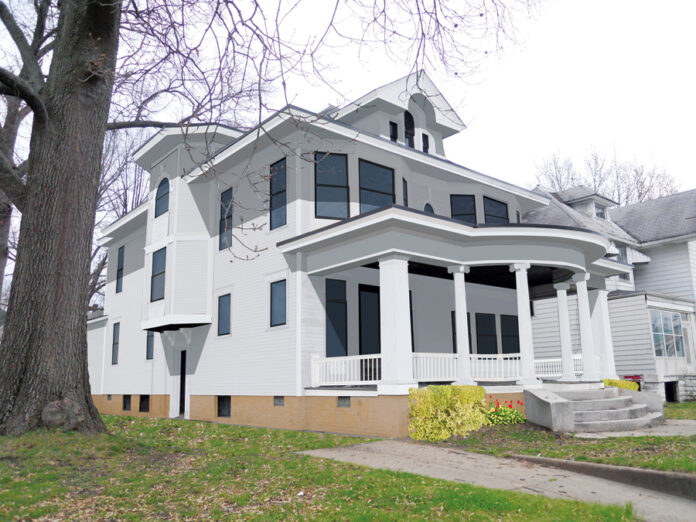
Le Parigo’s charming chef and owner, Cedric Coant, moved to Knoxville from Gennevilliers, France, a decade ago after falling in love with a Southern woman — now his wife. The European transplant longed to recreate the food he’d loved in his homeland; thus, Le Parigo, using all-natural ingredients, was born.

Located downtown near the pedestrian-only Market Square, this tiny restaurant evokes laid-back Parisian elegance in the heart of Knoxville. In true French form, the focus is on the food — and lingering for hours, if you want. (You will.)

My group shared a series of artfully presented appetizers, including seared pork belly, mussels à la Provençal, pan-roasted escargot, and a gleefully buttery lobster bisque. Like most French restaurants, Le Parigo isn’t cheap, but it’s the kind of place that inspires hours of lively conversation over glorious food and wine.

416 W. Clinch Ave., (865) 525-9214 or www.leparigo.net

Major Move

0
Terry Lewis of The Rug Merchant

After a two-year experience in self-proclaimed “semi-retirement,” Terry Lewis is back. Of course, his semi-retirement looked a lot like his longtime business — The Rug Merchant, a shrine to Old World-style imports — with just a few differences. For a little more than 20 years, Lincoln Avenue was home to Lewis’ store, but in 2007, he moved to Downtown’s Main Street in the ultramodern digs of the renovated Marlocon. The place was smaller than his former location in Olde Towne, an East Side neighborhood known for locally owned shops and boutiques, but, hey, this was his semi-retirement.

With a 40-year career in the flooring business, Lewis learned his business was his passion, so he moved his imported rugs to his original Lincoln Avenue location last year. Semi-retirement was over. Inside the 9,000-square-foot space is a showcase of rugs with plenty of design and color — a familiar inventory to those who frequented The Rug Merchant in Olde Towne.

The return has brought an interior remodeling, however: new paint and carpet and refinished hardwood floors. The foyer has a dressy look with space to display oversized (12-by-18) rugs. “The biggest comment we get (from customers) is ‘We’re so glad to have you back here,’” Lewis says. He agrees: “It’s more conducive for doing business.”

Inside Spaces

0
Rendering of the 2010 Evansville Living Downtown Idea Home by VPS Architecture

Evansville Living is several months into its newest Idea Home, and though the previous showcase homes featured new construction, this project, known as the 2010 Evansville Living Downtown Idea Home, is a community effort to revitalize the Washington Avenue Historic District. The once prosperous corridor of the city features large Colonial-style homes, which fell into decay after World War II. Stewart Sebree, director of the southwest field office for Indiana Landmarks, believes longtime neighbors of the 620 Washington Ave. home are “glad to see something happening.”

As the home develops, an interior theme is taking shape, Sebree says: a blending between historical and modern. “The concept is to use as much salvageable material as possible, but we also want to bring the home into the 21st century,” says Sebree. Construction crews are using materials original to the home and harvesting reusable materials from other historic buildings. (A slab of granite, used in the kitchen, was salvaged from the old Press Box building on Main Street recently torn down for the new stadium.) Numerous modern amenities also dot the kitchen, including an island with bar-style seating and an adjacent pantry with counter space.

A contemporary great room includes an original wood panel wall from the home. Doors have been stripped and hung again, and a three-bank window stays true to Colonial Revival style. Recessed lighting on the second floor leads to the master suite with a sitting room, a walk-in closet, and a private bath with a doorless shower and black and white pinwheel tile flooring.

Though neighbors can’t see this interior progress, Sebree says, he’s talked to them about the project. Some have spent decades in the neighborhood and have “social capital,” he says, invested in the area.

The 2010 Evansville Living Downtown Idea Home will open for tours with a preview celebration on Sept. 17, 2010.  Tucker Publishing Group is accepting Idea Home sponsors — renovation, preservation, building trade, and design experts who will participate in the effort. Contact Tucker Publishing Group at (812) 426-2115 for more information. 

Tomato Catch Up

0

The world’s most popular vegetable actually is a fruit. For years, there was much debate on whether a tomato is a fruit or vegetable, but the general conclusion now is that a tomato is classified botanically as a fruit but as a vegetable for its culinary purposes.

In the kitchen, chefs may have a shortage. Earlier this year, a January freeze in Florida wiped out much of the Sunshine State’s winter tomato harvest — one of the biggest suppliers of the fruit. The shortage has increased prices within the fast-food industry and grocery markets.

Fortunately, in our climate, summer is the time to plant tomatoes. They are easy to grow, and by late summer, they can produce more fruit than you might be able to consume. Some Evansville residents even sell their tomatoes to local restaurants.

To cash in on the tomato trade — or to simply have some for your own kitchen — remember a few tomato facts. Tomatoes love the sun. They grow best in rich, well-drained soil. To care for tomatoes, routinely water once planted and support as they grow.

They either can be started by seed in the spring or by seedlings that already have been germinated, available at local greenhouses. The hundreds of varieties range from small cherry tomatoes (great for salads) to large beefsteak or Better Boy tomatoes (great for sandwiches). Many heirloom varieties are popular with the home gardener. The heirlooms generally produce less fruit than traditional varieties, but they often have stronger tastes and unique colors. When looking for a tomato that fits your taste, ask your local greenhouse for a recommendation.

Homegrown tomatoes have other advantages. As with many commercially grown crops, mass-produced tomatoes often lack the same great taste homegrown tomatoes have. Often, the kind of tomato that is mass produced is grown for its disease resistance and high yield of fruit — rather than for its superior taste. Occasionally, farmers pick tomatoes from the vine while they are still green and not ripened. Later, they are chemically treated to change color before being sold.

For possible future shortages, preserve any extra tomatoes you have. My grandparents and I can any spare tomatoes and tomato juice that they have every year. It works for pasta sauce, chili, or vegetable soup during the winter.

Brian Wildeman is a graduate of Purdue University’s Landscape Horticulture and Design program. He is a designer with Landscapes by Dallas Foster, Inc.

A Big Mac Collection

0
John Nugent shows off a new addition to his Mac collection: the iPad, a touchscreen tablet computer released in April.

Absent from the shelves of John Nugent’s garage are paint cans, ladders, and gardening tools. Instead, the longtime collector of pocketknives and watches has a chronological arrangement of Macs — computers from Apple, a company well known for other technological successes such as a music device, the iPod, and a smartphone, the iPhone. Steve Jobs, Apple’s visionary credited for much of the company’s success, unveiled his newest buzzworthy item earlier this year, and the device reached consumers’ hands — and Nugent’s — in April: the iPad, a thin tablet computer with a 9.7-inch touchscreen and thousands of available apps.

With a variety of laptops and desktops, Nugent’s Mac mania kicked into full throttle three years ago when a friend showed him a Mac SE, a 1987 model with a 20-megabyte hard drive, an eight-megahertz processor, and two slots for the popular 1980s storage device: floppy disks. Nugent, an independent commercial real estate professional, felt nostalgic about the computer’s boxy look, a contrast to today’s thin-screened iMacs. Those big, square floppy disks? Obsolete. On the new Macs, SuperDrives — capable of reading and writing DVDs and CDs — are the latest trend.

Memory storage is great, but Nugent loves the Macs’ computing power. When he ditched PCs for good, “I thought, ‘To hell with it. I will no longer deal with this virus protection,’” says Nugent. He committed to Macs, known for durability against the computer virus problems that plague PCs. “When I dove,” he says, “I dove deep.” From the oldest (the Mac SE) to the newest (a 27-inch iMac i7), his collection now includes 31 Macs. “I just like them and have a passion for them,” says Nugent, who calls his garage his “Mac Museum” and frequently writes about it on his Facebook page. “I like that it shows the history of the company, and they’re just fun.”

L is for Living

0

On a busy Lincoln Avenue is an area commonly known as the “state hospital grounds.” The general term includes several soccer and baseball fields, numerous walking paths, wooded trails, and a lake where visitors feed ducks on sunny days from the dock.

Across the street is the modern home of Kathy and Tim Culiver. With generous windows lining the façade of the L-shaped home, the Culivers — self-proclaimed early risers who enjoy mornings relaxing on the porch facing the state hospital grounds — say the view was a major reason to buy property on the East Side in 2005. From dogs out for a walk with their owners to various birds flying from tree to tree, the Culivers love the tranquility of nature, but they love the convenience of the city. Their abode presents a wonderful dichotomy: nearby wooded stomping grounds a half mile from Green River Road, a heartbeat of commerce.

Before the Culivers could relax and enjoy the best of both worlds, there was work to be done.
In the 1940s, this neighborhood was Evansville’s suburbia. Gradually the city expanded outward, and the Culiver home now sits squarely inside city limits. When the Culivers visited the property, they felt the suburban vibe of the neighborhood’s beginnings. Both long had been residents of subdivisions, and it was an atmosphere that still appealed to them.

What the couple wanted was a place for an eventual active retirement, and what they saw on the property was opportunity — a long-vacated tennis court with a rusted 12-foot fence. Trees, bushes, lilies, and poison ivy surrounded the court. It was the neglected yard of former neighbors, who split their property to create the rare East Side lot for an interested homebuilder. (Continued on page 2)[pagebreak]

The Culivers were sold. Armed with garden tools, the couple physically cleared a way for their home: They ripped out shrubs and cut down 12-inch diameter trees. Tim, who grew up in Posey County and frequently visited his cousins’ farms with hogs and cattle, didn’t want to strip the land of all nature. The couple left 11 mature trees, including a commanding oak in the front yard. From squirrels to hawks, the Culivers see animals comfortable in their yard; Tim’s seen a red fox on snowy winter days out his living room’s window.

With the lot cleared, Kathy prepared plans for the home’s design. A medical technologist at Deaconess Hospital, Kathy says she’s not a creative person but also recognizes she is — and Tim seconds this sentiment — very “particular.” Kathy knows what she wants.

In 2005, Kathy took the plans she had worked up to David Oldham of Elements Interior Architecture. Oldham, an enthusiastic interior designer with an eye for modern aesthetics, understood Kathy’s style. As part of Elements’ space planning division, Oldham smoothed a few rough edges to make the Culivers’ dream home “killer,” a favorite adjective of Oldham.

The center point of this L-shaped home is an island kitchen countertop. “It all starts in the kitchen,” says Oldham. “It is the focal point. When you come in, it’s the first thing you see.” More specifically, the African red rock countertop was the inspiration for the warm color palette throughout the loft-style home.

Additional inspiration for the Culiver home arose from the city’s loft development program. More than 200 lofts were created after tax incentives inspired builders to renovate neglected Downtown buildings. Oldham lives in a Main Street loft above Stratman’s Pharmacy, featured in the 2008 City View. The Culivers visited the program’s results in the middle part of the last decade as part of a public tour. They liked the lofts’ style for its updated 1950s feel.

The exterior of the Culiver home has been a curiosity to passersby and strangers who have mistaken the home for a new business. The Culivers think the slightly sloped metal roof and the home’s clean, straight lines — staples of commercial buildings — contribute to the perception.

Still, the Culivers say their modern digs felt like home even before it was finished in 2007. “When we bought the lot,” Tim says, “I felt like I belonged to the neighborhood.”

First Bout

0
Photo of Jerry Lawler provided by Main Event Championship Wrestling

Jerry Lawler would be, well, just Jerry Lawler if it weren’t for his crown and penchant for piledriving baddies on the professional wrestling mat. That’s why Lawler’s nickname is “The King,” and he’s bringing his crown and his finishing move, the piledriver, to Evansville May 8 for Main Event Championship Wrestling’s inaugural headlining match.

The new organization arrives after a group of local wrestling fans convened in November 2009 and decided they wanted a different wrestling experience, “an old-school feel, the way shows used to run in Evansville,” says Jeremy Lewis, MECW’s spokesman. That style includes a four-sided ring where grapplers bodyslam, knife-edge chop, and dropkick — three traditional moves. It won’t include tables, ladders, and chairs — three weapons used for “hardcore” style.

A.C. West, a former wrestling manager and MECW’s executive director, worked his industry connections to land high-profile wrestlers: Jeff Jarrett — a legendary pro wrestler and founder of World Wrestling Entertainment’s rival organization, Total Nonstop Action Wrestling — and Lawler.

Lawler’s career began in Memphis, Tenn.; he frequented Evansville. He drew national attention for his feud with late comedian Andy Kaufman in the 1980s. Later, his hilarious ringside commentary for nationally televised WWE programs made him a WWE Hall of Famer.

Landing active wrestlers from big-name companies was important to a young organization, says Lewis, and each superstar needn’t too much convincing to wrestle for a fledging event. “We wanted to bring them back to the area,” Lewis says, “to show them there’s still wrestling out there that’s not ‘sports entertainment.’”

WWE CEO Vince McMahon popularized the term “sports entertainment,” a combination of over-the-top theatrics and competitive athletics. Though Lawler and Jarrett come from organizations heavy on sports entertainment (the acronym for Jarrett’s wrestling company is TNA), MECW is not that. It’s free of pyrotechnics and long-drawn-out speeches. Lawler will do in Evansville what he did here decades ago: wrestle in an environment where he feels like a king.