Wheely Cool

0
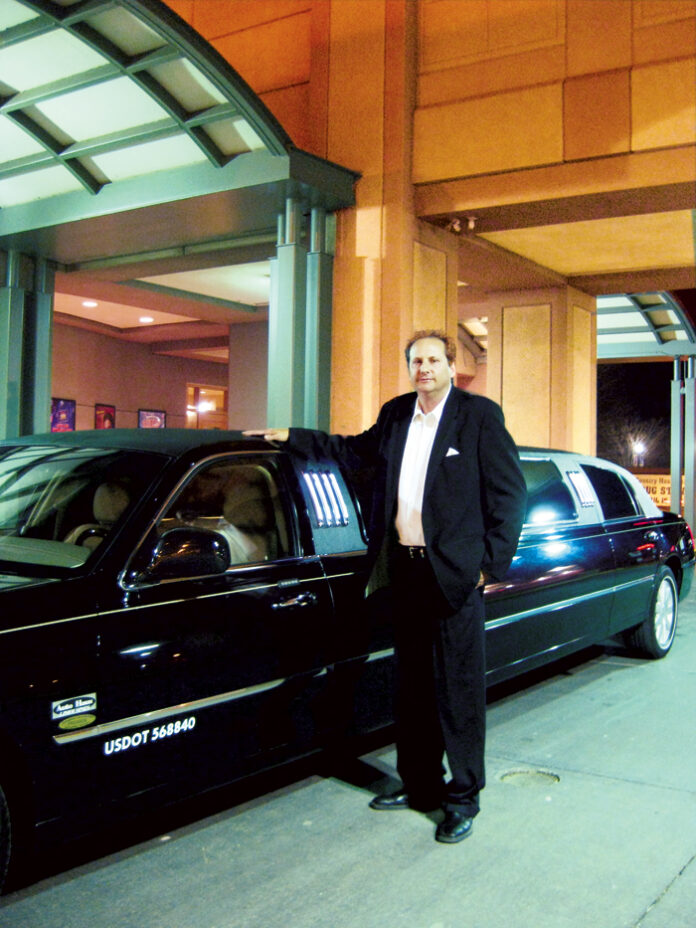
Magic Johnson, Elton John, and Jerry Seinfeld are a few of the celebrities who’ve ridden in limos driven by the Auto Haus team.

When the private jet flying Magic Johnson touched down in Evansville, Shawn Wittmer stood near his limousine waiting for the basketball legend. The NBA Hall of Famer amicably greeted Wittmer, the driver charged with safely transporting the multimillionaire from the airport to The Centre Downtown to give a speech at the ongoing Celebration of Diversity Distinguished Lecture Series. Wittmer, the owner of the luxury transportation company Auto Haus, has operated a fleet of limousines since 1992, and Johnson wasn’t the first celebrity Wittmer’s chauffeured.

Peabo Bryson was fresh off his hits from Disney soundtracks, Beauty and the Beast and Aladdin, when Bryson, a Grammy Award-winning artist, came to Evansville for a concert in the early 1990s. From there, Auto Haus accelerated, and more celebrities met Wittmer and his drivers for the next two decades, including comedians Bill Cosby and Jerry Seinfeld; baseball star Ozzie Smith and hometown hero Don Mattingly; and rock musicians Gene Simmons from Kiss and Elton John.

This spring, the driving factor at Auto Haus is prom. The Evansville Vanderburgh School Corporation had 2,220 students attend a high school prom last year, and many rented limos. “It seems like we can never have enough cars,” Wittmer jokes.

From proms to weddings to celebrity chauffeuring, sometimes a busy season requires Wittmer to move from behind his owner’s desk to behind his limousine’s wheel. On those occasions, his day begins before he’s scheduled to pick up his passengers. Wittmer cleans the limousines and fills the gas tanks. He arrives early to pick up his passengers and talks with them as much as they allow.

Country music star “Hank Williams Jr. didn’t say one word to me,” Wittmer recalls. Johnson, on the other hand, was friendly. He asked Wittmer how the University of Evansville men’s basketball team would perform that season. At one point, Johnson paused a phone conversation to sign autographs for Wittmer’s father and son, and he passed his cell phone to Wittmer. “I had no idea whom I was talking to,” Wittmer says. “I told her he just had to do something real quick.”

For more information on Auto Haus, visit www.autohauslimo.com.

Signs of Support

0
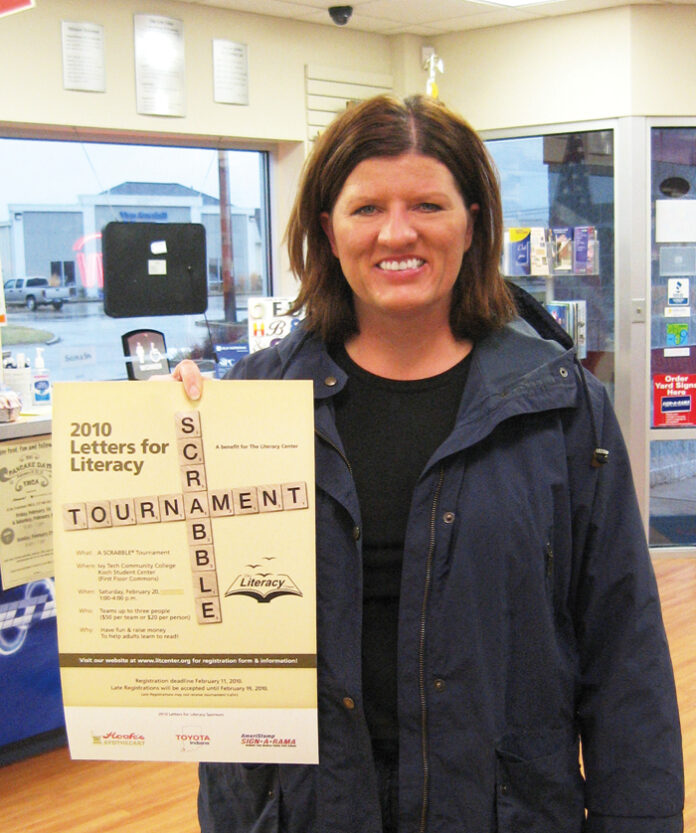
Jennifer Wigginton, executive director of the Literacy Center, holding sign from AmeriStamp’s Signs of Support program.

On a cold day in February, two volunteers strapped a banner across the pedestrian overpass on the Lloyd Expressway near Harrison High School. Printed in a bold font, the sign’s words told drivers about a Feb. 20 event — the Literacy Center’s biggest fundraiser, the Letters for Literacy Scrabble Tournament.

The banner was one of four donated by AmeriStamp Sign-A-Rama, a local sign and rubber stamp manufacturer. The donation comes from Signs of Support, an inaugural program boosting the marketing efforts for nonprofit organizations in 2010. For the Literacy Center, the initiative has meant an additional 25 promotional yard signs spread throughout the city and 50 posters distributed by volunteers at local businesses. The advertising campaign promoted not only the event but also the Literacy Center’s mission to improve adult literacy.

The marketing materials worked, says Jennifer Wigginton, the center’s executive director: “We received more press than any years I’ve known it.” Of the 78 participants in the 2010 tournament, half were new to the seven-year-old event. “That’s more than it’s ever been in the past,” says Wigginton. Increased participation equated to more than $4,500 earned at the tournament and auction.

The Literacy Center’s success shows what AmeriStamp’s Signs of Support program can do. “In today’s economy, we recognize that supporting charitable organizations is more important than ever, and for that reason, Signs of Support is an exciting venture for us,” says Debbie Valiant, AmeriStamp’s owner.

In the program’s first year, AmeriStamp has donated or reduced the costs on hundreds of banners, posters, window graphics, vehicle wraps, and building signs to dozens of local nonprofits, including Adam’s Food Pantry, the American Red Cross of Southwestern Indiana, Keep Evansville Beautiful, and the Parenting Time Center.

Wigginton says: “The publicity just helps our mission.”

For more on AmeriStamp Sign-A-Rama, visit www.signsoveramerica.com.

Dental Records

0
Dr. Mark Schymik of TriState Family Dental

Next time you step into a dentist’s waiting room and feel those pre-appointment jitters, just think: It could be worse. You could be lying in this partially reclining chair, fenced in by a primitive X-ray machine and a chest of century-old hand tools. That’s the scene in one corner of TriState Family Dental Center’s lobby (960 S. Hebron Ave.), a nod to the history of the profession. For a dental practice that proclaims, “We cater to cowards,” it also reminds fearful patients just how far technology has evolved.

TriState dentist Dr. Mark Schymik says that a patient of his father, the late Dr. John Schymik, found the entire collection in Georgia and asked if the dentist would like it for his office. “What’s interesting is that a lot of older patients say, ‘I remember that,’” says Dr. Schymik, who’s practiced for 10 years. Not surprisingly, many are prone to dental anxiety. But these days, “(dental care) is much different,” says Dr. Schymik, “much more comfortable.”

1. Tool Time
Dr. Schymik estimates that this handpiece, powered by an electric motor, dates back to the 1870s. (Dental engines have been run by air turbines since the 1950s.) The chair hearkens back to the late 1800s or early 1900s; according to a history of dentistry by the American Dental Association, fully reclining chairs weren’t introduced until 1958.

2. Old School
This turn-of-the-century operatory once belonged to Dr. John Dickinson, a Massachusetts dentist who graduated from dental school and began practicing in 1900. His diploma hangs on the back wall.

3. Looking Through You
Years before the Wright brothers flew the first successful airplane or biologist Alexander Fleming discovered penicillin, dentists were peering into patients’ mouths with X-ray units such as this one. (The ADA timeline lists the nation’s first dental X-ray as occurring in 1896 in New Orleans.) The machine’s power supply is on the right wall, and near the machine is an early pair of magnifying glasses.

4. Tray Station
Before healthy patients were rewarded with “Cavity Free Kid” stickers, dentists passed out “My Teeth are OK” buttons. Also on the dentist’s tray: silk dental floss; a jar containing powder for silver fillings; and a fear-provoking forceps for tooth extraction. “The design has changed to make removals more efficient and less traumatic to the surrounding structures,” Dr. Schymik says.

TriState Family Dental Centers
960 S. Hebron Ave., (812) 473-1900
800 N. First Ave., (812) 425-4206
www.catertocowards.net

For the Record

0
Joe Smith, owner of Joe’s Records, launched his music store business on the West Side. He expands into Illinois this spring.

“In the heat of a summer night
In the land of the dollar bill
When the town of Chicago died
And they talk about it still”

These lyrics from “The Night Chicago Died” still spin ‘round and ‘round in Joe Smith’s head just like the 45 he bought in 1974 for $1. He saw Paper Lace perform on American Bandstand and went wild with excitement. The next day his mom took him to a little shop in Mount Carmel, Ill. He bought the 45 with his allowance money and spun it unmercifully.

Smith first discovered his love for music at home. “My folks always were spinning records in the house, so my sister and I were exposed to quite a bit of music at a young age. It’s always been the driving force in my life,” says Smith.

As a teenager from Mount Carmel, Smith remembers going to the “big city” of Evansville to buy albums. His love for all things music led him to open his first Joe’s Records store in 2004 on Evansville’s West Side. In Mount Vernon, Ill., a fourth store opens in late April or early May 2010, a year in which experts predict 1 billion songs will be downloaded.

So how does a store selling vinyl records — and other assorted music-centric goods including posters and clothing — continue to thrive in the age of digital downloads? One reason, according to Smith, is that there are far too few actual stores in which to buy music. His team hopes to, at least on a regional level, remedy that situation.

In the last several years, vinyl sales have gone up. Nielsen SoundScan, a marketing and media information company, recorded a nationwide increase in vinyl sales in 2009. Good news for specialty shops like Joe’s Records: Smith reports a 1,500 percent increase in vinyl sales at his stores.

Smith, who describes himself as a “hard rock/heavy metal/classic rock kind of guy,” believes that record stores like his still have a niche and can make money. He admits that the market never will be what it once was but knows that there are avid customers who want to buy hard goods.

One problem that threatens stores like Smith’s is what he calls “media lowballers.” He believes that Internet retailers such as Amazon and big box stores such as Best Buy and Target hurt his business more than downloading. His solution: Expand to smaller markets where there is less competition. In his third location of Corydon, Ind., he’s finding people who are starved for music-buying culture. “We’re finding in the Corydon market that lots of people who used to buy a lot of music are rediscovering the music-buying culture. They just need a place to do it,” says Smith.

While old-school stores like Joe’s Records have made a resurgence across the country in recent years, music downloads have drastically altered the recording industry in the last decade. According to the Recording Industry Association of America (RIAA), sales of full-length CDs have dropped from 83.2 percent (of all music sales) in 1999 to 77.8 percent in 2008, while digital downloads have increased 12.8 percent since 2001 (the first year of recorded research for digital downloads).

Though Joe’s Records carries vinyl albums (and plenty of them), Smith emphasizes that his store is a media and lifestyles store. His stores also offer posters, T-shirts, movies, stickers, and video games. Joe’s Records also runs a successful special order business and has a robust eBay presence. “Being an independent store, we can choose to do business with as many vendors as we like,” says Smith. “This gives us a distinct advantage as far as availability.”

Joe’s Records caters to a clientele as vast as the albums in the store. “It would take several hundred volumes to encompass the literally thousands of freaks, weirdos, maniacs, fanatics, and passionate dunderheads who make up our regular customer base,” Smith says. “The one thing they all have in common: We truly love each and every one of them. If you don’t have a base, you’re closed.”

And Smith knows this because he works in his stores on a daily basis. As of late, he has been spending most of his time in the new Corydon location, which opened last October. Smith also credits his wife, Jennifer, with much of his store’s success. “She’s amazing and quite frankly, without her in the mix, it wouldn’t mean anything to me,” says Smith. “My family is by far the most important facet of my life. Everything else is just window dressings.”

For more information, visit www.joesrecords.com.

Maiden Voyage

0
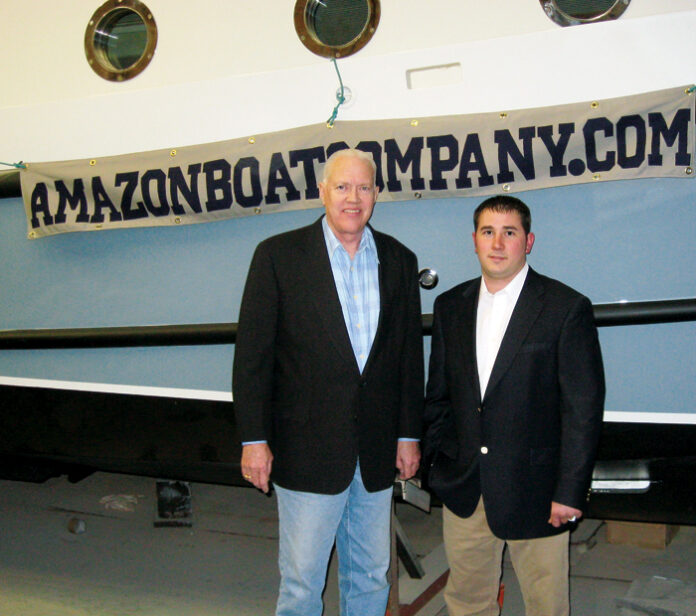
Southwest Indiana natives J.Z. Morris (left) and Matthew Nix teamed up to create the yacht, Passage.

When Matthew Nix selected a 15-person team with six full-time members more than a year ago, they undertook a project to create a seaworthy vessel: a yacht with solid cherry walls, a kitchen with granite countertops, a bathroom with a tiled shower and a Jack-and-Jill sink, and a living room with a skylight Nix describes as “giant.” With so many details, Nix says, he dreamed big throughout the project with his nights occupied with thoughts of “building a boat in my sleep and waking up 50 times with measurements and calculations racing through my head.”

J.Z. Morris is the reason Nix’s brain is so full of numbers. When Morris had a vision, Passage, a 50-foot-long yacht narrow enough to traverse rivers yet still seaworthy, he contacted Nix, the fifth generation co-owner of Carl A. Nix Welding Service Inc. in Poseyville, Ind., and longtime family friend. Morris — a native of New Harmony, Ind., who’s made a career in commercial real estate rentals from his Manhattan office — has had a lifelong interest in yachting. His late father, Robert, was a well-known financier from Southern Illinois with offices in New York and Florida. Robert began the predecessor company to Berry Plastics, one of the largest privately owned companies in Indiana headquartered in Evansville, Morris says. Morris’ mother, Alice, is a popular patron of charitable organizations in the Tri-State. In 1986, after studying at the Maine-based Westlawn Institute of Marine Technology, Morris launched Amazon Boat Company and soon found a team to create a 55-foot custom mahogany day sailer, Patrician, created by the Michigan-based Van Dam Custom Boats.

Nix spends his days repairing agricultural and construction equipment and shaping metal for custom projects. “When Mr. Morris approached me with this idea, I didn’t know that I could build it,” says Nix. Though the 25-year-old welding company owner is a self-described boat lover and owns a few boats for Ohio River recreational fun, he’s never been on a yacht. “But, I’ve never been one to back down from a challenge, and I am not afraid of hard work,” Nix says. “I saw how much passion Morris had, and I knew I would have the same. I do.” That attitude combined with Nix’s wealth of welding expertise gave Morris confidence that Nix could be a principal in Morris’ yacht business adventure, Amazon Boat Company.

Morris will launch Passage from the Ohio River banks near Mount Vernon, Ind., this April and travel the Tennessee River to Kentucky Lake. Then, he’ll head down a canal system into the Gulf of Mexico to spend his summer yachting the waters near south Florida.

Like Patrician, Morris’ new yacht is a dexterous vessel — narrow enough for traversing river passages but strong enough to withstand the rigors of the seas. Because yachts are supposed to have curves and “nice yachts shouldn’t have straight lines,” says Nix, Passage has “really beautiful curves.”

These beautiful curves are built at the beautiful bend in the river, Southwest Indiana, where Morris and Nix call home, which is why two landlocked men created a local boat company here. “I love to travel, but this is home,” says Nix. “If I’m going to run a business and have a family, I want it to be here.” Near the Ohio River, their boats and yachts have access to anywhere in the world, Nix says.

“Also, we have an abundance of good people in our area,” says Nix. “To build a custom yacht like ours at a reasonable price, it takes people who know how to give an honest day’s work and have pride in what they’re doing.”

The Midwestern work ethic Nix finds in the local workforce is a big reason he finds so much success in other entrepreneurial ventures. Nix also owns Outdoor Connections Inc., a retail store, in Poseyville, and he recently partnered with three others to launch a marketing company, Outdoor Video Creations and Marketing, which provides outdoor outfitters with marketing services. Yet, Nix isn’t finished with the yacht business, and he plans to take custom orders after Passage launches.

That will come after he has his first yacht adventure with Morris on Passage, he says. “I’m looking forward to spending time on it.”

For more information, visit www.amazonboatcompany.com.

Technology Transfer

0
David Bottomley vice president of business solutions at ITA, stands in his company’s data center.

The mainframe computer in Bob Bottomley’s workspace whirred and hummed, and its metal surface radiated such intense heat that the Evansville computer operator occasionally warmed sandwiches on it. By today’s technological standards, the room-encompassing IBM 360 mainframe computer was laughable. But it fascinated a young David Bottomley, who often visited his father at work with his mother, Janis. “I was impressed by the technology,” Bottomley recalls, “and the size of it.”

Bottomley — now vice president of business solutions at Information Technology Architects — never imagined that nearly three decades later, his career would take him back to the same location where his father worked: the Hulman Building, a historic 10-story structure at the corner of Fourth and Sycamore streets. Built in 1929 for the Central Union Bank, the Art Deco building has been likened to New York’s Empire State Building. After the bank collapsed during the Great Depression, Terre Haute, Ind., business tycoon and philanthropist Tony Hulman purchased the building. (He later became internationally known as the owner of the Indianapolis Motor Speedway.)

In April, ITA marks one year in its new Downtown location. The company’s data center occupies the former Southern Indiana Gas and Electric Company computer room on the second floor, where Bottomley’s father worked for nearly four decades before retiring in 2006. (SIGECO was a subsidiary of Sigcorp, Inc., which merged with Indiana Energy in 2000 to form Vectren). The spacious third-floor office suites, now workspaces for approximately 30 ITA employees, housed Vectren executives before the utility provider moved to its new corporate headquarters on the Riverfront in 2005.

Bottomley says the visits to his father’s workplace inspired his own pursuit of an IT career. So did the personal computer he received as a childhood Christmas gift. Bottomley devoted hours to learning his way around a PC, and by age 12, the self-taught computer whiz was fixing family and friends’ computers. During his time at Mount Vernon Senior High School, he earned a summer job at Pinnacle Computer Services, where he worked on numerous corporate networks.

Bottomley put his business savvy to work in 1997: As a 19-year-old, he raised more than $100,000 in capital and founded a local Internet service provider, Maverick Computer Services, Inc. Three years later, he sold the company to a Canadian firm; after stints as a systems administrator and network engineer at various Evansville companies, he joined ITA in 2007 to lead the company’s new business solutions division.

ITA was founded in 1996 as a consulting firm specializing in the healthcare field. The Evansville-headquartered company has managed systems integration projects for a luminous list of hundreds of clients including NASA, aircraft engine manufacturer Pratt & Whitney, Harvard Medical School, and the ministries of health of Australia and New Zealand. In a third-floor hallway of the Hulman Building hangs a map covered in pins that represent the geographic locations of ITA’s clients.

For years, ITA’s headquarters was in the basement of president and CEO Keith Barnett. “I hate to say ‘basement,’” Bottomley says with a laugh. “It was a really nice basement.” Even through the economic downturn, ITA’s business continued to boom. As the company hired more employees and outgrew its subterranean space, leaders eyed Downtown Evansville for a new office and data center.

Early last year, Bottomley met with a client in the Curtis Building, which had housed Maverick Computer Services a decade earlier. He left his business card with a tenant and soon received a call from Ed Curtis, the St. Louis-based developer who owns Downtown properties including the Curtis Building and the Hulman Building. Curtis called Bottomley to catch up, and Bottomley mentioned that his company was hunting for a suitable new space. “What are you doing with the old SIGECO room?” he asked. “Nothing,” he remembers Curtis replying. “We can’t figure out what to do with it.”

Bottomley realized the space would be perfect for ITA. The cost of building a new data center of a similar size would have stretched into the hundreds of thousands of dollars, and numerous components of a data center already were in place: raised floors, a precision HVAC unit, and a fire protection system. Also, “the Hulman Building was built like a fortress,” says Bottomley, “with steel reinforced concrete walls and a foundation down to bedrock.” The building’s sturdiness made it resistant to natural disasters: a reliable setting for ITA’s main infrastructure and data center co-location services for clients.

Although all of the existing equipment has been updated and modern infrastructure added, Bottomley admits that running a technology-based business in a historic building isn’t without challenges. To run cables, Chet Zuber, ITA data center/infrastructure manager, has drilled through the concrete and steel walls. The solid structure is one of the few aspects of the space that remains unaltered since Bob Bottomley’s days working on the IBM mainframe computer. “Everything has changed,” says his son, who remembers the sense of awe kindled by his childhood visits to his father’s workspace. “The technology has progressed so much further — it’s almost like apples and oranges.”

For more information, visit www.intear.com

Stacey McNeill

0

Four years ago, news surrounding Casino Aztar was front-page worthy: massive layoffs, revoked state casino licenses, and one big bankruptcy. A displeased Evansville mayor issued complaints about the new owner of the riverboat casino, Bill Yung, who also had casinos in New Jersey and Nevada.

Those state officials had a beef with the understaffed, dirty operations from Yung’s company, Columbia Sussex Corp., and the Garden State’s gaming commission yanked Columbia’s gaming license. Through it all was Stacey McNeill, Casino Aztar’s longtime marketing director, who began as a slot attendant shortly after the riverboat first docked on the Ohio in the mid-1990s. In March 2010, Tropicana Entertainment, Inc., which operates Casino Aztar, emerged from bankruptcy with a new owner, billionaire Carl Icahn.

McNeill’s first experience as a gambler began when she was just old enough to legally drink alcohol. She headed to a casino in Metropolis, Ill., with her grandmother, Donnie Swearer, and her friends. “They showed me what the casino is all about,” McNeill says, and she won a $900 jackpot on a slot machine, “which for a 21-year-old was pretty cool.”

Are you a gambler?
My passion for the game is what drew me here 15 years ago. I like to play blackjack, but it requires you to think a lot. My favorite games are craps and slots. Having that perspective from the gambler’s point of view has helped me become more successful in my position today.

What are gamblers looking for?
They’re looking for entertainment. It really boils down to that. We sell an experience, and people come knowing they’re likely not going to win. But, we want them to have fun while they’re here.

You are in the business of selling entertainment. Can you have fun at work?
Without a doubt, it feels more like fun. I have a personality that likes to be busy. I don’t like to be bored. In this industry, it’s always something different, something new. Because I’m in marketing, the work and fun kind of go hand-in-hand.

Do you stay for musical acts at the end of a workday? Can you relax and enjoy it?
I typically do stay for our performers, and I do try to have a good time. Relaxing is a little more difficult because when I’m on property, everyone knows me. So, I’m always ready to work or be professional if necessary.

One of the slogans at Casino Aztar is “Have a lucky day.” How do you define “luck”?
For me, “luck” is a perception of an enhanced condition in life. For example, I feel lucky to have been drawn to this industry all those years ago and for the opportunities available to me today because of it. In the casino, “luck” is simply being in the right place at the right time.

For a while, news surrounding the casino was all about recovery. What mode is the casino in now?
We really are focused on a bright future. Tropicana has probably already invested a couple million dollars in new slot products even before we emerged. It’s a game of wait-and-see to learn how much capital we can get and when we can get it. We just want to grow successes for the business and the community.

What challenges still lie ahead?
Probably the two biggest future challenges are the decline of economic conditions and the expansion of gaming in our neighboring states — specifically Kentucky.

What might be needed to face those?
The economic condition is just going to be tough. Fortunately for us, Evansville has a diverse economic climate. There’s automotive, manufacturing, pharmaceuticals, and oil. All of those things have helped sustain us a little better than some of the casinos across the country. As far as Kentucky gaming, that will be a serious threat. We will really have to focus on the value of our amenities for our players: the fact that we have two hotels and eight restaurants. Those kinds of amenities will matter.

Back Again

0

When Casino Aztar recently emerged from bankruptcy, we interviewed Stacey McNeill, the riverboat’s director of marketing for the April/May issue of Evansville Business magazine. Here’s a question we asked McNeill that we didn’t include in the article. For more on this Q&A, check out Back Talk in the current issue (p. 56).

Evansville Business: What do you count among Casino Aztar’s greatest achievements?

Stacey McNeill: I think the biggest achievements continue to be our support of the community and the Downtown. Over the years, we have always met — and in most cases exceeded — all of our commitments. The Downtown is now a place people want to live. I remember when we came here it wasn’t necessarily that way. I believe our commitments in the community will continue to grow, specifically with the development of the new arena and other future initiatives in the community.

Another Reason We Love This Town

0

The Pigeon Creek Greenway Passage, a planned 42-mile pedestrian/bicycle path encircling the city, is years from completion, but that’s no reason we can’t celebrate its progress.

From the American Recovery and Reinvestment Act — you know, the stimulus money — come funds to build a greenway extension from Franklin Street to Maryland Street along the Pigeon Creek levee into Lamasco Park. Included is a new trailhead at the park and a bridge for walkers and bikers to rise above the outflow from the levee’s pump station. Completion is expected by June 2011.

Expected this December is another greenway section, stretching from Kratzville Road to Dresden Street. The construction will lengthen the greenway’s total to six miles. In the meantime, enjoy the miles of greenway has now — along the Riverfront or by Garvin Park.

Want to read more Reasons We Love This Town?  Check out Evansville City View 2010!

Our Call: Unacceptable

0

Spring weather means it’s time to step outside for a walk, but would drivers please yield to pedestrians — or at least consider it — especially for crosswalks with pedestrian yield signs posted?

We pity the pedestrian who enters a crosswalk without looking. This April, let’s remember it’s the law to stop for walkers.

Dinosaur Destruction

0

Long ago, Millie the Tyrannosaurus rex was just a boy dinosaur named Rex in Indianapolis. When the Koch Family Children’s Museum of Evansville opened in 2006, the Tyrannosaurus rex moved south, and he became she.

No matter the gender, this prehistoric puppy has plenty of rage — and a keen eye for city development. In December 2009, with help from the demolition masters at Klenck Company and a 6,000-pound wrecking ball, she took to the Executive Inn Downtown, leaving space for a new arena.

Do you have a photo that is Pure Evansville? Submit your image to us for possible publication. Your image must be vertical and 300 dpi at 8 by 10 inches. Images not selected for publication may be posted online.

Art Attack

0
Cirque Merchanics transforms a gloomy industrial setting into a zany Birdhouse Factory in Henderson, Ky.

Last year, Cirque du Soleil played in 271 cities in 32 countries, and in February 2010, the Canada-based circus celebrated 25 years as a dominating entertainment empire. With that kind of history, Kyle Arnett booked the Cirque Mechanics Birdhouse Factory as the last show of the current Henderson Area Arts Alliance season at the Henderson Fine Arts Center April 10.

The show begins in a gloomy 1920s factory. Uptight management closes the doors, and a new team opens the zany “Birdhouse Factory” where contortionists perform on turntables and trampoline wall artists fly through the air. The factory’s equipment, including wheels, gears, and industrial light fixtures, become the props for a circus act. The performers are a vast, multitalented group of superb jugglers, high-flying trapeze artists, and hilarious clowns.

The Cirque creators expand the boundaries of creativity. A reviewer from The New York Times called the Birdhouse Factory “exceptional, evocative, eye-catching, ear-catching and, to keep the list short, engrossingly entertaining.” It demonstrates what HAAA hopes all art can do: captivate and inspire.

The HAAA began 16 years ago when a bluegrass music band performed in a new $6 million Henderson Fine Arts Center in its namesake Kentucky town. Then, the fledgling organization was an attempt to consolidate efforts from a variety of like-minded arts groups determined to bring more cultural experiences to Western Kentucky. “We’re a small venue on a much smaller budget,” says Arnett, HAAA’s executive director. “We can’t have the quantity of shows (Evansville offers), so we have to make sure we have quality and variety.”

Finding these diverse acts is up to Arnett. Last January, she traveled to a national booking conference in New York City. Arnett asked several arts directors what show they loved from their last three seasons, and each said, “Birdhouse Factory.”

Can Do Attitude

0

Last April, employees, students, and church members of four businesses, two universities, and one church gathered at Washington Square Mall to create sculptures from thousands of food cans stacked to resemble a soup bowl, pyramid, wind turbine, clown fish, hydroplane boat, and Star Wars’ robotic character, R2-D2. Some displays climbed nearly eight feet high.

After four days and numerous visitors, teams dismantled the sculptures, and the cans went to the Tri-State Food Bank, a nonprofit organization that distributes food to 250 area food pantries, soup kitchens, shelters, abuse centers, and other programs. The event raised $24,000 in cash donations and canned food.

That was the first year for Canstruction, a food drive from the American Institute of Architects of Southern Indiana and Altrusa International Club of Evansville. The latter is part of a civic-service network — Altrusa International, which has more than 300 chapters worldwide. The Evansville club has 38 dedicated women, and Canstruction is one example of the numerous projects Altrusa has provided the Tri-State for decades. The event returns to Washington Square Mall on April 9-12.

Though Canstruction supported the Tri-State Food Bank, Evansville’s Altrusa helps several areas of need, including homelessness, education, and disease prevention. For the last decade, the group has given birthday gifts to every client served by Meals on Wheels (more than 300).

For children in emergency shelters and residential service programs, Altrusa members have donated suitcases, backpacks, and duffels, filled with toothpaste, toothbrushes, shampoo, books, and puzzles. They’ve given 72,000 books to children in childcare facilities. The group has provided high school students with SAT and ACT study materials. Now serving the community for the 41st year, Altrusa shows small projects — an average of six a year — can have a big effect.

First Steps

0

Runner’s World magazine recently called the half-marathon “the fastest growing distance in our sport.” But what about those runners who like to go all the way? On April 11, the Southern Indiana Classic Marathon and Half Marathon will give people a choice.

The inaugural race is a qualifier for the 2011 Boston Marathon — an event more than a century old. The Heartbreak Hill, a grueling obstacle at the 20th mile of the 26.2-mile race, is one of the defining characteristics of the Boston Marathon.

The Evansville course, which begins and ends at the Vanderburgh County 4-H Fairgrounds, presents a challenge from the start, says Jill Gehlhausen, race director of the Southern Indiana Classic. “It’s basically rolling hills throughout,” she says. “It’s really hard to find 26 miles of road that are flat.”

Not intimidated by the course are the runners already signed up for the race. According to Gehlhausen, the event is on track to reach between 4,000 and 6,000 participants. With 26 hydration stations, five food stations, four massage stations, and an entertaining act every mile, those runners should find motivation and comfort, and the after-party looks like an award. “It’s all you can eat from 8 a.m. to 3 p.m.,” says Gehlhausen. Music performances, massage tables, kids’ inflatables, and a beer garden are on the fairgrounds.

An event like this needed community support, Gehlhausen says, and she found an outpouring. “We’ve gotten the most sponsorship I could have imagined for a first-year event,” she says. “Such an overwhelming blessing.”

Multiple Motives

0

Between the ages of 20 and 40 is when the disorder most commonly begins — though it can be seen at any age — and that’s Brittiney Norman’s growing fear: Multiple sclerosis is affecting people at younger and younger ages. As the community development manager at the local chapter of the National Multiple Sclerosis Society, she “wants to make sure children can lead happy, healthy lives,” Norman says.

The dream isn’t easy to achieve. Multiple sclerosis, a chronic disease, attacks the nervous system, harming the brain, spinal cord, and optic nerves. The symptoms are mild — such as numbness in the limbs — or severe, such as paralysis or loss of vision. The cause is unknown, and so is the cure. In the United States, an average of 200 people are diagnosed with multiple sclerosis every week.

For 11 years, the Multiple Sclerosis Society has led a walk Downtown to support services for 8,500 Hoosier residents living with the disease. Last year, 287 people participated in the one- and five-mile walks. The goal for the 2010 event on April 17 at the Civic Center Courtyard is 400 participants, says Norman.

Funds raised aid researchers working toward a cure. The walk’s final contribution helps the society fund social events — such as an Evansville Otters baseball game — for families with a member diagnosed with multiple sclerosis. Those types of activities aren’t as affordable for families paying the high healthcare costs of the disease, says Norman. That social dynamic is apparent at the annual walk, too, she says: “It’s always nice to see families come together to support one another.”

Soirées: Spring Fever

0
Gina Topper and Jim Sanders at the 19th annual Toast to the Arts

Partygoers to celebrations this winter season didn’t let a succession of storms stand between them and the events that raise important funds for our area’s causes. People who braved sudden snows and icy temperatures were rewarded for their generosity with red-hot fun. Check out some of the fun folks had at the winter soirées, and mark your calendars for some springtime fun.

Toast to the Arts
The 19th annual Toast to the Arts welcomed a record crowd to the University of Southern Indiana’s Carter Hall on Jan. 29. Guests sampled a selection of hors d’oeuvres while bidding on a huge selection of art and other silent auction offerings. Then, they enjoyed a dinner and live auction of special dinners, art, and other items. JP and Tammy Engelbrecht served as honorary chairs for the soirée, which raised funds to support scholarships and other student development needs as well as grants for the RopeWalk Writers Retreat and New Harmony Theatre.

A Chocolate Affair
The sweetest soirée of the year, the Lampion Center’s 13th annual A Chocolate Affair, broke an attendance record this year. More than 700 guests attended the Feb. 6 event. Inside Old National Bank’s Wayne Henning Atrium was a champagne bar, light jazz music, and tables of chocolate desserts from the area’s best caterers and restaurants. Funds raised supported the organization’s important work with area children and their families.

Men About Town Style Show
From fresh-faced 20-somethings to septuagenarians, a wide range of local gents strutted down the runway at Youth First’s always-popular Men About Town Style Show Feb. 12 at the Aztar Executive Conference Center. The models — including local firefighters, businesspeople, and medical professionals — raised funds for Youth First, which provides evidence-based programs that prevent substance abuse and promote healthy behaviors.

Really Big Show
Evansville ARC’s 8th annual Really Big Show was a really big success, providing the audience with great entertainment plus the chance to celebrate Valentine’s Day by supporting local children and adults with disabilities. The Feb. 13 event sold out The Centre and welcomed a huge crowd to the Curtain Call Reception following the show. Led by emcee Jeff Lyons, local celebrities wowed the audience with vignettes and mock commercials with a Carnival theme. The evening’s highlight was the performance by ARC clients, who sang with the enormously popular Gina Moore to close out the show, which raised more than $100,000.

To promote your event in Soirées, submit an application, available here for download or by request. For more information, contact Jennifer Rhoades, marketing manager, at (812) 426-2115.

A Walk Downtown

0

Evansville’s Main Street has changed considerably in the past decade. We opened it to traffic, developed a loft program, and excavated a block to make room for a new arena. Like Main Streets across the nation, the character of our Main Street changed over the course of a century as these postcards archived at Willard Library illustrate.

Tom Wintczak

0

Sixteen years ago, Tom Wintczak was the furthest thing from a trained artist: The Whiting, Ind., native earned a business degree from Indiana State University and managed the Evansville Regional Airport’s Hertz car rental facility for 23 years. But on a whim, he enrolled in a six-night pottery class through the University of Southern Indiana’s continuing education program. The first time Wintczak sat down at a potter’s wheel, “it just kind of stirred something in me,” he recalls. “It felt really right.”

The USI art course in 1994 remains his only formal training, and Wintczak didn’t stop creating when the class ended. In 1997, he formed Bee Tree Pottery, named for the trees on the rural Posey County property he shares with his wife, Ruth. He eventually left his job with Hertz to focus on his art. Wintczak specializes in an early American pottery form called redware. In his studio — an 1850s log cabin near his home — he also creates functional pottery such as tea sets and quirky folk art pieces such as face jars and snake jars.

In January, Wintczak celebrated one year as a full-time potter. “It’s been a great year,” he says. “I love it so much.” He’ll demonstrate the process of making redware at Heritage Artisans Week in New Harmony, Ind. (April 20-24), and he’ll display and sell various types of pottery at the Arts in Harmony art sale (May 1-2). Wintczak’s pottery also is sold at Nance Galleries (662 S. Green River Road) and on his Web site.

You’re a self-described history buff.
What’s the history of redware, your signature pottery style?

People would come to the village potter and ask him to put their family name or a Bible verse on a plate, and they would put it on the mantel … I do pieces that are inspirational because I think that’s what people were looking for in that time period, especially the German potters. Most of them came here escaping religious persecution, so they were part of communities that were heavily involved in religion. One phrase that I love to put on plates is, “Sing, pray, and go on God’s way/Perform what thou hast to do faithfully.” You can imagine if that were on a mantel, they would see that every day. It’s just a reminder, every day, to live.

In contrast, your face jugs and snake jugs are fascinating — and a little scary.
There’s actually a lot of history to the face jugs. Slave potters were making them in the West Indies, putting them by gravesites. We don’t know if it’s a ritual or a voodoo thing that evil repels evil — no one really knows because there’s no written history. They migrated with slave potters into the Appalachian Mountains, and they turned into a storage form to keep poisons and alcohol and medicines in and scare children away. The snake jugs came about later, and they were inspired by the temperance movement. By putting a snake on a jug, it was reminding the person that the whiskey was good for medicinal purposes, but watch out, it can bite. 

Do you have any hidden talents?
My wife and I both play instruments. (The style) goes back to our love of history — Appalachian music like old ballads and fiddle tunes. We play a lot of early American music. I play hammer dulcimer; we both play lap dulcimer. I started playing guitar about two years ago.

As a potter, what kind of legacy do you hope to leave?
I’ve thought about that at times. I’ve made thousands of pieces now, and they’re out there. You don’t really think about it when you’re first starting out, but as I visit museums, I start to think, “Pottery is something that doesn’t disintegrate. It breaks, but even when it’s broken, it still doesn’t disintegrate.” These things, good or bad, are always going to be out there. That’s a motivating force now to make good-quality things that are beautiful. I really do believe people a couple hundred years down the road — even if it’s just one person — might have one of my pieces. I do anniversary plates and wedding plates, just like people came to the village potter … and I think, “Gosh, these become family heirlooms.” It gets handed down to someone, and handed down, and handed down. That is kind of a heartwarming thing.

For more information on Wintczak and Bee Tree Pottery, visit www.beetreepottery.com.

A Decade of Design

0

Home is where the heart is, and area homes have been at the heart of Evansville Living since the magazine’s beginning. For 10 years, we’ve featured cozy cottages, ultra-modern lofts, historic mansions — all kinds of abodes — giving readers an intimate look into these places and the lives of the people who call them home. We’ve been inspired to create our own masterpieces: the four completed Evansville Living Idea Homes and one currently underway.

Our editors revisited a decade of home features and selected memorable images and stories:

Showroom Space

0
Andy Cook - Branch Manager, Ferguson Enterprises

Though the hundreds of bathroom and kitchen fixtures and appliances available in the Ferguson Enterprises home store are online, nothing replaces the experience of shopping in person, says Andy Cook, branch manager of the local Ferguson. In the Internet Age, the concept is increasingly rare, but the 7,000-square-foot showroom is one exception. The first Evansville Ferguson showroom opened on Morgan Avenue and moved near Burkhardt Road a year ago. Today, the Morgan location acts as a warehouse and distribution hub. The new location is a “destination showroom,” says Cook, where “people drive from miles and miles away because we offer a lot of products in one location.”

Those products range from Jacuzzi tubs and showers with sound systems to ornate kitchen fixtures and appliances. In the bathroom, the stone forest pedestal (around $3,000) is a higher-end fixture while the vitreous china pedestal is more affordable (around $200) but just as beautiful. Every light in the store is available for purchase: fancy drum lights, polished brass pendant lights, or smooth track lighting. For the kitchen, refrigerators such as a Viking Range stainless steel model stand in demonstration mock-ups. A dominating theme among the products: modern aesthetics. “Clean and straight lines seem to be becoming more and more popular,” says Cook.

But, that avocado green vanity feels like a 1970s piece. It is, says Cook, and retro pieces make a big impact on Ferguson’s range of products. “We tried to put a pretty good mix of traditional and contemporary and everything in between,” Cook says. With more than 1,400 locations in America, the list of vendors is hundreds deep such as Thermador, Kohler, and Jacuzzi Whirlpool Bath. “We have to show everything,” Cook says. “Customers like to see contrast.”

Ferguson Enterprises
6620 Interchange Road South, (812) 473-1721
621 W. Morgan Ave., (812) 424-3531
www.ferguson.com

About Face

0
At the Evansville Living Downtown Idea Home, crews are working to bring the Colonial Revival home back to its original grandeur.

The Colonial Revival home at 620 Washington Ave. once was part of a majestic corridor filled with beautiful, stately residences near Downtown. Built in 1906, the home’s majestic days have long since passed, and its neighborhood, the Washington Avenue Historic District, slowly lost its grandeur after World War II. With decades of attempted resurrections from preservationists, a new façade for the 620 Washington Ave. home is beginning to form.

Early this year, crews from Architectural Renovators completed framing on the property slated as the 2010 Evansville Living Downtown Idea Home. Presented by the City of Evansville, the Historic Landmarks Foundation of Indiana, and the Junior League of Evansville, this year’s premier showcase home demonstrates that even a severely mistreated historic property can be rehabilitated.

That mission continues with reconstructed windows on the façade. Workers also replaced siding and began millwork and trim. The Idea Home is an example of hope that home renovations can revitalize a blighted neighborhood, known by city officials as the Front Door Pride area. According to Stewart Sebree, the southwest field office director of the Historic Landmarks Foundation of Indiana, everything looks on schedule: “We shouldn’t have too many problems with it.”

The 2010 Evansville Living Downtown Idea Home will open for tours with a preview celebration on Sept. 17, 2010.  Tucker Publishing Group is accepting Idea Home sponsors — renovation, preservation, building trade, and design experts who will participate in the effort. Contact Tucker Publishing Group at (812) 426-2115 for more information.

Eat Cheap

0

You don’t have to stick with the dollar menu to eat cheaply. Here’s our guide to eating on a budget:

Burger Bank
It’s hard to be both nostalgic and modern, but the Burger Bank blends both. With a 52-year history, the South Side drive-thru restaurant has been a mini-burger destination (two for 80 cents), but owner Don Falcone’s expanded the menu: Philly cheese steaks, German bologna sandwiches with pepper jack cheese, and marinated grilled chicken breasts. The Burger Bank faithful are unperturbed by the changes because Falcone also has invested in the location. A repaired roof, new equipment, and a paint job keep this iconic eatery serving the community. 1617 S. Weinbach Ave.

Wok ’N Roll
Once upon a time, this Chinese restaurant was a fast-food fish place. Revamped late last year with a more international fare, Wok ’N Roll is quick (try the drive-through), but inside, a staff serves you (please wait to be seated). The combo meal is emperor here, though: sweet and sour chicken or General Tao’s chicken (yes, Tao) with egg rolls, egg drop soup, or crab Rangoon — at a $5 average. 311 S. Green River Road

Gator’s Fish House
The menu items at this restaurant inside a home are exactly that: homely. No reservations required. No candlelit dinners. Just lunch. In a place where you can sign your name on the wall and sit at the mix-and-match dining room furniture. You have two options: fish sandwich or hamburger. The fish sandwich is best. 1203 N. Main St.

Charlie’s Mongolian Barbeque
Restaurants should offer choices, and in that regard, Charlie’s Mongolian Barbeque has plenty. Stack your plate as high as you can — everyone else does. For first-timers to the stir-fry buffet, be brave. To begin, choose spaghetti or rice noodles. Then, select from a variety of vegetables. Add beef, seafood, or poultry. The chef prepares your dish at a circular grill. At your table is a bowl of rice and container of tortillas. Make a sandwich wrap or a dish served atop rice. No matter how you eat it, your belly should agree with the quote on Charlie’s T-shirts: “I’m a happy stomach.” 315 E. Diamond Ave.

Wisconsin Cheese Soup (Fresh Harvest Deli)
In a restaurant filled with warm pastels on the walls, it’s only appropriate the Wisconsin cheese soup at Fresh Harvest Deli is a comforting golden yellow. The thick, dairy-based soup ($2.73 for a small cup) is served piping hot on Wednesdays, and don’t let the name fool you: It doesn’t taste over-the-top cheesy. It’s creamy and savory. The cheese stands alone. 101 N.W. First St.

Baja Fish Tacos (Bonefish Grill)
Bonefish Grill, known for fish dishes from around the world and top-shelf martinis, has an atmosphere big on ambience — a place to see and be seen. Yet, on the menu is this affordable plate: the Baja fish taco, just under $9. Blackened on an oak fire grill, fresh tilapia is placed in a grilled flour tortilla and layered with shredded romaine, chimichurri sauce (herbed olive oil), and fresh mango salsa, then topped with a lime sour cream sauce. Pair this dish with the Patron margarita. 6401 E. Lloyd Expressway

Taco Tierra
Is it healthy? Not this menu. Do we care? Not at all. For Taco Tierra patrons, lunch starts as early as possible to hit the daily specials. We say 11:30 a.m. is the optimum time to eat the $1.99 sancho on Mondays, the 78-cent hard taco on Tuesdays, or the $1.09 bean burrito on Wednesdays. Wait. Let’s get there at 11:15 a.m. 420 S. Green River Road (Continued on page 2)[pagebreak]

Turoni’s Pizzery and Brewery
The skinny supermodel crust is legendary. It’s crispy and crunchy — and anything but store-bought. So, Chicago-style lovers beware; Turoni’s is not your pizza. This dish belongs to Evansvillians. To top our mozzarella cheese-lacquered pizza pies, we choose from a variety of ingredients: Italian sausage, pepper rings, jalapenos, tomatoes, cauliflower, artichoke hearts, Italian chicken breast. The perfect-pie side: Vinny’s Lager, an all-malt, German-style Pilsner brewed at the North Main Street location. A pint’s available at all three Turoni’s restaurants, including the spot in Newburgh. 408 N. Main St.; 4 N. Weinbach Ave.; 8011 Bell Oaks Drive, Newburgh

Roca Bar and Pizza
For a restaurant that claims to have made the first pizza in Evansville in 1953, the Roca Bar should have a pie worth experiencing — and it does. The original on the South Side is just as well known as its Newburgh counterpart, and the thin, crispy crust is consistent at both locations. Complement any pizza with the Italian salad. 1618 S. Kentucky Ave.; 8309 Bell Oaks Drive, Newburgh

The Slice
The décor at Eric Weber’s restaurant near the University of Evansville is best described as “college dorm meets pizza parlor”: checkered tablecloths, dim lighting, and photos of grinning customers. Weber, a Cornell University grad, says it’s “fun to play around” with pizza toppings, hence his specialties that include taco pizza and clam scampi with ricotta cheese pizza. Many slices are less than $2. 2011 Lincoln Ave.

Souvlakia Sandwich (Deerhead Sidewalk Café)
Every Friday and Saturday night, the crowd packs tightly inside the Deerhead Sidewalk Café for jazz and rock performances, and it’s a fine feeling to know the faithful love live music just as much as you do. But, another feeling you have, that’s called hunger. Satisfy it with the Deerhead’s souvlakia ($6.25): an open-faced pita sandwich, stuffed with charbroiled pork or chicken and feta cheese, topped with sautéed onions and green peppers and served with a dollop of tzatziki, a tangy cucumber sauce. The music fuels the soul; the sandwich fuels the body. 222 E. Columbia St.

Steak Fajita Spud (Spudz-N-Stuff)
Spudz-N-Stuff has more than 40 spuds to cater to your tater craving (plus pitas, sub sandwiches, salads, and brownies). Near the University of Southern Indiana, owner Jason Dicken knows the student budget well: “Free Brownie Mondays” and a Washington off a purchase on “Starving Student Sundays.” But you don’t have to be a college co-ed to enjoy the steak fajita spudz ($7.25). This spud — topped with cheddar, mozzarella, steak, sautéed onions, bell peppers, and sour cream — is one festive plate. 5225 Pearl Drive

Chicken ala Crema (Angelo’s Italian Restaurant)
Several years ago, Angelo Jawabreh, owner of Angelo’s Italian Restaurant, was making chicken Marsala when he accidentally poured Alfredo sauce over the dish. After tasting the botched entree, he deemed his error serendipitous and named it “chicken ala crema,” topping a bed of linguine with lightly breaded chicken cutlets and creamy Marsala wine sauce. The dish is mid-priced ($14.99), but it’s rich enough for two meals.
305 Main St.

The Flags of Amelia

0
The landscape at Amelia Island Plantation is varied and beautiful.

I love Florida, and I’m not alone — our subscription records tell this story. Outside of the immediate Tri-State, more readers of this magazine live in the Sunshine State than any other state.

To me, it’s all good. The Panhandle is a favored destination with its gorgeous white-sand beaches and its ease of access; the weather in South Florida is predictably sunny, and the Keys offer a total and tropical escape. An area of Florida I had yet to explore was the northeast Atlantic coast. A trip with travel journalists last fall to Amelia Island Plantation introduced me to yet another reason to love Florida.

Amelia Island Plantation is a luxury resort located on Amelia Island, Fla., the southernmost barrier island on the Atlantic Ocean in the U.S. Amelia Island is 29 miles north of Jacksonville International Airport.

The island has a fascinating and little-known history. It is the only community in the U.S. to have been governed under eight different flags. The island’s city center, Fernandina Beach, once was a seaport village, and in the early 20th century, it became known as the birthplace of the modern shrimping industry. Today, Fernandina Beach is characterized by Victorian-era architecture and a remarkable historic district lined with local shops and eateries.

Nature embodies Amelia Island Plantation. Nestled among centuries-old live oaks, the majestic maritime forest, tranquil salt marshes, and the beauty of the Atlantic Ocean, the resort promotes environmental sensitivity and a leisure lifestyle.

The 1,350-acre property includes a 249-room hotel, nine restaurants, four golf courses, and nearly two dozen Har-Tru® fast-dry clay tennis courts. More than 1,000 condominiums and 800 homes are located within the Plantation. All development is governed by protective covenants upheld to protect Amelia Island Plantation’s master plan.

If you’re familiar with Amelia Island Plantation, it’s likely through golf or tennis. The Amelia Island Plantation tennis program, led by Kelly Gunterman, a 25-year teaching professional, has hosted tournaments and events attracting tennis greats including Andre Agassi, Martina Navratilova, Chris Evert, Martina Hingis, Maria Sharapova, and Venus and Serena Williams.

Amelia Island Plantation offers 72 championship holes on four courses: Amelia Links, designed by Pete Dye and Bobby Weed, offers 36 holes on two signature courses, Oak Marsh and Ocean Links. Long Point is an 18-hole layout designed among marshlands and the towering sand dunes of the Atlantic. (Its creator, Tom Fazio, designed another course closer to home: Victoria National Golf Club in Newburgh.) Long Point is the primary course for club members; however, resort guests may reserve tee times a day in advance. Amelia River, open to the public, offers a Tom Jackson-designed 18-hole layout, sculpted around a forest of live oaks, sabal palms, and pine trees.

While I didn’t play golf or tennis on the trip, I did kayak the salt marshes and intercoastal waters, bike the trails, and explore the area on a Segway. Other journalists took advantage of fishing opportunities, explored the property on Island Hoppers (golf carts), and visited Fernandina Beach.

Amelia Island Plantation boasts its own shopping village filled with pleasant boutiques and eateries, including the Marché Burette deli, which reminded me a bit of the famous Modica Market in Seaside, Fla. I tried a great wood oven-fired pizza made with dough infused with a reduction of balsamic vinegar, garlic, and fresh herbs and rolled thin like a pita bread.

The Spa at Amelia Island Plantation is situated on a lagoon lined with tranquil oaks. A boardwalk connects the spa with the Tree House, a yoga studio where regular classes are offered; it also can be rented for wedding parties or events. The spa was lovely and very much green-focused. I enjoyed a very good sports massage after a morning of kayaking.

Florida fans are fortunate to have so many choices for fantastic family vacations. Don’t overlook the state’s northeast Atlantic coast and Amelia Island Plantation for a memorable vacation in a beautiful natural setting.

When You Go:
•  Amelia Island Plantation- (888) 261-6161 – www.aipfl.com
•  The City of Fernandina Beach – www.fbfl.us
•  Amelia Island Tourist Development Council – www.ameliaisland.org

Follow Us

0

At one time or another, everyone has wished they could take back something they either said or wrote. Imagine, if you will, that you are a major network reporter and your regrettable words were published to more than a million people and these words were of an off-the-record comment said by the president (you know, of the United States of America) in which he called a major hip hop musician a “jackass,” no less. Twitter has made this scenario an all too easy occurrence for journalists.

According to the Global Language Monitor, a Texas-based company that tracks word usage on the Internet, Twitter earned the title of “Top Word of 2009.” The microblogging site delivers short messages called tweets, where users have 140 characters in which to voice something insightful, plug a new product, or simply over-share in a newsfeed-type format to followers (people who choose to subscribe to an author’s tweets). After the massive boom of new Twitter users last year (a 1,382 percent increase in one month alone according to a March 2009 Nielsen study), Twitter recognized its impact on news organizations and changed the question it prompts users to update their status from “What are you doing?” to “What’s happening?” in November 2009.

Where journalism and Twitter intersect
The debate about ethics and journalism is not a new one, and though the number of Twitter users has flatlined around 20 million, the social networking Web site appears to no longer be a trend. It’s part of our social culture.

The instantaneous nature of Twitter makes it easy to tweet without properly checking facts or gaining editorial approval. The Society of Professional Journalists offers a comprehensive list of ethical standards expected of media professionals, including: Test the accuracy of information, present both sides of the argument, and do not misrepresent stories with teaser headlines. Do the same rules apply to the Twittersphere?

Tamara Wandel, associate professor of communication at the University of Evansville, says the answer isn’t a simple yes or no. “Theoretically, there shouldn’t be a different set of ethics. But in practicality, right now there’s a huge chasm,” she says. In addition, Beth Sweeney, a local NBC news anchor, says that journalists now have the daunting task of “walking the ethical line.” “Objectivity and safe distance have always been the rule of thumb for traditional media,” she says, “but now all of a sudden we’re expecting reporters to interact with readers or viewers on a regular basis via social media.”

The brave new world of social media
As an ever-increasing number of media professionals recognizes the power of Twitter as a journalistic tool, many news organizations now require (or highly encourage) employees to use social media avenues, such as Twitter, as part of their job. The problem comes when no guidelines or expectations are set beforehand. Some people point to the now infamous “jackass tweet” mentioned earlier, which was published by ABC’s Terry Moran. The tweet in question said: Pres. Obama just called Kanye West a “jackass” for his outburst at VMAs when Taylor Swift won. Now THAT’S presidential.

This certainly isn’t the first time such a comment has been made publicly about Obama’s disdain over the temper tantrum rapper Kanye West threw on a nationally televised music awards show. What is interesting is the fact that the tweet was taken down and that ABC released an apology statement saying, “…This was done before our editorial process had been completed. That was wrong…” What are the expectations for social media use when there are few, if any, guidelines. (Continued on page 2) [pagebreak]

Twitterisms and what they mean:

  • Twittercide – Deleting or wiping everything off your Twitter page.
  • Twitterholic – A person who is addicted to Twitter.
  • Tweetup – A request by a user to meet with friends via Twitter.
  • Twitterquette – The social decorum expected of you when you join Twitter.
  • Twittervision – A condition where a reader can only read the first 140 characters of something (even when it’s not on Twitter).

To tweet or not to tweet
Almost as good a question as “What should you tweet?” is “What’s off limits for journalists?” Several national media outlets have come under fire in previous months for instituting draconian guidelines for staffers’ use of Twitter and other social media sites. Last September, The Washington Post laid out strict regulations for employees:

Post journalists must refrain from writing, tweeting, or posting anything — including photographs or video — that could be perceived as reflecting political, racial, sexist, religious, or other bias or favoritism that could be used to tarnish our journalistic credibility. This same caution should be used when joining, following, or friending any person or organization online.

Local media guidelines aren’t as rigid. In fact, Hot96’s morning show co-host, Atom Smasher, says he has no rules regarding what topics he tweets about. “I tweet about pretty much whatever is going on on the show as well as my personal life, which is a lot of the show,” he says. “The lines are blurred frequently.” He says that his tweets do not go through an editing process, and he does not have to submit them for review. If you follow @AtomSmasherShow, you know this is true, and to be fair, Smasher isn’t a journalist as much as he is a deejay with a knack for silly statements: Atom’s “been slacking today on posting. Please forgive me and/or whip me with a wet spaghetti noodle.” (Posted Feb. 5.)

Beth Sweeney, 14 News Sunrise anchor, says that while there are general guidelines regarding tweeting in place at her news station (such as be positive and avoid controversial topics), the general rule of thumb is to use the same guidelines for Twitter as television. “I treat it the same way I would if I’m on air,” she says. “When it comes to breaking news, I want to be first, but I also want to be accurate.”

The interactive appeal of Twitter is undeniable. Historically, journalism has been more of a one-way conversation: Readers read what newspapers print, listeners hear what deejays say, and viewers see what broadcasters display. Never before have journalists had such an instant and intimate connection to followers. Sweeney says that Twitter is also a great way for viewers to get to know on-air personalities. She not only tweets about the news but also about her interests such as University of Kentucky basketball, running, and The Biggest Loser reality TV show. The Sunrise show on 14 WFIE has even added a segment in order to incorporate more interactivity with viewers. Sweeney explains that she poses questions on Facebook and Twitter about daily hot topics and reads followers’ comments and suggestions on air. This takes citizen journalism to a whole new level.

Recent research
According to a 2009 study of more than 400 journalists across the nation conducted by Wandel, online media is gaining credibility in the eyes of journalists. Her research shows that more than half of all journalists say their use of Twitter as a tool for journalistic work increased over the past year. Forty-two percent said they use Twitter as a means to disseminate the news, and almost half (48 percent) use Twitter as a way to monitor discussion on a story idea or topic. Wandel’s research also shows that almost 40 percent of journalists have quoted bloggers and 35 percent have incorporated citizen-generated videos.

Undoubtedly, ethics in tweeting will continue to be a hot topic for those in the media, but for now it’s safe to say public figures will add more caution to their statements — on or off the record.

Ice Queen

0
Adrienne Rudolph, Drew Harris, George Ann Griffin Atkinson, Lauren Vonderscher, Paige Godsey and Kaylie Pruiett

Bundled in a down jacket, warm-ups, and mittens, George Ann Griffin Atkinson stands on the sidelines of the rink at Swonder Ice Arena preparing her students for an upcoming regional figure skating competition. In the 12 hours a week she spends on the ice coaching with additional hours of practice, she says cold limbs come with the territory: “It’s the occupational hazard of being a figure skater.”

In the coming months, the veteran skater expects a surge of young, new students to join her on the ice; this tends to occur with the conclusion of the Winter Olympic Games, she says. Griffin’s own motivation to pursue the sport, however, blossomed well into adulthood.

At age 3, the Evansville native survived a bout with polio. She avoided paralysis and other severe complications, but the viral illness left her with poor reflexes. As part of her physical recovery, her parents enrolled her in acrobatics, ballet, and skating lessons. Griffin remembers wobbling across a tiny municipal ice rink as a 6-year-old. The recreational skating program was meant for fun, not serious training; in her two years of participation, she confesses she never took the sport seriously. She went on to chase other dreams: After graduating from high school, Griffin headed to the University of Evansville for her bachelor’s degree and eventually earned a master’s degree and completed doctoral coursework at the University of Louisville. Her early career included a stint as a psychologist at a local rehabilitation hospital, and for 25 years, she has been employed as a math instructor at the University of Southern Indiana.

Griffin didn’t delve into the world of figure skating again until her son, George Michael Atkinson, grew enamored with the sport after watching competitions on television. Coached at Swonder Ice Arena by former skating pro Richard Swenning, he laced up his first pair of skates before his third birthday. After Swenning left the city, the young skater found another inspiring coach in the late Robert Graham. The former Ice Follies skater came to Evansville from Seattle, says Griffin, who calls Graham an accomplished showman with a knack for encouraging ambitious, young skaters. Soon after George began training with Graham, the coach built a rapport with Griffin, too. She was enrolled in ballet classes and physically fit, so Graham encouraged her to take to the ice. Griffin started skating to bond with her son, she says, never imagining it would be more than a hobby.

When Graham left Evansville, the mother and son headed north to train at the Indiana/World Skating Academy in Indianapolis, where Graham took his advanced skaters during summers. As a teen, George competed twice at the national U.S. Junior Figure Skating Championships and received an invitation to an international competition in Canada. Although his focus has shifted away from skating (the Butler University graduate currently is pursuing a master’s degree in business administration), he still teaches private lessons and group classes during the summer.

Long after George tapered back his time on the ice, Griffin — now passionate about the sport — kept training. She’s accomplished dramatic lifts and throws she says she never imagined she could do, and she can land a double Salchow (a jump where the skater takes off from one foot, completes two revolutions in the air, and lands on the opposite foot). Her skills include both freestyle and ice dancing, which she calls her forte. Griffin currently is learning the Tango Romantica (the compulsory dance at this year’s Olympics) and the Austrian Waltz.[pagebreak]

Griffin has medaled in several competitions and has received a gold medal in a U.S. Figure Skating skills test, which she likens to a degree. She’s rubbed elbows with some of the skating world’s elite including Nicole Bobek, Irina Slutskaya, Christopher Dean, and Todd Eldredge. During a practice session in Indianapolis, Griffin was observed by legendary figure skater Scott Hamilton, who told her he liked her routine. “He was so down to earth and very gracious,” Griffin recalls, “and it was a highlight of my skating experience.”

In 2002, Griffin was asked to coach, something she never considered previously. “I assumed there were special classes you had to take in order to be a coach, but when I talked to my coaches and friends, they were very encouraging and said I should do it,” she says, noting that she has passed numerous testing achievements in the coaching realm and plans to achieve more this year.

Griffin focuses on teaching her students the fundamentals of skating and offers them a solid foundation before moving them on to harder skills. This also helps buffer the harsh judging which can occur in the sport. Her students say that practice, patience, and a steady effort make all the difference in their performances.

“She encourages everyone to reach their personal best,” says Taylor Travis, 14, who has been coached by Griffin for five years. “She is invested emotionally in her skaters and always has them looking toward their future.”

“She’s like a second mother to me, and she has helped me accomplish all of my moves,” says ice dancer Belle Junge, 16. “She likes to challenge her skaters, but it is always in a positive way. She is patient, tolerant, and a great person to work with.”

Griffin realizes that skating is not only expensive but also physically demanding and often focused on the young. She does not shy away from taking on older students or those with disabilities such as Susan Nance, a 56-year-old blind student who trains with her at Swonder. Nance initially wanted to take group lessons, but she struggled with running into other skaters. Rink officials called Griffin about taking on Nance as a private student; due to Griffin’s background in working with people with disabilities, they thought the pairing would be a good fit.

Nance agrees: “Skating for me is so freeing, and George Ann is extremely patient and understanding that someone has to be out on the ice with me at all times,” she says. “I am not the kind of student that is going to be a feather in her cap or fare well with group lessons, but she has helped me overcome my own limitations. I enjoy the feeling of movement I get when I am out on the ice.”

“She may have a few unique challenges, but she’s a wonderful student,” Griffin adds. “We were able to figure out a system that works for her.”

This spring, Griffin knows to expect the aforementioned surge of new students, spurred on by the enthralling performances at the Olympics. She’s quick to point out that most skaters and coaches have alternative careers once the gold medal dreams dim, and she encourages her skaters to complement their sport with a good education and solid career path.

“There is more to the sport than people think,” Griffin says. “Figure skating can be a tough world beyond cold fingers and toes, and it is my job not to overburden my students with the details of skating, but rather to let them foster a love for the sport and gain a passion for excellence in all that they do and to cherish the memories and friendships that they have made.”

Brian Williams

0

Growing up in Evansville, some of Brian Williams’ fondest moments came from his days as a Boy Scout — attending the World Jamboree in Japan and canoeing the Boundary Waters in northern Minnesota.

The experiences and life lessons made Williams a passionate believer in the Boy Scouts of America, and since the early 1980s, he’s volunteered for the organization in a variety of leadership roles. (He also has watched his sons Seth, a second-year law student at Indiana University’s Maurer School of Law, and Nathan, a senior in the honors program at IU’s Kelley School of Business, grow up in the local Buffalo Trace Council and attain the rank of Eagle Scout.)

As the Boy Scouts of America celebrate their 100th anniversary this year, Williams, a partner at Kahn, Dees, Donovan & Kahn, looks forward to his own milestone. He’s one of three key leaders for the Central Region — 13 states from West Virginia to South Dakota — and is in charge of operations for the National Scout Jamboree in Fort A.P. Hill, Va., July 26-August 4. Up to 45,000 youth and adults are expected to attend the gathering.  – Kristen Lund

There are a whole host of lessons one learns in Scouting. The program is character- and values-driven. As a youth, you don’t think about it that way. You realize it as you’re going through the program; you probably come to appreciate it more even after you leave the program.

As a parent, it’s a fine line between how much you push and shove and how much you just have to give children an opportunity and let them find themselves. My sons became active in the Cub Scout program primarily because Mom and Dad took them that direction. … The boys visited a unit, they liked it, and they’ve participated in it ever since. Frankly, part of the success of the Scouting program is finding a unit that fits your family’s personality and has an active program.

I think the focus on outdoor programs is critical for teaching youth many aspects of leadership and character development. It’s a means by which it’s fun to learn those kinds of things. Environmental issues clearly are a part of an outdoor education — “leaving no trace” is one (message) that has ramifications throughout one’s life. You carry that through in your career — leave your job and leave your clients in a little better position than they found themselves.

For more on the Buffalo Trace Council of the Boy Scouts of America, visit www.buffalotracecouncil.org or call (812) 423-5246.

Women Warriors

0
Petunia Pickle Bottom bags available at Cocoblue Maternity, just one of the Experience Evansville participating vendors.

Before Rosie the Riveter flexed her muscles to inspire millions of American women during World War II, the women of the Junior League of Evansville already had been hard at work for decades.

This year, the JLE celebrates 84 years of community outreach — from fundraising to volunteerism. The JLE recently donated $2,500 to the Boys & Girls Club of Evansville, and the women are a regular volunteering presence at Evansville Living Idea Homes. “Wherever the help is needed,” says Stephanie Morris, the JLE president, “we go there.”

During the month of April, purchase a $25 Experience Evansville card and shop ‘til you drop. This shopping event, in which more than 90 local merchants offer a 20 percent discount to cardholders, raises funds for JLE’s charitable projects.

For more information, call (812) 423-9127 or visit www.juniorleagueofevansville.org.

Recycling Revealed

0

Every issue of Evansville Living contains more than 100 pages, each of which goes through several rounds of revisions and red pen marks. By the time the magazine goes to press, our staff has amassed a hefty recycling load that we cart off to Wesselman Woods Nature Preserve.

We’re not alone. Every time we arrive at the urban forest’s recycling facility, the bins are heaped with discarded paper products: cardboard, office paper, packaging, etc. The sheer volume of materials made us wonder how often they’re collected — and where they go.

According to Aaron Chenoweth, marketing and communications director for Wesselman Nature Society, the drop-off facility receives approximately 750 tons of recyclables each year — that’s 1.5 million pounds. Every week, with help from volunteers, several semi trailers haul recyclables to two Evansville companies: Smurfit-Stone Recycling Company and Tri-State Resource Recovery, which purchase the materials. (D & L Innovative Materials, LLC, also in Evansville, processes the collected glass, and the Vanderburgh County Solid Waste District works with Wesselman Nature Society to provide “Recycle Saturday” events throughout the area. In 2009, this off-site program collected 200 tons of recyclables.)

Revenue from the processing of materials fluctuates with the world markets, but last year, Wesselman Nature Society earned more than $12,000 for its recyclables. Proceeds from recycled items support the nonprofit organization’s eco-friendly mission and programs.

To learn more about recycling at Wesselman Woods Nature Preserve or see a schedule of “Recycle Saturday” events, visit www.wesselmannaturesociety.org/recycling.

Bodybuilding Beauty

0

At age 22, Iryna McCraw came to the United States from Eastern Europe to pursue bodybuilding. Why would a young, beautiful Russian woman — now 31 — choose to bulk up? Simply put: “It’s what I like to do,” she says. Her late father, Vladimir Degtyarov, was an Olympic gymnast for the Soviet Union in the 1960s, and he passed on his athletic ability and determination to his daughter. It showed last November, when the Madisonville, Ky., resident won the Kentucky Muscle figure championship, a well-known bodybuilding competition in Louisville.

She was no stranger to the event; she won third place in 2004, sixth in 2005, and second in 2007. Last fall, McCraw “wasn’t worried,” she says. “I was going in with total confidence.” As the winner, McCraw qualified for the prestigious Arnold Amateur, an international competition in Columbus, Ohio, the first weekend of March. It’s part of the Arnold Sports Festival, which draws 17,000 athletes each year to compete in 40 events.

The event’s name comes from Arnold Schwarzenegger, who popularized the sport of bodybuilding before becoming a movie-star-turned-governor. “I guess it’s my little Russian dream to be by the ‘Terminator,’” says McCraw. (The winner is photographed with the Governator at the men’s Arnold Classic finals.) McCraw, who competes in the “figure” category of bodybuilding that tests the contestant’s build, looks, and overall presentation, will face some of the world’s most muscled women with the same goal.

McCraw’s training begins eight weeks before a competition, and her daily routine consists of 30-40 minutes of morning cardio, midday weight lifting, and 30-40 minutes of evening cardio. Her routine varies: “All exercise works,” she says. “The main key is to eat healthy, though.” She consumes small portions eight times a day, every two hours to keep her metabolism going. McCraw eats no sweets, wine, pasta, or cheese. She drinks water often and takes supplements and vitamins.

Prior to competition, though, McCraw has a “dry-out week,” she says. She eats more food, drinks less water, and rests more. On competition day, McCraw eats dry oatmeal and rice cakes because it absorbs water from the body. “I should eat more,” she says, “but I worry.”

McCraw’s family calms her nerves, she says. Her husband, Ron, who owns Evansville’s Thomas Kinkade Signature Gallery, and son, Daniel, 8, cheer her on in the audience. “He is always there,” says McCraw, “saying, ‘Go, Mom!’”

For more information on the Arnold Sports Festival, visit www.arnoldsportsfestival.com

“B” Cubed

0

Could anything be better than a day filled with beer, bourbon, and barbecue? Wait. How about those ingredients all in one cocktail? When BourbonBlog.com was invited to film the Beer, Bourbon & BBQ Festival in New York City in February, mixologist Stephen Dennison and I invented such a concoction.

The Beer, Bourbon & BBQ Cocktail blends the smokiness of barbecue with your favorite bourbon. The wheaty musk of Hefeweizen beer forms the backbone of flavors flittering with honey, which rounds the flavor profile in this cocktail. It stands bold on its own or paired with a prize-winning barbecue dinner. The drink is a springtime reminder of life in Bluegrass Country.

— Tom Fischer of Evansville is the host of an online show, BourbonBlog.com. He works closely with his Web site’s drink advisor, mixologist Stephen Dennison.

Ingredients:
•  Your favorite bourbon
•  Honey-infused bourbon (Evan Williams Honey Reserve or Wild Turkey American Honey)
•  1 bottle of Hefeweizen beer
•  Your favorite barbecue sauce
•  1 orange

For the Barbecue Water:
Combine equal parts of barbecue sauce and steaming hot water in mixing bowl. Whisk until incorporated. Let sit to cool or refrigerate.

Instructions:
Combine 2 oz. of your favorite bourbon, 1 oz. honey-infused bourbon, and 1/4 oz. of barbecue water and squeeze of a quarter of an orange in cocktail shaker and shake over ice. Strain and pour into martini glass. Dry shake a fourth of a bottle of Hefeweizen beer (hold tight to shaker as carbonation may cause shaker to explode). Spoon beer foam over top of the cocktail to garnish.

Rock and Robin

0

The designers at Landscapes by Dallas Foster, Inc. are no strangers to home shows, but their exhibits typically don’t feature Old World-inspired flower markets, antique stone walls and furniture, and hundreds of flowering plants and trees. Then again, the Indiana Flower & Patio Show isn’t a typical home show, says Brian Wildeman, a designer with the Vincennes, Ind.-based company and [Evansville Living’s] “Digging In” columnist.

The annual Indiana Flower & Patio Show, held March 13-21 at the Indiana State Fairgrounds in Indianapolis, features around 30 gardens and landscapes by the state’s top landscapers and outdoor living experts, including Pam Parker, owner of JP Parker Co. Florist in Indianapolis and Franklin, Ind. Interested in working with a landscape design company located outside the Indianapolis area, Parker — a perennial favorite at the Indiana Flower & Patio Show for 30 years — called Foster last November and proposed collaborating at 2010’s show.

Every year, the show has a theme that all gardens must follow. Foster’s staff and Parker designed their space around [The Adventures of Robin Hood], which recounts the exploits of Robin Hood, his band of Merry Men, and the fair Maid Marian in medieval England. “It has feminine and masculine sides to it,” says Wildeman, which inspired “elegant floral displays and a natural, native look.”

Parker will sell cut flowers in an area resembling a medieval market, and the rest of the exhibit is the Dallas Foster team’s take on Sherwood Forest: mature trees, three water features, moss-covered boulders, and antique stone with branches arching over the walkway. Approximately 100,000 visitors are expected to walk through the exhibit and the other gardens. “It is a garden show for Indiana,” Wildeman says, “not just Indy.”

Foot Fetish

0

The longest recorded shoe chain in human history is 18,992 feet. To break that record, Jim Bush needs 10,000 pairs. In October, he asked the community for support, and a shoe collection drive began. Currently, Bush and his group of volunteers have gathered 4,000. The deadline coincides with the St. Patrick’s Day Run of Luck on March 13. The record, though fun, is ancillary compared to Bush’s main mission: The shoes collected are donated to those without footwear.

Four years ago, Bush, the founder and director of the seven-kilometer road race and one-mile walk, adopted the shoe collection efforts of Soles4Souls, an international nonprofit that’s given more than 5 million shoes to people in more than 125 countries since 2005. In honor of the race’s 10th year, Bush wanted 10,000 shoes, a lofty goal; last year, 2,000 were collected. This year, through a commitment from Shoe Carnival and Soles4Souls, 3,000 shoes will go to Evansvillians in need of quality footwear.

This charitable aspect is one reason this Downtown event doesn’t carry the same debauchery generally associated with St. Patrick’s Day celebrations. The event includes giveaways, costume contests, and a kids’ race. “We have a good, family-fun event,” Bush says. “We try to have a little something for everybody, not just for runners.”

To learn where to drop off shoes, visit www.runofluck7k.com.

Snapshots

0

Check out photos submitted by our readers, featuring them with a copy of Evansville Living in an interesting place.

Veggie Lovers

0

Recently, when my husband and I invited another couple over for dinner, I confidently chose a tried-and-true recipe. But when I pulled the eggplant Parmesan out of the oven, I wondered if I’d committed a hostess faux pas by serving a vegetarian dish to a meat and potatoes-loving duo.

Fortunately, our friends seemed to like the meal (and the male guest overcame his admitted fear of eating “anything purple”). Better yet, one of the country’s top foodies predicts that such dining dilemmas are fading. Andrew Knowlton, restaurant editor of Bon Appétit magazine, recently predicted that vegetarian cuisine would be the breakout “party food” of 2010.

Why not? The Centers for Disease Control and Prevention says a meatless diet can meet all the recommendations for nutrients, and numerous studies show vegetarians have a lower risk of heart disease, diabetes, and some cancers. Whether you’re a full-blooded vegetarian or simply want to cook a meatless meal, Sarah Blythe, a culinary arts student at Ivy Tech Community College in Evansville, offers this recipe for stuffed mushrooms:

Stuffed Mushrooms (serves 10)

Stuffing:
1/2 cup butternut squash; small dice
1/3 cup carrots; peel and small dice
1/3 cup mixed yellow, orange, and green bell peppers; small dice
1/4 cup parsnips; peel and small dice
3/4 tablespoon curry powder
1/4 tablespoon cayenne pepper
1/2 tablespoon salt
3/4 tablespoon white pepper

Slurry: 1 tablespoon cornstarch, 1/4 cup water
1/2 cup water
1/2 teaspoon mirepoix or vegetable base
2 cups baby spinach; mince in food processor
Mushroom trimmings (peel and stem); mince in food processor
2 small apples (approx. 1/2 cup); peel and small dice
1 small pear (approx. 1/4 cup); peel and small dice
Pan spray

Mushrooms:
10 jumbo white button mushrooms; peel and remove stems
Olive oil as needed
Seasoning mix (to coat the mushrooms):
3/4 tablespoon curry powder
1/4 tablespoon cayenne pepper
1/2 tablespoon salt
3/4 tablespoon white pepper
1 tablespoon garlic powder

Garnish:
Feta cheese
Kalamata and green olives, sliced

Grease a half sheet pan with cooking spray and spread out the squash, carrots, peppers, and parsnips. Roast in a 350-degree oven until vegetables are caramelized. Meanwhile, roll mushrooms in seasoning mix and sprinkle a little of the seasoning mix inside the mushroom caps. Blanch in hot olive oil until lightly browned, turning once. After removing the mushroom caps, discard the oil and add the roasted vegetables, seasonings, slurry, water, and mirepoix base to the pan. Let the liquid cook until thickened. After thickened, pull off the stove and add the minced spinach, mushrooms, and diced apples and pears. Stuff the mushrooms with the mixture and garnish with feta cheese and olives.

Ah, Nuts

0

When Christa Kramer isn’t whipping Evansvillians into shape at one of the YMCA’s aerobics classes, she’s offering them nutritional advice. The registered dietitian knows a healthy diet can be a little nutty. Once considered a fattening snack, nuts have resurged as a healthy choice — with a few caveats. Here’s Kramer’s advice.

Nuts are packed with protein, fiber, vitamins, minerals, and healthy monounsaturated fats. Those nutrients are the reasons “several studies have shown one to two ounces of nuts a day can reduce the risk of cardiovascular disease and diabetes,” says Kramer. That’s one to two handfuls daily.

“If you’re going to have a candy bar or a bag of chips,” Kramer says, “nuts are a healthier option.” Remember, though: Fat is still fat, so moderation is key. Pair nuts with another nutritious snack. (For example, eat nuts with apples, place in oatmeal, or mix with yogurt). “This way, you control a moderate amount of nuts you eat,” Kramer says.

These nuts seem the most nutritious: walnuts (a good source of omega-3 essential fatty acids — well-known cardiovascular boosters), almonds (high in vitamin E, a potent antioxidant), and pecans (packed with 19 vitamins).

If the nuts are dipped in honey, sugar, or chocolate, then the nuts’ health “benefits are null,” Kramer says. Look for the dry-roasted and unsalted variety.

Forward Thinking

0

The Progression Matrix:   Our simplification of Evansville from 2000-2010

Look around this city. What you see is Evansville. Ten years ago, it was a different place. A mix of progress and preservation led to this moment. Some bold, new moves worked while others haven’t. A few recurring issues demand progress where change has been lacking for years. We didn’t fit a whole decade’s worth of progress in here. How could we? To look ahead, we should examine how Evansville got where it is today through the lens of the last 10 years.

Predicting the Future:   Where will the next decade take us? 2010-2020

In the 10 years since the first issue of Evansville Living arrived on newsstands and in mailboxes, we’ve worked hard to present stories that shape our community. In our 61st issue, we talk to entrepreneurs, politicians, educators, and others about their vision for Evansville in 2020.

City Development

Changes in the city you’ll see
We are building a foundation of success there, of rejuvenating that entire area (Front Door Pride area near Downtown). Right now we are building some great quality housing but targeting low- and moderate-income individuals and families. We’ll see a complete transformation of that neighborhood.

INDOT (Indiana Department of Transportation) has plans for a new cloverleaf at U.S. Highway 41 and the Lloyd Expressway. Over the next several years, we’ll see construction work take place there. It eliminates two stoplights. That will make it easier to make it across the city.

A New Way to Ride Your Bike
“You’ll continue to see an emphasis in making sure we’re building a transportation system that accommodates not just vehicles but also bicyclists and pedestrians,” says Weinzapfel. As one example, he points to scheduled construction on Oak Hill Road to create two wide lanes with room for bicyclists and vehicles along with a middle lane dedicated to turns (a la the new Lincoln Avenue).

A New Route North
The Indiana Department of Transportation currently has a plan to complete Interstate 69 from Evansville to Crane, Ind. (nearly 85 miles southwest of Indianapolis). The Hoosier state government still needs to decide on funding for the construction of the remaining portion. “I hope the state doesn’t turn its back on I-69 or Southwest Indiana,” says Weinzapfel. Will we drive I-69 all the way to Indianapolis in 2020? Weinzapfel says, “I think there’s a good chance we will.”

— Mayor Jonathan Weinzapfel          (Continued on Page 2)

[pagebreak]

What We Will Consider Historic Homes
Things that were built in the ’50s and ’60s that have sprawling ranch appeal. I love things from the mid-20th century. I’d hate to see some of those buildings being lost.

Historians Will Look Back at the Last 10 Years and See…
Progress and growth. I hope in the ways of architecture, culture, and business development that this next decade sees good things for the city.

Where You’ll Want to Live
This might be the next corridor out of Downtown (new housing along Washington Avenue). There are a lot of preservationists in that area.

— Leslie Townsend, director of Historic Southern Indiana

Demographics

The 2010 Census hasn’t produced any numbers yet — watch for your 10-question form in the mail this March — but the last two surveys show that by 2020, Evansville may be smaller. In 2000, our population was 121,582. In 2008, a survey between official census counts found the population had declined to 116,309. (That’s 10,000 fewer people than in 1990.)

For demographic data, Sandra Appler, Indiana senior government partnership specialist with the U.S. Census Bureau, points to the Indiana Business Research Center at Indiana University’s Kelley School of Business. Many of the organization’s projections are statewide, but “everything indicates Evansville is trending as the state is trending,” Appler says. Of course, trends change, but these IBRC projections offer a snapshot of how our community may look in the future.

– The diversity of Hoosiers will increase, and the fastest growing category is “two or more races,” projected to grow 135 percent by 2030.

– Indiana’s Hispanic population will double in the next 20 or 25 years. (In 2030, the Hispanic community will make up 23 percent of the United States’ population, compared to 8 percent in Indiana.)

– By 2040, the number of Hoosiers older than 65 will increase by 90 percent. Due to aging, a key workforce demographic — the number of people between ages 25 and 54 — will decline.

Politics

What Your Government Will Look Like
“If I were a betting man, I wouldn’t necessarily bet the farm on consolidation happening by 2020,” says Robert Dion, an associate professor of political science at the University of Evansville. In the early 1970s, Mayor Russell Lloyd Sr. proposed a merger plan called VandiGov. County-wide voters said no.  In 1990, a citizens’ committee drafted a merger plan that was tabled by Mayor Frank McDonald and county commissioners.  And in 2006, another plan drafted by a citizens’ committee was held up in the state legislature.

About that Historic Presidential Election Indiana Took Part In…
2020 will be a presidential election year, but don’t expect Evansvillians’ opinions to matter much for presidential nominations again, says Dion: “It was an incredibly unusual thing to have a nomination contest last all the way to May. It is a virtual certainty that all the hoopla of 2008 will be just a dim memory because Evansville is going to go back to being largely ignored by the national campaigns.”

Whom to Watch For Locally
“There’s been evidence of a new crowd of Democrats, who are somewhat different from their predecessors,” says Dion. One is Wendy Bredhold, a Democrat who is on record saying Barack Obama’s close presidential campaign inspired her venture into local politics as a city council member. For the Republican party, watch for the 30-something Nicholas Hermann, chairman of Vanderburgh County GOP.

Your Attitude Toward Politics
“This still will be a more or less conservative part of the world. Democrats from this part of the state — by and large — tend to be more conservative than the average Democrat,” says Dion. (Continued on Page 3)[pagebreak]

Health Care

How Doctors Will Care for You
The doctor will no longer see you now … in his office because advancements in telehealth are near, says Ann White, the assistant dean for nursing at the University of Southern Indiana. This is a big boost for critically ill patients. The Hadi Shrine, fraternity brothers who support health efforts for sick children, purchased a camera system for USI so university faculty could transmit health problems of ill children to doctors in larger cities. “Instead of making patients drive two hours, we’ll have a camera system which can just transmit your image to the doctor’s office,” says White. The camera technology today still is fairly superficial. (Doctors can look at a burned hand, for example.) But, in 10 years, looking inside the body and transmitting images will be possible.

How You Will Care for You
The health care about to boom: preventive health. “The only way we can be efficient in health care is to prevent the illness from happening in the first place,” White says. “That’s going to be a huge cultural shift.” Evansvillians — and, let’s face it, Americans in general — need to think about healthier eating options and lifestyle habits such as not smoking. “It’s going to start when they’re young,” White says. “That’s where we’ll make an impact.”

How Medicine Will Care for You
That medicine you take is about to get better. “Medications are going to target the areas that need to be targeted,” White says. Currently, medicines don’t do that. Hence, side effects.

Criminal Justice

Since 2000, social media has exploded, says Vanderburgh County Sheriff Eric Williams. In the next decade, law enforcement officials see social technological advancements as a way to boost crime awareness in the community, which leads to crime prevention. Williams predicts these tools will be a two-way method of communication between citizens and officers. For example, when deputies recovered a stolen digital camera, they posted a few of the camera’s photos on the sheriff’s Facebook page and asked if anyone knew the pictures’ subjects. Soon, Williams had matches and returned the stolen goods. “We are only as effective as the community allows us to be,” he says.

After apprehension, look for GPS monitoring systems to ease the population rates in jails, the sheriff says. With superior electronic systems, tracking convicted criminals outside of the confines of jails, Williams says, is a smart option.

Charities

How Our Nonprofits Will Survive and Serve
In 10 years, as we recover from this economic slump, people will begin to work together differently to address community needs. There may be fewer nonprofits — or nonprofits working together in various ways. That may be combining services, sharing staff, looking at how they can combine backroom operations, or making resources stretch further.

It’s more and more difficult for (nonprofits) to survive. Just like any other business, you either find new ways or reinvent yourself, or you may not be able to continue as sources of revenue dry up. I think that nonprofits are creative and they truly believe in serving the community, or they wouldn’t be in the business they’re in.

I think we’re going to continue, in the next 10 years, to work to address poverty and education in our community. … (They are) the root of a lot of our social issues.

— Carol Braden-Clarke, president of United Way of Southwestern Indiana          (Continued on Page 4)

[pagebreak]

Higher Learning

What Will Be Changing in Higher Education
The greatest changes that are going to happen for higher education — and that’s for the University of Evansville, the University of Southern Indiana, or Ivy Tech — will not come from the institutions themselves but from societal changes. There is coming to be what there never has been in the past: a profound understanding within our society as a whole of the great importance of all aspects of education — from kindergarten through advanced graduate study — and what it means to the lives of everyone, including those who are not directly benefiting from having the high education themselves.

Those countries that have a highly educated population are going to be better off than in areas where that is not the case. We are seeing — especially in developing countries — efforts to improve their postures in those areas. There’s going to be much more competition with the United States. China has committed itself to having within the next 20 years four universities that rank within the top 10 worldwide. It is beginning to dawn on the American government system and the American public that we must compete in that regard. The primacy of American higher education is not going to be maintained without some very real effort and probably some expenditure. I believe that conscience is coming.

We are going to see the needs at a higher and higher portion move to baccalaureate study. That will cause an elevation not only in the numbers but in the importance of the advanced degrees as well.

— H. Ray Hoops, former president of the University of Southern Indiana

Education

How and What Children Will Learn
Forget the four walls of a classroom. Businesses are going global every day, and students need to follow, says Vince Bertram, superintendent of the Evansville Vanderburgh School Corporation. “I see in the future a breaking down of the traditional educational model,” he says, and technology makes this possible — “Students can get education any time, anywhere.”

The best example is Skype, an Internet calling service which allows free videoconferencing. Courses then could be taught from around the world — not just Evansville. “If we are going to expect students to keep up in a global environment,” Bertram says, “they really have to understand the environment in which they will compete.”

This changes what students will learn: “emphasis on global markets, cultural awareness, and world languages,” Bertram says. “These are the fundamental changes in the structure of the school.”

Religion

How We’ll Worship
“Religion changes pretty slowly, so I would expect that over a decade, there won’t be enormous changes,” says Wendy McCormick, Southwest Center director of the Indianapolis-based Center for Congregations. What’s here to stay? While most Evansville congregations are Christian, other faith traditions will stay on our religious landscape, she says. Also, a diverse range of Christian traditions will continue to flourish — and new ones will form.

The congregations of 2020 will be:
Small. Especially in small towns and rural areas, many of the Tri-State’s congregations are small, with fewer than 50 or 100 people in worship. Some religious leaders are “bi-vocational” and work another job outside leading a congregation.

Service-oriented. “In the economic downturn, many congregations really have stepped up what they do for the poor and for people in need,” McCormick notes. She also predicts a greater concern for environmental responsibility.

Spiritual. Young adults in particular “are looking for ‘authentic spiritual experience,’” says McCormick. “That generation tends to be suspicious of razzle-dazzle. They’re not looking for slick, packaged programming.” These spiritual seekers may reject established congregations, forming house churches or new houses of worship as part of the emerging church movement. (Continued on Page 5)

[pagebreak]

Dining

Where, How Much, and What You’ll Eat
We will have some signature facilities. I’m speaking in terms of individuals who have received adequate training whereby they can open their own establishments. It’s along the lines of a tapas restaurant — not the small portions but the variety.

There will be meat, but it won’t be meat as we know it. As Americans, we can eat too much meat in one meal. These selections will be bite-sized portions but varied and several different types of portions on each plate. You’ll have the incorporation of more fresh fruit as well as vegetables.

Evansville is a pretty chain-driven city, but signature facilities will offer opportunities to consume local produce as well as livestock.

– Watez Phelps, chair of Ivy Tech Community College’s hospitality administration program

Arts

What Will Move You
Art always is an evolution, but that doesn’t mean it’s going in one direction.

Graphic art will continue to grow tremendously. The dance theaters, the philharmonic orchestras are struggling right now. Grant money is down and probably still will hit another low because of the economy, not because of loss of interest. The strong ones will survive. It’s another evolutionary process. Those that have been around for a long time and have weathered a few storms will pull through it. Any newer ones — innovative ones hoping to launch — might be stymied for a while. But, you will see different kinds of art come out. Wars and other struggles bring emotion to life.

— Mary Jane Schenk, executive director of the Arts Council of Southwestern Indiana

Entertainment

What You’ll Be Listening To
Don’t worry: “Blues always will be the blues, and rock always will be rock,” says longtime blues guitarist Tommy Stillwell. A new genre may be on its way, though. Country, rhythm and blues, and 1970s Southern rock “all seem to be fusing,” says Stillwell, who’s played for more than 30 years. “Someone’s going to coin the term for this new type of music.” He sees this genre beginning now, and he points to the Grammy Award-winning collaboration of bluegrass artist Alison Krauss and rocker Robert Plant as one example of this new developing sound.

Where You’ll Go to Be Entertained
“I would think Downtown,” says Stillwell. “We have Casino Aztar two blocks off the south end of the walkway, and we have the Victory, The Centre, and the arena right at the north end. I think it’s coming together. It’s happening right before our eyes.”

Style

How We’ll Dress
As a self-described “veteran of many fashion wars,” Jaye Moseley, owner of Excursions boutique in Evansville and Owensboro, Ky., has seen trends come and go — and come again. Still, the rules for looking great are timeless: “Select the lines that interpret the trends in the most wearable way,” Moseley says.

Which trends won’t stand the test of a decade? Currently, Moseley is “not loving anything too distressed or acid washed,” she admits. “And I successfully have resisted any form of harem pant.”

It’s hard to say which trends will stick around: “Fashion reflects what’s happening in pop culture, the economy, and politics,” Moseley says. She believes customers will continue to favor natural, organic fabrics — but she also predicts innovations in synthetic fabrics will make our clothes last longer, feel more comfortable, and cost less. Finally, “it also is my dream that the designers all will get together and finally realize that the real woman they are trying to dress is not a 20-year-old anorexic millionaire,” Moseley says.

It’s Our Party

0

Thank you! I can begin my 61st letter in this magazine in no other way. I would be well served if those two words also were the last words of this letter; that’s all I really need to say as I introduce the 10th anniversary issue of Evansville Living.

With such spare words, though, I’d miss an opportunity to share the back story on the production of this issue. We began planning this issue late last year. We’re so busy producing our monthly magazines and custom projects that we couldn’t, and didn’t, take time 12 to 18 months ago to plan a 10th anniversary issue. Certainly we knew we would mark the occasion and express gratitude to our readers and the community.

A May 2006 issue of the online magazine Slate poked fun at American publishers’ anniversary issues: “As if governed by a calendar set to the base-five system, the average American magazine puts everything aside every half decade to throw itself a very public party in its own pages.” Like “birthday parties thrown by the birthday boy, anniversary issues tend to overindulge the honoree,” the Slate story continued.

The fifth anniversary issue of Evansville Living featured a fun retrospect of our vast body of work; indeed Slate could have written about us. It’s hard to defend a sidebar story on the editor’s hairstyles since inception — “hey, we were young and not as mature,” is my lame response.

Because we’re a city magazine, I think we get a bit of a pass on the anniversary self-indulgence. After all, we’re celebrating our city as much — more, really — than we are the magazine. That was our central thought as we planned our 10th anniversary issue. In this issue, we invite readers to take a look around; Evansville is a very different city today than it was 10 years ago. In the feature story “Forward Thinking,” our matrix (p. 42) plots 10 years of Evansville history into two pages and four quadrants. Then, we present the Evansville of the next decade, as envisioned by notable local personalities. As we reflect on all our city has accomplished over the past decade, it is exciting to consider projections for the future.

The staff at Tucker Publishing Group is very proud to celebrate our 10th anniversary issue of Evansville Living. We are gratified to aid positive outcomes in our community by serving our mission. Thank you!

As always, I look forward to hearing from you.

Sincerely,
Kristen K Tucker
Kristen K. Tucker
Publisher & Editor

Food for Thought

0

Pad Thai with tofu, rice paper-wrapped salad rolls, and a grilled Provençal vegetable sandwich. While these entrees may sound like the daily specials at a pricey fusion restaurant, they actually showed up on a recent week’s menu at the University of Evansville.

From smoothie bars to brick-oven specialty pizzas, modern college students’ dining options are a far cry from the chicken nuggets and cheeseburgers of their parents’ college days. Sodexo, the food services titan that handles dining both for UE and the University of Southern Indiana, recently released a list of 2010’s college food trends. The verdict? Young adults still appreciate comfort food — just a more sophisticated version. “Students are expanding the category of feel-good foods to include comfort world cuisine,” says Tom Post, president of campus services for Sodexo, whether that’s a vegetarian jambalaya or Vietnamese pho (a noodle soup).

When UE’s Ridgway University Center opened in fall 2008, the school’s dining options received an upgrade, too: A food court features six restaurants, plus a coffee shop and convenience store. Following suit with the global comfort food trend is Fusion, which switches its menu daily and ranges from custom stir-fry to Greek and Cajun nights. “For the students, the new experience hasn’t worn off yet,” says retiring UE president Stephen Jennings. Also, thanks to Fusion, “I even like tofu now,” Jennings says.

Across town, USI’s dining services also are growing. Next spring, two new restaurants are slated to open: Salsa Rico, serving made-to-order Mexican dishes similar to Qdoba or Chipotle, and Cyclone Salad, offering salads, paninis, smoothies, and other light fare. The choices largely were based on student surveys, says USI’s food services manager, Chris Briggs: “Some of the top things being mentioned were healthier choices and a Mexican concept.”

Briggs estimates that 6,000 transactions take place daily at USI dining facilities, which include The Loft (the main dining facility), Café a la Cart (which sells prepackaged foods), Pete’s Arena (a pizza joint), and several other restaurants. “It’s nothing like it was 10 years ago,” Briggs says. “The selection and variety are enormous.”

Both UE and USI dining facilities are open to the public. To learn more about, visit www.uedining.com or  www.usifood.com.

Three Wines Under $15

0

Today, inexpensive (and good) wine isn’t hard to find. The Historic Newburgh and Evansville Living Wine, Art & Jazz Festival (May 14-15) offers a range of wines — from expensive to cheap — but the Hoosier-made wines have a universal theme: They’re good. We looked at three vintners displaying their bottles at the spring festival and found three bottles worth a sip — each under $15. 

Bitter Sweet

0

Every few years, Americans find a new nutritional evil. First, fat (the saturated kind found in meat and dairy products) was bad. Then, the Atkins diet finally found popularity and claimed carbohydrates (the ones in pasta and breads) packed on the pounds. Now, the culprit is sugar — filled with calories and no nutrients.

The truth is, says Breann Ellis, a registered dietitian, “we can’t point our finger at sugar as the sole cause of obesity in our society.” Daily overindulgence in saturated fat, carbohydrates, or sugar is the problem. But yes, admits Ellis, the owner of Absolute Wellness, we all need less sugar. Here’s how to avoid a diet so sweet its long-term health effects can leave us feeling bitter.

Agriculture Awareness
“Get back to eating from the farm,” Ellis says. “These are the foods in the most minimally processed state — whole fruits, vegetables, and grains.” Eat less packaged food.

Overly “Ose”
“All these processed foods have sugar added to them,” Ellis says. Check out the ingredient label: high-fructose corn syrup (used in 40 percent of all food products), fruit-juice concentrate, sucrose, honey. “Those all are red flags,” Ellis says. “Usually if it ends in ‘ose,’ it’s a sugar.”
Ingredient Importance
If the aforementioned ingredients are listed near the top, there’s a high amount of sugar in that food item. “We want sugar as far down on the list as we can get it,” Ellis says, “or completely absent.”

Usual and Unusual Suspects
The usual suspects with heavy amounts of sugar: soft drinks, candies, and desserts. Less well-known items, says Ellis, are fruit juice, pasta sauce, and some yogurts.

Sweet Change
Don’t overwhelm yourself with change. Slowly try to minimize your sugar intake in each meal. Don’t replace regular sugar with artificial sweeteners — it’s still sugar.  “We are just bombarded with sweets all the time,” says Ellis, and therefore, a high “sweet equity” means the body can overindulge in sugary desserts without a natural filter to warn: This is too dang sweet.

Chew On This

0

The longtime pizza institution, Turoni’s Pizzery (408 N. Main St., 4 N. Weinbach Ave.), now has a third location in Newburgh (8011 Bell Oaks Drive). The famous thin crust with a crunch remains the menu’s highlight. … The owners of upscale casual restaurant Ma. T. 888 China Bistro (5636 Vogel Road) have opened a fast food restaurant, Wok ’N Roll (311 S. Green River Road). The quick, takeout joint also offers a dine-in atmosphere with a wait staff and a menu of Asian-inspired dishes. … Hott ’s Grill (122 N. Weinbach Ave.) has reopened after a 2009 fire required renovation. The East Side bar and restaurant serves a tavern-style menu. Paul Hoskins, longtime owner of Savant Catering in Downtown Evansville, has opened MainGate Sports Bar and Restaurant (518/520 Main St.). The menu includes tavern fare: chili con queso, the Honolulu honey salad, and fried catfish sandwiches. … Simply Irresistible (2007 Lincoln Ave.) has opened near the University of Evansville campus. The dine-in restaurant carries a menu with dumplings, hamburgers, sandwiches, wraps, jambalaya, and salads.

Nibbles:
A renovation and expansion of Kirby’s Private Dining (1119 Parrett St.) is scheduled for completion March 8. The 120-seat ballroom will become a 200-seat Downtown venue. Scott Schymik, the executive chef and owner of the upscale private dining restaurant and catering company, won Evansville’s first Steel Cook competition, a culinary contest pitting eight local chefs for kitchen bragging rights, in late January. In honor of their fourth year in operation, the owners of Black Buggy Restaurant & Bakery (4920 Davis Lant Drive; Hwy. 57 S., Washington, Ind.) have added healthier options — grilled chicken, whole grain rice, and steamed vegetables — to the buffets. “Some guests said they only visit on special occasions because the buffet was too much,” says general manager Audrey Hinderliter. “People were telling us they love our chicken and dressing but need a smaller portion.” The wait staff at the Amish-style locations now serves a low-cost, one-plate option. A salad bar is another addition.

Child Support

0
Executive director Nancy Gump helps Brynn Todd sit atop one of two Newfoundland dogs that visit Ark Crisis Child Care Center.

Eight years ago, LaMeshia Mitchell found herself in what she calls a crisis housing situation. She needed time away from her children to seek assistance with rent and utility payments, so she pulled out a brochure she’d received from a friend and dialed Ark Crisis Child Care Center.

With her children safely in day care, Mitchell resolved the emergency, but as she says, “life is full of many obstacles.” In 2002, her husband, Leon, sustained a head injury that left him with language difficulties. Mitchell, the mother of seven children ages 2 to 22, currently is seeking employment while completing a business management degree online through the University of Phoenix. She’s eager for the new possibilities the degree will bring, but with so many responsibilities, Mitchell occasionally “needs a break from such a large household,” she says. “I have a pretty big plate. And it’s full.”

Nancy Gump, the executive director of Ark Crisis Child Care Center, credits Mitchell for acknowledging that sometimes, parents need time to themselves. Still, too many families don’t ask for help when times get tough, and the results can be disastrous. “The only common denominator of any child abuse or neglect case is high stress,” says Gump, who’s on a mission to prevent those children from becoming statistics. This April, during National Child Abuse Prevention Month, the longtime children’s advocate is spreading the word that prevention doesn’t happen in the courts or with police intervention: It starts with families.

In 1981, Ark Crisis Child Care Center was founded as a signature project of the Junior League of Evansville, a women’s charitable organization. Statistics showed that child abuse and neglect were serious problems in Vanderburgh County, and the number of cases was on the rise. What’s more, a 1974 Evansville Press story reported that more than half of parents who ended up in court for abuse previously had been involved with a social service agency, but their high risk for abusing their children went unaddressed. As Junior League members researched ways to confront the issue, one theme seemed apparent: Tackling the root cause of child abuse may prevent future cases.

The group opened Ark at First Presbyterian Church in Downtown Evansville, offering free, short-term child care for families facing life-altering challenges. That could be unemployment or a job search, unexpectedly gaining custody of a child, seeking counseling for mental health or addiction issues, or a multitude of other stressors, says Gump, including the natural stress of raising a child.

Nearly 30 years later, the state-licensed center (which now occupies a building on the corner of Lincoln Avenue and Governor Street) is one of just 11 crisis child care centers in the United States. It provides emergency child care for children 6 weeks to 6 years old, accepting drop-ins and never turning away an emergency. Ark’s role is to give children a safe haven, isolating them from family stress. “Most of the children know there’s something going on,” Gump says. “They know there’s that high level of anxiety.”

That’s why Ark provides a setting and activities focused on fun, from the playground out back to the bubbling aquariums throughout the center, says Gump. Two “foster grandparents” (retirees who came to Ark as part of a national program for seniors) and the center’s employees provide plenty of affection for the children. So do Mobie and Zebie, two Newfoundlands who regularly visit. On a recent morning at Ark, toddlers fawned over the docile animals, stroking their fur and straddling them like ponies. “Hi, doggies! Hi, doggies,” chanted one girl, chasing one of the dogs around the room. The smiles on the children’s faces gave no hint of the struggles their families face.[pagebreak]

Ark, too, faces challenges of its own. When Gump took the helm in 2005, state funding provided approximately three-quarters of the operating budget, and community support accounted for the remaining 25 percent. In 2008, a slash in state funding reversed those numbers, making donations from corporations, foundations, and individuals even more crucial. Although state funding since has increased, Gump points out, “Ark has no opportunity to generate any type of revenue.”

On top of the financial need is an increase in demand. Since the economy slowed in 2008, more families have faced unemployment and time-consuming job searches, Gump says. Consequently, the hours of child care provided by Ark jumped more than 15 percent from 2008 to 2009. “There is an increased community awareness about Ark,” says Gump, “It’s proactive just to say, ‘I need a break so I can be really great with my kids.’”

Child advocacy is a longtime passion for Gump, an energetic Detroit native who relocated to Evansville 13 years ago. After graduating from the University of Michigan, she decided to pursue a career in nonprofit development and moved to Chicago to work for Youth Guidance, a nonprofit serving at-risk youth. The fluent Spanish speaker then became a bilingual teacher with Chicago Public Schools. Her success with English as a Second Language students from kindergarten through middle school drew the attention of Truman College, which tapped her to teach ESL classes for adults, and Northern Illinois University, which hired her as an adjunct instructor for workforce training.

In 1997, Gump moved to Evansville, the hometown of her now-ex husband. She was hired to work in development at St. Vincent’s Day Care Center, and there, she found her niche working with young children. In 2004, she welcomed a child of her own: From China, Gump adopted her daughter, Fui Xin (now 6), whose name means “bright blessing.”

The next year, Ark’s board hired Gump as executive director. She had developed a rapport with the organization during her time in Evansville: “I always felt very aligned to their mission,” Gump recalls. And while proving outcomes can be a challenge (“Anytime you don’t hear of an abuse or neglect case,” she says, “there we were”), recent statistics offer a reason to believe something is working. Last year, the Indiana Youth Institute reported that the rate of child abuse and neglect per 1,000 Vanderburgh County children was 15.5 in 2008, down from 22.5 in 2005.

Still, area rates are higher than state and national averages, and Gump has big long-term goals for the organization, including 24/7 child care availability and therapy services for children who have been victims of abuse and neglect. In the short term, she’s eager to build an outdoor playscape with help from volunteers. The project will transform the back parking lot into a playground that integrates learning centers and the natural landscape.

Her biggest goal, however, is to raise awareness about the importance of prevention — even if that requires “penetrating the family bubble,” she says, pointing to the high-profile death of Kalab Lay as an example. The 3-year-old Evansville boy died in April 2008 at the hands of abusive parents, who now face lengthy prison sentences. In the mobile home park where the family lived, “they’re in very close proximity of others,” Gump says. “Somebody heard something. We worry about (intruding) as a society; we don’t want to feel like the grandmother peering through the windows.” But just as LaMeshia Mitchell’s friend handed her a brochure for the child care center, “if a family’s facing some stressful issues, just mention Ark,” Gump says. “We have to feel comfortable to reach out and help.”

Ark Crisis Child Care Center (415 Lincoln Ave., at the corner of Lincoln Avenue and Governor Street) offers free, emergency care for children 6 weeks to 6 years old. To learn more, call the center at (812) 423-9425 or visit www.arkcrisis.org.

Bean Scene

0

To a beef-loving chili traditionalist, vegetarian chili may sound like blasphemy. But with a hearty helping of beans and seasonings, the spicy black bean chili at Zoup! Fresh Soup Company is a tasty, meatless variation on a favorite winter warm-up. The thick chili aces the “spoon test,” and you won’t miss the meat, says franchise owner Nooshin Mehrnia of Newburgh: “The taste is like a beef chili.”

Green chilies and chili seasonings pack just the right amount of heat, and this chili ($3.75-$5.50 for sizes ranging from eight to 16 ounces; includes bread) delivers a nutritional punch, too. An eight-ounce serving contains just two grams of fat and 11 grams of fiber.

Every day, Zoup! serves a rotating selection of a dozen soups, plus salads and sandwiches. (Evansville’s Zoup! opened at 6240 E. Virginia St. on the East Side late last year and is the Michigan-based chain’s first Indiana restaurant.) To check the availability of spicy black bean chili or another soup, get the day’s menu by calling the restaurant or visiting www.zoup.com.

Taste… A Wine and Dessert House

0
Cammie Harris and Althea Grant modeled their business after upscale wine bars they’d visited along the East Coast.

Growing up on the East Coast, Cammie Harris felt right at home in an urban setting. After the New Jersey native’s husband took a job at Mead Johnson, the family moved to small-town Newburgh, Ind., four years ago. One summer, Harris got a taste of home when she explored Downtown Evansville on the annual loft and condominium tour. The blend of historic buildings and modern aesthetics was “very different from anything else I’d seen in Evansville,” she recalls. “It was more like a city atmosphere, and it really inspired me.”

Downtown Evansville also spoke to Althea Grant, a Shelbyville, Ky., native and friend of Harris’ who soon would become a business partner. Although Harris owned North Main Annex Café, an Evansville staple that closed late last year, and Grant owned a bridal shop in Kentucky, the duo decided they wanted to launch a new venture together. After tossing around ideas of opening a clothing store or a juice bar, they started reminiscing about their favorite big-city businesses, and they remembered upscale wine bars in Philadelphia, New York, and Atlanta. “We just thought it was a really cool concept,” says Grant.

But would it work in Evansville? Grant and Harris tested the waters by hosting private parties for three months in the fall of 2008, then took a leap of faith and officially opened Taste … A Wine and Dessert House that December. One year after its opening, Taste still is a popular Main Street night spot.

As a Downtown dweller, I was impressed by Harris and Grant’s vision for their business, and I stopped by with my husband and a visiting relative on a recent Saturday night. When we arrived just after 8 p.m., we were one of a few groups of patrons; an hour later, an empty table was hard to come by as people streamed in to hear a live performance from a four-piece jazz and blues band. From young couples to groups of friends, suits and ties to Carhartt jeans, the crowd was diverse.

Taste’s upscale yet intimate atmosphere largely is due to its setting: the lower level of The Marlocon, home to loft apartments and condominiums as well as The Rug Merchant. With brick walls, arched doorways, and low ceilings, Taste’s venue captures the ambience of an Old World wine cellar, while the streamlined décor adds an urban touch.

Fresh off a hearty meal at Firefly Southern Grill, my group bypassed the selection of light fare (cheese plates, pâtés, and more) and flipped through our menus to the namesake offerings: wines and desserts. While Taste’s wine selections often change based on popularity and availability, the restaurant serves 50-plus wines at any given time, and the sheer number of choices can be mind-boggling. So I opted for a “wine flight” of three different two-ounce pours.

My first choice, the Voga pinot grigio, delivered light, crisp notes of pear and apple. I also opted for another white wine: a perfumey viognier from Chile with a delicately sweet aroma of honeysuckle. My final choice? The Bitch grenache from south Australia. When I told the server I liked my red wines fruity, not too dry but not too sweet, she recommended this wine. The name may be provocative, but the wine, with juicy notes of raspberry and strawberry, was beautifully palatable. And despite its catty appeal (try buying a bottle for your table of female friends), this wine begs to be taken seriously. Renowned wine critic Robert Parker once gave it a score of 90 (outstanding) in his newsletter The Wine Advocate. “Supple, sweet, and tasty,” he wrote, “this wine totally over-delivers for its humble price and is an exceptional value.”

My dining companions opted for sweeter wines — a riesling and moscato d’Asti — to complement their desserts: pumpkin cheesecake and apple strudel cheesecake. I ordered the chocolate pâté, drizzled with cherry port sauce, simply out of intrigue but found the smooth texture and rich tastes irresistible.

Harris and Grant say they still are “working the kinks out,” and there were a few minor ones: For example, one of our menus was missing the dessert page. Still, the classy yet laid-back atmosphere and impressive selection of desserts and wine made Taste well worth a trip Downtown. “I think we’ve grown in how we look at Taste,” says Harris. “We probably came in blind, and now that we’ve been open for a year, we’ve kind of figured out what works.”

What to Know:
Location: 323 Main St. • Phone: (812) 424-8278
Hours: 5-11 p.m. Tuesday-Thursday; 5 p.m.-1 a.m. Friday-Saturday
Adult Beverages: Yes • Prices: Average glass of wine is $6-$15; average dessert is $5.50 • Reservations: Yes, for groups of eight and up • Payment: Major credit cards accepted

Fire Power

0

A dozen years ago, Sandy Robb opened her cake and candy shop on West Franklin Street in a building more than a century old. Her inspiration came from her childhood: “I missed the candy shop,” she says. Today, the longtime cake baker and candy maker still has a knack for sweets. Admittedly, Robb likes traditional candies, including caramel pecan flipovers and blueberry truffles, but that’s her personal preference. She’s adventurous in the kitchen, so on Robb’s shelves in Sandy’s Cakes & Candy Supplies (2301 W. Franklin St.) are red hot chili truffles — strong mixtures of sweet chocolate and fiery chili.

Robb’s oldest daughter, Sara Rhoades, encouraged the creation after she returned two years ago from a vacation in North Carolina where she stepped into a small, coastal candy shop with a similar item. The red hot chili truffle begins with dark chocolate mixed with a heavy whipping cream. Robb then injects hot chili oil to create a spicy center. Rolled in a cocoa powder, the candy is topped by an edible red glitter. The result is a truffle that has a deceivingly chocolatey taste in your mouth but takes a spicy turn in the throat once the bite is complete.

Robb’s culinary career began three decades ago with cakes, however, and her shop shines with custom, three-dimensional creations: carefully crafted turkeys, snowmen, and more. When it comes to daring treats, Robb relies on her family’s opinions, she says: “They’re my guinea pigs.”

To learn more about Sandy’s Cakes & Candy Supplies, call (812) 424-6444.