


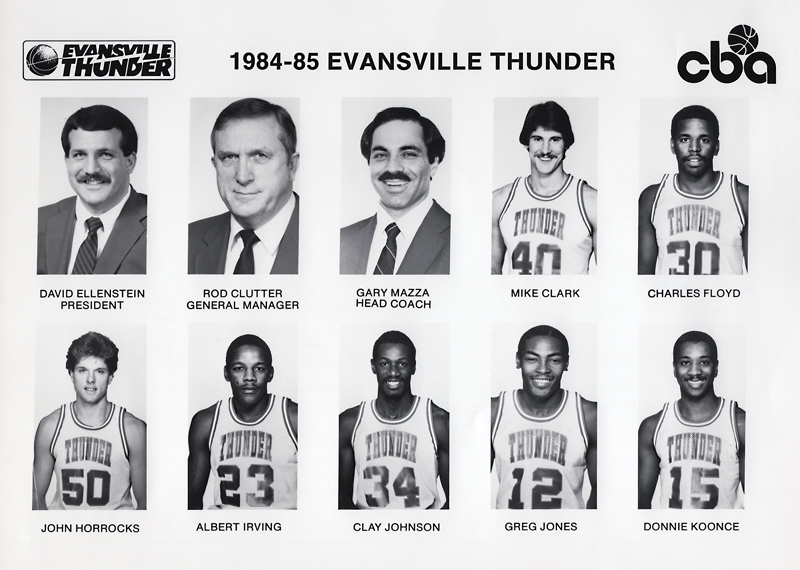
Four decades before the Oklahoma City Thunder claimed the 2025 National Basketball Association championship, a local pro team carried the same name. The Evansville Thunder of the now-defunct Continental Basketball Association played home games at Roberts Municipal Stadium in the mid-1980s. In two seasons, they compiled a 48-48 record and lost a first-round playoff series each year.
From the Thunder’s outset, its story was one of “what if.” Owner Dave Ellenstein, whose family ran successful jewelry franchises under the Acme and Rogers names, approached University of Evansville legend Jerry Sloan to lead the team. Sloan agreed, sort of: He would be allowed to leave if an NBA team came calling. With Sloan in tow, ticket sales soared. “It was a big deal. It was professional basketball coming in,” Ellenstein says. But enthusiasm waned when the Utah Jazz plucked Sloan away shortly before the 1984-85 season started; his 23 seasons head coaching in Utah landed him in the Naismith Basketball Hall of Fame in 2009.
Undeterred, Ellenstein hired less-known Gary Mazza, who coached 23 games before being replaced by former UE standout Wayne Boultinghouse, and then ex-Pacers star small forward Roger Brown. The latter finished the Thunder’s first season and coached most of the second before Ellenstein took over for the team’s final few games.

Many Thunder players spent time in the NBA. None was more notorious than Marvin Barnes. An All-American at Rhode Island’s Providence College and veteran of the American Basketball Association, NBA, and other CBA teams, Barnes’ nickname, “Bad News,” reflected a background that included much-publicized substance abuse.
“He was something,” Ellenstein recalls of Barnes. “I can’t remember which team he came from last, but the owner called me and said, ‘Would you like to have Marvin Barnes?’ And I said, ‘Sure!’ So, he flies in, walks in my office and says, ‘Mr. Ellenstein, I’m crazy, but enough marijuana will keep me not crazy. And I’m a good player.’”
The Thunder’s Lorenzo Romar graduated to a successful college coaching career, including at the University of Washington. Ellenstein also remembers Claude Gregory, who “was a huge individual physically,” he says. “I would have the guys over to my house for breakfast, and Claude would eat — this is no exaggeration — a dozen eggs, half a loaf of bread, a pound of bacon, and all the biscuits and gravy you could serve.”
The Thunder had other legacies. Ellenstein hired the late Ted Bernhardt, who at the time was a local high school basketball referee, to work Thunder games. Bernhardt eventually wore a whistle 1988-2006 in the NBA.
Ellenstein was led to the CBA — which ran 1946-2009 — through his sister, then living in Philadelphia, Pennsylvania; she knew the league’s commissioner. Ellenstein’s strength was in marketing; he even assisted CBA franchises in Kansas City, Missouri, and Tampa, Florida, with promotional concepts. He came up with ThunderMan, the superhero-esque mascot who sported the team’s red, white, and gold. The red and white nodded to Ellenstein’s alma mater Harrison High School, while the gold “was because I was a jeweler,” he says.
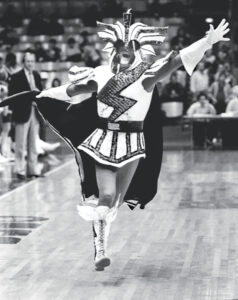
The late Michael Boenigk portrayed ThunderMan. “Michael spent hours designing and tweaking that fabulous costume,” recalls his wife, Paula. “Michael was so energized when he rallied the crowds at the game. I think what he enjoyed most was visiting elementary schools and sharing his ThunderMan costume. Years later, adults would approach him and ask if he was ThunderMan. … Those interactions years later would keep him beaming for a day.”
Ellenstein’s ownership and brief coaching stint with a CBA franchise put him in contact with legendary NBA figures who sought help for their teams’ rosters. “I spoke to (famed Boston Celtics coach) Red Auerbach on the phone. I talked to (legendary Los Angeles Lakers executive) Jerry West on the phone,” Ellenstein recalls. “I still didn’t know what I was doing, but it was a lot of fun.”
There wasn’t a third Thunder season for the most basic of reasons. “It was ungodly expensive to keep this thing going, and I just ran out of money,” Ellenstein says. Many CBA franchises similarly had short lives. But to this day, Ellenstein believes the Thunder would have had a better chance of sticking around past 1986 had Sloan remained. “If (Sloan) stayed even one year or two,” Ellenstein says, “it would’ve been successful.”