


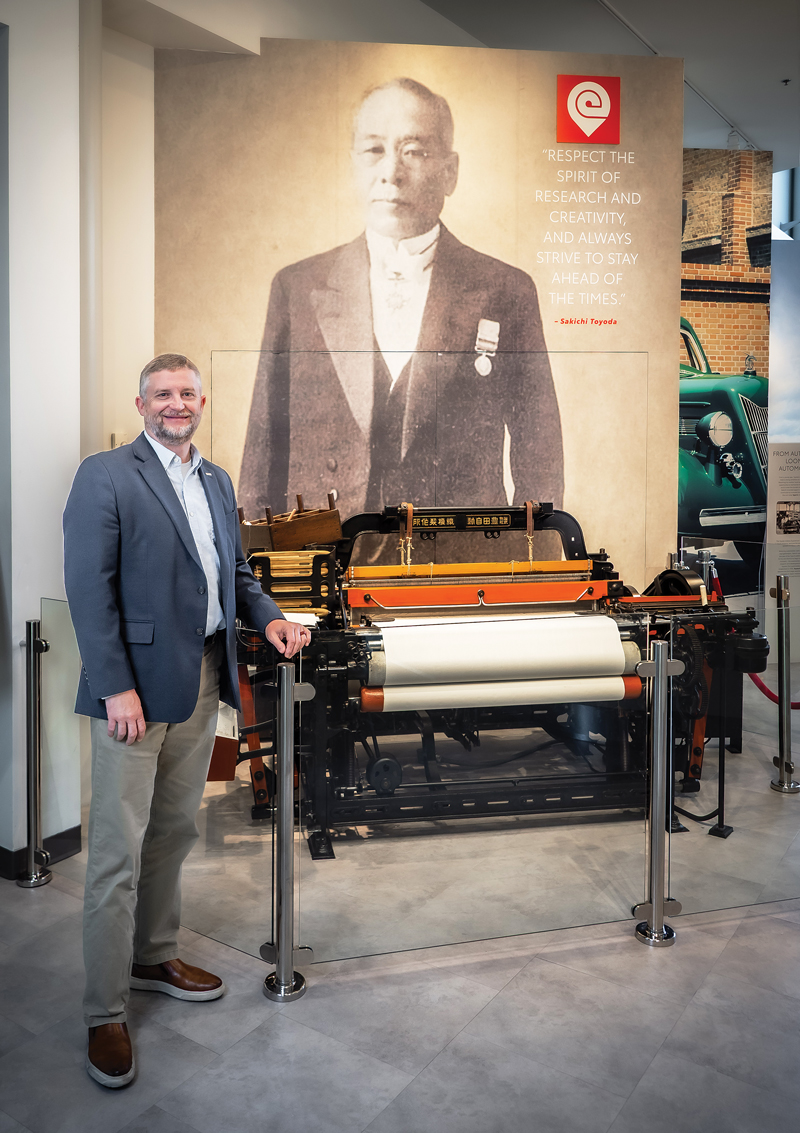
Thirty years after the first shovel of dirt signaled change was coming, Toyota Motor Manufacturing Indiana has left an immeasurable impact — employing thousands, boosting regional organizations with volunteerism and financial gifts, and building and shipping more than eight million high-quality vehicles across North America.
“It’s fair to say that Toyota didn’t just add jobs. They really changed who we are as a region,” says Lloyd Winnecke, CEO of the Evansville Regional Economic Partnership. Data from E-REP proves Winnecke’s point: In the early 2000s, one in nine local manufacturing jobs was tied to the automotive industry. Today, following a wave of expansions at Toyota Indiana and suppliers such as Vuteq and Toyota Boshoku, the figure is one in five.
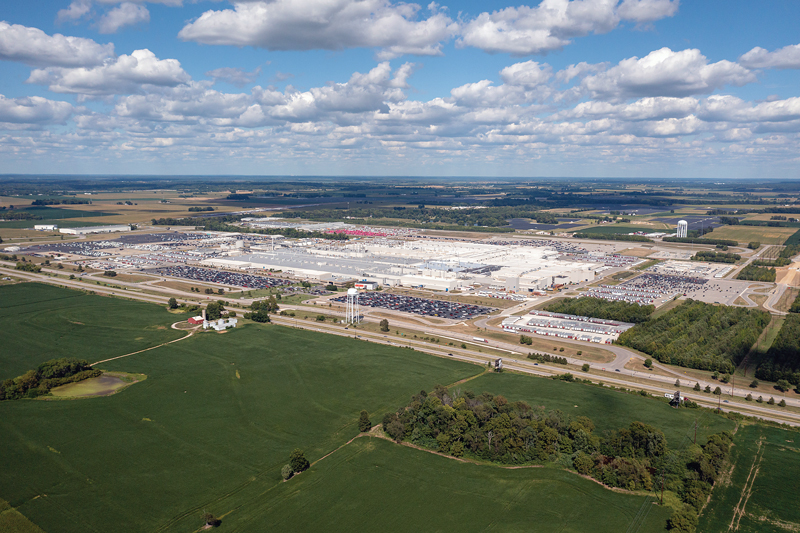
The 4.5 million-square-foot factory is divided among the original facility (now known as West Plant) and East Plant, which was added in 2003. It has long been a site of innovation — as current Toyota Indiana President Jason Puckett calls it, a “greenfield,” literally and figuratively. The facility sprouted from Gibson County farmland, and after its 1998 opening, it birthed two models that remain prominent in Toyota’s portfolio: the Tundra, a full-size pickup, and the Sequoia, an SUV derived from the Tundra.
Assembly of both models moved to San Antonio, Texas, in 2009 and 2022, respectively, but Toyota Indiana has continued to grow, with electrification a major driver. These days, 7,380 team members currently build the Highlander, Highlander Hybrid, Grand Highlander, Grand Highlander Hybrid, Sienna Hybrid, Lexus TX, Lexus TX Hybrid, and Lexus TX Plug-In Hybrid.
More evolution is on the way. Toyota has announced that the 2027 Highlander, a battery-electric vehicle, and a second battery-electric vehicle will be assembled at Toyota’s facility in Georgetown, Kentucky. This relocation “will allow Toyota Indiana to increase production capacity for the Grand Highlander, one of Toyota’s most popular SUVs,” according to a statement from the automaker. A new battery pack assembly plant on-site at Toyota Indiana also is under construction.
Toyota Indiana in 2025 surpassed eight million total vehicles assembled, as well as one million hybrid vehicles. Puckett cites Toyota’s worldwide commitment to reducing carbon emissions for driving the factory’s hybrid traffic, and he points to shifts in customer preferences. “Sixty-five percent of what we built last year was electrified: hybrid or plug-in hybrid,” he says. “That transition has happened.”
Building Automobiles and Careers
The key to maintaining such busy and flexible assembly lines? Toyota Indiana officials credit a dedicated workforce that has kept up with and even led new vehicle technology.
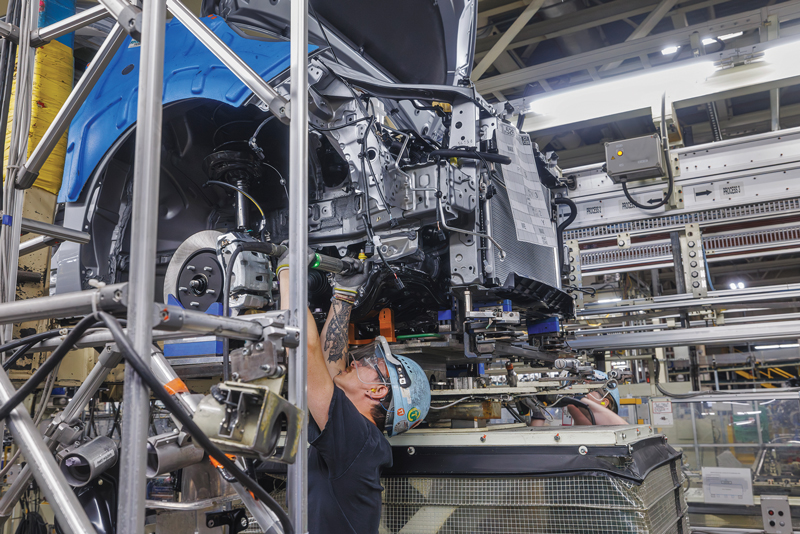
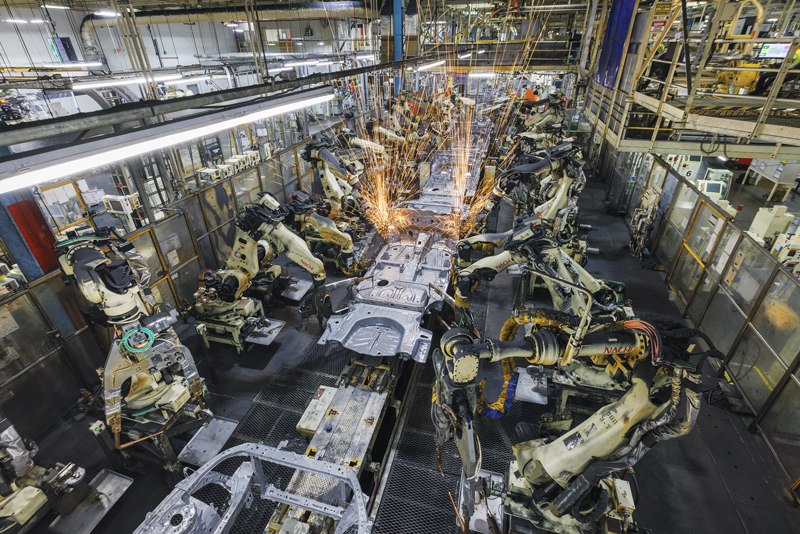
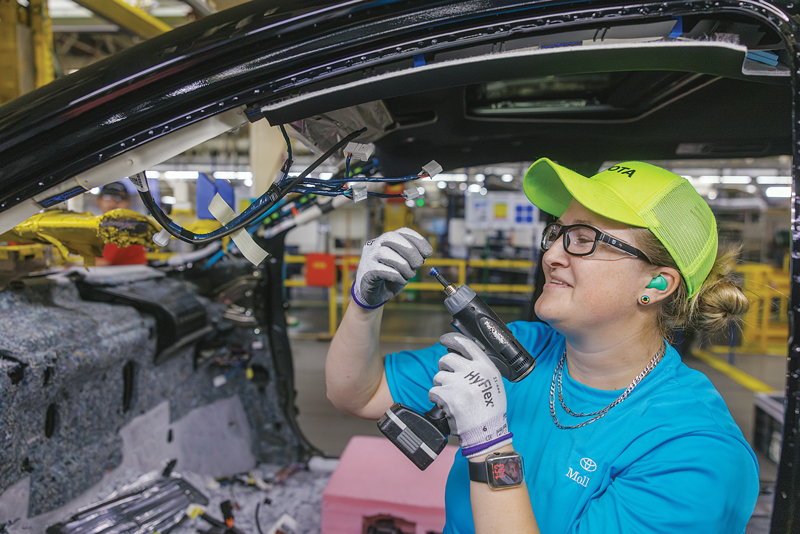
“When this plant started, we still had a high level of automation, even then, in some of the shops from a robotics standpoint,” says Puckett, a Hawesville, Kentucky, native who returned to Toyota Indiana last year after working at the plant early in his career. “Automation and digitalization definitely has changed the business, but we’ve really invested in our members. They’ve stepped up to the challenge, and it’s how we’ve been able to continue to grow over the 30 years.”
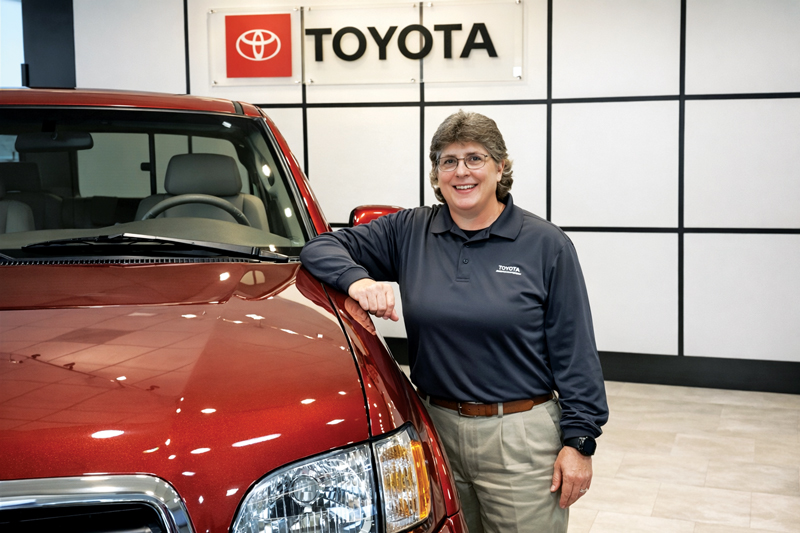
Amanda Culver would agree, having worked for Toyota Indiana since its Gibson County operations opened in 1998. As a manager in quality assurance, Culver’s job involves making sure each vehicle meets or exceeds its buyer’s expectations — a soup-to-nuts inspection of door locks, infotainment systems, steering, lights, signals, and more.
Culver has had a front-row seat at the plant’s evolution. She notes that its first Tundras played cassette tapes; today’s vehicles include elaborate wireless systems connected to smartphones. Learning on the job is part of Toyota employment, she explains, and embracing this mindset can lead to a long career.
“I think about all the changes we have had in the facility, and our team members are the core of that process,” says Culver, whose own path through Toyota has come full circle. She began as a team member in Vehicle Performance Inspection. She later moved to Press and Weld Inspections, Assembly Inspections and Vehicle Performance for the East Plant, and Dynamic Audit. She rejoined the Quality Inspection Team as a manager in 2019, and also took a temporary assignment in that area with Mazda Toyota Manufacturing in Huntsville, Alabama.
Toyota Indiana, Culver says, “welcomes people from all different walks of life, and people in different periods of life, as well.” The critical role of each Toyota worker is exemplified using what the automaker calls Andon: Any team member may alert the Andon by pulling a cord, halting plant production to evaluate and fix a potential issue in a vehicle before it travels down the assembly line.
Beyond the line, Toyota Indiana team members have access to three fitness facilities within the plant, a team store for uniforms, and a shoe and eye glasses store. There’s onsite childcare, a medical center, pharmacy, and credit union, plus athletic fields, a disc golf course, and hiking trails. Employees can dine in a pair of cafeterias or pick up on-the-go meals in several mini-markets; all breaks, including a 45-minute lunch, are taken at the same time.
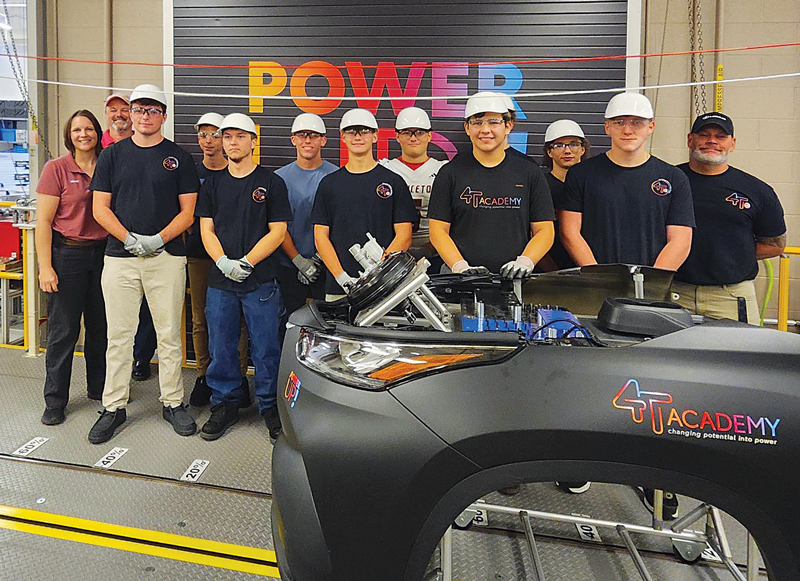
Educational partnerships in Southwestern Indiana have keyed Toyota into locating and training the workforce needed to meet its production goals. The 4T Academy trains interested high school juniors and seniors in manufacturing, with other areas of emphasis including engineering, computer science, precision machining, industrial automation and robotics, industrial maintenance, and environmental sustainability. The 4T name is a nod to Toyota and mascots of Gibson County’s three area high schools: Gibson Southern’s Titans, Princeton’s Tigers, and Wood Memorial’s Trojans.
“Some of it is instruction at the school, and some of it is work experience in the plant,” Puckett says. “Then, at the end of the program, it allows them to come into full-time employment, if that’s what they choose.” Such programs are critical, he adds, so that “we can make sure the workforce that’s coming in is ready for our challenges.”
Seven schools participate, including Benjamin Bosse in Evansville. Principal Aaron Huff says the Toyota partnership allows students “to see beyond what’s in front of them and reimagine what high school education looks like. By the time they graduate, our students aren’t just receiving a diploma; they have a clear, high-wage career path and the technical skills to lead in their community.”
The University of Evansville Center for Innovation & Change has partnered with Toyota Indiana on projects such as a mobile innovation lab, in which a Sienna was gutted and turned into a classroom on wheels, and Driving Possibilities, an effort to steer more students toward science, technology, engineering, and math careers. TMMI is a major sponsor of UE’s annual High School Changemaker Challenge, and although it didn’t win the top prize in 2021, one pitch by then-Bosse student Robert Lopez was pursued by the company and fueled design for the city’s utility infrastructure beneath the planned Toyota Trinity Stormwater Park in Downtown Evansville.
“In many ways, this partnership has helped transform our region,” says Erin Lewis, executive director of the Center for Innovation & Change, which has worked with Toyota since 2016. “When students see innovation happening both in their classrooms and at Toyota’s plant in nearby Princeton, they begin to understand that world-class ideas, and world-class opportunities, are right here at home.”
A Culture of Giving
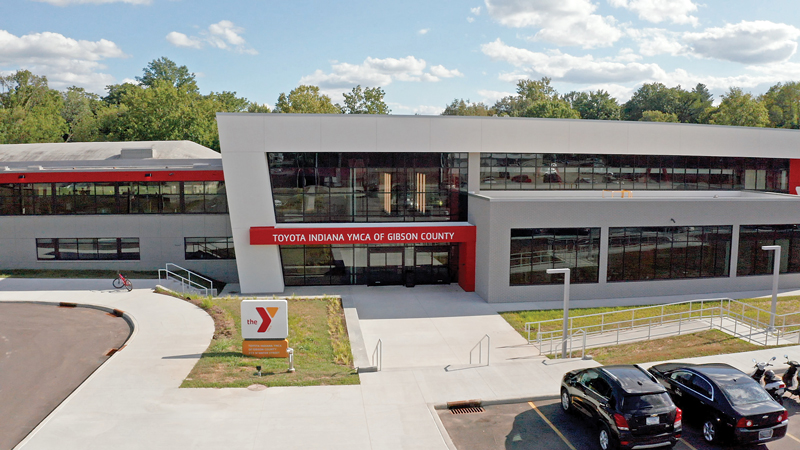
In the 30 years since it broke ground, Toyota Indiana has invested about $55 million in various regional philanthropic endeavors. Perhaps no organization has been impacted more than the YMCA of Southwestern Indiana. The influence goes beyond the Toyota Indiana YMCA in Downtown Princeton, which opened in May 2025, although both organizations point to that project with pride.
This initiative involved thinking big. The YMCA first considered smaller renovations to the former Lowell Elementary School building. But Johnathan Pope, CEO of the YMCA of Southwestern Indiana, says Toyota’s vision and generosity enabled a larger endeavor to take root. The project stayed at the school site, but it included an expansion, plus substantial renovations to the existing structure. ProRehab and The Isaiah 1:17 Project lease space in the new Toyota YMCA building for family services and physical rehabilitation services.
“They loved the idea of having a Toyota YMCA in town,” Pope says of the automaker’s local executives. “They said they believed in what we were doing. Because they signed on, we were able to leverage their name, and we ended up raising about $23 million for that project in total. The scale and scope changed.”
Toyota also sponsors STEM labs at the Ascension St. Vincent YMCA in Downtown Evansville and the CenterPoint Energy YMCA (formerly the Caldwell Community Center) in the city’s Glenwood neighborhood. For good measure, Toyota team members also log time at YMCA Camp Carson in Gibson County, assisting with upkeep.
Current and past Toyota executives have left their mark on area organizations. Evansville native Tim Hollander, who preceded Puckett in the role of Toyota Indiana president, was honored in October with the Dr. William Wooten Champion of Youth First award. Now the president of Toyota Canada, Hollander served on Youth First’s board and remains on the nonprofit’s advisory council.
Area leaders praise Toyota Indiana’s vast philanthropy and employment. “It’s tough to find a significant project in the region that they have not made a significant contribution to, especially in Gibson County,” says Winnecke, who served three terms as Evansville’s mayor before becoming E-REP’s CEO. Current Evansville Mayor Stephanie Terry says Toyota “has been a consistent community leader,” offering “significant support for STEM education, workforce development, and nonprofit partners. That focus on people is what helps communities grow and stay strong.”
Princeton has a sister city relationship with Tahara, Japan, and Toyota representatives accompanied Mayor Greg Wright on a visit there in June 2024. Beyond the new YMCA, Wright says Toyota employees have given the city a lift during plant slowdowns or annual maintenance shutdowns. As recently as summer 2024, they painted fire hydrants and worked on sidewalks and the city’s skate park. “No matter what I threw at them, they were able to take it and run with it,” Wright says. “You couldn’t ask for anything better.”
He says a goal for the city is getting more of the company’s team members to reside near the plant; about 22 percent of Toyota’s workforce live in Gibson County, and fewer lay their heads down in Princeton. Apartment developments have helped, Wright says, but “we need more developers to come here and build houses.”
On the Horizon
Looking for a job, or wanting to move on from your current one? Toyota is hiring as it celebrates 30 years in Gibson County; it aims to push its workforce beyond 8,000. Puckett says Toyota has team members who “came in basically with very little experience and (are) in higher levels of management here in the plant now. I think opportunities are endless, and our doors are open.”
The demand for vehicles Toyota Indiana produces remains high: In 2025, team members assembled 427,844 automobiles, the plant’s second-highest total in its 28 years of production. Puckett says automation is here to stay, but the need for human capital in vehicle manufacturing also is needed, provided it can adapt.
“Our team members are going to continue to play a key role,” he says. “But the role will change. Some of that is up to us to make sure we’re upskilling (workers) in the plant, as AI and digitalization happens. Then we need the skill to be able to maintain those systems and continue to advance them.”
Puckett’s first stint with Toyota dates to 1997, “before concrete was in the building,” he says. “I would never have guessed it would look like it does today, in the people we have, and what they’ve accomplished.” Looking ahead, he says, “we want to continue to position ourselves best to take on that next challenge. And I’ll say it again: We have to focus on that workforce development piece and making sure that our people stay on the front edge of that and are ready for whatever that challenge is.”
Read More: Toyota Indiana’s parent company is making a big investment in regional operations.
Assembling A Regional Powerhouse
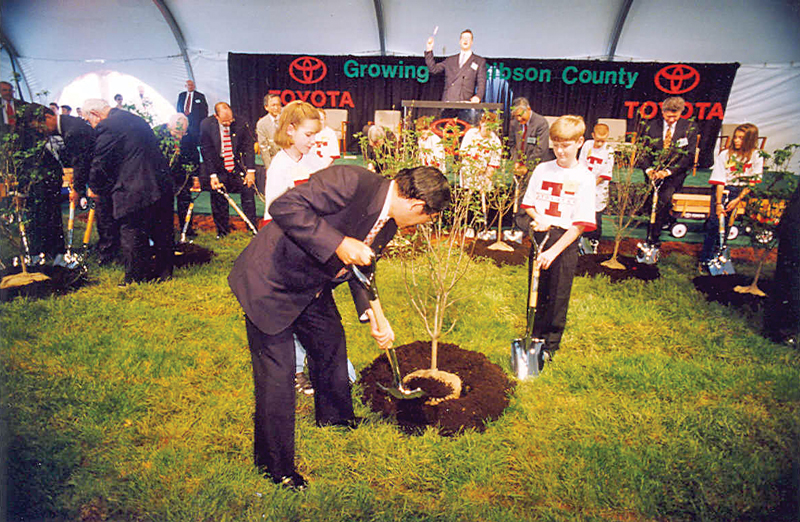
May 8, 1996: More than 300 guests attend the groundbreaking for Indiana’s first Toyota manufacturing facility, including Toyota Motor Corporation President Hiroshi Okuda and newly appointed Toyota Motor Manufacturing President Seizo Okamoto.
Dec. 10, 1998: TMMI’s first vehicle, a Tundra pickup, rolls off the assembly line, as 1,500 guests, including Toyota Chairman Shoichiro Toyoda, Okamoto, and Indiana Gov. Frank O’Bannon, look on. The plant produced about 100,000 vehicles annually at
full capacity.
2000: Ground is broken on Toyota’s East Plant, and the existing plant begins production on
the Sequoia.
2003: The Toyota Children’s Center opens, as does the East Plant as assembly begins on the Sienna.
2008: Toyota Indiana launches an afforestation and plants 130,900 trees on 225 acres.
2009: Assemblage starts on the Highlander.
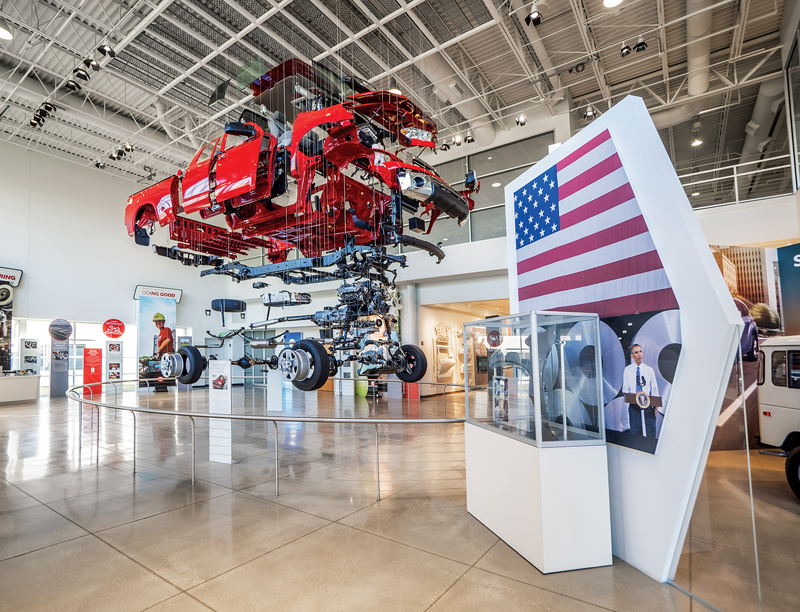
2010: The plant’s Experience Center opens, providing an outlet for Toyota Indiana to share an inside look at advanced manufacturing with the public.
2012: An expansion of Highlander production includes the hybrid model.
2017: Indiana Gov. Eric Holcomb purchases Toyota Indiana’s five millionth vehicle, a 2018 Sequoia.
2020: Toyota and area schools create the 4T Academy to train interested high schoolers for careers in auto manufacturing.
2023: Production begins on the Grand Highlander and Lexus TX.