


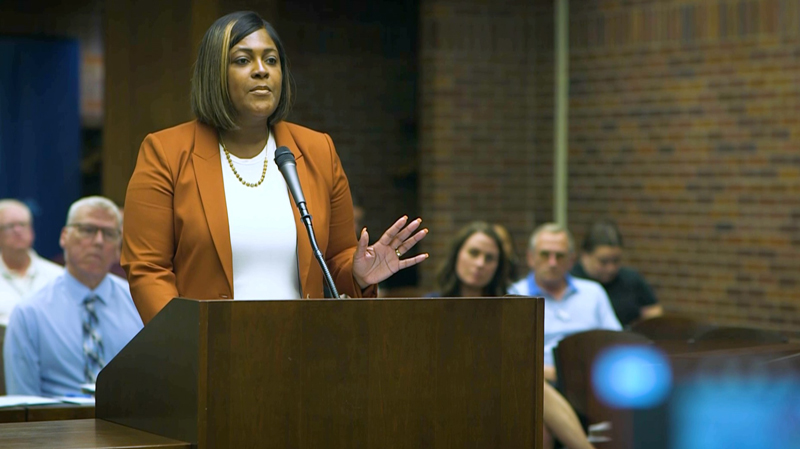
Evansville Mayor Stephanie Terry says her 2026 budget proposal prioritizes city government’s most essential services, an approach largely made necessary by stark cuts to typical revenue streams and rising costs of operations.
Terry told the city council at a Sept. 9 budget hearing that public safety, housing, road improvements, parks projects, and technology are top-tier items in her $140.1 million general fund budget, a total that is a 0.3 percent decrease from 2025’s budget. Council members will consider a first reading of the budget Sept. 22, with a vote on approval expected Oct. 6. The city’s 2026 fiscal year begins Jan. 1.
Year-over-year general fund growth is about 1.6 percent, Terry says, citing negotiating salary increases with employee unions and higher costs of doing business. She notes that higher utility bills causing an uproar among residents affect local government, too: The city administration expects a 21 percent jump in its own utility costs.
The impact of Indiana Senate Bill 1’s tax credit for homeowners is being felt by municipalities statewide. Terry says the average Evansville property owner can expect about $300 a year in tax relief, and “on the surface, it’s a great thing. … The side effect is reduced revenues for cities and towns across Indiana.”
Starting in 2026, Terry says, Evansville expects about a $4.1 million loss because of the legislation, which Gov. Mike Braun signed into law in April. In response, Terry says the city will tighten its belt in numerous areas. Examples include postponing new vehicle purchases, Mesker Park Zoo & Botanic Garden improvements, and a rebuild of East Virginia Street to include pedestrian paths. Terry says the city also will “manage vacancies strategically through attrition.”
She adds that her budget proposal does not attempt to recoup any loss of property tax revenue by raising income taxes, an alternative that Indiana lawmakers allowed. More than 40 percent of Evansville’s general fund budget is from property taxes. Terry says she will propose using Casino Fund reserves to cover shortfalls if necessary; she hopes that step is not required.
“Cities everywhere are scaling back and making tough decisions,” Terry told the council. “We are prepared to do the same because we have to.”
She says the budget book on council members’ desks includes $1 million for the city’s affordable housing trust fund, plus $4.5 million for paving and road safety improvements. The road budget is up $1 million from the 2025 level, and Terry says that increase, combined with the recently approved wheel tax taking effect in 2026, means the city will be able to complete more work.
The general fund’s $500,000 for parks projects does not include the 66-year-old Hartke Pool, which has been closed since 2024. Parks and Recreation Executive Director Danielle Crook has said there’s no word yet on if the pool would be demolished or its structural and mechanical issues could be repaired.
Included in Terry’s budget proposal is $125,000 for a revamped city website. The city’s current website is more than a decade old, and the mayor’s office often hears complaints that it is difficult to navigate, says Joe Atkinson, the city’s communications director.
“The budget request to redesign the website aims to fix those issues,” Atkinson told Evansville Business in an emailed statement. “We want to make it easier to interact with city offices, to access city services, and simply to find the information that residents expect to access on the city website. A new website with a clean, modern design and an easy-to-navigate layout will do all of those things, helping residents stay engaged with their community.”
Seventy percent of the city’s general fund budget is tied to public safety, with most of that dedicated to salaries, Terry told the City Council — she described those costs as “non-negotiable” — plus investments in “cybersecurity and digital protections,” she adds. The city agreed to new contracts with the city’s police and fire unions, as well as the construction of the first new fire station in many years.
Terry also mentioned the city’s recent move to draw ambulance services in house in 2026, which the city says will bring long-term cost savings after an initial investment of $7 million in supplies and equipment. The city council on Sept. 8 proceeded along that path in a 6-1 vote; longstanding city ambulance provider AMR had urged a delay pending a more detailed analysis of the projected savings.
Evansville carries more than $1 billion in debt on various projects, many of which Terry says are tied to the Water and Sewer Utility. Terry told council members that the city maintains strong bond ratings and will issue no bonds in 2026 from the general fund, parks district, or redevelopment district. Meanwhile, “our staff and financial advisers are constantly looking for opportunities to refinance our debt,” she adds.
Terry told the council that she sought public feedback on her 2026 budget preparation, and during that process, “We heard loud and clear: Take care of the basics,” she says, and that is reflected in the plan she has presented.
“2026 is going to be tight. That’s the plain truth,” she says. “But this budget navigates those challenges.”