



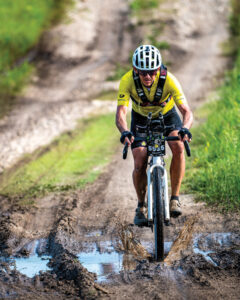
Describe completing a race entirely on gravel and rough terrain.
Sometimes it’s on gravel, sometimes it’s on dirt. You’re literally some of the time on a two-wheel path going through herds of cattle. In the 2023 race, we had a lot of rain, a lot of mud. You’re out there covering so much distance that one area might be dry and other areas totally wet. This year, I finished in 25 hours and 5 minutes … and I ended up crashing at mile four of 350. I went down pretty hard: scraped up knees, scraped up elbow, hit my shoulder. It hurt. … It’s like, OK, I’ve hurt my shoulder again. [He broke his collarbone in the 2022 Unbound Gravel XL.] I’m gonna get back on the bike and figure out if I can do it or not. I’ve only got 346 more miles to go. I got it done. … I ended up separating the shoulder, a grade-three separation. The ligaments are torn. … I’m never going to claim to be a smart guy. Just determined and competitive.
You mentioned that Unbound’s XL distance is 350 miles in rural Kansas. How do you stay motivated for the long haul?
There’s lots of time with no one to talk to along the way, but one thing that’s really cool is how the people of Emporia and those surrounding towns do not leave you by yourself. There are people out all night cheering. Imagine from Evansville, if you would make a 350-mile loop, how much ground you’d cover. The people of that area, they embrace the event … they’re out on ATVs, handing out water. And Fireball. And beer. [Laughs].
What are the keys to completing such a long distance?
There’s another guy that does really crazy stuff, lots of distance. I’ve ridden with him at races before. And he says, the race doesn’t begin until 200 miles. Because at 200 miles, most people, their body is going to be trash. That’s when they’re going to go, “I quit. I can’t do it anymore.” That’s the wall that you’ve got to bust through. That’s probably not going to be your only wall [laughs], but it’s one you’ve got to get past. I tell people it really is a mental exercise to get to the finish line. As far as physical training, it’s just a lot of time on the saddle leading up to the race. It’s at the end of May, and typically by then I have about 7,000 miles in.

You’re 55. What do you recommend about fitness to others your age?
The important thing is movement. I know a lot of people will be intimidated by what I do. It’s just getting out and doing whatever you do. You don’t need to ride the kind of miles that I ride, as long as you ride, walk, run, play pickleball … it is just movement. And weightlifting is important especially at our age.
What’s the community of gravel cyclists like?
This year I started a Telegram group … we’ll chat and share information because, ultimately, I want everybody on the (starting) line to finish. While we’re all competitive, it’s really a camaraderie. [Roger’s wife, Katie, intervenes here: “Roger has people from all over the U.S. and from other countries who follow him and ask questions. They want to pick his brain … he’ll always say, one, you have to get time in the saddle — get on and ride. And then the other thing is, you’ve got to believe you can do it. Anyone who wants to join can come share ideas and ask questions. It’s a no-judgment zone.”]
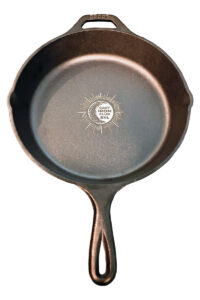
The Iron Skillet
The Orths both are involved in Unbound Gravel (which used to be called Dirty Kanza): Cyclists score race spots through a lottery, but Katie’s volunteer hours at Unbound enable Roger to earn a guaranteed entry. Many cyclists have finished Unbound’s 100- and 200-mile routes. Roger’s latest finish on May 31 was his fifth at 350 miles and earned him the
inaugural membership into Unbound’s Cast Iron Club — and the first Iron Skillet award, which was introduced in April. Its engraving says, in part, “This isn’t just a trophy, it’s a badge of honor, forged in dust, darkness … and built to last.” “We’re not going to cook with it,” Roger says with a laugh. “We’re going to hang it. We haven’t figured out where yet.”