


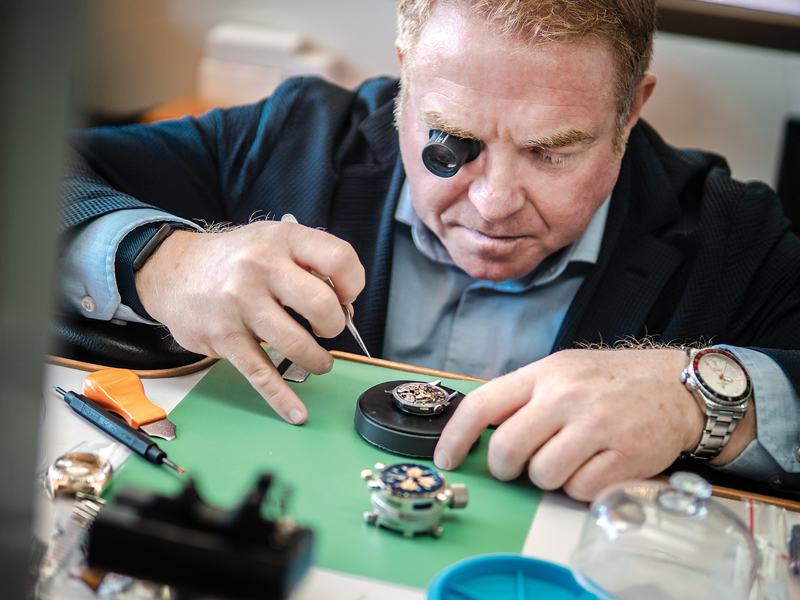
The son of a typewriter repairman, Dean Powell always was intrigued by how small machines work. Raised in Arizona and educated at Lilitz Watch Technicum in Pennsylvania, Powell is a watchmaker who for 17 years has applied a delicate, skilled touch in a glassed-in corner of Brinker’s Jewelers’ East Side shop.
“A classically trained watchmaker is someone who’s gone through school and could build certain components of a watch if necessary,” Powell says. “Three hundred years ago, yes, they were handmaking lots of clocks and pocket watches. These days, it’s more refined, a lot of parts exchange and repair. But the education is similar. … It’s mechanics, theory, everything involving time.”
A luxury watch can have as many as 500 parts. “It is a tiny machine that is designed to run 24 hours a day, seven days a week for years on end uninterrupted. There are not many machines made to do that,” Powell says.
Watchmaking has become a rare trade. In fact, the school where Powell was trained closed in 2025. “It’s difficult to find qualified candidates who actually want to get through the process,” Powell says. “It’s expensive to create watchmakers. But the opportunities in watchmaking are fantastic. You can literally go anywhere in the world and get a job.
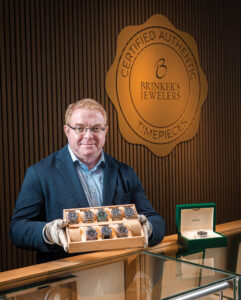
Brinker’s sells Certified Authentic watches — some straight from the dealer and some preowned — from multiple makers. A big name is missing after Rolex pulled out of the Evansville market in April 2025. “We enjoyed our partnership with Rolex for two decades, and we will continue to be successful because a brand doesn’t make a jewelry store successful — it’s people, their knowledge, passion for the industry and the way they take care of their customers,” Powell says.
Although smartwatches are common, wrist accoutrements haven’t gone away with the arrival of cell phones. Powell says some owners feel “controlled by their watch” after a certain point and desire to move on from it, yet still want something on their wrist. He says a majority of Brinker’s watch customers are men, but “we do have some pretty serious female watch clients.”
“People say the need for watches is going away, and the people who wear them are disappearing. That’s not true. It’s a niche — it’s not as common as it was in the 1950s and before cellphones. But it’s replenishing. You have younger generations that are still interested (in watches). There’s value because of the element of time involved, the involvement of precious metals, there’s art. It’s recognized, it’s also a status symbol,” Powell says. “As long as it fills those blanks, it continues to flourish.”