


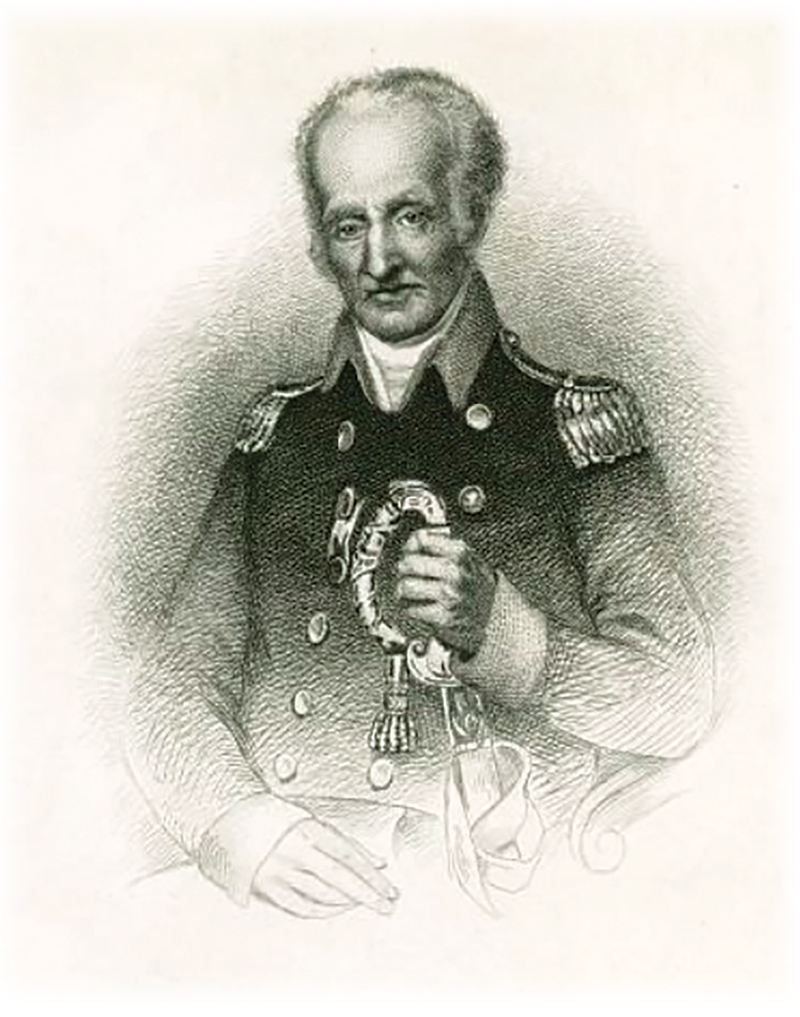
Two hundred fifty years ago — just as America’s Declaration of Independence was being signed — the gleam was likely fading from the eyes of Richard Henderson.
Henderson was a North Carolina judge-turned-land speculator. He had a vision of acquiring a huge swath of wilderness across the Cumberland Mountains, west of the colonies of Virginia and North Carolina, land that would eventually make up about half of Kentucky and a portion of Tennessee.
Henderson and his investors intended to enrich themselves by then selling that land to settlers. They even hoped that land would become another British colony, which they wanted to call Transylvania (Latin for “beyond the forest”).
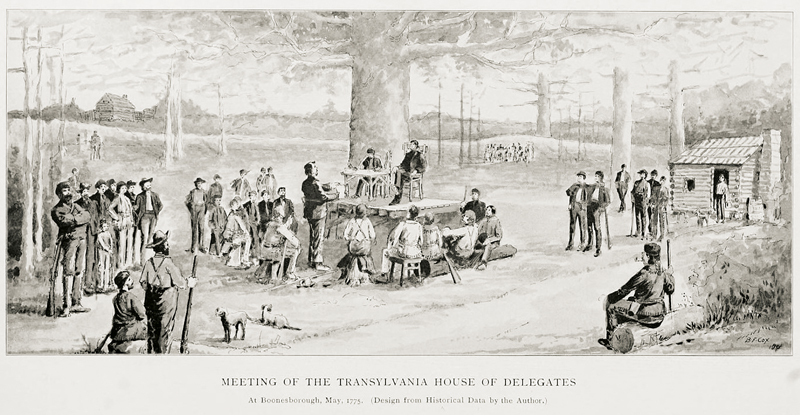
In 1774, he organized Richard Henderson and Company (later called the Transylvania Company) with a group of investors. With the help of frontiersman Daniel Boone, Henderson and other representatives of the Transylvania Company in March 1775 met and made a treaty with Cherokees to buy some 20 million acres bounded by the Ohio, Kentucky, and Cumberland rivers. They then hired Boone and a company of axmen to hack a trail (which would become the Wilderness Road) through the wooded mountains via Cumberland Gap to the Kentucky River, where Boone founded a settlement called Boonesborough. It was there, in May 1775, that Richard Henderson issued a call for representatives of a handful of frontier forts to meet and hammer out a framework of laws for his empire.
That was probably the high-water mark of Henderson’s scheme. The governors of both Virginia and North Carolina promptly disputed Henderson’s claims to control the land, and the Virginia General Assembly in 1776 declared the lands due west of Virginia to be its new Kentucky County. With Virginia and North Carolina opposed to Henderson’s plans, the Continental Congress declined to recognize Transylvania as the 14th colony.
As a consolation, the Virginia General Assembly in 1778 recognized that “Richard Henderson, and company, have been at very great expense in making a purchase of the Cherokee Indians” that, though declared void, benefited Virginia by “increasing its inhabitants, and establishing a barrier against the Indians.” So it gave Henderson’s company a grant of 200,000 acres where the Green River flows into the Ohio River.
The land known as Henderson’s Grant sat empty for a generation, aside from a few squatters along with occasional bandits and river pirates. In April 1797, survivors and heirs of the Transylvania Company dispatched Major Samuel Hopkins and a surveyor to lay out a town. They selected the highest ground on the Ohio — a place then called Red Banks — and drew out the first streets of what they named Henderson.
It was a place Richard Henderson never laid eyes on: He died in 1785, two years after the American colonists’ war against the British Empire concluded in victory.