


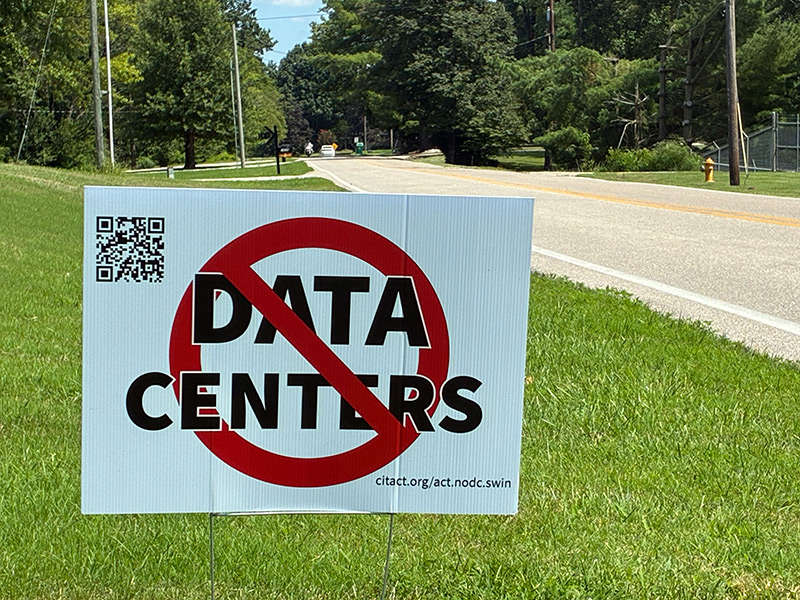
A panel discussion hosted by the Rotary Club of Evansville sought to cast a favorable light on data centers, which have become a lightning rod for criticism in public meetings and online forums across the country.
Participants in the Aug. 4 event moderated by Evansville Regional Economic Partnership CEO Lloyd Winnecke said that, in certain circumstances and with guardrails in place, data centers would deliver construction jobs, permanent jobs, a reliable taxpaying entity, and lower utility rates.
But data centers — facilities housing networked computer servers, data storage drives, and IT infrastructure used to process and share digital information — have attracted complaints for their massive size, land usage, and energy and resource consumption. Other areas of Indiana have them: New Carlisle is home to Amazon’s Project Rainer, an $11 billion complex on 1,200 acres. An October 2025 CNBC article described it as one of the world’s largest AI data centers.
“To be clear, no technology company or developer has filed for any rezoning or special use on any specific site,” Winnecke told the Rotary audience. But regional interest — and opposition — exists. Vanderburgh County Commissioners are wading into the conversation, and Posey County Commissioners have said they will oppose any requests to develop a data center in agriculturally zoned areas outside of Wadesville.

Speakers at the Aug. 4 presentation, who included Indiana Secretary of Energy & Natural Resources Suzanne Jaworowski and CenterPoint Energy’s Indiana Operations President Michael Roeder, cited the possibility of decreased electric rates. Roeder has estimated $250 million in savings over 15 years for the utility’s approximately 150,000 electric customers in Southwestern Indiana.
“We’ve heard the community loud and clear over the last year on affordability,” he said. “We are continuing to work on that, but there’s not a better solution to affordability than being able to land one of these data centers and immediately lower bills when they come online.”
Jaworowski told the audience that data centers utilize a lot of electricity but “are very well-prepared to help us build out our new electricity generation and transmission systems. And we are seeing that here in Indiana. We have policies that force partnerships to happen and force the large load users … to pay for that electricity.” The outcome, she said, is a lowered cost of electricity. “Even though it sounds incongruent that this big demand can help lower our cost, that is, in fact, what happens.”
Decisions on data centers should be made locally, and counties should pass ordinances covering items such as noise and setback regulations, said Rotary panelist David Bottorff, Executive Director of the Association of Indiana Counties. But Bottorff, too, cited potential benefits. “These companies are wanting to come to the county or the community,” he said. “They want to pay their property taxes. And they want to pay a little bit more. … This is an economic opportunity that counties should look at.” John Bates, another panelist and Business Manager of the United Association of Plumbers & Steamfitters Local 136, touted the construction job opportunities a data center would provide.
Winnceke told the Rotary audience that many people ask him “why data centers are needed and why we need more. We live in a digital world, and it’s becoming increasingly reliant on digital technology,” he said. “If you watched your favorite show on Netflix last night, it was processed thanks to a data center. When you rely on a bank ATM, that too works through a data center. And the same goes for cell phone technology. All that happens because of data centers.”
Skeptics and opponents of data centers have questioned their long-term viability given how fast technology moves, plus environmental impacts and whether promised savings on utility bills will materialize. Local governments will ultimately make the decisions, Winnecke said, adding that E-REP has gotten involved in the conversation because of its mission “to help create an environment where people want to invest in our region.”
In fact, E-REP has devoted a page on its website to data centers, with headlines stating the facilities “can strengthen local communities” when “planned responsibly.” The page claims that for every $1 in county services that data centers require, they can generate up to $13 in local tax revenue and that such facilities in 2024 contributed more than $926 billion to U.S. gross domestic product through construction, operations, suppliers, and related business activity. E-REP states that a 250-megawatt data center can represent between $2.3 billion and $3.8 billion in investment, strengthening the local tax base.
Warrick County residents have filled meeting rooms to speak about rumored data centers, and the county’s planning commission voted July 13 to table an ordinance spelling out rules for such facilities. Commissioners are holding a special meeting that’s open to the public to review the proposal to amend the Comprehensive Zoning Code at 9 a.m. Aug. 11 at Friedman Park Event Center at 2700 Park Blvd. in Newburgh. E-REP publicly urged the planning commission to postpone its vote, using a July 12 Facebook post to call the ordinance “onerous” and state that data centers “can help fund the basics: schools, roads, public safety, and infrastructure.” Two days earlier, another E-REP post stated that “a rushed ordinance could block responsible investment and the local job opportunities that come with it.” Here, the topic is not just hypothetical: On July 30, Warrick commissioners met with the county’s legal counsel and economic development representatives in an executive session to discuss a data center development being referred to as “Project Zora.”
On Aug. 6, Vanderburgh County’s Area Plan Commission passed an ordinance establishing a committee to study potential impacts of data centers. County Commissioners must approve the measure for the Data Center Research Committee to go into effect.
The ordinance would “implement a temporary deferral on new data center development applications while the committee conducts its work,” an Aug. 5 news release from the county commissioners states. “The committee would evaluate how data centers could affect land use, infrastructure, utilities, transportation, stormwater, environmental resources, public safety, and economic development. It would also develop recommendations for potential updates to the County’s Zoning Ordinance to help guide the responsible development and operation of future data center projects.”
The proposed ordinance “does not prohibit data centers permanently,” the statement added. “Instead, it provides time to research their potential impacts and determine whether additional local regulations are needed before applications are considered.”
Governor Weighs In
The day before the Rotary Club’s panel discussion, Indiana Gov. Mike Braun appeared at E-REP’s annual Lunch with the Governor at Old National Events Plaza. Following the event, Evansville Business asked Braun about his administration’s stance on data centers and how local governments should approach them.
“I’d say be careful so that you size them up to where they make sense for your community, your county,” Braun replied. “There’s a lot of discussion out there that’s probably got some misinformation to it. … I wouldn’t give them any (property tax) abatements. They should be helping your community.”
Braun emphasized that counties should decide what’s best for them. “It’s going to be a local decision. Size it up carefully,” he said. “You’ll get probably lower property taxes out of it because it’ll add a lot to your assessed value. You’ll get 150 to maybe 250 really good-paying jobs.”
He continued, “There’ll be a lot of windfall financially when they build it, but you’ve got to make sure that’s the right fit for your own community. So, I tell everybody, get the right information, make the decision. The state’s going to leave it up to you, and we should be a resource for helping you make a decision, not telling you what to do.”