


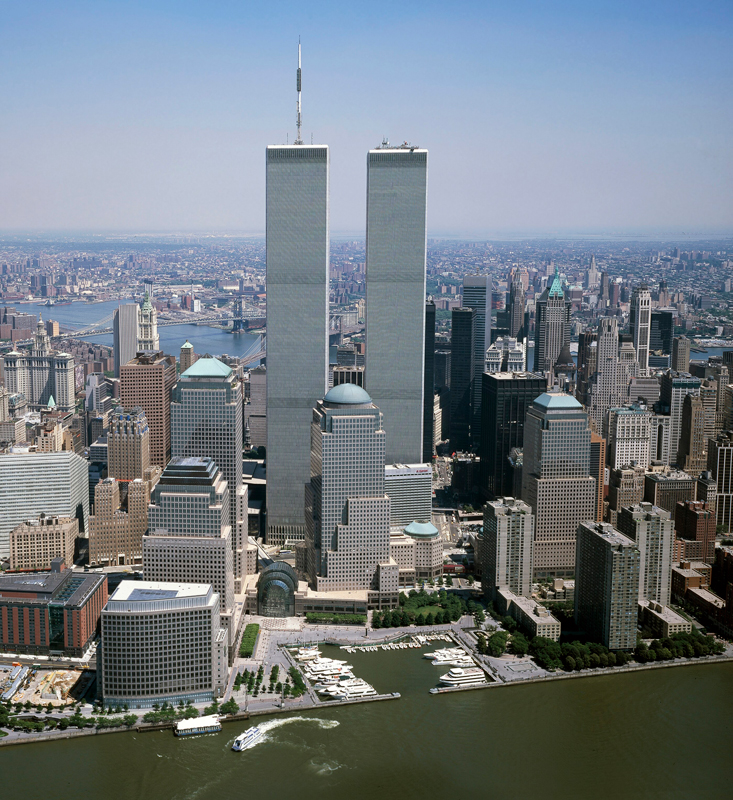
No event has shaped modern American life as much as the terrorist attacks on Sept. 11, 2001 — there is “before” and “after.” In one day, Americans felt horror, confusion, sorrow, anger, and immense pride in our country. A quarter-century later, we asked Evansville residents their perspectives on the tragedy and what it continues to teach us. Here are excerpts of their responses.
“I entered broadcasting in a post-9/11 world, so I’ve only known journalism shaped by heightened security, rapid information sharing, and a deeper focus on emergency preparedness. Today, as Executive Director of the American Red Cross Southwest Indiana Chapter, I see how the lessons of 9/11 continue to influence disaster response. Agencies, nonprofits, and first responders work collaboratively, train for a wider range of threats, and place greater emphasis on resilience before crises occur. The attacks reinforced a lasting truth: strong partnerships and prepared communities are essential to helping people recover when the unthinkable happens. When we come together to support one another, our communities are at their strongest.” — Beth Sweeney, Executive Director, American Red Cross of Southwest Indiana
“I was a young American watching the events of Sept, 11, 2001, unfold on television, never knowing how that day would shape my life. A few months later, I joined the U.S. Army. What began as a national tragedy soon became deeply personal. I went from witnessing history to helping write the next chapter of it, serving alongside a generation of Americans who answered the call. Twenty-five years later, my perspective has evolved. I still remember the unity our country experienced after Sept. 11. Americans stood together despite our differences because we understood that we were Americans first. I also think about the decades of service and sacrifice that followed. The wars lasted far longer than most of us imagined, affecting not only those who served, but their families and communities as well. Today, I think less about the politics of Sept. 11 and more about the people. Through my work with Honor Flight of Southern Indiana, I am reminded that service is a legacy passed from one generation to the next. Twenty-five years later, I believe the greatest lesson of 9/11 is what happens when Americans remember that we belong to one another and come together with a common purpose.” — William J. Kurzendoerfer, Retired U.S Army 1st Sgt.; Local Veterans’ Employment Representative for the State of Indiana
“At the National 9/11 Pentagon Memorial, a high school class waited for a long time to shake hands with us. … We all felt the agony of so many who died that day from such cruel terrorism.” — Paul Medcalf, Retired U.S. Air Force E-5 Staff Sgt.; Honor Flight of Southern Indiana EVV20 veteran
“I grew up in Clarksville, Tennessee, directly beside Fort Campbell, the third-largest Army base in America. I was a senior in high school when Sept. 11 occurred. Almost every student in my school had military ties, and all military personnel were activated after the attack. People’s parents, siblings, and other family were possibly going to fight, and emotions were high. What was normally a 15-minute drive home turned into about a 30-minute drive home because of all the traffic. Before the attack, we’d drive on base to shop or play basketball with very little hassle. After the attack, gates to the base were closed to minimal entry points. Security became more stringent. As members of law enforcement today, we are constantly made aware of potential threats and the information sharing is of the utmost importance. Our country changed after that day and, in a lot of ways, prepared us to stay more vigilant.” — Philip Smith, Chief, Evansville Police Department
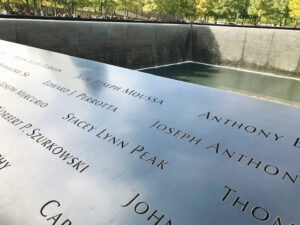
“The morning hours of that sunny Tuesday morning provided a false background of the tragedy, the atrocity that was unfolding for almost 3 thousand people, their families and for our world. The visuals are infinite: Firefighters rushing to the scene of disaster nearly a thousand feet up while citizens inside near the towers attempting to flee to anywhere to be safe. And there is the unforgettable image of firefighters raising a flag among the rubble below. The Pentagon and Pennsylvania were to follow. We were not quite the same after that, but a business trip to New York 18 years later gave me a new focus on the impact of this heartbreak. … With respect, I had my eyes open to those we lost on the names on the top edge of the pool at the 9/11 Memorial & Museum. One of the names is Stacey Peak of Tell City, Indiana. She worked there. Through the ashes, we had a new perspective on history that undoubtedly will shape the century we live in.” — Brad Byrd, Retired News Anchor Channel 25 WEHT-TV (click here to find the location of Stacey’s name at the 9/11 Memorial & Museum)
“Our life in our wonderful country changed forever after the Sept. 11 attacks on our homeland. As a combat veteran of the Vietnam War, I was blessed to have been afforded an Honor Flight on May 2 this year. While in Washington, I was able to see several memorials, the last of which was at the National 9/11 Pentagon Memorial, where 184 Americans lost their lives when American Airlines Flight 77 was hijacked and crashed into the Pentagon. One hundred twenty-five of the casualties were in the building, and 59 were in the plane. As a warrior, you hope that your war is the last one. We all know this will never be the case. Our enemy in Vietnam used terrorist means of fighting as did the foreign terrorists who carried out Sept. 11 and still are playing havoc around the world. We lost a lot of our freedoms after Sept. 11, feel less secure in a lot of life’s endeavors, and have had to endure many thousands of military and civilian casualties in our War on Terror. God Bless America.” — Ellis King, Retired U.S. Army Spec 5; Honor Flight of Southern Indiana EVV20 veteran
“We always talk about ‘freedom isn’t free.’ I’m not sure younger generations realize how much we have sacrificed as a free country to maintain our freedom. I’m concerned that the general public is becoming complacent and not understanding the dangers that can quickly change everything. It is important to remember our history, to help us plan for our future.” — Cliff Weaver, Director, Evansville/Vanderburgh County Emergency Management Agency; Former Fire Inspector, Evansville Fire Department
“The Age of Innocence, or what was left of it, came to an abrupt end. You don’t have to use an airport to feel it. Try entering a college or pro athletic event without being treated like a possible terrorist. Find a street or highway without Big Brother cameras recording your vehicle and, yes, your face, and tracking your every turn. Are these extreme precautions good or bad? Maybe both. That’s for each of us to decide. But extreme acts against us required extreme acts of defense. We may be safer now than we were 25 years ago.” — Randy Wheeler Retired News Director, 104.1 WIKY-FM
Answers extended for digital publication and edited for length and clarity by Jodi Keen