


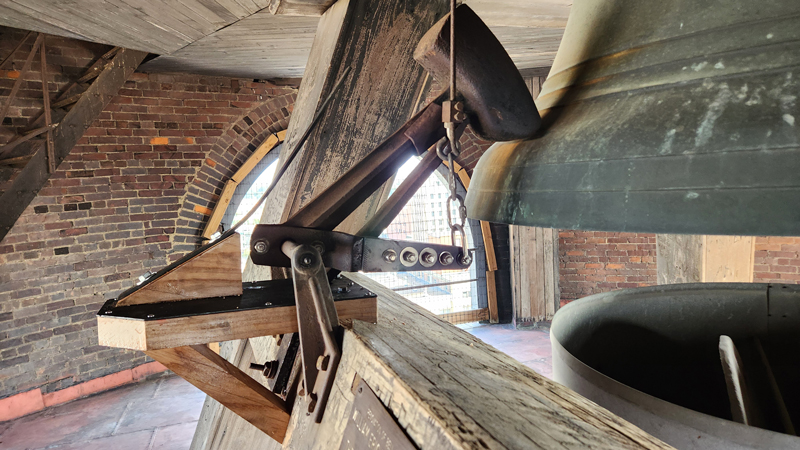
A familiar sound has returned to Downtown Evansville: the chime of the Old Vanderburgh County Courthouse bell. It had been silent for six months after an undetected microcrack in the 100-pound-plus drop hammer formed into a full crack, necessitating repairs.
“During a routine inspection of the bell tower, staff discovered that the drop hammer had snapped off its base,” says Laura Tomes, chief deputy of the Vanderburgh County Board of Commissioners, which owns and operates the Old Courthouse.
The drop hammer, which strikes the bell, was made of cast iron, “so when it broke, that was it. It would have been very difficult to repair it,” says Larry Bristow, vice president of the Old Courthouse Foundation Board of Directors since 2010 and former executive director of the Conrad Baker Foundation, which managed the building from 1967 until 2000, when the county took over ownership.
It was the same drop hammer installed with the old courthouse bell in 1890. “Construction did not finish on the rotunda floor until the bell could be lifted through the skylight and put into place,” Bristow explains. (History buffs may be interested in taking one of the courthouse tours that Bristow leads.)
“The original drop hammer lasted an incredible 134 years — delivering an estimated seven million strikes,” Tomes says. (Seven million and one strikes, and you’re out!)
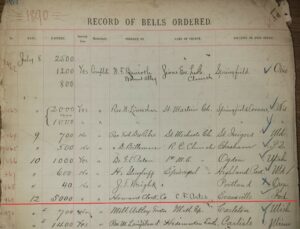
In May, the county pursued a replacement from Saint Louis, Missouri-based McShane Bell Foundry, the same company that cast the bell in 1890. “McShane was enthusiastic about assisting with the project and even located the original purchase record from 1890,” adds Tomes. The company was founded in Baltimore, Maryland, in 1856, but moved to the Midwest in 2019. “Their ability to reference these original documents added a meaningful connection between the historic bell and its latest restoration,” Tomes adds.
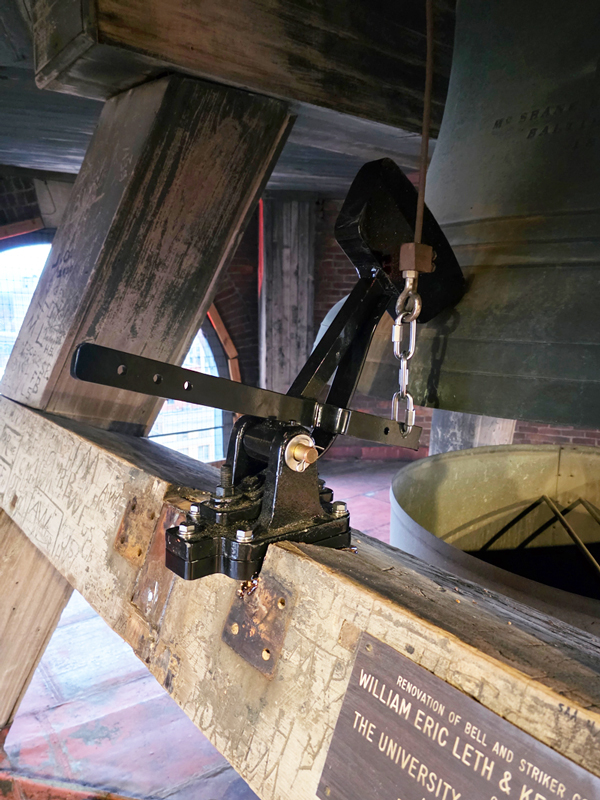
The University of Southern Indiana’s Center for Applied Research was contacted in August to install the new drop hammer. CAR, which helps organizations, governments, businesses, and individuals use USI resources to tackle real-world problems and ideas, had previous experience with bell repairs in 1985 and 2023-24. Last year, CAR students replaced and repaired rusted and rotted parts, like the drop hammer’s wooden platform and lever arm, plus the chain that connects the bell to the clock. Some of them — including manufacturing engineering technology students senior Mason Eickhoff, sophomore Evalynn Voyles, and 2024 graduate Leo Osborne — were called back to work in October to install a new drop hammer.
“We were very fortunate to find the folks locally that were able to do repairs,” Bristow says.“Their prior experience, combined with their technical expertise, made them uniquely qualified for this next phase of restoration,” Tomes adds.
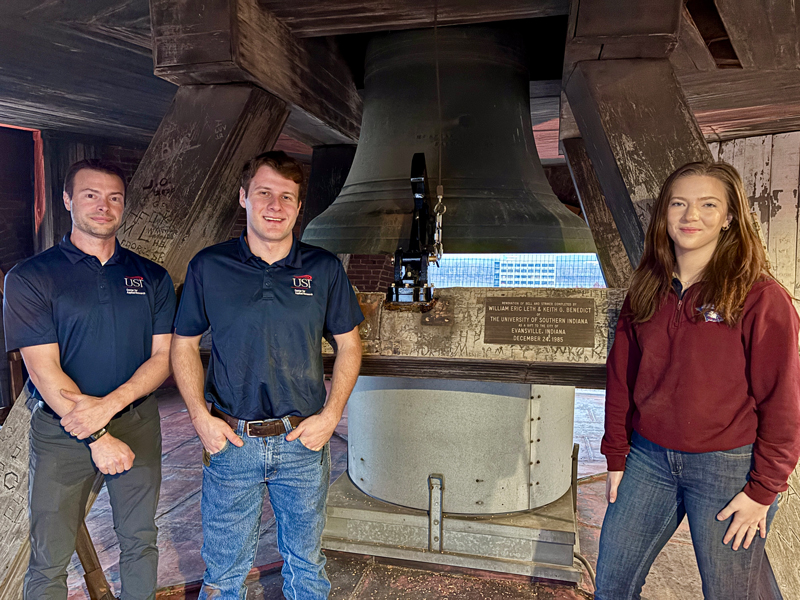
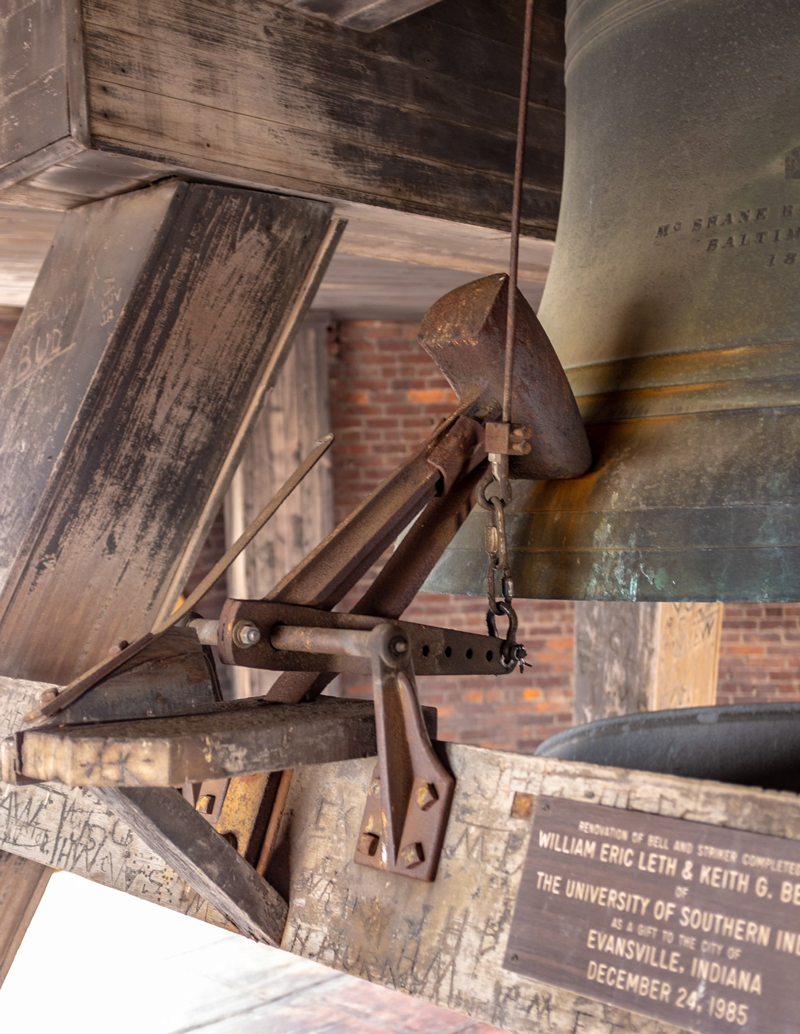
“We thought it would be simple — take one out and put the new one in,” says Steven Stump, CAR’s director for the last four years. But the new drop hammer’s arm was a different size than the old one, which meant a whole new wooden platform had to be installed. Since the hammer must hit the same place on the bell to ensure the quality of the chimes, students used USI’s preferred digital 3D modeling software, SolidWorks, and a 3D printer to create models and ensure the correct sizing of all parts before final installation. They used a waterjet cutter to cut metal plates for the platform and a mill to drill holes for screws to go through the beams that hold the bell and its drop hammer in place. “They shaved down some of the wood on the beam where the platform for the drop hammer sits to create a recess for the new platform to sit on,” Stump explains.
This new drop hammer has some “new bells and whistles,” Bristow says, compared to the old one. It is steel instead of cast iron, making it more durable and able to last longer than 134 years. The screws also adjust, so when the hammer strikes, it can retract more to reset and strike again, which creates a better sound. The entire project cost the county $2,954.
“The hope is that everything we added and the way we installed it makes sure that no one in the county has to worry about it for another 100 years,” Stump says. “We were really pleased to have the opportunity to work with the county on this.”
Students did test fits Nov. 7 and Nov. 21 before the final installation on Nov. 25, when the bell rang five chimes at 5 p.m. Hearing its first sound in six months was moving, Bristow says. “I was surprisingly emotional. It was really good to hear and to know that it’s going to be in service for many, many years to come. It’s a sound I’ve gotten used to.”
“Based on the materials and construction, the new drop hammer is expected to last even longer than the original, helping ensure that the Old Courthouse bell continues ringing for generations to come,” Tomes says.
Old Vanderburgh County Courthouse Bell Facts
Created by: McShane Bell Foundry, established in 1856 in Baltimore, Maryland
Date Ordered: July 12, 1890, by Howard Clock Co./C.F. Artes, a local jeweler
Shipped: Aug. 2, 1890
Total Weight: 4,977 pounds
Cost of Bell: $1,045.17 (21 cents per pound) in 1890
Height: 5-6 feet
A Quick Note …
Bells like the one in the Old Vanderburgh County Courthouse are supposed to be turned every so often — just a few inches — so the drop hammer does not hit the same spot repeatedly, leaving a dent that makes the chimes duller. It was discovered in 2019 that no one had rotated this bell since at least 1969, Bristow estimates, though no one knows for sure. “Look at the bell, and you can see little scars on it,” he says.

Why didn’t anyone rotate the bell for 50 years? In part, because the large wrenches needed to loosen the huge bolts that hold the bell in place on its beams went missing. During renovation work in 2023-24, USI students created new wrenches 3-4 feet long so the bell can be rotated. While they were there, they also rotated the bell a few inches.
How long until the bell needs to be rotated again? Bristow is not sure, but perhaps every couple of years, and it will be part of the bell’s regular maintenance going forward. “We’re going to go back and look at it in a year and think if it needs to be nudged a little bit,” he says.
The next item of restoration likely will be the clock that operates the bell, he says. The tower clock was maintained for 15 years by Carroll Hickrod; after he passed away in 2023, custodians have been responsible for any routine maintenance.
“Our concern is the clock faces that are a part of the same system, with the glass, metal, wooden frame, and brickwork, and it looks really rough,” Bristow says, adding the foundation has set aside a little money, but repairs will be a significant expense.