



With the 48th Maple Sugarbush Festival around the corner — and more than 1,500 attendees bringing their appetites to Evansville’s virgin old-growth forest for a pancake breakfast March 7-8 — Wesselman Woods enlisted a team of nearly 20 volunteers to carry out a tradition older than many of the forest’s trees.
Over two hours on a chilly January morning, Wesselman Woods staff led volunteers through a process refined over the years, but owing its roots to Indigenous people who discovered sugar content in Southwestern Indiana trees. (Although the maple tapping class occurs only once a year, Wesselman Woods offers other courses through its environmental studies series. Tickets are $15 for Indiana Master Naturalists and $20 for the public.)
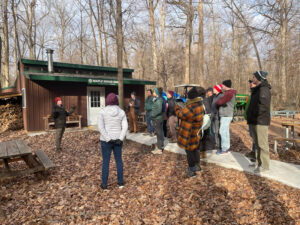
“Sugar maple is most common here, then silver, then red maples,” says Derek Walsh, Wesselman Woods’s Director of Natural Resources and Research. “Sugars thrive here. The sugar maple tapping industry this far south is about the limit.”
Tapping is a form of pressure release that poses no danger to the tree if performed early, so Wesselman Woods’s staff typically begins in early or mid-January when winter temperatures allow tree sap to move through a freeze-thaw process. They select trees with a minimum 10-inch diameter and tag them with a yellow ribbon. Traversing into the nature preserve’s grove of sugar maples — a sugarbush — sugar tapping volunteers drill 1.25 inches into each selected tree to reach the sapwood. After cleaning the drilled hole of shavings, a spigot is hand-screwed in and hooked up to a bucket and cover to ward off water and insects.
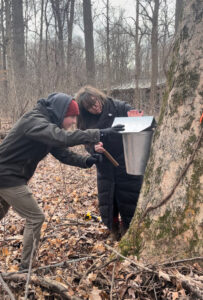
“The trees transport gallons of sap per day; we tap a fraction,” Walsh says. Wesselman Woods’ sugar maples produced 10 gallons of sap per day 20 years ago and logged 400 gallons for the 2022 season. The rate dropped to 55 gallons by 2024 and led to a year off because of a lack of freeze-thaw cycles in 2025.
Walsh reports that it takes 40 gallons of sugar maple sap to make one bottle of syrup. Because Wesselman Woods needs 15-20 gallons of syrup to feed the public at the Maple Sugarbush Festival, the syrup served at the festival comes from the Harris Sugarbush in Greencastle, Indiana. But festival attendees can purchase syrup tapped from Wesselman Woods trees, some of which are more than 200 years old.
Before being bottled for sale, sap collected twice daily by volunteers is transported from the forest to a sugar shack and stored in plastic barrels to keep it cool and free of bugs and mold. The sap drips through a track and boils over a fire for 33 hours — “it smells incredible,” Walsh says, “being cooked outside over flavored wood and having a smoky flavor” — reducing water content and thickening before passing through an industrial-grade coffee filter.

The time-intensive process requires extra hands — hence the recruitment for volunteers, including for Wesselman Woods’ popular breakfast fundraiser. Evansville resident Katelin Keene signed up for the tapping class after pitching in at last year’s Maple Sugarbush Festival — “I was a sugar shack sentinel,” she says — and wanting to see the syrup process from start to finish. “We were joking and calling it ‘professional development,’” she laughs.
But it’s a sweet tribute to Evansville’s natural environment, Walsh says: “It’s a labor of love.”
Sample the state’s sugar maple success stories 7 a.m.-noon March 7-8 at the Maple Sugarbush Festival. Tickets start at $12 and reserve each ticket holder one spot at an hourly seating at the breakfast held at Wesselman Woods, 551 N. Boeke Road.