

Evansville is home to a four-year private university and a four-year state-supported university, as well as a community college and numerous public, parochial, and independent high schools. But efforts to train the next-generation workforce extends beyond the walls of those traditional institutions.
The region is filled with professionals whose training came, at least in part, from other directions. Workers across various building trades and those who make their living in salons and massage therapy cut their teeth in established, certified programs led by skilled instructors.
According to the Evansville Regional Economic Partnership, employment in the “personal care and service” industry accounts for nearly 2,000 professionals in Vanderburgh County, while more than 20,000 jobs are tied to construction and manufacturing — the sorts of professions that often require extensive apprenticeship tutelage.
Leaders of these workforce pathways say there are good salaries to be earned, especially for those who embrace keeping up with the newest technologies and trends. They point out perks such as job security, skills that travel, and in some cases, union-negotiated wages and scheduling flexibility. And, these are professions in consistent demand. Joint Apprenticeship and Training Committee Director Roger Clark puts it simply: “Our field is growing, not shrinking,” he says.
Read on to discover how sheet metal workers, massage therapists, cosmetologists, and more Southwestern Indiana professionals are writing their futures outside of a traditional classroom setting.
More Than Surface Deep
Future cosmetologists learn to embrace ever-changing beauty trends
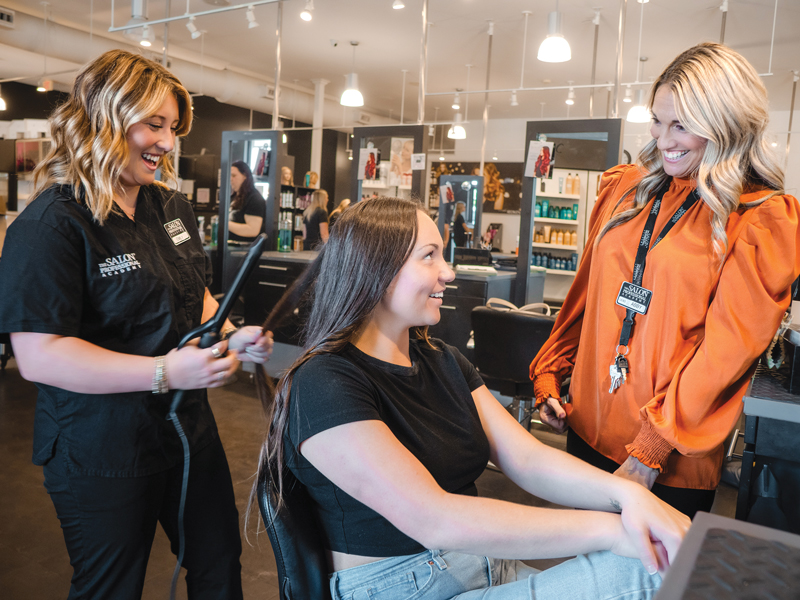
Call it the TikTok effect: The Salon Professional Academy regularly receives calls from interested students as well as salons needing trained cosmetologists to meet regional demand.
It’s not work that just anyone can do, at least not reliably, professionally, and safely. During the COVID-19 pandemic, many people “watched TikTok and YouTube and they all thought they were nail techs,” says Robin Halter, TSPA’s co-owner with Carla Boyles.
TSPA, a Redken partner, runs programs accredited through the National Accrediting Commission of Career Arts and Sciences. One hundred thirty-five students are enrolled, including 86 in the 1,500-hour cosmetology program. Aesthetics programs need 700-750 hours to complete, based on which state the student is being qualified to work in. Manicuring is 450 hours. “Last year and now this year, we’ve actually had to cap our student body,” Halter says. “Our programs are filled up.” Since 1982, aspiring cosmetologists also have studied at Roger’s Academy of Hair Design.
Instructors like Abby Turpen explain starting points, such as knowing how to texture and braid hair. She encourages students to not be discouraged if a skill doesn’t come easy and to ask questions. “We tell them all the time: Beauty is pain,” says Turpen, a cosmetologist for 24 years who has taught for two decades. “The harder something is for you, the more challenging, people shy away from it. … But when you go work in a salon, you’re not going to be able to say, ‘I don’t know how to do that.’ You’re not going to keep your job very long.”
Emily Futrell heard the stereotypes about cosmetology work — that pay is low and career advancement is limited. But she loved going to the salon with her mom as a child, and “it’s just something I’ve always wanted to do,” she says After attending college out of town for three years, Futrell enrolled at TSPA in January and now is crafting her own future. In fact, she entered and won the “Best Overall” award 2025 Student Stylist of the Year Contest, a national competition sponsored by the American Association of Career Schools and L’Oréal Professional Products Division.
Already strong, Futrell’s confidence soared after winning the contest. “I feel like I’m more eager to take on the ‘scary’ things,” she says, adding that she enjoys the creativity of cosmetology. “I don’t want to do the same thing every day,” she explains. “I want to do something that … I don’t know how it’s going to turn out.”
Post-pandemic, curriculum emphasis has increased on “soft skills” such as relating well with people — essential to building rapport with salon clients — as well as money management. The vast majority of students in the academy’s programs graduate, and most remain in the region, where full- or part-time work is plentiful. Boyles and Halter point out that the professions can be good pathways for people who want to set schedules around family or other obligations.
After two decades, Turpen still loves her craft, and she enjoys seeing students such as Futrell succeed. “I have so many students that own their own businesses now,” Turpen says. “And I was a part of that journey.”
Built to Succeed
Union programs keep apprentices on the edge of innovation.
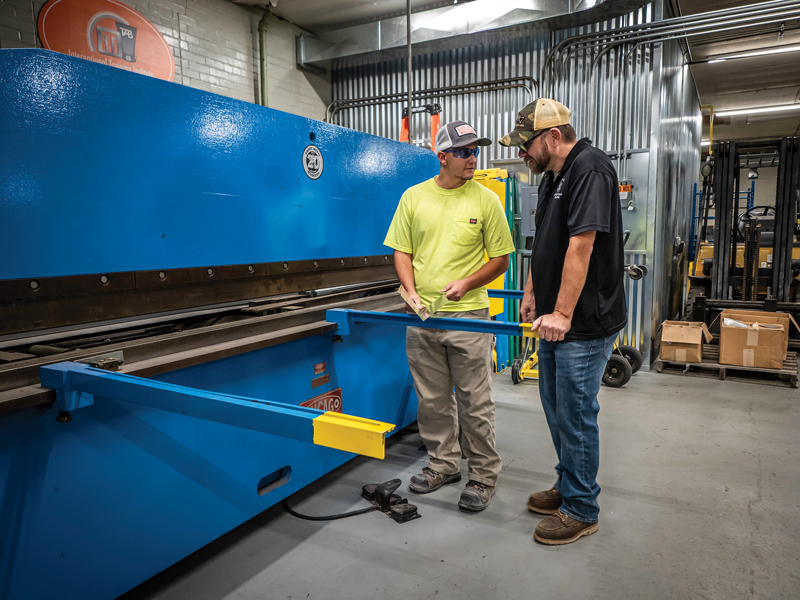
Apprenticeship programs facilitated by labor unions long have played a major role in training the area’s workforce on new technologies, safety, and the shifting needs of local employers.
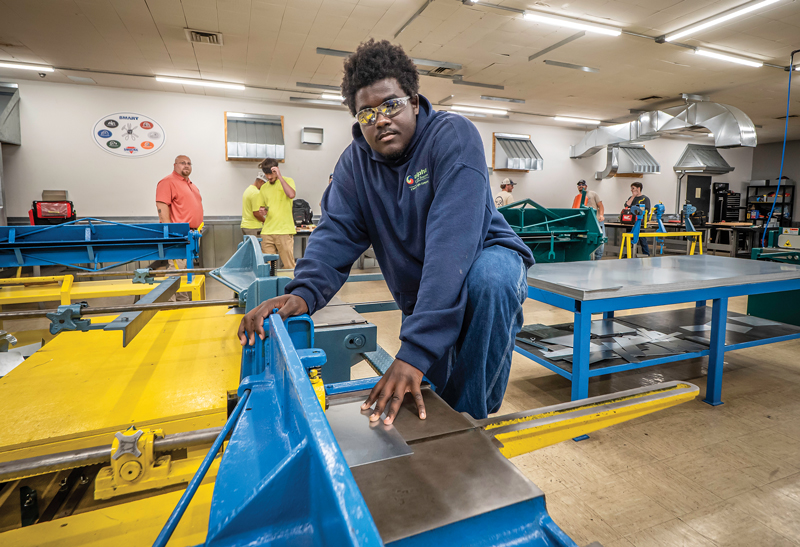
One effort is through SMART Local 20, which is part of the International Association of Sheet Metal, Air, Rail, and Transportation Workers. Local 20 covers all of Indiana, and the Evansville chapter — one of seven in the Hoosier State — has 384 active members. Enrollment has shown a recent 4-percent increase. The school on West Franklin Street has about 50 apprentices enrolled in a five-year program; each year of training covers 28 weeks from August to May.
While attending training one day a week — sessions correspond to their year in the program — apprentices work for regional contractors. The need is consistent: About eight in 10 graduates land jobs within three months. Most of them have roots in the Evansville area and decide to stay, but with experience that lends itself to industries like heating and cooling, industrial welding, and architectural fabrication, their skills also travel well.
“Upon graduation, they are free to go anywhere to work,” says Matthew Pruiett, marketing representative for SMART Local 20 and a union member since 2014. “We have a job bank of areas across the country that need help.” A misconception about the industry, Pruiett says, is that layoffs are frequent. “Construction has ups and downs,” he explains, but “if you put forth effort, you’re going to work regardless.”
SMART Local 20 connects with potential trainees through social media, career fairs, and outreach at regional schools. Pruiett says new apprentices are generally 18-25 years old, although older individuals also show interest, and through community outreach, there have been upticks of women and Black apprentices.
The union keeps up with technology trends by seeking input from contractors and industry leaders to make sure training is cutting-edge. Evansville’s sheet metal training center includes an American Welding Society-accredited test facility, where apprentices can train on a laser welder that transfers a design to a burn table or water jet that then cuts out metal.
Like SMART Local 20’s other four facilities, Evansville’s campus offers an accredited detailing lab and has Gold Level Accreditation from the International Training Institute. Participants can find additional ways to challenge themselves: As an apprentice, Pruiett himself won first place in the discipline of architecture in a statewide apprenticeship contest.
Pruiett says newer generations are more technologically inclined and have adjusted well as Local 20’s apprenticeship training has transitioned away from books to laptops and tablets. He says this instruction approach corresponds with AutoCAD, the computer-aided design software used in several disciplines, including construction.
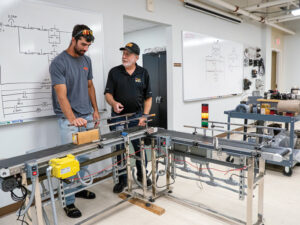
Another key player in workforce training is the Joint Apprenticeship and Training Committee with an Electrical Training Center on Lynch Road. The partnership of the Southern Indiana chapter of the National Electrical Contractors Association and the International Brotherhood of Electrical Workers Local 16 dates back to 1944 and was the first electrical apprenticeship program in Indiana to be registered with the state’s Department of Labor.
Demand for journeyman electricians is strong here. Training Director Roger Clark says apprenticeship enrollment has nearly doubled in the last five years, to its current level of around 245. Training is 34 weeks, from September through May.
As with SMART Local 20, most JATC graduates remain in Southwestern Indiana. “They are highly skilled and have made a reputation for themselves in this area during their apprenticeship,” Clark explains. Who are the best fits? “We tend to focus on students coming out of high schools and even college that are decent in math and science that seem to have some mechanical abilities or interests, depending on what classes they might have taken or experience in their background,” Clark says, adding that women in the program are on the rise: “It’s not just for guys,” he says.
Both JATC and SMART Local 20 partner with Ivy Tech Community College so apprentices can earn college degrees. JATC graduates become journeyman electricians certified with the U.S. Department of Labor and also holders of an Ivy Tech Associate Degree of Applied Science. SMART Local 20 apprenticeship graduates earn an Associate of Applied Science in Sheet Metal Technology.
This training path, too, is quick to adapt. “Our national offices and electrical vendors are constantly adding new technology and materials to our curriculum to keep us on the forefront of any new parts of our industry in real time,” Clark says.
He says electricians in training must learn about all types of power generation and utilization, because “it will take a mixture of all of them to supply the 24/7 demand for power that is coming in our future,” Clark says. “Our field is growing, not shrinking.”
Apprenticeship programs operate proudly under union banners; local members say the commitment of unions ensure high-skilled work as well as quality of life. “I reaped the benefit of the union collectively bargaining even before I was a union member,” Clark says. “We should all support collective bargaining no matter what you do for a living. There is a union somewhere fighting for your better pay and safety.”
The Art of Touch
Massage therapy students can apply healing techniques across industries
When it comes to training therapists on wellness trends and techniques, Bodyworks Massage Institute isn’t reactionary — it’s ahead of the curve. In fact, it’s the public that seems to be catching up.
“I can see wellness trending higher. It’s not just addressing tension and relaxing,” says instructor Chastity Axton, a licensed massage therapist who trained at the institute in 2017. “Bodyworks has always made a real effort in teaching a variety of services that people look for. We’ve done that all along.”
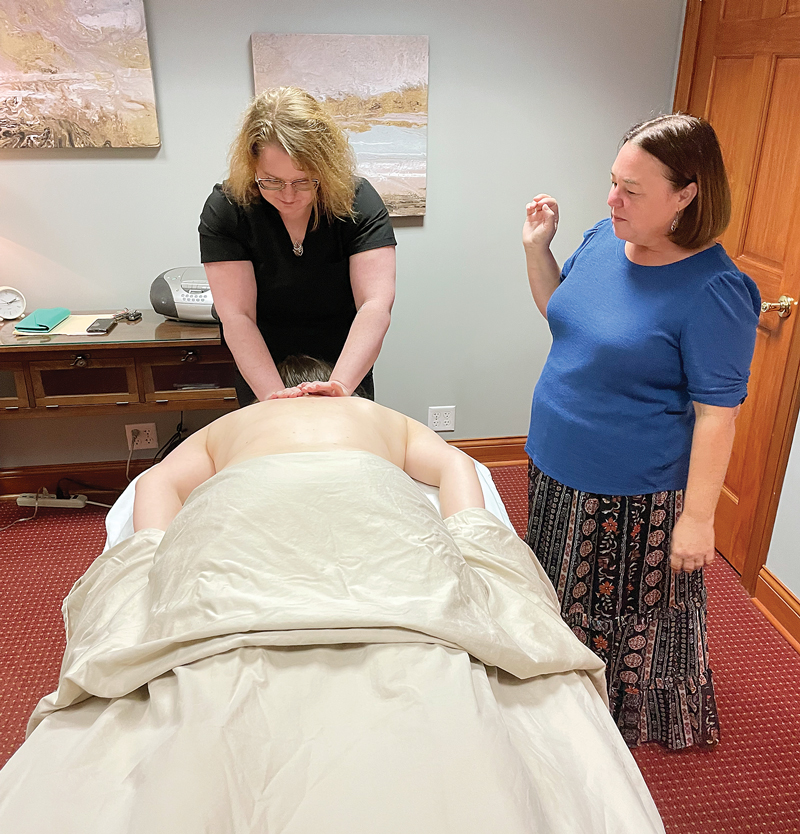
Founded in 2000 by owner Cecile Martin, Bodyworks Massage Institute has built a reputation for high-quality massage training. Over 12 months, students complete a 625-hour program that involves classroom instruction, massage clinics with paying clients, and on-their-own assignments. Specialized certifications are required for performing advanced massage such as craniosacral or manual lymphatic drainage, “so in all of our classes, we have taught a basic intro to give the students little tastes” of different techniques, Axton says.
That variety attracted Kassie Anise, an Owensboro, Kentucky, resident who last year decided to pursue a long-held interest in massage. In addition to studying theory, anatomy, physiology, pathology, and learning muscles, she’s learned body mechanics to properly hold herself and distribute energy so her own body doesn’t wear out during sessions. She says the experience has demonstrated her own skill at connecting with others’ energy.
“I’ve learned that I’m a little more intuitive than I thought I was,” Asine says. “You can tell me all day that you’ve got this neck problem, this leg problem. But I can feel your tension in your arms and in your calves and in your feet and in your skull. You can feel it on your scalp. And so it’s just kind of learning how to find those things and help problems that people maybe don’t even know that they have.”
Each term typically accommodates 6-10 students. After a dip in enrollment during COVID-19, numbers have been rising. Approximately 450 students — nearly 100 percent who have enrolled — have graduated since the institute was founded in 2000 and gone on to work at spas, physical therapy and chiropractic practices, and even on cruise ships. Martin says student demographics have evolved to feature more male and gender-diverse students ages 25-55. Martin and Axton add that many students are pursuing massage therapy as a second or third career or “have attended college and felt that the college-career path was just not right for them,” Martin says.
Other educational avenues include Ahh Spa’s 700-hour Professional Massage Therapy program. Ivy Tech Community College’s Evansville campus offers certificate courses in therapeutic massage and holistic health, plus an Associate of Applied Science focused on massage. Above all, institutions want to give students a wide range of skills to launch their massage therapy careers and open the door for employment opportunities.
“Everybody’s so beautifully special with their own unique skills. There are so many gifts,” Axton says. “We look at the gifts and the positivity of every single person and try to help that person succeed within where it’s going to be best for them.”