


“In the future days which we seek to make secure, we look forward to a world founded upon four essential human freedoms. The first is freedom of speech and expression — everywhere in the world. The second is freedom of every person to worship God in his own way — everywhere in the world. The third is freedom from want — which, translated into world terms, means economic understandings which will secure to every nation a healthy peacetime life for its inhabitants — everywhere in the world. The fourth is freedom from fear — which, translated into world terms, means a world-wide reduction of armaments to such a point and in such a thorough fashion that no nation will be in a position to commit an act of physical aggression against any neighbor — anywhere in the world.” — U.S. President Franklin D. Roosevelt, State of the Union, Jan. 6, 1941
When I see the imposing Four Freedoms monument on the riverfront, my first thought is of my mother. As a high school “Victory Girl” during World War II, she and her friends served doughnuts and coffee to soldiers in the old Chicago & Eastern Illinois train depot, which also housed the city’s USO station. I can picture her walking under those columns on Tuesdays and Thursdays, when she worked three-hour shifts starting at 3 p.m. Despite there being a jukebox in the main room, my grandfather had strict rules against her dancing with the men.
The 26-foot-tall limestone columns were part of the Evansville-Terre Haute railroad (later C&EI), a beautiful passenger depot constructed in 1907 and rivaled only by the Romanesque Louisville & Nashville Depot on Fulton Avenue. The depot served thousands of passengers, as Evansville was a crossroads of sorts for both peacetime travelers and, later, soldiers in both world wars.
After 1945, the USO was converted into a community center for teens (mainly from Central High School, which still was Downtown) to socialize after hours during the 1950s and early ’60s. When the decision to create a central government campus was made, all the buildings in the present area of the Civic Center and Old National Events Plaza went under a wrecking ball. Before the depot was razed, then-Building Authority Director Dale Andrews was quoted in the Feb. 12, 1967, Evansville Press newspaper as suggesting the columns be saved as “a symbol of the Four Freedoms,” as the city had very little in the way of actual public art back then. Then-Mayor Frank McDonald Sr. agreed, and for a time, two-foot sections of the dismantled columns sat in a grassy area behind the Water Works facility where Shawnee Drive turns into Waterworks Road.
In 1975, city leaders like Civitan Club member C. Thomas Akin and Citizens National Bank Vice President Bill Brooks approached then-Mayor Russell Lloyd Sr. about creating a small plaza featuring the columns, with seals of all 50 states surrounding it. The Bicentennial Tribute Fund committee set an initial goal of $117,000 and started a community drive that included selling 494 sets of celebratory mugs — 1,976 total — featuring the stone columns for $25. High school kids like me asked parents and shoppers at Washington Square Mall for their loose change. We even held school fundraisers for the memorial, with school clubs competing against one another. Akin himself donated $5,000. The Indiana American Revolution Bicentennial Administration contributed another $5,000, and the U.S. Department of Commerce added $30,000.
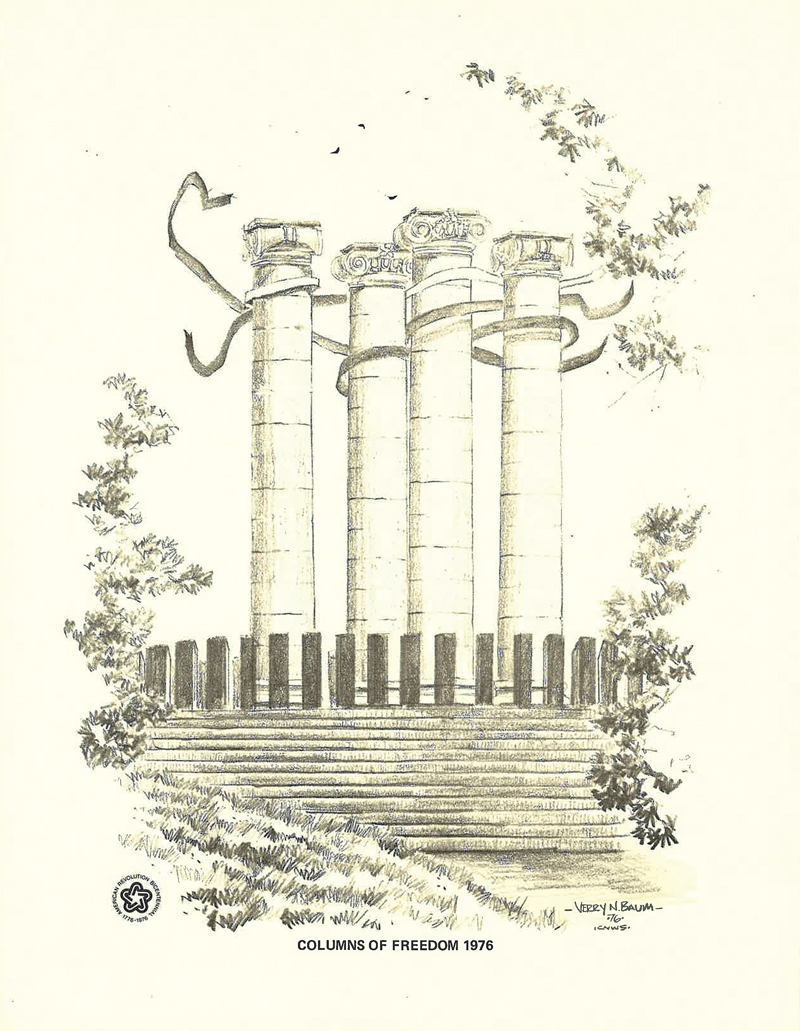
Eventually, $137,000 was raised — $5,000 over the actual cost to erect the columns — which tops $750,000 in today’s currency. Supporting the columns at 201 S.E. Riverside Drive was a 60-foot-diameter circular stone base representing unity. Although the columns were installed in time for the grand 1976 Bicentennial, the entire project with state markers and 13 steps representing the original colonies would not be finished until 1978. A metal ribbon that would have adorned the columns was scrapped at the last minute, as it was considered a hazard during high winds.
A highlight of the Freedom Festival on July 4, 1976, was when my mother and I joined friends and neighbors as the tribute was illuminated by 15 floodlights for the first time. I remember my mother staring up at the columns. I asked what she thought. She replied, “Well, they didn’t look so big at the depot.”
Kelley Coures retired in January 2024 as executive director of the Evansville Department of Metropolitan Development. He has shared his vast knowledge of local history with Evansville Living readers since 2011.