


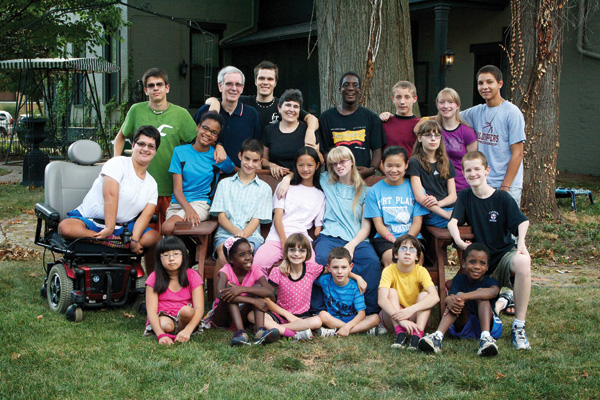
Inside the Jackson home, an imposing old structure in Evansville’s Riverside Historic District, is a constant babble. It’s soft and lighthearted, punctuated with bits of song and the patter of feet traveling up and down the three stories. The rooms are tidy, the beds are made, the countertops are clean, the toys are put away, and the books are stacked on desks, ready to be studied. In one corner of the kitchen is a large dry-erase board. It’s divided into a grid, and in each box of the grid, a name is written. Under each name is a list of activities. This dry-erase board is one of the tools Mary-Jo (“Mama”) and Michael (“Daddy”) Jackson, both 60, use to make sure they’re attending to each one of their 20 adopted children who currently live in the house.
Michael and Mary-Jo have adopted 27 children from nine countries, most of whom have some kind of special needs condition such as birth defects (including missing limbs), a traumatic brain injury, developmental delays, malnourishment, and mental and emotional conditions that make communication difficult.
Why would they do all this? An engineering manager at Mead Johnson Nutritionals, Michael says humorously, “We’re definitely insane.” Yet, the calmness and clear functionality of the home — despite how recently they made their July move from upstate New York — suggests otherwise.
It all started in 1994. Russia had just opened their borders for adoption, and its orphanages were under fire. Children’s advocates accused country leaders of neglect and abuse, and the proof was ample. In most orphanages, children were bathed together in facilities where hot water was scarce. Fruits, vegetables, or red meat were off the menu. They slept on old mattresses. Toys were rare. Inspectors from the World Health Organization considered these state-run orphanages appalling. The effects on the children, who received little affection during a key developmental age, were long-lasting: infections, delayed growth, and a host of social issues.
Then, Michael and Mary-Jo’s youngest of seven biological children, Liam, was 10. Their children had toys, hot water, and food. The couple, who always dreamed of adopting, thought the recent collapse of the Soviet Union was one reason to start. The other? American foster-care workers often declined the Jacksons’ request, citing their large family size as a deterrent.
Michael flew to St. Petersburg to adopt Bryan, their first of 11 Russian children. “Once I saw in the orphanage the conditions that the kids live in over there, it’s kind of hard to say, ‘No,’ anymore.” In less than two years, they had brought home four children. That may seem quick, but it wasn’t easy. “We always thought, ‘Did we choose the right child?’” Michael says. “We always wonder what happened to the other ones.”
From there, they joined an Internet support group for adoptive parents. The Jacksons learned other families were having trouble with their adoptions. Mary-Jo, armed with her extensive experience as a parent and her master’s degree in early childhood education from Western Michigan University, was generous with advice. “Almost inevitably, the people would just say, ‘No, we don’t want to continue with this,’” she says. That was when these families would ask the Jacksons to adopt the children already adopted. Ten children joined the family in that way, called “disrupted adoptions.”
Despite the obvious obstacles of the special needs presented by each of these children, their day-to-day sibling interactions are normal. “Sometimes, it can get confusing around here,” says 10-year-old Fiona, a South Korean native. “There’s not one thing that we all agree on, especially when we’re watching movies.”
“Or the minute we get inside the car for church,” adds 16-year-old Owen from Romania. “We can’t last a minute without arguing. Or if there’s ice cream, we all rush and push (each other) out of the way.”
“Other than that,” says Fiona. “We’re a pretty happy family.” They play games and put on talent shows. “We try to help out with each other,” says 18-year-old Belinda, a Serbia native. They call each other their closest confidants. When Fiona’s upset, “usually I’m going to one of the older girls,” she says, “and I talk to them about it and usually ask them, ‘Should I go to mom? Or should I just keep it to myself?’”[pagebreak]
While their interpersonal relationships are familiar to most with siblings, the household is complex and high-maintenance, and the Jacksons frequently bring children into the home on a six-month guardianship. The trial period tells the couple if they can sufficiently serve the child’s special needs — and if the child can mesh with the unique dynamic. They’ve had to say no a few times.
But after the Jacksons say yes, “we ask mom a million questions,” Owen says. They often are questions the couple asked themselves. To assess whether a child would be a suitable member of the family, they reference past experiences with conditions. Children with special needs require such “specific, individualized and never-ending attention and supervision,” says Mary-Jo. “We would never take a child that we didn’t feel we had the energy and the ability to care for.”
With so many children from different countries, how easy is it to teach English? “Everybody worries about that,” Mary-Jo says, “and I can tell you that was the easiest thing.” Every child could speak conversational English within six weeks, purely by immersion, she says.
To foster a bond to the family, Mary-Jo and Michael give all of them middle names that honor someone in the Jackson family tree. “That’s very important to them,” Mary-Jo says, “and I hear them talking about that sometimes, among themselves. It really connects them, in kind of a minor way.” To assist with that continuity and connection, the Jacksons hang family pictures in the house where the children can see those people after whom they were named.
How do the Jacksons maintain such structured lives for these children? “I’m very organized,” Mary-Jo says, “and we stick to it. If we didn’t have the structure, it would be chaos.” Chaos is what the children have experienced in their previous homes and situations, she says, and so “these kids are happier with a schedule. They’re happier if they know what’s going to happen. They don’t need any more surprises. They need everything to be mundane and routine.”
The city itself helps. “We find this place fantastic,” says Mary-Jo. They appreciated the small, rural, farming community where they lived in New York, but the resources for the children’s development were limited.
In Evansville, they found schools that accepted special needs students who didn’t fall into specific, pre-existing categories; supermarkets close to the home; and a wealth of resources for doctors, psychologists, behavioral specialists, and other health professionals who could attend to the children. (Their healthcare is covered under Michael’s health insurance. The Jacksons don’t receive any financial help from the government or nonprofit organizations.)
The children are thankful for what Evansville can offer, too. Belinda, who uses a wheelchair, attends Harrison High School, because, as she says, “I’m going with a wheelchair group. I’ve been trying to get to a wheelchair group forever, so I’m excited for that.”
Their new house, big enough for the entire family, is within walking distance of Central Library, the Ohio River, parks, and playgrounds. They’ve felt welcomed by the community, both by neighbors who deliver produce and tell them about community activities and by their church and schools. “The people at school — both the Catholic system and the Evansville public schools — have gone out of their way to get all of the paperwork in order for all of these different children and are constantly sending me emails and calling me with information and advice. They’ve just been incredible. I’m used to having to find out all that stuff myself, and they’ve made it much easier for me,” Mary-Jo says.
The Jacksons aren’t finished adopting, and Mary-Jo is particularly interested in additional domestic adoptions. “We never have boring days around here,” Mary-Jo says. “Both Michael and I just enjoy being with the kids.”
Their passion is more than mere gratification, though. “Our job is to give them the skills they need to go out in the world and be successful, independent adults,” Michael says. “And if they do that, then we’ve done our job.”