

A swank New York restaurant uses the name Arabelle. It also is the name of an upscale United Kingdom jeweler, and a high-class fabrics company has the name Arabelle. Attaching “Arabelle” to describe something as upper crust is no coincidence: In Dutch, “arabella” means “beautiful.”
In Evansville, the building named Arabelle once held a bank and a drug store until, like most Downtown edifices, it experienced neglect and decay as the population gradually moved from the center of the city for decades. The three-story, mostly brick building, constructed in the 1800s, sat unoccupied on Main Street until the mid-2000s when Debra Talley and Mike Martin of Architectural Renovators bought the Arabelle.
On the Arabelle’s first floor is a Subway, the national sub sandwich shop that is not the pricey Arabelle Restaurant in New York (five-dollar foot-longs!), but for those in the Downtown business district, the quick eatery is a welcomed neighbor. The smells of the sandwiches occasionally do waft upstairs, however, to Jason English’s condo. The upscale atmosphere of this ultramodern living space is a perfect reflection of the world’s other Arabelles.
Talley and Martin’s decision to renovate came after a series of successful building rehabs spurred Martin to focus on the Arabelle. Talley watched Club Fitness Zone, a bright blue workout facility owned by her son Heath grow after that business — just a half block away from the Arabelle — opened in a building renovated by Martin.
Loft developments in Chicago and St. Louis sparked Martin’s interest in Downtown renovations. He adds modern touches to historic structures in need of tender loving care. Martin revamped the former Gottam Building (615 Main St.) in 1999. With 16-foot high ceilings for the second-floor loft apartment, the 1890-built Gottam became a mixed-use facility with retail space on the first floor. Earlier this year, that building became rubble as demolition crews made way for the new arena, expected to be completed by the end of 2011.
To boost residential housing Downtown, Mayor Jonathan Weinzapfel — then in his first term — instituted a loft incentive program in 2004. The city offered a $20,000 grant for loft developers per unit. Since then, through various loft programs, the city has provided nearly $2.5 million in grants and loans. That’s translated into $21 million of Downtown housing projects.
Private investment continues long after the government incentive eroded. In August 2010, officials from The Kunkel Group, a construction company that used the incentive program to create condo complexes in the former Main Street deJong’s and J.C. Penney retail stores, announced they’d transform the former Hilliard Lyons headquarters into 44 apartments — a project across the street from the Arabelle, which also was renovated without the financial aide of the loft program.[pagebreak]
English owns Icon, an East Side nightclub big on atmosphere. Inside the club, white marble floor greets visitors, the open-ceiling concept exposes metal girders, and the plush furniture invites mingling. English, an Evansville native, worked with local interior designer Marjorie Bergen to create the nightclub’s big-city feel, but his condo is a creation straight from his mind. “I just click and point,” says English on his penchant to finding furniture on the Internet.
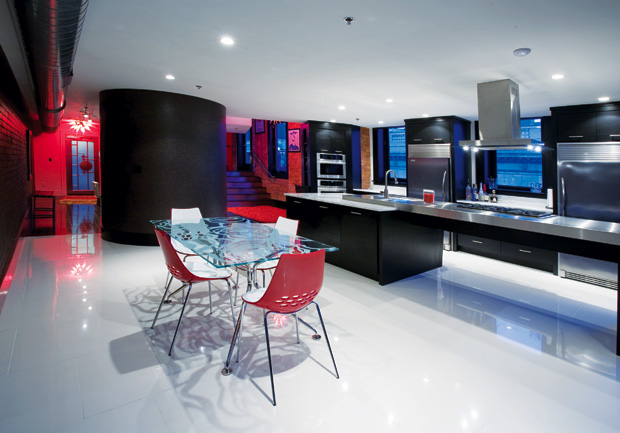
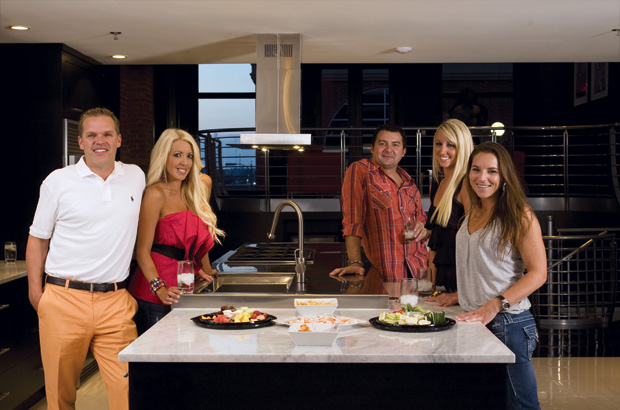
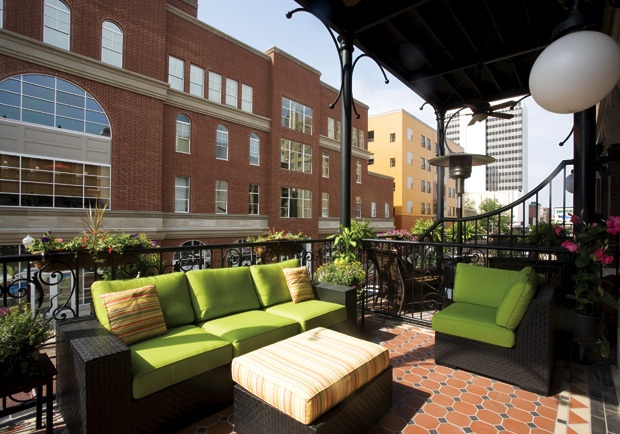
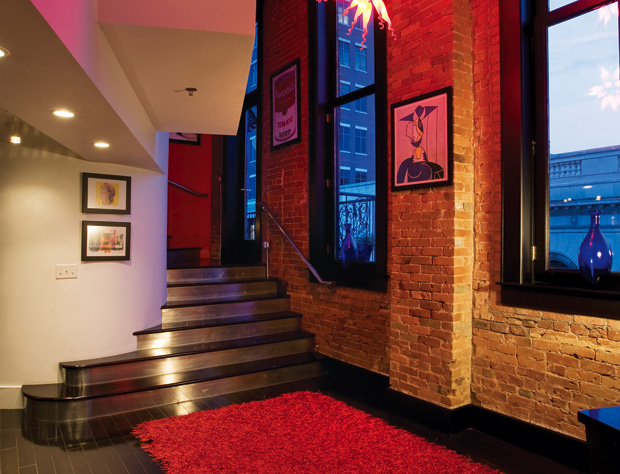
For a bachelor, the three-story condo with four balconies has a masculine feel with a cohesive color scheme of black, silver, and dark brown with occasional bold, brilliant pops of color. The open living concept gives the owner the space to host parties, and the exposed brick walls are thick, creating a sound barrier.
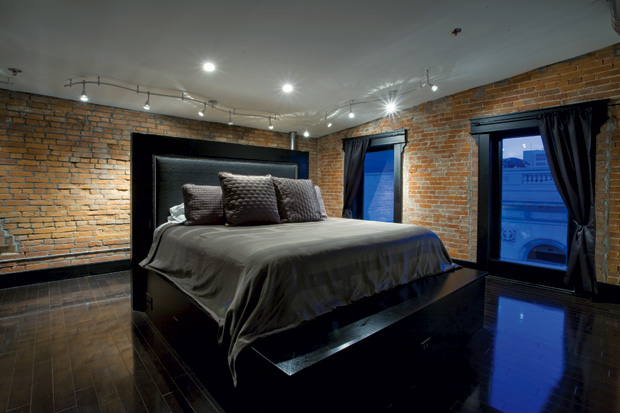
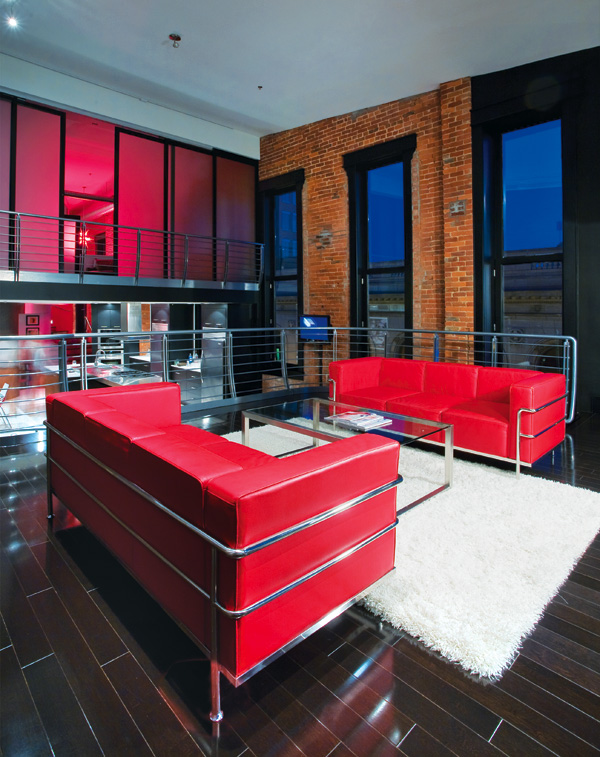
A safe door, crafted by Martin, greets English’s guests. The idea came after English toured lofts in Miami. It was fun, he says, and this safe door is light and warm, a contrast to the heavy, bulky designs of safes. The kitchen and dining room are small, which is fine with English, who likes to dine out. On the main floor’s living room, a large disco ball looms above red leather couches and a shaggy white rug. Upstairs, English’s simple bedroom has one piece of furniture, a black bed in the center of the room built atop an old elevator shaft. The floors are black bamboo, which English loves, though, he admits, the surface is hard to keep clean.
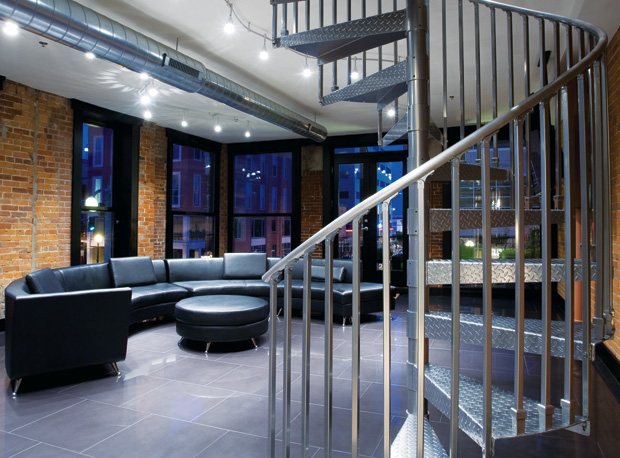
Along the walls are paintings and photographs of his favorite musicians, actors, and icons such as Elvis Presley, Marilyn Monroe, and Frank Sinatra. Track lighting spotlights the artwork, but often, large flat-screen televisions are the centerpieces of English’s living rooms. Down the spiraling steel staircase, the bottom floor’s television room boasts a pivotal flat screen, able to turn from the big, black couches to face the nearby balcony where friends sit outside to watch pay-per-view fights.
The interior is spacious and comfortable, but English says the location was a motivating factor for the purchase. The convenience to walk to restaurants, bars, and work (English also owns an adult nightclub near Casino Aztar) is a good reason to leave his condo every once in a while. “I’ve had four or five condos,” says English. Most recently, he lived in the penthouse of Main Street’s Marlocon, another of Martin’s ultramodern creations. “I think this is the first one I’d have separation anxiety (if I left it),” he says. “It’s a lot of fun.”