


Editor’s note: This is an extended version of the story published in the November/December 2025 issue.
Lucas Weinzapfel waves off the notion that some of today’s youth are unprepared — or unwilling — to handle incessant ranting and raving from coaches and fans, helping create a shortage of people thick-skinned enough to handle the far-from-lucrative profession of officiating.
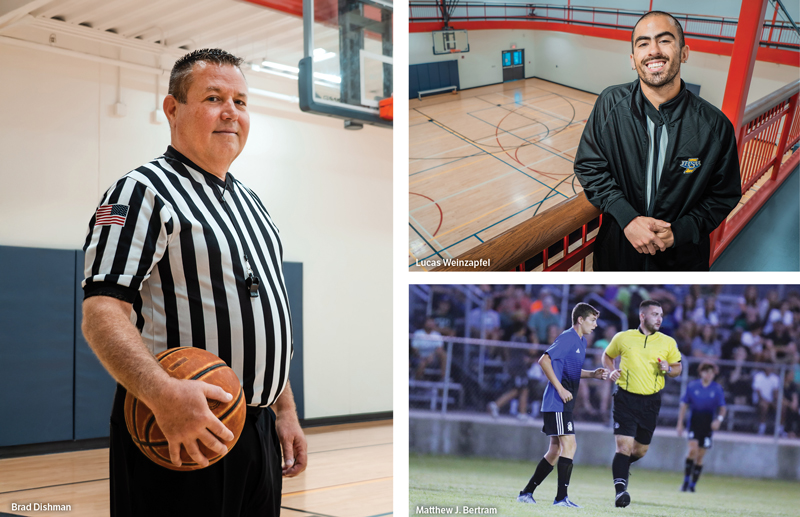
“I feel the overwhelming criticism and pressure of the job definitely warrants a sizable role in the shortage of officials,” says Weinzapfel, 23, who, after graduating from the University of Southern Indiana, in July 2024 passed the basketball licensing exam and earned his Indiana High School Athletic Association certification. He also spots other causes for there being fewer referees — and fewer recruits. “Yes, many officials are close to retirement age and the pay is relatively low, but I sense a lack of purpose for many who digress from participating,” he says.
Harrison High School athletics director Andre Thomas notes that the number of officials has decreased for at least 10 years. “Unfortunately, no one has been able to come up with an answer yet,” he says. “The National Association of Sports Officials and the IHSAA have made attempts to help, but none has been very successful.”
At the local level, younger people jump in, but most don’t stay involved. “We probably see 8-10 new softball or baseball umpires every year. But only one or two are still around after Year Two or Three. And we are lucky to have one after five years,” Thomas says. “Besides raising a family, there are so many things that pull them away. Job, kids are two big ones, but the biggest issue remains the fans, coaches, and parents.”
WARY AND UNDERPAID
Results from a 2023 nationwide anonymous survey of referees conducted by NASO indicated that more than 50 percent of respondents from all levels have feared for their safety at a given point, with 12 percent reporting they have been physically assaulted during or after a sporting event. More than half felt they were underpaid.
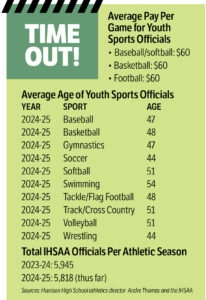
Respondents’ average age ticked up to 56.68 years from 53.29 in 2017. In every sport, the average age climbed over 50 years for the first time in any NASO survey. The underlying theme: To officiate, you have to want to do it.
Weinzapfel says officiating is his way of giving back and staying in the game. He graduated from Evansville Day School in 2018 and attended Southern Illinois University in Carbondale before finishing his bachelor’s degree in Professional Studies at the University of Southern Indiana. He wants to eventually officiate beyond the youth/high school level.
“One thing I look forward to about being a referee is communicating the rules clearly to players since most players and people at a variety of games I’ve attended, as well as seen on social media, think they know all the rules, and a lot of the time, they’ll be wrong,” says Weinzapfel, who officiates middle school and elementary basketball games. “My goal is to educate players so they can have fun and perform their best and educate parents/fans as well. I know some parents/fans can be a bit to deal with (when) getting a little loud/rowdy at games. If they are willing to listen, I’ll be glad to discuss explanations for calls and rules, but if they are a bit hotheaded, I’ll also know when to leave them be.”
Although he doesn’t really have a mentor, Weinzapfel met Rob Wann — known as Ref Rob on TikTok — at a Puma AAU Tournament in July 2023. Wann has gone viral for his unique officiating style that includes explaining to teens the reasoning behind his calls as he looks to educate them on the game. “He just told me there’s no better time to get started because of the shortage,” Weinzapfel says.
STAYING IN THE GAME
While a goalkeeper for the USI men’s soccer team, a 2016 concussion ended Matthew J. Bertram’s playing career. “It was so bad that I had to go to rehabilitation for nearly seven months to be able to comprehend reading again,” he says.
Bertram made his mark early as an athlete at Castle High School, where he was runner-up for Indiana Soccer Player of the Year in 2015 and named a National Soccer Coaches Association of America Scholar All-American in 2016. In baseball, he played for the Indiana Bulls World Wooden Bat Association 15U runner-up team in 2013.
To stay in the game, he turned to refereeing. “Officiating has always allowed me to stay connected to athletes, and that passion now runs right alongside my career,” says Bertram, now 28, who owns Bertram Chiropractic and Wellness in Evansville. “We take care of athletes across the Tri-State at every level — from youth programs all the way to college standouts.”
Upon the birth of his third child, Bertram recently concluded officiating after nearly a decade, working varsity high school basketball and soccer along with NCAA Division I and II and NAIA college soccer matches. “I absolutely think there is a shortage of officials, more so in soccer than in basketball,” says Bertram, whose younger brother, Michael, also a referee, joined him on the pitch while balancing his first year at Indiana University’s medical school. The pair has seen firsthand how the culture of sports can wear down new officials. “Not a lot of people enjoy being yelled at and ridiculed of course; however, sports officials are not robots,” Bertram says. “Mistakes do happen — that’s part of the game. But when parents and fans cross the line, it drives people away. If you get a call wrong, I understand there will be some pushback, but there’s an extent to what’s appropriate, and too often that line is crossed.”
To help address the shortage, Bertram points to three solutions: First, “Raising compensation makes the job more attractive. Unless you’re in a top college division, officiating is not financially sustainable on its own,\” he says. Second, “Former athletes and younger people can be recruited into officiating if they have guidance. Mentorship helps build confidence and retention.” Third, “Officials need to feel respected and safe. Enforcing sportsmanship rules and cracking down on abuse from the sidelines is essential.”
Bertram has used officiating as an avenue to help him transition from being a competitive athlete to a doctor and business owner. “It’s about staying connected to the game and giving back to the sports that shaped me,” he says.
SOCIETY HAS CHANGED
In his fifth year as IHSAA commissioner, Paul Neidig has a slightly different perspective on the perceived officiating shortage. “More people focus on industry-type jobs,” says Neidig, who was the Evansville Vanderburgh School Corporation’s Chief Administrative Officer from 2012-15. “There is a shortage of teachers and police officers. People in service jobs. It’s a different environment from what it was in the past.”
He adds there needs to be more clergymen and others who focus “on making the world a better place. There’s a lot of basic mistrust today,” he says. “You see self-appointed critics in all aspects of society. In education, people are more critical than you’ve ever seen before.” All it takes is a few keystrokes on a laptop or a cell phone and presto: a negative post on social media for all to see. There’s no filter, Neidig says. And in the social media world, stories are sometimes sensationalized to create more clicks.
Before joining the IHSAA staff, Neidig served as chief of staff and athletics director for the EVSC, Deputy Chief of Staff from 2009-12, and Central High School athletics director from 2001-10. He also worked at Central as a teacher, department chair, head coach and assistant coach for boys’ basketball, and assistant athletic director and technology director 1985-2001.
Neidig, who played basketball for North Posey High School and at Eastern Illinois University in Charleston, never was an official, but he can empathize from the other side of the coin. While a lack of officials is more prevalent in baseball and football, Neidig says the number of high school basketball officials is holding steady. However, he’s acutely aware that officials are growing older. His answer is for each graying official to recruit one new official to eventually take his place.
GIVING BACK
Brad Dishman, in his 35th year as basketball referee and after a 23-year officiating football, says an adequate number of younger/new officials are available but many are currently working weekend youth tournaments. However, the older generation is aging fast.
“Many (young officials) are currently working the weekend youth tournaments,” says Dishman, who began his officiating career working Plaza Park games when he was a senior at Harrison High School. “The IHSAA has successfully implemented recruitment programs such as informational booths during the state tournaments for each respective sport. Officials are present to provide literature and guide those interested in the registration/licensing process.”
The IHSAA has partnered with the 24 local officials associations throughout the state to establish a mentoring program. This offers new prospective officials free registration as well as an assigned local mentor official.”
Like many officials, roaming the sidelines was a way to stay in the game and make a little extra money, says Dishman, who played baseball and freshman basketball at Harrison. And perhaps a little glory: Dishman, 54, worked the 2011 Class A boys’ state championship basketball game between Indianapolis Metropolitan and Triton.
“Despite change over the years in style, pace and athleticism in how the game is played as well as social media influences, I feel the job remains the same,” he says. “It’s still a self-rewarding opportunity to be involved in sports, serve educational-based high school athletics and develop friendships.”
From Basketball Hoops to Wedding Rings
Chris and Siobhan Pietruszkiewicz met while officiating — and still take to the court
Chris Pietruszkiewicz met his wife, Siobhan, on the basketball court. It was 1996, and each was refereeing a pair of high school basketball games in suburban Washington, D.C. A few days earlier, Siobhan had endured a rough night with a poor officiating partner. When asked to ref again, she said, “I don’t know if I want to do this. Who is assigned to the game?” Her partner was Chris; they married three years later.
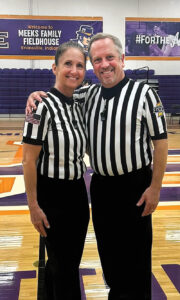
Since becoming University of Evansville’s 24th president in July 2018, Chris has dramatically cut down the number of games he officiates each year, from more than 50 to around 10. But he relishes the handful of EVSC and area high school games he and his wife referee together. “It’s like an extended date,” he says.
Siobhan officiates basketball games for local middle schools and St. John the Baptist Catholic School in Newburgh. Both Pietruszkiewiczes are members of the Southwestern Indiana Officials Association; Chris also serves on the NCAA Division I Board of Directors.
Spectators often don’t realize UE’s first family is running the court. Before a 2024 game at Lynnville’s Tecumseh High School, a man told Christopher, “You look remarkably similar to the president at the University of Evansville.” Playing along, he replied, “I get that a lot. Do you like him?” The man at the scorer’s table said, “Yeah. He’s a good guy.” “Prez P” acknowledged that he was, indeed, the UE president. “People don’t expect me to be a high school ref,” he says.
A native of Scranton, Pennsylvania, Pietruskiewicz made a few different stops before joining the law faculty in 2001 at Louisiana State University in Baton Rouge, where he later served as vice chancellor for business and financial affairs. After playing basketball, baseball, and golf for Bishop O’Hara High School in Scranton, Pietruskiewicz was looking for a new challenge. He found a way to stay involved in sports by serving as a referee in basketball and umpire in baseball in 1991.
Heckles have been few, but memorable: Once, the stands were hushed during a timeout in the fourth quarter of a close high school basketball game in Baton Rouge. A fan up in the rafters yelled at the top of his lungs, “Hey ref, maybe your next call, you should call for a cab.” Chris quickly put his whistle in his mouth because he didn’t want anyone to see him laughing. “That was a good line,” he says.
Siobhan, who played field hockey, volleyball, and basketball at Georgetown Visitation Prep in Washington, D.C., started officiating high school basketball games in that area in 1993. “I loved being around basketball,” she says.
Chris loves refereeing’s “immersive avocation. It’s not my normal day job,” he says. “There’s a certain solidarity officiating a really tough game,” adds Siobhan, a licensed clinical social worker. “We trust each other.” They officiate together in Evansville as much as they possibly can. “We know each other really well and we know the kind of calls we will make,” she says.
Both think local fans are amazing and do not hassle referees any more today than they once did. “They are really into the game and are knowledgeable about the game,” Siobhan says. (The couple tactfully declined to single out which schools had the best and worst cheering sections.)”
One of Prez P’s favorite memories was officiating scrimmages for the LSU men’s and women’s teams. “We saw great athletes,” he says. “We have met some serious players over the years.” They enjoy watching sports with their two sons: Ryan, 20, is a sophomore at Wake Forest University in Winston-Salem, North Carolina, while John, 15, is a sophomore at Reitz Memorial High School.
The Pietruskiewiczes have worn many hats in several circumstances, but neither plans to put their referees’ whistle away anytime soon. Fifty percent of the time, we upset someone. But they really like it when they see us show up,” Siohban says. “We call a fair game.”