


Read more about Evansville’s chapter in the American story in the July/August 2026 feature story.
What did Evansville look like in 1776? As America was taking form, this bend in the Ohio River was surrounded by untamed wilderness. There was no city; the site was the ancestral homeland of indigenous peoples, including the Shawnee and Miami tribes. At the time, the land was claimed by the British as part of the American frontier, just a few decades before the City of Evansville was founded by Hugh McGary Jr. in 1812.
All around the Ohio River bend, a forest of hardwood trees was thriving. Now confined to 310 acres about five miles east of the river, the area known as Wesselman Woods was still in its youth in 1776. Oak and tulip poplar trees that had grown since the 1650s witnessed the aftermath of America’s birth, as settlers and explorers moved West. And because it was never cleared or logged, Wesselman Woods remains the nation’s largest urban virgin old-growth forest, offering a rare glimpse at what Southwestern Indiana looked like before European settlement.
“It’s very humbling to stand among trees and a landscape that was already here when America celebrated its first birthday,” says Co-Executive Director Kristina Arwood. “This forest has quietly persisted while generations of people have come and gone.”
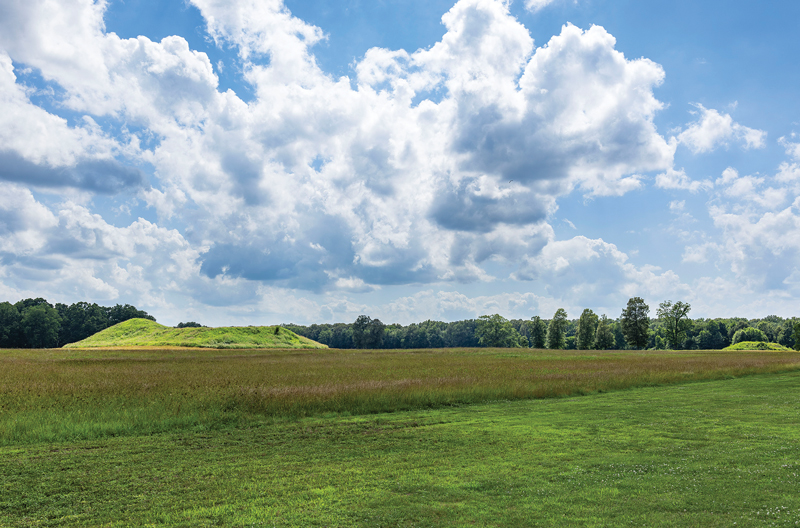
In fact, the area’s earliest inhabitants arrived far earlier than the forest. Mississippian tribes populated at least 600 acres on the Ohio River near the present Vanderburgh-Warrick County line. Between 1100 and 1250 A.D., they constructed 11 flat-topped earthen mounds and produced corn, creating an important center among the Mississippian River Valley villages of Native Americans. By 1450, the civilization was abandoned as its inhabitants moved elsewhere. Four hundred years later, Mathias Angel began buying the former Mississippian land, which he operated as a working farm. The mounds remained, and in 1938, Angel’s descendants sold 480 acres to the Indiana Historical Society to preserve the site. Named in his honor, Angel Mounds is a state-protected site and considered one of the best-preserved Mississippian sites.
“Angel Mounds is a glimpse into what came before what we now know as the United States,” says Mike Linderman, who oversees Angel Mounds State Historic Site as the Western Regional Director for Indiana State Museum and Historic Sites. “It is a touchstone of an era very different from our current world.”
Through it all ran the Ohio River, Evansville’s earliest settler. Meaning “good river” in the Iroquoian language of the Seneca tribe, the Ohio had cut through forests and prairies since prehistoric times. A few colonists explored it and traded with the river valley’s indigenous residents in the 17th century before European settlers migrated West. In his “Notes on the State of Virginia,” published in the early 1780s, Thomas Jefferson called it “the most beautiful river on earth.” Two hundred fifty years later, we still agree.
A Picture in Time
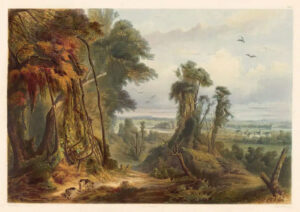
Get a glimpse of what Southwestern Indiana looked like in 1776 by visiting the Maximilian-Bodmer collection in New Harmony. Twenty-six years after the Lewis and Clark Expedition to explore the Louisiana Purchase ended, a Rhenish naturalist named Alexander Philip Maximilian, Prince of Wied, led a scientific expedition toward the Missouri River. The expedition arrived in New Harmony in October 1832, soon after both the Harmonist and Owen-Maclure experiments ended. While Maximilian spent six months convalescing, Swiss artist Johann Karl Bodmer documented the region’s lush landscapes and frontier life. His paintings are part of a permanent collection maintained by Historic New Harmony and the University of Southern Indiana.
Where Evansville and America’s Milestones Intersect
1776 — Through the Declaration of Independence, American colonists break away from the British Empire. The area that is now Evansville, Indiana, was untamed wilderness.
1803 — Soon after the Louisiana Purchase is finalized, land encompassing the future Evansville is relinquished by Native Americans to Gen. William Henry Harrison.
1812 — Hugh McGary Jr. purchases 441 acres along the Ohio River — initially naming the settlement McGary’s Landing — one month before America enters a two-year-plus war with England.
1816 — Fourth U.S. President James Madison signs a congressional resolution making Indiana the 19th state. Evansville is incorporated in 1817 and designated the county seat in 1818.
1837 — The neighboring town of Lamasco (named for four proprietors) is platted just west of Pigeon Creek, 10 years before Evansville receives its city charter and 33 years before Lamasco is annexed.
1853 — The city’s first railroad line opens the same year that the Wabash & Erie Canal finishes construction here, cementing Evansville’s status as an important regional transportation artery.
1861 — The Civil War breaks out. Indiana sides with the Union, while Kentucky declares neutrality and never legally secedes from the North. Evansville serves as a stop on the Underground Railroad.
1886 — Lucia Blount holds the first meetings for the Evansville Equal Suffrage Society at her Downtown home, 34 years before the 19th Amendment guarantees women the right to vote.
1937 — A swollen Ohio River floods five states, leading federal officials to invest in permanent levees. Evansville’s extensive system spans more than 26 miles and costs $55 million to build.
1942 — Shortly after the U.S. declares war on Japan (and then Germany and Italy), the Evansville Shipyard and Republic Aviation plant begin to produce massive volumes of war matériels.
1950s — Local factories switch back to making consumer goods — and a lot of them — after the war ends. As a major appliance manufacturer, the city earns the moniker “Refrigerator Capital of the World.”
1962 — One year before Martin Luther King Jr.’s “I Have a Dream” speech, the last all-Black class graduates from Lincoln School as the local education system starts desegregating.
1976 — As America celebrates its 200th birthday, local residents erect a riverside monument dedicated to the four freedoms mentioned in President Franklin D. Roosevelt’s 1941 State of the Union address.
2023 — To honor Evansville’s significant wartime contributions, the National Park Service proclaims it a World War II Heritage City, the only city in the state of Indiana that can bear the distinction.