

Read more about Evansville’s chapter in the American story in the July/August 2026 feature story.
Southwestern Indiana’s place in the global fight for freedom includes stories of intra-country battles, with residents playing important roles from the Civil War through the Civil Rights Movement.
Civil War
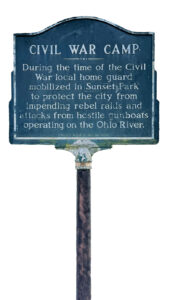
Skirmishes occurred regionally around the Ohio River — think Adam “Stovepipe” Johnson’s 1862 supplies raid on Newburgh. A historical marker near the Evansville Museum of Arts, History & Science marks where a home guard protected Evansvillians from Confederate raids and gunboats. Another outside Woods & Woods veterans law firm at 808 S.E. Third St. describes a 16-acre refugee camp called Blackford’s Grove that was a temporary home to pro-Union residents fleeing southern states that had seceded.
“A Confederate army under (Gen.) John Hunt Morgan had crossed the Ohio River above Owensboro, and Evansville was perceived as a possible target,” says Vanderburgh County Historian Stan Schmitt. “For most of a week, almost everything was closed down in Evansville, and its men were armed and placed in camps for training. When the threat ended, everything returned to normal.”
Lyles Station and The Underground Railroad
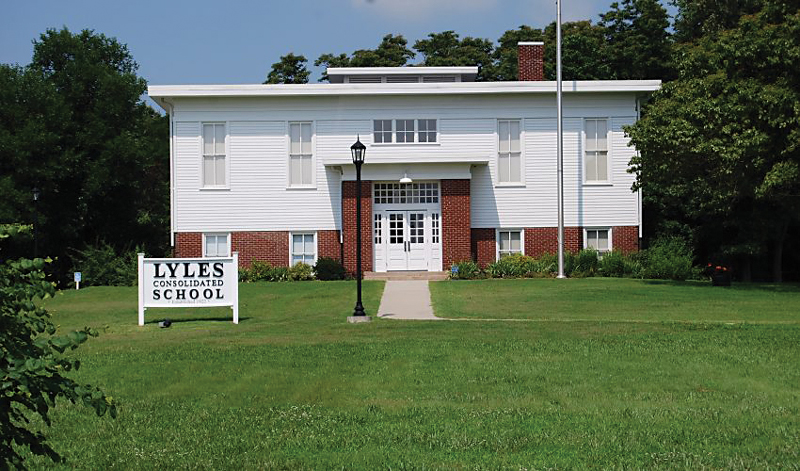
Liberated brothers Joshua and Sanford Lyles came to Gibson County from Tennessee in the 1840s, buying land that by 1886 was known as Lyles Station. Formerly enslaved people and their descendants built and sustained the community a little more than five miles northwest of Princeton.
Current residents and those who grew up in Lyles Station have worked to tell its stories. Built in 1919, Lyles Consolidated School opened in 2003 as a museum of local history. Wayman Chapel, built in 1886, is being restored with a $500,000 grant from the National Trust for Historic Preservation’s Preserving Black Churches program.
“We all have pride in our history,” says Denise Jamerson, a lifelong Lyles Station resident and member of Wayman Chapel. Her husband, John, is the minister. “I’m a piece of the generations of history of Lyles Station.”
By the 1820s, some formerly enslaved people resided in Evansville, while many continued north via the Underground Railroad. Philanthropist Willard Carpenter’s house and the Old North United Methodist Church were stops, and residents Charles McJohnston, Judge A. I. Robinson, and Samuel McCutchan served as “conductors,” lighting the path to freedom.
Civil Rights Movement and Baptisttown
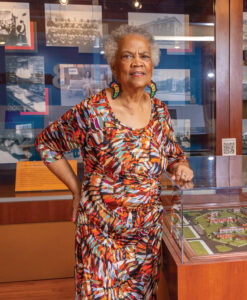
“We are better off today because of the perseverance and collective fight for equality of those who came before us,” says Kori Miller, Executive Director of the Evansville African American Museum.
Educator Sally Wyatt Steward, NAACP leader Willie Effie Thomas, County Recorder Estella Moss, school board member Cola King “C.K.” Newsome, pastor W.R. Brown Sr., Human Rights Commissioner Jacqueline LaGrone, newspaper editor Sondra Matthews, and City Councilor John Caldwell Jr. helped advance civil rights in Evansville. Many of those efforts took place in Baptisttown, the city’s historically Black neighborhood. More than 200 businesses, civic organizations, churches, and social clubs were located there between the 1930s and ’60s.
“Much of the leadership came as a result of a group of prominent citizens in Baptisttown who were educators, administrators, clergy, and civic leaders … who were connected to Lincoln High School and dedicated to improving life in the area, pushed for equal rights,” Miller adds.
That history is preserved in institutions like Liberty Baptist Church, formerly segregated Lincoln School, and the African American museum, located in the former Lincoln Gardens housing project.
Women’s Suffrage
Although Lucia Blount’s name may not be widely known, she was instrumental in the local women’s suffrage movement. She organized the Ladies Literary Club in 1874, during which discussions about suffrage were frequent. After helping form the Evansville Equal Suffrage Society, she moved to Washington, D.C., and joined the national movement. The 19th Amendment was ratified in 1920, giving women the vote, although it would be years before Native Americans and Black people shared that right.