


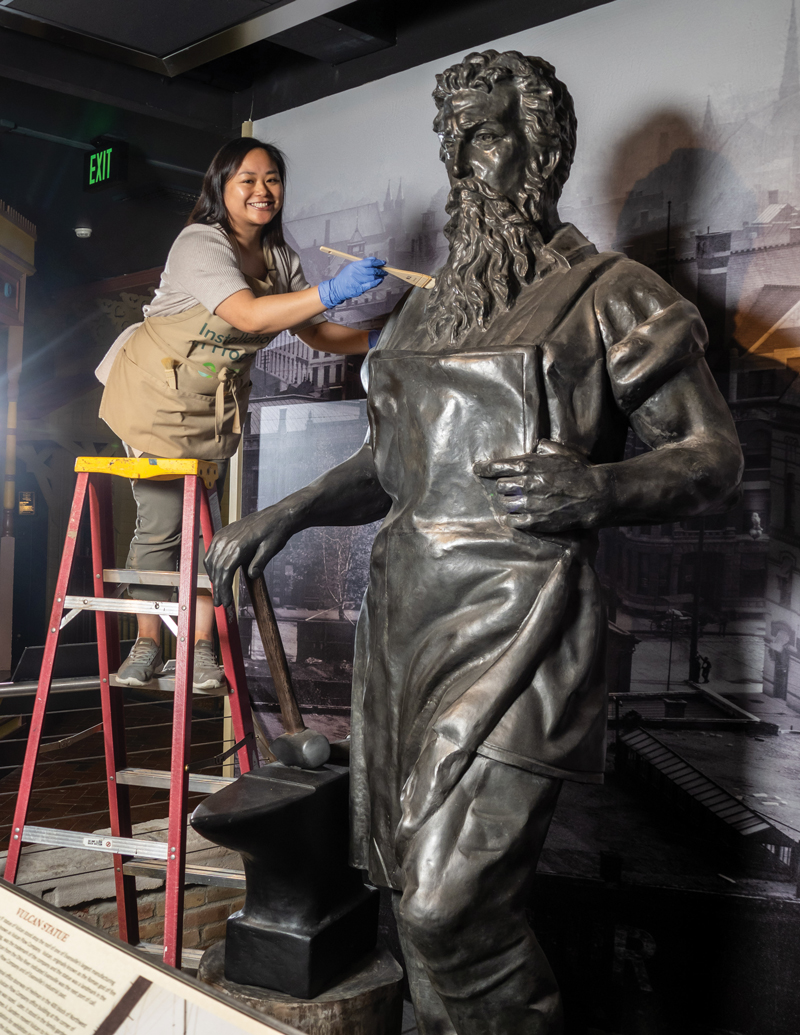
“Hypervigilant.” That word is emblazoned on a laminated card displayed above Kaman Hillenburg’s computer like a badge of honor. Not only for herself – the first Evansville Museum of Arts, History & Science Collections Manager – but for the entire institution.
It originated when the Alliance of American Museums (AAM) cited collections management in awarding the museum’s accreditation in 2022. “The Museum’s staff and Collections Manager are hypervigilant with regard to risk management of the collection while on exhibition and in storage,” the AAM report said. “That gives me a little boost every time I see it,” Hillenburg says.
Caring for the museum’s artworks and objects, breathtaking or quirky, is a complex task. “To simplify it for field-trip students, I tell them I’m the one who gets to touch everything that we say they can’t,” Hillenburg says. “That’s always followed with a response of ‘woah!’”
Hillenburg’s colleagues appreciate the fire behind her meticulous approach. “Kaman is the consummate museum professional,” says Tom Lonnberg, Chief Curator & Curator of History. “She is passionate about the care, in all facets of the word, of our collection.”
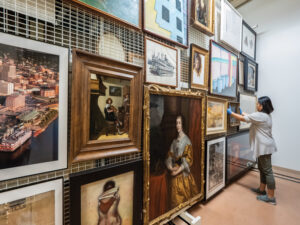
At 45,000 objects, it is a lot to manage. “The museum’s collection is rich with artworks, historic artifacts, and objects in fields of science,” says Jennifer Evans Corn, the museum’s John Streetman Executive Director.
The collection’s origins can be traced to artifacts purchased from the 1904 Saint Louis World’s Fair by Evansville residents interested in starting a museum here. Today, some hitherto-unseen surprises for visitors remain boxed in storage, awaiting future endeavors.
Siegfried Weng, the executive director from 1950 to 1969, led a flurry of collection growth. “His friends from around the country donated objects to us, and that’s how Picasso’s ‘Seated Woman in Red Hat’ arrived,” Director Emerita Mary Bower says.
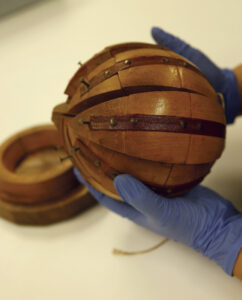
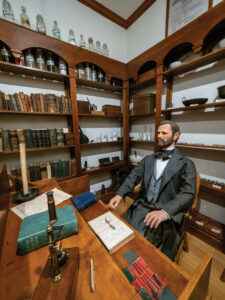
“Over the past century, we have collected pretty much everything under the sun,” Hillenburg says. “In the museum field, it is what we call a ‘general collection.’” Its broad array of art includes several gems, from Käthe Kollwitz prints to Gino Miles’ spherical, stainless-steel sculpture greeting visitors. History is equally important, with Lonnberg citing the 9,000 World War II-era photographs of landing ship-tank production at the Evansville Shipyard. The U.S. Navy donated them in 1948. Another mainstay is its purchase of Mid-States exhibition art over six decades. These 500 works trace the progress of contemporary regional art, with a selection on display in the Mid-States gallery.
Hillenburg, who was born in Hong Kong and grew up in northern California, found her passion for museums at an early age. “My middle-school teacher, Cassandra English, propelled my museum career,” she says. “She inspired me to volunteer at Rosicrucian Egyptian Museum in San Jose, and I fell in love with it.”
She got her foot in the door at the Evansville Museum while earning dual bachelor’s degrees in archaeology and art history from the University of Evansville. “Kaman knew she wanted to work at a museum, and we were thrilled to have her,” Bower says. “We just kept giving her more responsibility.” After working the front desk and helping stage exhibitions, Hillenburg pinch-hit when the registrar was on leave. That data and logistics work lit a fire for her.
When the museum established its collections manager role in 2017, Hillenburg had already shown she could manage the permanent collections’ art and artifacts, logistics, data, inventory, insurance, and storage. “She was ideal, really, and has done a tremendous job,” Bower, her hiring manager, says. “She’s organized, detail-oriented, and very tidy. She explains to staff her expectations for moving objects and maintaining order and cleanliness in the gallery, collection, and work areas. In the kindest way, mind you, but they know she means business.”
That discipline extends to the collections database. “Data entry is my jam,” Hillenburg says. That’s a good thing, since inventory management takes a village. She routinely leads and mentors university interns through the process, taking inventory of everything in storage and on display. The effort pays dividends in supporting the curatorial team. “In addition to making our collections more accessible, she produces big results by focusing on the details, minute or enormous,” says Cheyenne E. Miller, Virginia G. Schroeder Curator of Art. “She juggles endless tasks, switching between them seamlessly.”
That ability goes beyond her work. In her spare time, she formed and led the Southwestern Indiana Collection Connection Association from 2014 to 2023. It enabled her to develop best practices with 100 peers from area museums and historical societies. She is now secretary and board member for the Association of Midwest Museums. “I’m also a true-crime fan and wanted to be a detective when I was growing up,” she says, laughing. “Museum work matches some of those skills without risking injury.”
What is next for Hillenburg and the museum? On the heels of last year’s Picasso unveiling, the museum has another surprise up its sleeve: sculpture. It will open a new gallery for that work later this year. Included will be “The Caryatids” by Abbott Pattison. He sculpted its female figures from Greek mythology in 8,000 pounds of Tuscan Carrara marble. His children donated this, his final work, following his death in 1999. Wrapped in storage for 15 years, these women soon will receive their due, under Hillenburg’s careful coordination.