


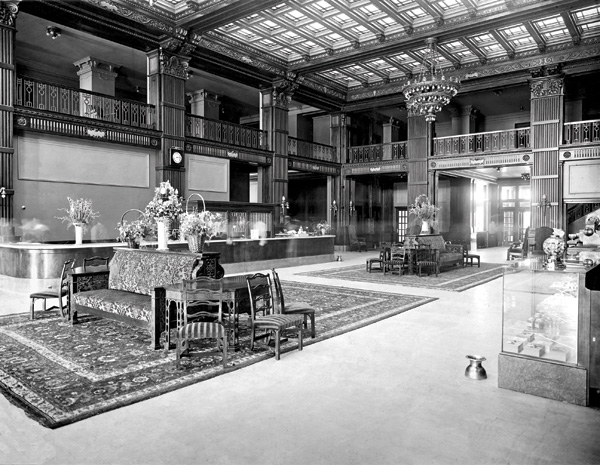
Background: The McCurdy Hotel, built at a cost of $750,000, debuted in 1917 with 300 rooms. St. Louis architect H. Ziegler Dietz designed the Colonial Revival–style hotel incorporating pink Tennessee marble in the lobby. An ad in the Evansville Courier heralded it as a “palatial and modern hostelry that will be unrivaled in any city of 100,000 in the world.” The hotel attracted dignitaries as well as everyday visitors to the city, but in the late 1960s, reservations dwindled as Downtown businesses closed. The hotel fell into bankruptcy and was auctioned, becoming in 1979 a retirement home — where it served as home for hundreds of senior citizens until 2009. Since then, the historic building has sat vacant, often open to the elements and unauthorized interlopers, awaiting development into apartments. Statewide, preservationists and historians are concerned about the McCurdy’s future. As the city discusses the future of a new Downtown hotel and struggles to restore and develop the McCurdy, we ask, “Could the McCurdy again function as a hotel?”
Success stories: While the nation has lost a great many historic hotels to demolition, many operate today under the banner “Historic Hotels of America,” a designation of the National Trust for Historic Preservation. We need look only to Orange County, Indiana, to see the case for restoring historic hotels; the best examples in the nation lie in French Lick and West Baden, Indiana. We’re inspired by these historic hotels we’ve visited.
The Cincinnatian Hotel, Cincinnati, Ohio, was built in 1882 as the Palace Hotel with 300 rooms. The hotel, which has been in continuous operation, experienced a $25 million renovation in 1987, reducing the great rooms to 146.
The Seelbach Hilton Hotel, Louisville, Kentucky, opened in 1905 inspired by fine European hotels. Following the economic slump in 1975, the hotel closed its doors until it was bought by Louisville native and Hollywood actor Roger Davis, who invested millions and opened the hotel again in 1982. In 2009, the hotel finished its most recent renovation at a cost of $12 million.
The Battle House Renaissance Hotel, Mobile, Alabama, opened in 1908 replacing an earlier Battle House built in 1852 that burned down in 1905. In 1974, the hotel closed its doors, and they remained closed for 30 years. In 2003, Retirement Systems of Alabama (the state’s employee retirement plan) began a $200 million restoration of the hotel and an adjoining skyscraper; the hotel reopened in 2007.