


Every family has summer traditions they reminisce about — maybe a sojourn to Holiday World or a camping trip. My relatives — practical folks who were short on discretionary funds — share one key summer memory: Gathering one day each August at our farm to harvest corn.
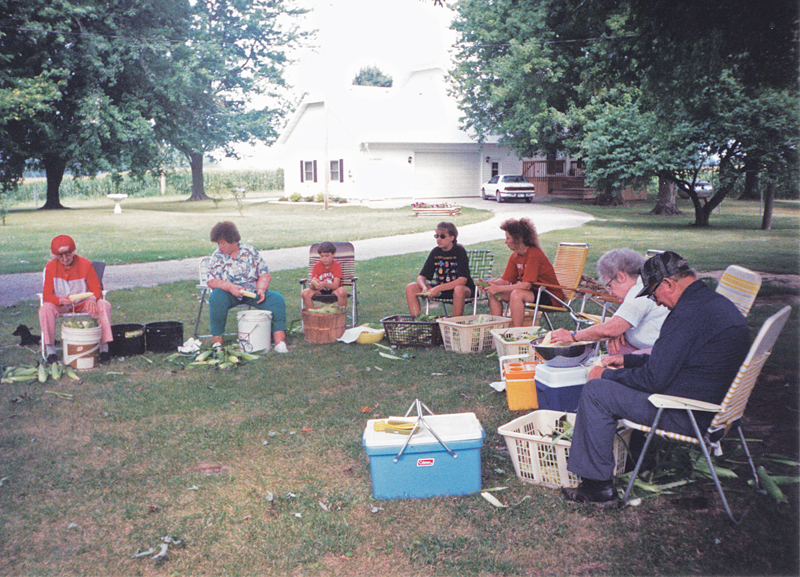
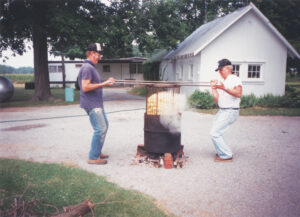
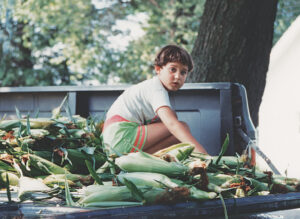
Since the 1930s, the Keens have grown soybeans and sweet corn on a farm — now topping 600 acres — in Wayne County, Illinois. Most of the crop is sold for profit, but we had a plot that we harvested for our own tables. When I joined the family in the mid-1980s, the one-day harvest tradition was in its third decade. There were only a few days between when the corn was ripe enough to pick and when the wildlife would find it, so we had to be ready to assemble quickly. We started around 5:30 in the morning, when my grandfather Verl, father David, uncle Gene, and cousin Jarod would hop in a pickup truck, drive out to the fields, and handpick about 15 bushels of corn. The quartet then would deposit the ears on the front lawn of my grandparents’ house, where about a dozen relatives would sit in lawn chairs and shuck ears for hours, discarding husks and silk into wash baskets and buckets. A fire built inside three tiers of bricks in the gravel driveway heated water to boiling in a 55-gallon metal drum. Clean ears were lowered into the water via a wire basket and blanched for about five minutes, then moved into a water bath to slow the cobs’ rate of cooking.
It was hot, sticky work. I didn’t like getting up early or shucking in the heat, and I especially loathed the way the tiny, fine silk in each cob would refuse to separate from the kernels — and when they finally let go, they’d cling to me. We’d finish shucking and cooking around noon, break for lunch, and then pick up our electric knives, cut the kernels from the cobs, and fill plastic bags bound for our freezers or mason jars. Come winter, that corn would be served in vegetable soup and alongside beef stew and meatloaf — and it would taste just as fresh and crisp as the day it was plucked off the stalk.
To pass the time, we’d swap stories. Sitting around flying husks of corn, you’d hear tall tales that somehow turned out to be true, like how one snowy December evening, a man broke into his neighbor’s trailer and stole a TV. That’s when electronics were huge hunks of metal and plastic, and the man needed a wheelbarrow to cart the TV back to his house a few doors down. He barely had time to enjoy his new acquisition before the police came calling, and he couldn’t understand how the cops knew it was him. (Did I mention that it was snowing?)
Another story was about the time Virgil Myers, a painter and part-time clown with the Ringling Brothers, was dared to perform his signature standing-on-his-head move atop the silo he was painting. Virgil did just that, like it was an everyday occurrence. (No word on if the farm’s insurance policy was checked first.)
One relative would begin a story, and another would jump in, helping spin the yarn. Soon, four generations were bowled over, wiping tears of laughter from their eyes — with a handkerchief, of course, because our hands were covered in corn silk.
Some years, like in 1996, there was a drought, resulting in no corn to harvest. But most years, we waited by the phone each August, ready to drive to the farm with just a few days’ notice and shuck ears until we thought we’d be sick of corn forever.
Our August tradition began winding down in the early 2000s, several years before my grandfather passed away from cancer. I never experienced those harvest days as an adult, and looking back, I wish I had recognized the precious opportunity to bond with my elders. Those memories live on through my parents, aunts, and uncles, and even though we haven’t gathered to shuck corn in years, we never miss the chance to swap those stories.